The fundamental dividing line between the Generac 10,000 Starting Watt and the Jackery Explorer 1000 v2 is fuel-driven heavy electrical output versus lightweight, zero-emission battery storage. Generac engineered an industrial gasoline generator capable of energizing heavy household circuits and high-draw motor equipment through standard mechanical combustion, while Jackery built a compact lithium iron phosphate station designed for whisper-quiet indoor operation, mobile charging, and swift recharging from domestic electrical outlets or solar panels.
Homeowners seeking a whole-house energy shield to run central air conditioning, well pumps, and multi-appliance loads through severe grid disruptions should choose the Generac 10,000 Starting Watt. In contrast, outdoor campers, apartment residents, and remote professionals needing clean, portable indoor power without storing gasoline should select the Jackery Explorer 1000 v2.


Generac 10,000 Starting Watt vs Jackery Explorer 1000 v2 at a Glance
| Attribute | Generac 10,000 Starting Watt | Jackery Explorer 1000 v2 |
|---|---|---|
| Running Wattage | 8,000 watts | 1,500 watts |
| Peak / Starting Wattage | 10,000 watts | 3,000 watts |
| Power Source / Fuel Type | Gasoline | Battery Powered, Solar Powered |
| Energy Storage / Tank Capacity | 7.9-gallon steel fuel tank | 1,070Wh LFP battery capacity |
| Runtime | Up to 10 hours at 50% load (11 hours rated) | 42 minutes at listed load |
| Weight | 112 pounds | 23.8 pounds |
| Starting Mechanism | Electric push-button with recoil backup | Digital push-button activation |
| Outlets | Two 120V 20A GFCI duplex, one 120/240V 30A L14-30R | Three AC pure sine wave, two USB-C, one USB-A, one DC car port |
| Safety Monitoring | COsense automatic carbon monoxide shutdown | ChargeShield 2.0 battery management system |
| Best For | Whole-home backup & high-draw electrical equipment | Portable camping & clean indoor emergency power |
Power Output and Electrical Capacity
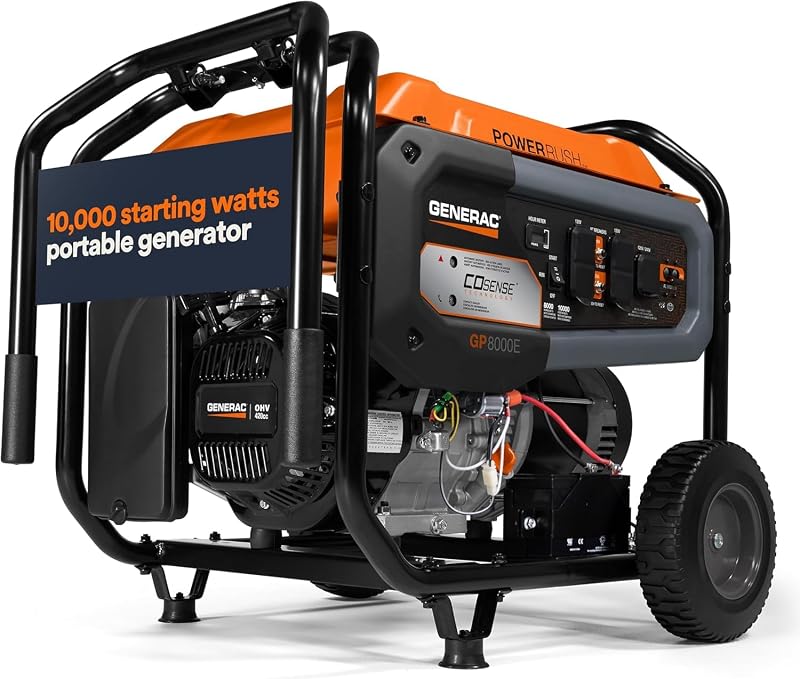
Electrical capacity dictates what equipment you can safely operate simultaneously when the electrical grid collapses. When analyzing Generac 10,000 Starting Watt vs Jackery Explorer 1000 v2 wattage, the two units occupy completely different tiers of electrical performance. The Generac model functions as an industrial-grade workhorse, producing 8,000 running watts and surging up to 10,000 starting watts. Built into its architecture is PowerRush technology, which increases electrical current on demand above rated output by over 30 percent specifically when starting electric motors. This makes the Generac capable of kicking over heavy inductive loads like central air conditioning systems, deep well pumps, sump pumps, and jobsite power tools without stalling the engine or tripping circuit breakers.
By comparison, the Jackery Explorer 1000 v2 delivers 1,500 continuous running watts paired with a 3,000-watt surge peak. While this output handles everyday residential appliances like standard refrigerators, electric cooking pots, blenders, televisions, and desktop computer workstations, it lacks the raw headroom for whole-house utility panels or central HVAC systems. Readers evaluating full-panel transfer connections often look at larger hybrid generators such as the duromax xp13000eh vs jackery explorer 1000 v2 to measure whether massive continuous capacity is mandatory for their floor plans.
Furthermore, output voltage creates a massive functional divide. Generac equips its machine with a dedicated 120/240V 30-amp twist-lock receptacle (L14-30R) alongside four 120V 20-amp GFCI-protected household plugs, allowing direct connection to an interlock kit or manual transfer switch to power 240V circuits. The Jackery unit outputs exclusively 120V alternating current across three pure sine wave wall outlets, supplemented by two USB-C ports (with up to PD 100W output), one USB-A port, and a 12V DC car port. The Jackery provides cleaner, ultra-stable waveforms for micro-electronics, but the Generac provides the pure brute strength required to run an entire household.
Edge: Generac 10,000 Starting Watt due to its massive 8,000 running watts, 10,000 starting watts, and 120/240V transfer switch capability.
Fuel Supply and Extended Runtime
Runtime calculations reveal how long your equipment remains functional during an emergency and what resources you need to maintain that flow. In any assessment of Generac 10,000 Starting Watt vs Jackery Explorer 1000 v2 runtime, the two units rely on entirely different thermodynamic principles. Generac utilizes a 420cc four-stroke OHV gas engine paired with an integrated 7.9-gallon steel fuel tank. According to official performance metrics, this tank provides up to 10 continuous hours of electricity at a 50 percent load, up to 15 hours at a 25 percent load, and an 11-hour rated baseline. As long as you maintain a stockpile of stabilized liquid gasoline, you can refill the tank in two minutes and resume full-capacity generation indefinitely.
The Explorer 1000 v2 operates on a fixed energy reserve of 1,070 watt-hours stored within an internal lithium iron phosphate (LFP) battery pack. Under maximum continuous drain at its rated output, the official specifications note an operational runtime of roughly 42 minutes. When powering lighter intermittent devices like a domestic refrigerator or CPAP machine, it can extend over several hours or through the night. However, once the 1,070 watt-hour capacity reaches zero, generation halts completely until the internal battery receives a recharge. Shoppers comparing extended outage performance often examine matchups like the westinghouse wgen9500df vs jackery explorer 1000 v2 to weigh high-capacity fuel tanks against fixed-capacity battery cells.
Recharging the Jackery battery is flexible yet tied to external conditions. Plugged into an AC wall socket, the unit can recharge from empty to 100 percent in just one hour when emergency charging is engaged through the smartphone app, or 1.7 hours under its default battery-preserving profile. It can also accept input from compatible Jackery solar panels (sold separately). However, during an extended multi-day winter storm without sunlight or grid power, the Jackery cannot replenish itself, whereas the Generac continues generating as long as liquid fuel is on hand.
Edge: Generac 10,000 Starting Watt because continuous fuel replenishment enables non-stop power during multi-day grid failures.
Portability, Dimensions, and Storage
Mobility determines whether a power system remains permanently stationed outside a suburban home or travels effortlessly in a vehicle trunk. The Jackery Explorer 1000 v2 excels dramatically in physical convenience, weighing a mere 23.8 pounds and measuring 12.87 inches long, 8.82 inches wide, and 9.72 inches high. It features an integrated foldable carrying handle, allowing almost any adult to lift, reposition, and pack it away with one hand. It occupies virtually no storage space in a closet, camper van, or vehicle backseat, making it effortless to deploy on a whim.
Conversely, the Generac 10,000 Starting Watt is a heavy mechanical assembly weighing 112 pounds out of the box, with dimensions measuring 27.2 inches long, 27 inches wide, and 26.5 inches high. Moving the Generac across flat surfaces is aided by its 1.25-inch steel tube cradle, 9.5-inch never-flat transport wheels, and a fold-down locking handle. Even with these ergonomic inclusions, lifting 112 pounds into a truck bed or up a flight of stairs requires two people and significant physical exertion. Those seeking a more balanced footprint among gas equipment often explore articles like the generac gp3300i vs 10,000 starting watt to observe how smaller displacement engines reduce physical bulk.
When storage space and vehicle payload are constrained, the differences become stark. The Jackery requires no special ventilation or gasoline draining before off-season storage, whereas the Generac requires a dedicated garage, shed, or covered exterior shelter, alongside proper fuel stabilization to prevent carburetor fouling during long periods of disuse.
Edge: Jackery Explorer 1000 v2 by an enormous margin due to its 23.8-pound footprint and compact dimensions.
Indoor Usability, Emissions, and Safety
Safety parameters dictate where an energy supply can physically operate without endangering human life. Internal combustion engines produce harmful exhaust gases, most notably carbon monoxide. Because of this, the Generac unit must never run indoors, inside garages, or near open windows. To protect operators, Generac equips this model with COsense technology, an automated safety system that continuously monitors ambient carbon monoxide levels and shuts down the engine immediately if dangerous concentrations accumulate. While COsense provides an essential failsafe, the generator still demands open-air exterior positioning at all times.
The Jackery Explorer 1000 v2 produces zero exhaust emissions, zero particulate matter, and zero carbon monoxide. It operates safely inside sealed living quarters, directly next to a bed, inside an enclosed camping tent, or on an apartment kitchen counter. The unit utilizes an intrinsically stable lithium iron phosphate (LFP) chemistry managed by ChargeShield 2.0 technology, safeguarding internal circuitry against overcharging, over-discharging, thermal spikes, and short circuits. It is also rated for over 4,000 charge cycles before dropping to 70 percent original capacity, translating to a lifespan exceeding 10 years of regular use.
For individuals residing in apartments, townhomes, or rental properties where burning fossil fuels is legally prohibited or physically impossible, the Jackery is the only viable option. The contrasting safety needs between portable inverters and enclosed power stations are frequently highlighted when comparing the champion 100519 vs jackery explorer 1000 v2, reinforcing how crucial indoor clearance is for urban preparedness.
Edge: Jackery Explorer 1000 v2 thanks to emission-free operation, safe indoor deployment, and durable 4,000-cycle LFP chemistry.
Noise Levels, Modern Outlets, and Daily Operation
Daily usability extends beyond raw output into the audible disruption and port variety experienced by the user. The Jackery Explorer 1000 v2 operates with negligible sound emissions. When charging, users can engage a 30 dB quiet overnight charging mode directly from the Jackery mobile app, making it quieter than a gentle whisper. In active discharge mode, internal cooling fans run intermittently, producing minimal acoustic distraction. This makes it an exceptional tool for remote job sites, video production sets, nighttime medical CPAP support, and peaceful wilderness camping grounds.
The Generac unit relies on a 420cc mechanical engine with reciprocating pistons, spinning alternator components, and an exhaust muffler. While exact decibel levels are not specified in the listing, industrial gas generators in the 8,000 to 10,000-watt class produce substantial mechanical noise and noticeable vibration that travels through walls. It requires standard engine maintenance: monitoring the oil level with the included oil bottle, periodic spark plug inspections, and cleaning air filters. The Generac does incorporate user-friendly push-button electric start powered by an included 12V lead-acid battery, complete with a plug-in wall jack to maintain battery health and a manual recoil backup cord.
In terms of output variety, the Jackery caters directly to modern electronics with two USB-C ports delivering up to PD 100W fast charging, a standard USB-A port, a 12V car socket, and an integrated LED work light. The Generac focuses squarely on utility distribution, giving you two duplex 120V 20A GFCI outlets and one high-amp 120/240V twist-lock outlet. Those who appreciate quieter operations but still require inverter technology often review the generac gp3300i vs jackery explorer 1000 v2 to bridge the gap between heavy combustion and silence.
Edge: Jackery Explorer 1000 v2 for whisper-quiet performance, smartphone app integration, and modern USB-C charging.
Pros and Cons
Generac 10,000 Starting Watt
Pros
- 8,000 running and 10,000 starting watts
- PowerRush adds 30% starting capacity
- 120/240V 30A locking outlet for transfer switches
- Up to 15 hours runtime at 25% load
- COsense carbon monoxide auto-shutdown protection
Cons
- Heavy 112-pound steel cradle
- Gas combustion cannot run indoors
- Requires ongoing fuel and engine oil maintenance
View Generac 10,000 Starting Watt on Amazon
Jackery Explorer 1000 v2

Pros
- Lightweight 23.8-pound portable chassis
- Zero emissions safe for indoor living spaces
- Long-lasting LFP battery rated for 4,000 cycles
- One-hour fast emergency charging via app
- Seven versatile outlets including dual USB-C ports
Cons
- 1,070Wh capacity limits high-draw runtime
- 1,500W output cannot run 240V home loads
- Recharging depends on grid or solar availability
View Jackery Explorer 1000 v2 on Amazon
Who Should Buy Each One
Choose the Generac 10,000 Starting Watt If:
- You need to power high-voltage 240V appliances like a central air conditioner, well pump, or electric water heater during outages.
- You own a standalone home with an exterior transfer switch or interlock kit that can take full advantage of an L14-30R connection.
- You demand massive surge protection via PowerRush technology to start large compressor motors without nuisance tripping.
- You have outdoor storage space for gasoline reserves to maintain continuous power across severe, multi-day weather disasters.
Choose the Jackery Explorer 1000 v2 If:
- You live in an apartment, condominium, or suburban HOA neighborhood where running a loud gas engine outdoors is prohibited.
- You want a lightweight, 23.8-pound portable power source for car camping, overland travel, or tailgating events.
- You need clean, silent backup power that can run indoors beside your bed or desk without carbon monoxide hazards.
- You prioritize modern device charging with 100W USB-C PD outputs and fast one-hour emergency recharging via an app.
Final Verdict
A comprehensive Jackery Explorer 1000 v2 vs Generac 10,000 Starting Watt evaluation reveals that these two products do not compete for the exact same job; they solve two distinct power challenges. If your priority is defending your household against catastrophic, long-duration grid failures, any honest Generac 10,000 Starting Watt review must conclude that the Generac is the undisputed victor. Its 8,000 running watts, 10,000 peak surge watts, and 120/240V 30A connection provide the brute electrical muscle needed to keep central heating, air conditioning, refrigeration, and well pumps running simultaneously. When asking is Generac 10,000 Starting Watt worth it for whole-home preservation, the answer is a definitive yes.
On the other hand, if you require a quiet, zero-emission energy solution that you can carry in one hand and operate in a living room or tent, the Jackery Explorer 1000 v2 is the superior investment. Any balanced Jackery Explorer 1000 v2 review highlights its rapid one-hour fast recharging, durable 4,000-cycle LFP battery pack, 100W USB-C connectivity, and 23.8-pound portability. When deciding whether the Generac 10,000 Starting Watt or Jackery Explorer 1000 v2 for camping makes more sense, Jackery wins without hesitation. For urbanites, apartment dwellers, and mobile adventurers asking is Jackery Explorer 1000 v2 worth it, the convenience and indoor safety make it an outstanding power companion.
FAQ
Can the Jackery Explorer 1000 v2 run a central air conditioner?
No, the Jackery Explorer 1000 v2 delivers 1,500 continuous running watts at 120 volts and does not support 240V circuits. Central air conditioners generally require 240V connections and high startup surges that exceed the Explorer’s 3,000-watt surge ceiling. For central air conditioning systems, the Generac 10,000 Starting Watt is specifically equipped with the required wattage and 120/240V 30-amp outlet.
How long will the Generac 10,000 Starting Watt run on a single tank of fuel?
The Generac unit features a 7.9-gallon steel fuel tank paired with its 420cc OHV engine. Under a 50 percent electrical load, it provides up to 10 hours of continuous operation. At a lighter 25 percent load, runtime extends up to 15 hours, with an overall rated baseline listing of 11 hours depending on active electrical demand.
Is it safe to run the Jackery Explorer 1000 v2 inside an apartment or tent?
Yes, the Jackery Explorer 1000 v2 is an emission-free portable power station that does not emit exhaust fumes, hazardous gases, or carbon monoxide. It uses a sealed LFP battery managed by ChargeShield 2.0 technology, making it completely safe for indoor use in apartments, bedrooms, offices, and camping tents.
Can you connect the Generac 10,000 Starting Watt directly to a home breaker panel?
Yes, the Generac generator features a 120/240V 30A locking receptacle (L14-30R). When connected by a qualified electrician to an approved manual transfer switch or generator interlock panel, it can distribute electrical current directly into dedicated home circuits to power hardwired loads like well pumps and air conditioners.
How quickly does the Jackery Explorer 1000 v2 recharge from empty?
When connected to an AC wall outlet, the Jackery Explorer 1000 v2 can complete a full 0 to 100 percent recharge in approximately one hour if emergency fast charging is activated via the Jackery mobile app. Under its standard charging mode designed to preserve long-term battery health, a complete charge takes roughly 1.7 hours.
Does the Generac 10,000 Starting Watt have a backup starting option if the battery dies?
Yes, while the Generac generator features a primary push-button electric start powered by an included 12V lead-acid battery, it also includes a manual recoil pull-cord backup. If the starter battery is ever depleted, you can start the 420cc engine manually using the pull cord.


