The single difference that decides the choice between a dual fuel generator and a dedicated gas generator is fuel adaptability: dual fuel models let you switch between gasoline and liquid propane, whereas gas-only models run exclusively on gasoline. While gasoline delivers high energy density and immediate pump availability, propane offers indefinite shelf life and cleaner storage, fundamentally changing how you manage fuel reserves during extended outages.
Homeowners seeking resilient emergency backup with non-perishable propane reserves should choose a dual fuel generator, while campers and mobile trade workers prioritizing lightweight simplicity and maximum raw wattage per pound should choose a dedicated gas generator.



Dual Fuel vs Gas Generators at a Glance
| Feature | Dual Fuel Generator | Gas Generator |
|---|---|---|
| Primary Fuel Types | Gasoline and Liquid Propane (LPG) | Gasoline only |
| Engine Displacement Range | 149cc to 224cc | 208cc |
| Starting / Peak Wattage Range | 3,500W to 4,750W | 4,400W |
| Running Wattage Range | 3,100W to 3,800W | 3,400W |
| Voltage Configurations | 120V single voltage or 120V/240V switchable | 120V single voltage |
| Starting System | Recoil pull start or key-turn electric start | Electronic start |
| Runtime Capabilities | 8 to 11 hours on gasoline; up to 24 hours on 20-lb propane tank | Up to 14 hours at 25% load on 2-gallon tank |
| Noise Level Ratings | 59 dBA at 25% load in Eco Mode (PowerSmart) | Under 72 dBA at 23 feet (Oxseryn) |
| Chassis and Weight Profile | Enclosed inverter or heavy steel frame with wheel kit | 56-pound portable open-frame design |
| Best For | Home emergency backup and flexible outage prep | Lightweight RV camping and jobsite transport |
Fuel Versatility and Fuel Shelf Life
Fuel logistics define the everyday practicality of any portable power station. In a dedicated gas generator vs dual fuel comparison, the primary advantage of a dual fuel machine lies in how it eliminates the anxiety of fuel spoilage. Gasoline contains volatile organic compounds and ethanol blends that actively draw moisture from the atmosphere. Over three to six months, untreated gasoline degrades, forming gummy residues and varnish that obstruct tiny carburetor jets. If a severe winter storm knocks out power and your emergency fuel has soured, your machine simply will not run.
Liquid propane solves this maintenance hazard entirely. A dual fuel generator fuel shelf life on propane is virtually indefinite; steel LPG cylinders can sit in a shed or garage for years without chemical breakdown, tank corrosion, or gum formation. Using the dedicated propane hose connection supplied on models like the WEN 4,750-Watt Dual Fuel Portable Generator, you can store multiple 20-pound barbecue tanks indefinitely and connect them instantly when an emergency occurs. If local gas stations close due to power failures or supply shortages, you can still draw on propane supplies from patio grills, patio heaters, or hardware stores.
By contrast, running a dedicated gas model requires strict fuel rotation regimens, stabilizing additives, and regular tank draining before seasonal storage. If you rely on gasoline alone, you must constantly replenish your jerrycans to ensure fresh fuel is on hand. While dual fuel configurations introduce a secondary regulator and fuel selector switch, the operational flexibility of burning whatever fuel is physically accessible makes dual fuel designs far more adaptable during regional emergencies, a factor detailed in our look at the westinghouse wgen9500df vs ecoflow delta 2.
Edge: Dual Fuel Generator, because the indefinite storage shelf life of propane eliminates fuel gumming and provides a secondary fuel path when gasoline pumps are offline.
Power Output and Voltage Flexibility
When evaluating power performance, the fuel you burn directly dictates the wattage your engine can produce. Gasoline possesses a higher energy density per unit volume than liquid propane. Consequently, dual fuel engines experience an inherent operational drop in output when switched from gasoline to propane. In any comprehensive dual fuel generator review, this wattage deficit is an important trade-off to measure against your household electrical loads.
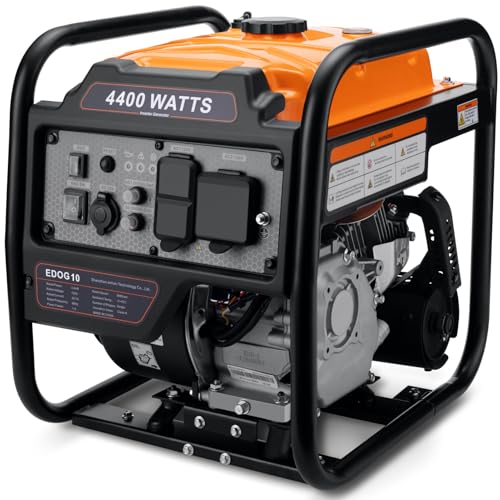
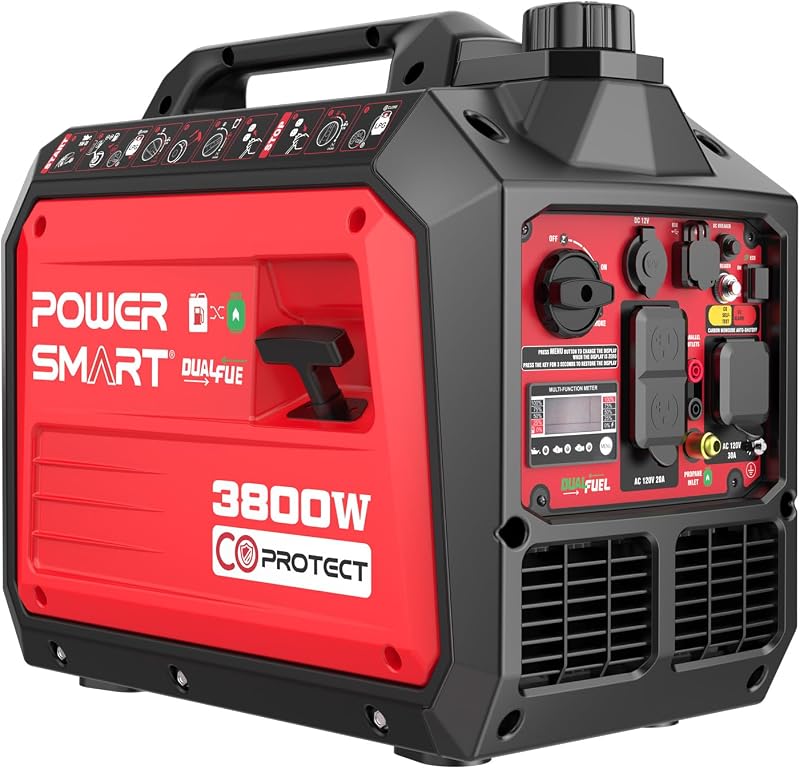
The numbers from manufacturer specifications illustrate this gap clearly. The PowerSmart 3800 Watt Dual Fuel Inverter Generator produces 3,800 starting watts and 3,300 running watts when fueled by gasoline, but drops to 3,500 starting watts and 3,100 running watts when burning propane. Similarly, the WEN DF475T generates 4,750 surge watts and 3,800 running watts on gasoline, decreasing to 4,350 surge watts and 3,500 running watts on propane. Dedicated gasoline models do not suffer this fuel compromise. For instance, the Oxseryn 4400 Watts Inverter Generator extracts a full 4,400 peak watts and 3,400 running watts from its 208cc engine, optimizing internal compression purely for gasoline combustion.
Beyond raw wattage, output voltage determines whether a generator can run heavy household circuits. The WEN dual fuel unit includes an onboard voltage selector switch that toggles output between standard 120V and high-capacity 240V, feeding a NEMA L14-30R twist-lock receptacle designed specifically for home manual transfer switches. In contrast, the Oxseryn gasoline generator is strictly a 120V platform, limiting its utility to standard plug-in appliances or 120V RV hookups. For buyers choosing a dual fuel or gas generator for home backup, 240V capability is essential if you intend to run a multi-wire branch circuit or a central well pump, a balance also explored in our generac gp8000e vs westinghouse wgen9500df review.
Edge: Dual Fuel Generator, because the availability of 120V/240V switching on heavy dual fuel platforms outweighs the minor wattage penalty experienced when burning propane.
Runtime and Fuel Efficiency
Runtime determines how often you must step into bad weather to refuel your equipment. Looking at dual fuel vs gas generator runtime metrics reveals distinctly different operational strategies based on tank sizes and engine management technologies. Dedicated gas machines like the Oxseryn line rely on an onboard 2-gallon steel fuel tank paired with an intelligent ECO mode, which throttles the 208cc engine up or down based on active electrical demand to yield up to 14 hours of continuous runtime at a 25% load.
Dual fuel machines approach runtime from two different angles. Compact inverter dual fuel units, such as the PowerSmart 3800, hold 1.3 gallons of gasoline to achieve 8 hours of runtime at a 25% load. However, when hooked up to an external 20-pound propane cylinder via its pressure regulator, that same PowerSmart unit stretches its runtime up to 24 hours under Eco mode. This capability allows an entire day and night of low-draw refrigeration and device charging without a single refueling interruption.
Larger open-frame dual fuel generators balance high power with traditional fuel volume. The WEN DF475T packs a 4-gallon fuel tank that delivers up to 11 hours of runtime at 50% load on gasoline. While gas generators provide respectable efficiency from integrated tanks, the ability to tether a dual fuel unit to standard external propane tanks offers virtually limitless continuous runtime, making it easy to swap tanks without stopping the generator if auxiliary valve setups are used, as observed in our analysis of the duromax xp13000eh vs ecoflow delta 2.
Edge: Dual Fuel Generator, because tethering to a standard 20-pound external propane cylinder delivers runtimes of up to 24 hours that no compact onboard gasoline tank can match.
Portability, Weight, and Form Factor
A generator that produces immense power is of little help if it is too heavy or awkward to transport to your jobsite or campsite. Here, the dedicated gas generator demonstrates a distinct physical advantage. Because dedicated gas systems do not require heavy dual-fuel carburetors, onboard gas-to-propane switching valves, or external brass regulator plumbing, their structural chassis can remain remarkably streamlined.
A focused gas portable generator review highlights the Oxseryn 4400-Watts Open Frame Generator as a standout for mobility. Despite housing a large 208cc 4-stroke engine and producing 4,400 peak watts, it weighs just 56 pounds. Its open-frame architecture provides exposed tubular steel grab points, allowing a single person to lift it into a truck bed, trunk, or RV storage compartment without requiring ramps or a second pair of hands.
Dual fuel platforms tend to be significantly heavier. Units designed with dual-fuel architecture, large-displacement engines, and switchable voltage selectors-like the 224cc WEN model-require heavy-duty steel framing that necessitates a dedicated wheel and folding handle kit just to maneuver around a driveway. Even compact inverter-style dual fuel generators, while enclosed for noise management, demand extra physical space to pack the external 47-inch LPG connection hose and fuel regulator assembly alongside your other camping gear. When selecting a dual fuel or gas generator for rv camping where storage space and gross vehicle weight ratings are strictly limited, every pound saved makes a tangible difference.
Edge: Gas Generator, because dedicated open-frame construction keeps the unit at a lightweight 56 pounds, allowing single-person transport without wheel kits.
Long-Term Maintenance and Reliability
Routine upkeep dictates how many seasons of service you extract from an engine. In the debate surrounding propane vs gas generator maintenance, fuel cleanliness is the defining factor. Gasoline engines run dirtier over time; fuel degradation can coat internal intake valves in carbon deposits, and stale fuel left in a carburetor float bowl will oxidize and plug needle valves, preventing starting after long storage intervals.
Liquid propane enters the engine as a dry gas rather than a liquid mist. Because propane contains no ethanol, complex chemical detergents, or heavy aromatic additives, it burns exceptionally clean. Operating a dual fuel generator on propane drastically reduces carbon buildup on cylinder heads, exhaust ports, and spark plugs. Furthermore, because propane leaves no wet fuel residue inside the carburetor, there is no liquid fuel to varnish the jets when you shut down the machine for the season. You can simply turn off the propane bottle valve, let the remaining vapor burn out of the line, and store the machine without draining the carburetor bowl.
Both equipment types share standard four-stroke internal combustion maintenance requirements, including low oil shutdown sensors to guard against engine seizure, cold start technology to aid cold-weather cranking, and carbon monoxide monitoring for user safety. Both the PowerSmart dual fuel and Oxseryn gas units feature low-oil protection, while the PowerSmart adds a certified carbon monoxide sensor per ANSI/UL2201 and ANSI/PGMA G300 standards. However, the dual fuel design grants you the luxury of running entirely on propane, sparing you from the carburetor cleanings that plague neglected gasoline generators, as we noted in the generac gp8000e vs duromax xp13000eh breakdown.
Edge: Dual Fuel Generator, because running on dry propane eliminates carburetor gumming, minimizes carbon deposits, and simplifies off-season storage.
Noise Profiles and Operational Cleanliness
Operational volume and exhaust cleanliness play a major role in determining whether a generator is suitable for crowded campgrounds, suburban neighborhoods, or remote off-grid cabins. Noise output is primarily governed by whether the machine uses an open-frame steel cage or an acoustic, fully enclosed plastic cabinet, paired with an effective engine speed governor.
The PowerSmart 3800 dual fuel unit exemplifies whisper-quiet inverter technology, registering an operating sound level of just 59 dBA at a 25% load in Eco Mode. At 59 dBA, the sound is comparable to normal conversational speech, making it neighbor-friendly at campground sites or along dense residential property lines during an outage. In addition, burning propane creates noticeably less odor and exhaust smoke than burning gasoline, making the operational footprint around your patio or RV significantly more pleasant.
Open-frame dedicated gas generators, on the other hand, produce considerably more acoustic resonance. The Oxseryn 4400-watt generator is rated at under 72 dBA from 23 feet away. While 72 dBA is manageable for open outdoor jobsites, agricultural work, or emergency daytime power, it is significantly louder than an enclosed inverter unit. The open tubular frame allows mechanical clatter from the engine block, valve train, and cooling fan to radiate freely in all directions. When deciding whether is a dual fuel generator worth it for recreation, the combination of enclosed sound dampening and low-odor propane exhaust provides a distinct comfort advantage.
Edge: Dual Fuel Generator, because enclosed inverter models achieve sound ratings as low as 59 dBA while propane exhaust produces significantly less odor than gasoline fumes.
Pros and Cons
Dual Fuel
Pros
- Runs on gasoline or non-perishable propane
- Up to 24 hours propane runtime on PowerSmart
- Switchable 120V/240V output on WEN model
- Quiet 59 dBA operation on enclosed inverter
- Eliminates carburetor gumming when using propane
Cons
- Lower wattage output when burning propane
- Heavier frames requiring wheel kits for transport
- Requires carrying external LPG hoses and regulators
View PowerSmart 3800 Watt Dual Fuel Inverter on Amazon
Gas Generator

Pros
- Lightweight 56-pound portable open-frame design
- Full 4,400 peak watts without fuel power drops
- Up to 14 hours runtime with ECO mode
- Built-in fuel gauge for easy monitoring
- Straightforward design with fewer plumbing components
Cons
- Gasoline degrades quickly during long-term storage
- Louder sound profile rated under 72 dBA
- Restricted strictly to 120V electrical output
View Oxseryn Power Equipment 4400 Watts Inverter on Amazon
Who Should Buy Each One
Choose the Dual Fuel Generator If
- You need reliable home backup power and want the security of keeping non-perishable propane tanks stored indefinitely without fuel stabilizers.
- You require switchable 120V/240V power to connect directly to a manual transfer switch for whole-house utility panels.
- You prioritize ultra-quiet, low-odor operation at campgrounds or around residential neighborhoods using enclosed inverter platforms.
- You want extended unattended runtimes of up to 24 hours by hooking your power station to external 20-pound propane tanks.
Choose the Gas Generator If
- You need a lightweight, highly mobile open-frame unit weighing only 56 pounds that one person can load into a truck bed or camper.
- You want maximum starting and running watts from every cubic centimeter of displacement without any propane power penalties.
- You use your generator frequently on jobsites or outdoor projects where fresh gasoline is routinely cycled and fuel spoilage is not an issue.
- You prefer a simple, streamlined machine without the bulk of secondary gas valves, external regulators, or LPG connection hoses.
Final Verdict
For the vast majority of property owners and emergency planners, the dual fuel generator is the superior long-term investment. While gasoline remains an excellent high-output fuel, its rapid shelf-life degradation makes dedicated gas machines vulnerable during unexpected power outages. The ability to run a dual fuel model off standard 20-pound propane tanks provides unmatched storage reliability, eliminates carburetor maintenance issues, and allows continuous runtimes up to 24 hours. Combined with the option for 120V/240V switchable power on larger models or 59 dBA quiet operation on inverter models, dual fuel systems solve the real-world logistical headaches of emergency preparedness.
However, the dedicated gas generator remains the undisputed winner for users who demand lightweight portability and straightforward power. If your primary use involves RV camping, tailgating, or remote construction tasks, an open-frame unit like the 56-pound Oxseryn delivers 4,400 peak watts without the added bulk, extra plumbing, or weight of dual-fuel components. If you cycle through fuel regularly and need maximum mobility per watt, a dedicated gas generator provides clean, focused simplicity.
FAQ
Can I switch between gasoline and propane while a dual fuel generator is running?
Most dual fuel generators require you to adjust a fuel selection dial or switch on the front control panel. While some modern systems allow on-the-fly switching, manufacturer safety instructions generally recommend shutting down the engine or turning off the active fuel supply valve to let the carburetor clear before switching fuel types, preventing fuel line cross-contamination.
Why does a dual fuel generator produce less wattage on propane than on gasoline?
Gasoline has a higher volumetric energy density than liquid propane, meaning a given volume of gasoline releases more heat and chemical energy during combustion. Because the engine’s displacement remains fixed, burning propane yields roughly 10% fewer running and starting watts than burning gasoline in the same combustion chamber.
How long can I store propane compared to gasoline for emergency backup?
Gasoline typically begins to degrade and oxidize within three to six months unless treated with a specialized fuel stabilizer, which may extend its life up to a year. In contrast, liquid propane sealed in certified steel cylinders does not oxidize, degrade, or separate over time, providing an effective shelf life of several decades as long as the container remains undamaged.
Do dual fuel generators include the hose needed to connect to a propane tank?
Yes, dual fuel models that feature propane capability, such as the WEN DF475T, explicitly include the necessary accessories, such as a 47-inch LPG connection hose with an integrated pressure regulator, straight out of the box so you can connect to standard propane tanks immediately.
Are dedicated gas generators lighter than dual fuel models?
Dedicated gas generators generally weigh less than dual fuel models with comparable output. Gas-only generators do not need heavy internal gas-selector mechanisms, secondary regulator mountings, or reinforced fuel plumbing, allowing open-frame models like the 4,400-watt Oxseryn to remain at a compact 56 pounds.
Does running a generator on propane reduce engine maintenance?
Yes. Because propane is a clean-burning dry gaseous fuel containing no ethanol or varnish-forming compounds, it leaves virtually no carbon deposits on spark plugs or valves and cannot gum up carburetor passages during storage, significantly cutting down on routine fuel system cleaning.