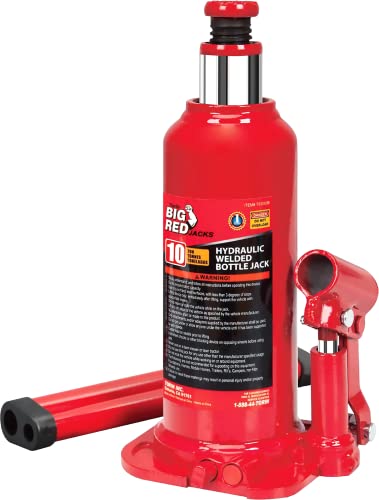
The fundamental divide between the Daytona 3 Ton and the Torin Big Red comes down to mechanical architecture: Daytona provides a rolling horizontal floor jack engineered for low vehicle clearance and quick positioning, while Big Red is a vertical hydraulic bottle jack built for massive downward structural loads in a compact footprint.
Choose the Daytona 3 Ton if you maintain passenger vehicles, sports cars, or crossovers on smooth garage floors and need fast undercarriage access. Choose the Torin Big Red if you manage heavy-duty trucks, commercial equipment, or agricultural machinery that demands immense lifting capacity in a portable package.

Daytona 3 Ton vs Torin Big Red at a Glance
| Feature | Daytona 3 Ton | Torin Big Red |
|---|---|---|
| Jack Architecture | Horizontal hydraulic floor jack | Vertical hydraulic bottle jack |
| Rated Capacity | 3 Tons (6,000 lbs) | 10 Tons (20,000 lbs) |
| Minimum Saddle Height | 5.0 inches | 8.81 inches |
| Maximum Lifting Height | 18.25 inches | 17.63 inches |
| Hydraulic Cylinder System | Dual piston Rapid Pump | Glide-action pressure pump |
| Frame Material | Heavy-duty alloy steel | Drop-forged alloyed steel |
| Chassis Mobility | Rear 360-degree ball bearing swivel casters | Stationary welded base |
| Unit Weight | 103 pounds | 10.4 pounds |
| Overload Protection | The listing does not specify | Built-in oil-bypass and overload valve |
| Best For | Routine garage maintenance and lower-clearance autos | Heavy commercial trucks, farm machinery, and structural lifting |
Lifting Capacity and Structural Intended Use
Rated load capacity defines what a hydraulic lifting tool can safely bear without structural deformation or hydraulic seal blowout. The torin big red 10 ton capacity yields 20,000 pounds of vertical support, designed to handle commercial vehicles, heavy agricultural implements, loaded trailers, and structural building projects. By contrast, the Daytona 3 Ton supports up to 6,000 pounds, matching the gross axle ratings of sedans, family minivans, light crossovers, and half-ton consumer pickup trucks.
Understanding this capacity difference requires looking at how vehicle weight distributes during maintenance. When lifting a corner or an axle of a passenger automobile, a 3-ton floor jack easily supports the working load because you rarely lift an entire vehicle off the ground at once. However, when managing commercial chassis, motorhomes, or heavy structural beams, the Daytona reaches its mechanical threshold quickly. The Torin Big Red bottle jack review highlights how drop-forged alloy steel and industrial welding enable the compact cylinder to support more than triple the Daytona’s rated threshold without flinching.
When readers weigh a daytona 3 ton vs pittsburgh 3 ton or evaluate high-tonnage bottle jacks, intended use dictates the safety margin. If your fleet includes commercial machinery, livestock haulers, or multi-axle trailers, exceeding a 3-ton rating is mandatory. The Torin delivers commercial-grade peace of mind under immense payloads where passenger-car jacks cannot operate.
Edge: Torin Big Red wins this category by offering more than triple the working capacity to accommodate heavy-duty commercial and structural tasks.
Minimum Clearance and Maximum Lift Range
A jack is only useful if it can fit beneath the target lifting point before elevating the chassis. The Daytona 3 Ton lifting height range spans from a low minimum entry of 5 inches up to a maximum elevation of 18.25 inches. This low-profile profile allows the horizontal arm to roll beneath sports cars, sedans, and factory unibody pinch welds that sit close to the asphalt.
The Big Red operates on a completely different geometric plane, featuring a minimum collapsed height of 8.81 inches and a maximum stroke of 17.63 inches. Because the hydraulic piston sits vertically inside the reservoir body, it cannot physically collapse below roughly 9 inches. Attempting to position this bottle jack beneath a low-slung sedan or an unlifted station wagon is impossible without first driving the tire onto ramps or timber blocks. To offset its stroke limits, Big Red includes an adjustable screw top extension saddle that threads outward to bridge empty space on taller trucks.
Comparing the daytona floor jack vs big red bottle jack in terms of daily utility reveals that maximum reach is comparable, but minimum clearance separates them entirely. The Daytona achieves nearly two feet of lift from a flat starting point, providing wide clearance for jack stands. The Torin reaches 17.63 inches, but only if your vehicle frame or solid axle starts high enough off the ground to receive the jack in the first place.
Edge: Daytona 3 Ton wins because its 5-inch minimum height accommodates low-profile automobiles while still matching the overall vertical elevation of the bottle jack.
Pumping Speed and Hydraulic Operation
Pumping efficiency determines how quickly a technician can secure a vehicle on support stands. Daytona integrates a dual piston Rapid Pump hydraulic system engineered to lift typical automotive loads to full height in approximately 3-1/2 pumps. The twin hydraulic pistons displace fluid rapidly when unladen, bringing the saddle into contact with the chassis almost immediately, then modulating resistance as the vehicle rises.
The Big Red uses a single-action glide pressure pump paired with a two-piece segmented manual pump handle. While the glide-action design requires minimal physical force to raise thousands of pounds, the fluid displacement per stroke is substantially smaller than a dual-piston floor jack. Raising a heavy axle takes dozens of short, deliberate manual strokes, which demands more time and patience under the frame rail.
When contrasting equipment types in our pittsburgh 3 ton vs torin big red analysis, rapid elevation proves critical for shop workflow. The long lever handle and dual-piston stroke on the Daytona floor jack create an effortless pumping experience from an upright standing or crouching position, eliminating the need to kneel directly next to the wheel well.
Edge: Daytona 3 Ton takes the lead with its dual piston Rapid Pump system that achieves full height in roughly 3-1/2 pumps.
Mobility, Portability, and Storage
Mobility determines where and how you can deploy your lifting equipment. The Daytona 3 Ton weighs a substantial 103 pounds. To offset this immense bulk, it incorporates premium rear ball-bearing swivel casters that provide 360-degree mobility across flat, smooth surfaces. You can steer the long steel chassis beneath frame rails with simple handle twists, but hoisting this 103-pound tool into a truck bed or trunk requires significant physical strain.
The Torin Big Red presents the polar opposite in form factor: it weighs just 10.4 pounds and measures 4.88 inches long, 4.13 inches wide, and 8.81 inches tall. This lightweight, compact footprint lets you stow the unit inside an under-seat truck compartment, an off-road emergency tote, or a small shop cabinet without consuming valuable square footage. The trade-off is zero rolling mobility; you must physically lift and position the Big Red directly beneath the lift point by hand.
Just as equipment form factors dictate workspace efficiency in our big green egg xl vs vision grills classic breakdown, hydraulic tool mobility dictates where maintenance can happen. If you work on smooth concrete, Daytona’s 103-pound rolling frame is convenient. If you need a field-repair tool for muddy trails, farm fields, or highway shoulders, Big Red is vastly easier to transport.
Edge: Torin Big Red wins on portability and storage thanks to its 10.4-pound total weight and compact dimensions.
Build Quality, Safety Mechanisms, and Durability
Durability under extreme mechanical pressure separates reliable shop tools from hazardous equipment. The Daytona floor jack is forged from heavy-duty alloy steel and coated in green finish, designed to resist torsional twist when bearing asymmetric loads. The broad horizontal stance stabilizes the vehicle against tipping, while the rear swivel assemblies feature heavy ball bearings to resist binding under load.
The Torin Big Red TAM91003B features drop-forged alloyed steel construction joined by an inner and outer welded structure. Unlike traditional screw-together bottle jack bodies that can weep hydraulic fluid over time, the industrial welded casing delivers leak-free performance under tough commercial conditions. Safety engineering is further reinforced by a serrated, heat-treated saddle for bite against metal axles, alongside an integrated oil-bypass and overload valve that stops the hydraulic ram from pushing past its travel limits. Big Red includes a 1-year limited manufacturer warranty, whereas the Daytona listing does not specify warranty coverage.
Much like comparing material integrity in our big green egg vs kamado joe comparison, evaluating hydraulic construction comes down to deliberate failure prevention. Big Red’s welded cylinder, overload bypass, and heat-treated contact saddle provide exceptional structural integrity for high-pressure lifting.
Edge: Torin Big Red wins for its fully welded leak-free body, integrated overload bypass protection, and explicit 1-year warranty coverage.
Pros and Cons
Daytona 3 Ton

Pros
- Low 5-inch minimum entry height
- Dual piston Rapid Pump lifts in 3-1/2 pumps
- Reaches 18.25-inch maximum elevation
- 360-degree ball bearing rear swivel casters
Cons
- Heavy 103-pound total unit weight
- 3-ton limit unsuitable for heavy commercial equipment
Torin Big Red

Pros
- Massive 10-ton 20,000-pound lifting capacity
- Lightweight 10.4-pound portable frame
- Inner and outer leak-free welded structure
- Built-in oil-bypass and overload safety valve
- Adjustable screw top extension saddle
Cons
- Tall 8.81-inch minimum clearance requirement
- Stationary design lacks rolling positioning wheels
Who Should Buy Each One
Choose the Daytona 3 Ton If
- You maintain sedans, sports cars, or unlifted crossovers that require a low 5-inch clearance height to reach lift points.
- You work on a paved driveway or smooth concrete garage floor where 360-degree rolling casters speed up tool positioning.
- You demand fast setup times and want a dual-piston hydraulic system that raises the saddle in approximately 3-1/2 pumps.
- You intend for the jack to remain in your home workshop rather than carrying a 103-pound tool in your vehicle.
Choose the Torin Big Red If
- You need up to 10 tons (20,000 pounds) of brute force for heavy pickup trucks, agricultural machinery, or structural support beams.
- You require a lightweight 10.4-pound tool that stows neatly in a truck bed toolbox or emergency roadside kit.
- Your vehicles feature solid axles or lifted suspensions with more than 9 inches of ground clearance.
- You prioritize drop-forged welded steel that resists oil leaks and includes a built-in overload protection valve.
Final Verdict
For standard garage maintenance on passenger cars, SUVs, and half-ton pickups, the Daytona 3 Ton is the superior choice for most home mechanics. Its broad 5-inch to 18.25-inch lift range slips under low rocker panels without struggle, while its dual piston Rapid Pump mechanism and rear swivel casters make wheel rotations, brake jobs, and oil changes fast and ergonomic. The trade-off is its heavy 103-pound steel footprint, making it strictly a stationary garage companion.
When the job shifts to commercial weights, high-clearance frames, or remote mobility, the Torin Big Red is the undeniable winner. Weighing only 10.4 pounds yet rated for 20,000 pounds, it delivers commercial-grade power in a compact package with leak-free welded seams and integrated overload safety. For truck owners with solid axles or anyone lifting farm trailers and structural loads, Big Red offers unmatched strength at a fraction of the size.
FAQ
Can the Torin Big Red bottle jack lift a low-profile passenger car?
No, the Torin Big Red cannot fit under standard low-profile passenger cars because its minimum collapsed height is 8.81 inches. Most passenger sedans and sports cars feature rocker panel lift points that sit between 5 and 7 inches off the ground. For low-clearance vehicles, a horizontal floor jack like the Daytona 3 Ton with its 5-inch minimum height is necessary.
How fast does the Daytona 3 Ton raise a vehicle compared to a bottle jack?
The Daytona 3 Ton uses a dual piston Rapid Pump system that contacts the chassis and lifts work loads to full height in approximately 3-1/2 handle pumps. In contrast, the single glide-action piston on the Torin Big Red bottle jack displaces a smaller volume of fluid per cycle, requiring dozens of short strokes to achieve its full extension.
Is the Torin Big Red bottle jack safe to use without jack stands?
No hydraulic jack, including the Torin Big Red and the Daytona 3 Ton, should ever support a vehicle while an operator works underneath. Hydraulic pressure relies on rubber seals and fluid valves that can fail unexpectedly. While the Torin Big Red includes a serrated heat-treated saddle and built-in overload bypass valve, you must always lower the vehicle onto mechanical jack stands before beginning work.
Why is the Daytona 3 Ton floor jack so much heavier than the Torin Big Red?
The Daytona 3 Ton weighs 103 pounds because of its extensive horizontal chassis, long lifting arm, steel wheels, and dual-cylinder hydraulic block designed to provide leverage and roll across shop floors. The Torin Big Red weighs only 10.4 pounds because its hydraulic cylinder acts directly upward against the load in a vertical column, eliminating the heavy steel side plates, wheels, and linkage arms found on floor jacks.
Between the Daytona 3 Ton or Torin Big Red for truck maintenance, which is better?
The choice between the Daytona 3 Ton or Torin Big Red for truck maintenance depends on suspension height and where you position the jack. The Daytona 3 Ton is better for lifting trucks from the perimeter frame rails because of its broad 18.25-inch maximum reach and rolling maneuverability. The Torin Big Red is better for lifting directly from heavy solid axles or leaf spring perches where ground clearance already exceeds 9 inches and massive tonnage capacity is beneficial.
Is Torin Big Red worth it for non-automotive lifting tasks?
Yes, the Torin Big Red is well-suited for non-automotive tasks such as leveling porch posts, raising foundation beams, lifting agricultural equipment, or positioning heavy machinery. Its 10-ton (20,000-pound) capacity, drop-forged welded construction, and flat stabilizing base make it practical for vertical structural pushing where a bulky wheeled floor jack cannot fit.