The core distinction when deciding between the AMD Ryzen 5 5600X and the AMD Ryzen 7 5700X centers on out-of-the-box readiness versus extended multithreaded compute capacity. While both desktop processors share AMD’s mature Zen 3 microarchitecture, Socket AM4 motherboard compatibility, and an identical 4.6 GHz maximum boost frequency ceiling, the Ryzen 5 provides a balanced six-core layout paired with a factory-supplied thermal solution, whereas the Ryzen 7 steps up to an eight-core die shipped without a cooler.
Builders putting together a focused gaming rig should choose the Ryzen 5 5600X to obtain an all-in-one package that runs straight out of the box without supplemental hardware purchases. Users managing intensive video production workflows, heavy software compilation, or complex multitasking environments should select the Ryzen 7 5700X to leverage its 16 concurrent threads.


AMD Ryzen 5 5600X vs Ryzen 7 5700X at a Glance
| Feature | AMD Ryzen 5 5600X | AMD Ryzen 7 5700X |
|---|---|---|
| Processor Series | Ryzen 5 | Ryzen 7 |
| Physical Core Count | 6 Cores | 8 Cores |
| Concurrent Thread Count | 12 Threads | 16 Threads |
| Maximum Boost Clock | 4.6 GHz | 4.6 GHz |
| Total Cache Size | 35 MB | 36 MB |
| Thermal Design Wattage | 65 Watts | 65 Watts |
| Bundled Thermal Solution | AMD Wraith Stealth Cooler | Cooler Not Included |
| Motherboard Socket | Socket AM4 | Socket AM4 |
| PCIe Interface Support | PCIe 4.0 on X570 / B550 | PCIe 4.0 on X570 / B550 |
| Best For | Mainstream Gaming Builds | Workstation Tasks and Multitasking |
Core Count and Multithreaded Processing
The headline metric separating these two processors is the internal core configuration. The Ryzen 5 5600X is constructed with 6 physical cores and 12 processing threads, whereas the Ryzen 7 5700X is equipped with 8 physical cores and 16 processing threads. In day-to-day operation, physical cores dictate how many distinct computational tasks a central processing unit can execute simultaneously without interleaving instructions or stalling execution pipelines. For standard desktop operations like running an operating system, handling several browser tabs, and playing a contemporary title, a six-core processor offers adequate parallelism to prevent micro-stuttering and system slowdowns.
When examining the ryzen 5 5600x vs 5700x core count differential under sustained heavy computing, the extra two cores on the 5700X produce a decisive advantage. Creative software suites designed for video editing, 3D rendering, audio mastering, and data science distribute mathematical calculations across every available thread. In multi-threaded rendering queues, the 5700X delivers a 33 percent increase in hardware resources over the 5600X. If you find yourself frequently comparing older product tiers such as the amd ryzen 5 5600x vs ryzen 7 5800x, you will recognize that eight Zen 3 cores represent the sweet spot for modern creative productivity on the AM4 platform.
The extra threads also play an important role when considering whether to choose the ryzen 5 5600x or 5700x for streaming. Running open broadcaster software alongside a demanding game creates simultaneous contention for CPU resources. The 16 threads of the 5700X allow the system to allocate dedicated threads to encoding the video stream while preserving uninterrupted execution blocks for game logic, frame dispatching, and background voice chat applications. The 5600X can handle gaming streams through hardware video encoders on modern graphics cards, but the 5700X provides far more headroom for software-based encoding profiles and heavy background utility suites.
Edge: AMD Ryzen 7 5700X provides 33 percent more physical cores and four additional threads to dramatically accelerate compute-heavy rendering and multitasking pipelines.
Thermal Solution and Out-of-Box Packaging
Thermal management is an essential element of every desktop PC assembly, and the retail packaging choices between these two models represent a major practical divergence. The Ryzen 5 5600X arrives bundled with the AMD Wraith Stealth cooler, a compact aluminum heatsink fan engineered specifically by AMD to dissipate 65 watts of thermal output. The inclusion of this cooler means that a purchaser receives everything needed to seat the processor into a motherboard, secure the retention mechanism, and boot the operating system without sourcing third-party cooling gear or checking mounting bracket dimensions.
In contrast, the Ryzen 7 5700X listing explicitly states cooler not included. AMD designed this processor as a bare-silicon package targeting PC builders who either already own a high-performance aftermarket cooler or intend to select a dedicated tower air cooler or liquid cooling radiator. When calculating the 5600x vs 5700x cooler included factor, the Ryzen 5 5600X represents a complete out-of-the-box build solution, while the Ryzen 7 5700X mandates an additional purchase and installation step before the computer can even complete its initial power-on self-test.
This packaging difference impacts both build simplicity and final cabinet organization. While the Wraith Stealth cooler bundled with the 5600X is a quiet, capable thermal companion for general computing and standard gaming sessions, high-demand multi-core sustained processing benefits substantially from beefier heatsinks. Similar hardware package distinctions occur when evaluating the amd ryzen 5 5600 vs 5600x, where thermal accessories influence assembly velocity. For buyers who prefer zero friction during assembly, the 5600X is the far more convenient package.
Edge: AMD Ryzen 5 5600X includes the factory AMD Wraith Stealth cooler in the box for instant, hassle-free installation.
Gaming Performance and Frame Rates
When evaluating the ryzen 5 5600x or ryzen 7 5700x for gaming, their underlying architecture reveals why they perform almost identically in pure gameplay scenarios. Both processors feature a 4.6 GHz Max Boost clock rating and are built on identical Zen 3 microarchitecture execution engines. The manufacturer documentation specifies that both chips can deliver elite 100+ FPS performance in the world’s most popular games. In titles that prioritize single-thread throughput and low memory latency, the execution instructions per clock cycle and boost frequencies are virtually indistinguishable between the two silicon layouts.
Most modern game engines are optimized around a six-core operational baseline, with physics, artificial intelligence, audio processing, and rendering pipelines distributed across 8 to 12 threads. Because the 5600X possesses 6 cores and 12 threads operating up to 4.6 GHz, modern game engines rarely saturate its compute capacity. In an amd ryzen 5 5600x review focused purely on frame delivery, the processor routinely saturates modern discrete graphics cards at 1080p and 1440p resolutions without creating CPU bottlenecks.
The question of whether is ryzen 7 5700x worth it for pure gaming comes down to how much multitasking you perform while playing. If you keep hardware monitoring software, browser windows, music streaming platforms, and capture utilities running on a second monitor while gaming, the 5700X absorbs those ancillary processes across its spare threads without interrupting frame pacing. While gaming enthusiasts exploring specialized hardware might cross-shop specialized 3D V-Cache offerings like the amd ryzen 5 5600x vs ryzen 7 5800x3d, standard Zen 3 gaming frame delivery between the 5600X and 5700X remains effectively neck and neck.
Edge: Tie. Both processors reach identical 4.6 GHz peak boost speeds and produce equivalent frame rates across modern gaming titles.
Power Consumption and Thermal Efficiency
Power characteristics directly dictate system thermals, acoustic levels, and component longevity. A look at the 5600x vs 5700x wattage specifications shows that both chips carry an identical manufacturer thermal design power rating of 65 watts. Operating within a 65-watt envelope makes both central processors exceptionally power-efficient relative to their processing throughput, keeping chassis temperatures low and preventing thermal throttling inside compact computer enclosures.
However, distributing 65 watts across 6 physical cores produces a different power density profile than distributing 65 watts across 8 physical cores. In the Ryzen 5 5600X, each of the six cores has access to a slightly higher proportional slice of the total energy budget under sustained multi-threaded workloads, allowing the processor to maintain high sustained clock frequencies using its included Wraith Stealth cooler. In an amd ryzen 7 5700x review, the processor demonstrates impressive engineering by packing eight functional Zen 3 cores into that exact same 65-watt limit, maximizing computational throughput per watt expended.
When comparing platform efficiency in an amd ryzen 5 5600 vs ryzen 7 5700x comparison, this modest power draw translates directly into component savings and wide compatibility. Neither chip requires an oversized power supply unit or a motherboard with heavy-duty voltage regulator modules. Any standard Socket AM4 motherboard can deliver the stable power delivery required by either chip. Still, because the 5700X packs eight processing cores into the same envelope, it extracts superior computational work for every watt of power consumed from the wall outlet.
Edge: AMD Ryzen 7 5700X achieves higher multi-threaded work output per watt while adhering to the same 65-watt power ceiling.
Cache Configuration and Platform Synergy
The internal cache memory hierarchy is an indispensable factor in overall system responsiveness. When reviewing the amd ryzen 5 5600x vs ryzen 7 5700x specs, the cache listings reveal closely matched totals. The Ryzen 5 5600X provides 35 MB of total cache, which includes 4 MB of secondary cache as noted in the product specifications. The Ryzen 7 5700X slightly expands upon this by providing 36 MB of total cache memory. This fast on-die cache acts as a high-speed buffer between the execution cores and the system RAM, reducing memory latency during high-frequency computational tasks.
Both processors share identical memory support specifications, natively supporting DDR4 system memory running at DDR-3200 speeds across dual-channel configurations. Furthermore, both chips are engineered for the advanced Socket AM4 platform and fully support the high-bandwidth PCIe 4.0 standard when installed on AMD X570 and B550 motherboards. This PCIe 4.0 interface ensures that modern solid-state storage drives and contemporary discrete graphics cards can communicate directly with the processor without throughput bottlenecks.
For builders seeking a long-term upgrade path on an existing AM4 motherboard, the extra cache and eight-core configuration of the 5700X offer slightly better endurance as software requirements evolve. While extreme high-end upgrades such as the amd ryzen 7 5700x vs ryzen 9 5900x deliver higher thread counts, the 5700X represents an exceptionally balanced combination of cache capacity and platform maturity that breathes fresh life into legacy desktop configurations.
Edge: AMD Ryzen 7 5700X offers a modest cache advantage with 36 MB of total cache memory alongside identical PCIe 4.0 and DDR4-3200 support.
Pros and Cons
AMD Ryzen 5 5600X
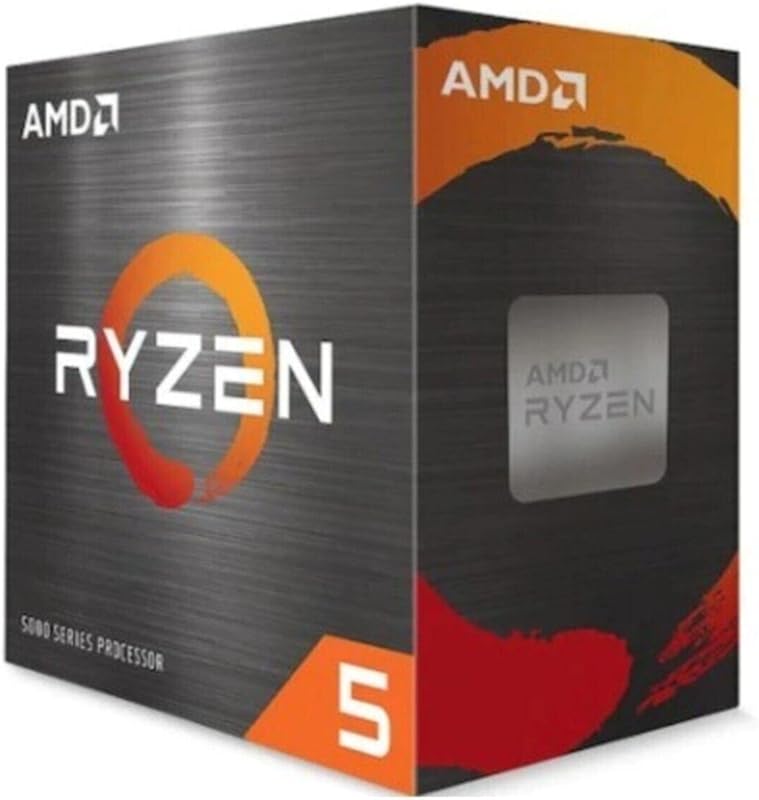
Pros
- Bundled AMD Wraith Stealth cooler
- High 4.6 GHz max boost clock
- Efficient 65W thermal design power
- Capable 6-core 12-thread gaming configuration
Cons
- Lower multi-threaded capacity than 8-core chips
- Slightly smaller 35 MB cache pool
View AMD Ryzen 5 5600X on Amazon
Who Should Buy Each One
Choose the AMD Ryzen 5 5600X If
- You want a complete, ready-to-assemble kit that includes the capable AMD Wraith Stealth cooler directly in the box.
- Your primary system use is mainstream PC gaming where 6 cores and 12 threads easily deliver 100+ FPS frame rates.
- You want to avoid the extra expense, logistical planning, and assembly time of researching and mounting a separate aftermarket cooler.
- You want high single-core performance with a maximum boost clock of 4.6 GHz on an existing B550 or X570 motherboard.
Choose the AMD Ryzen 7 5700X If

- You regularly edit high-resolution video, render 3D scenes, compile large codebases, or run heavy multithreaded simulation workloads.
- You broadcast live gameplay streams to platforms like Twitch or YouTube and require dedicated threads for background encoding software.
- You already possess a quality aftermarket Socket AM4 air or liquid cooler ready to mount into your desktop chassis.
- You want an 8-core, 16-thread processor that fits within a conservative 65-watt power envelope without overloading your system power supply.
Final Verdict
For the vast majority of PC builders assembling a computer dedicated to gaming, the AMD Ryzen 5 5600X remains the smartest and most convenient choice. Its six high-speed Zen 3 cores, 4.6 GHz max boost frequency, and full PCIe 4.0 compatibility on B550 and X570 motherboards deliver smooth, high-framerate performance across all major modern titles. The inclusion of the capable AMD Wraith Stealth cooler inside the box eliminates the necessity of purchasing secondary hardware, making the 5600X an exceptionally cohesive, plug-and-play package.
On the other hand, the ryzen 7 5700x vs amd ryzen 5 5600x comparison tips heavily toward the 5700X for multitaskers, digital content creators, and live game streamers. Its 8 physical cores and 16 concurrent threads supply the computational horsepower needed to slice through video export queues, background rendering tasks, and CPU-intensive software without slowing down everyday responsiveness. If you already own an AM4-compatible cooling solution or do not mind sourcing one separately, the Ryzen 7 5700X delivers an undeniable performance expansion for multi-threaded workloads.
FAQ
Does the Ryzen 7 5700X provide higher gaming frame rates than the Ryzen 5 5600X?
In standard gaming scenarios where the discrete graphics card is the primary performance limiter, both processors deliver practically identical frame rates. Both the 5600X and 5700X feature the same 4.6 GHz maximum boost clock and shared Zen 3 architecture. The 5700X only provides a gaming advantage if you run heavy background applications, live capture software, or numerous browser windows simultaneously while gaming.
Why does the AMD Ryzen 5 5600X come with a cooler while the Ryzen 7 5700X does not?
The Ryzen 5 5600X is positioned as an all-in-one mainstream solution, so AMD packages it with their Wraith Stealth cooler to give builders an immediate out-of-the-box solution. The Ryzen 7 5700X targets advanced enthusiasts, creators, and upgraders who frequently utilize existing aftermarket cooling setups or prefer choosing high-performance third-party air or liquid coolers.
Can I use an AMD Wraith Stealth cooler on the Ryzen 7 5700X?
While the Wraith Stealth cooler physically mounts onto the Socket AM4 retention bracket used by the Ryzen 7 5700X, AMD lists the processor as cooler not included. Because the 5700X concentrates eight cores under sustained processing loads, a dedicated aftermarket cooler with greater thermal dissipation capacity is recommended to maintain peak multi-core boost clocks and quiet acoustics.
Do both processors require a discrete graphics card?
Yes. Neither the AMD Ryzen 5 5600X nor the AMD Ryzen 7 5700X features integrated graphics processing silicon on the die. As explicitly noted in the 5700X specifications, a discrete graphics card installed into a motherboard PCIe slot is required to output display signals to your monitors.
Do the Ryzen 5 5600X and Ryzen 7 5700X support PCIe 4.0?
Both desktop processors feature native support for PCIe 4.0 when installed on compatible Socket AM4 motherboards featuring the AMD X570 or B550 chipsets. This provides high-speed communication channels for PCIe 4.0 NVMe storage drives and modern graphics cards.
What type and speed of RAM do these processors support?
Both central processors feature integrated memory controllers supporting DDR4 system memory with a standard native specification of DDR4-3200. They run in dual-channel configurations on compatible Socket AM4 motherboards to supply high data transfer rates between the memory modules and the on-die cache.
Which processor is better suited for live game streaming?
The AMD Ryzen 7 5700X is significantly better suited for live game streaming if you use CPU-based software encoding. Its 8 cores and 16 concurrent threads allow the processor to manage gameplay rendering on dedicated cores while leaving remaining threads to handle video capture, stream encoding, and background broadcasting software without causing frame drops.