The single difference that decides the choice between the AMD Ryzen 5 7600 and the AMD Ryzen 7 7800X3D is cache architecture: the 7800X3D stacks an enormous 96 MB L3 cache pool to eliminate frame-rate dips in CPU-heavy games, whereas the 7600 relies on a standard 32 MB L3 cache paired with a lean 65-watt power envelope.
Builders assembling an energy-efficient rig who want an out-of-the-box cooling solution should choose the Ryzen 5 7600, while competitive gamers and content creators needing uncompromised frame rates and multi-threaded headroom should invest in the Ryzen 7 7800X3D.
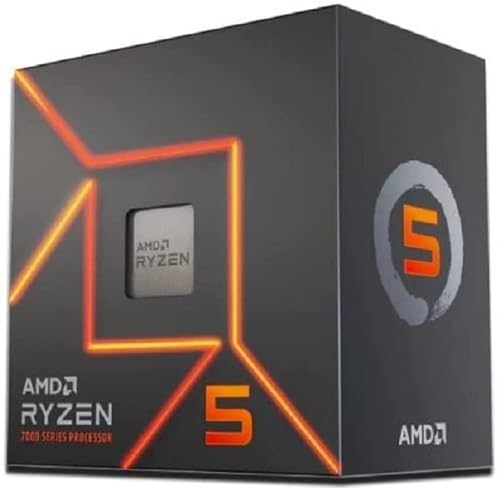

AMD Ryzen 5 7600 vs Ryzen 7 7800X3D at a Glance
| Feature | AMD Ryzen 5 7600 | AMD Ryzen 7 7800X3D |
|---|---|---|
| Processor Series | Ryzen 5 | Ryzen 7 |
| Core & Thread Count | 6 Cores / 12 Threads | 8 Cores / 16 Threads |
| Architecture & Process | Zen 4 (5 nm) | Zen 4 (5 nm) |
| Base Clock Speed | 3.8 GHz | 4.2 GHz |
| Max Boost Speed | 5.2 GHz | Not listed |
| L2 Cache | 6 MB | 8 MB |
| L3 Cache | 32 MB | 96 MB |
| Total Cache | 38 MB | 104 MB |
| Default TDP | 65 Watts | 120 Watts |
| Bundled Cooler | AMD Wraith Stealth | Not listed |
| Socket Compatibility | Socket AM5 | Socket AM5 |
| Best For | Efficient 1080p and 1440p gaming | High-refresh gaming and enthusiast rigs |
Cache Architecture and Gaming Performance
On-chip cache serves as ultra-high-speed memory directly adjacent to the compute cores, storing frequently accessed gaming instructions to minimize latency. When a game engine queries memory and finds the data in the CPU cache rather than making a trip to system RAM, frame pacing improves dramatically. The 7600 vs 7800x3d cache difference is the cornerstone of this comparison. The Ryzen 5 7600 arrives with 6 MB of L2 cache and 32 MB of L3 cache for a combined 38 MB pool. In contrast, the Ryzen 7 7800X3D incorporates AMD 3D V-Cache packaging, combining 8 MB of L2 cache with an expansive 96 MB L3 cache slice to achieve 104 MB of total cache memory installed.
In practice, when evaluating ryzen 7600 vs 7800x3d gaming benchmarks across modern simulation titles, open-world adventures, and competitive shooters, that massive memory buffer changes the gameplay experience. Physics calculations, draw calls, and simulation logic fit inside the 7800X3D cache structure, insulating the processor from memory latency bottlenecks. While an amd ryzen 5 7600x vs ryzen 7 7800x3d matchup presents similar architectural trade-offs, the standard 7600 must pull data from system memory far more frequently, which can produce lower one-percent low frame rates during chaotic scenes.
Resolution scaling also influences this dynamic. In a ryzen 5 7600 vs 7800x3d 1440p evaluation, graphics card limitations begin to compress the raw frame-rate gap compared to 1080p testing. However, even at higher display resolutions, the 7800X3D provides superior frame-time consistency in titles with complex asset streaming. When asking whether to buy the amd ryzen 5 7600 or ryzen 7 7800x3d for gaming, the choice hinges on whether your target titles thrive on cache capacity or remain entirely graphics-bound.
Edge: AMD Ryzen 7 7800X3D because its 104 MB total cache drastically reduces memory latency and secures higher minimum frame rates.
Core Count, Multitasking, and Streaming Headroom
Processing cores and concurrent threads dictate how effectively a central processor juggles modern game engines alongside background system tasks. The Ryzen 5 7600 features 6 cores and 12 processing threads based on AMD Zen 4 architecture. The Ryzen 7 7800X3D expands compute resources to an octa-core configuration with 8 cores and 16 processing threads. While 6 cores remain competent for modern game engines, modern titles increasingly allocate background worker threads for shader compilation, audio processing, and asset decompression.
For gamers wondering whether to choose the amd ryzen 5 7600 or ryzen 7 7800x3d for streaming, the extra physical cores on the Ryzen 7 chip provide vital system isolation. Running broadcasting suites, audio routing software, webcams, and chat overlays concurrently can saturate a 6-core processor, causing dropped frames in your broadcast or stuttering inside the game. The 8-core design of the 7800X3D ensures four additional execution threads remain open to manage streaming software overhead without cannibalizing primary game execution loops, as detailed in our amd ryzen 7 7700x vs 7800x3d comparison.
Creative workloads and general multitasking similarly reward the higher thread count. The 7800X3D processes multi-threaded video encoding, batch file operations, and code compilation with greater velocity than the 7600. While neither CPU functions as a dedicated workstation part, the 8-core ceiling gives the 7800X3D meaningful flexibility when your computer serves as both a gaming station and a daily productivity workhorse.
Edge: AMD Ryzen 7 7800X3D due to two additional physical cores and four extra threads that provide essential headroom for streaming and background tasks.
Power Consumption and Thermal Footprint
Electrical wattage determines not only system power draw but also the heat generated inside your computer chassis and the cooling gear necessary to tame it. Examining ryzen 7800x3d vs ryzen 5 7600 power consumption shows distinct operational profiles. The Ryzen 5 7600 operates at a nominal default wattage of 65 watts, making it one of the most electrically conservative processors built on the 5 nm Zen 4 process. The Ryzen 7 7800X3D is rated for 120 watts of power draw, almost doubling the baseline thermal output of its 6-core sibling.
Thermal management requirements reflect this power divergence. The 7800X3D listing specifies a maximum operating temperature of 89 degrees Celsius. Because 3D V-Cache stacks memory dies vertically over the core complex, heat dissipation requires steady, robust airflow or liquid cooling to maintain optimal operating temperatures below that thermal ceiling. In contrast, the 65-watt Ryzen 5 7600 generates substantially less total thermal energy under full multi-core load, allowing it to function comfortably in compact micro-ATX or mini-ITX enclosures, similar to observations in our amd ryzen 5 7600 vs 7600x analysis.
For builders operating smaller power supplies or assembling systems for quiet living room environments, the 65-watt footprint of the Ryzen 5 7600 simplifies installation. Lower power draw translates to minimal fan acoustics, reduced heat discharge into your room, and less overall stress on entry-tier motherboard voltage regulator modules.
Edge: AMD Ryzen 5 7600 because its 65-watt design runs dramatically cooler and draws far less electricity under full system load.
Clock Speeds and Processing Architecture
Both processors share AMD 5 nm Zen 4 architecture, offering unified instruction handling, 64-bit processing, and integrated AMD Radeon Graphics for baseline display output. However, their frequency profiles diverge to accommodate their physical structures. The Ryzen 5 7600 features a base clock speed of 3.8 GHz with a maximum boost speed reaching up to 5.2 GHz, alongside unlocked overclocking capability. The Ryzen 7 7800X3D features a higher base clock of 4.20 GHz, though the product listing does not specify a max boost ceiling.
In standard execution tasks, clock frequency determines how rapidly a single thread processes sequential instructions. Any detailed amd ryzen 5 7600 review highlights the chip agility in basic desktop tasks, file unzipping, and single-threaded operations due to its snappy 5.2 GHz top-end capability. The 7600 is fully unlocked for overclocking, giving enthusiasts the leeway to tune clock curves and maximize clock performance on compatible AM5 motherboards, a balance explored across our amd ryzen 5 7600 vs ryzen 7 7700 breakdown.
By contrast, an in-depth ryzen 7 7800x3d review underscores how the 3D cache layer alters frequency priorities. Because stacked cache dies are sensitive to thermal accumulation and voltage variance, operating frequencies are closely regulated to ensure reliability within the 89-degree operating limit. Both chips include an AMD Radeon Graphics controller, with the 7800X3D listing confirming a 2200 MHz graphics frequency, granting essential troubleshooting and media display capabilities without needing a discrete graphics card installed.
Edge: Tie because the Ryzen 5 7600 offers higher boost flexibility and unlocked tuning, while the Ryzen 7 7800X3D delivers a faster 4.2 GHz base clock.
Bundled Accessories and Out-of-Box Integration
The total investment required to get a computer operational depends heavily on what components accompany the processor in the retail package. The AMD Ryzen 5 7600 includes the AMD Wraith Stealth cooler directly in the box, utilizing a matched heatsink with fan designed to manage the processor 65-watt thermal signature. This allows a builder to assemble a working system immediately without sourcing external mounting brackets or separate thermal equipment.
Conversely, the AMD Ryzen 7 7800X3D ships as a standalone processor unit; the product listing confirms a 120-watt power draw and does not include a cooling solution. Owners must factor in the procurement, sizing, and installation of a dedicated tower heatsink or liquid cooling apparatus capable of maintaining thermal stability beneath the 89-degree operating limit. This requirement adds hardware complexity to system assembly.
Both models share universal compatibility with the Socket AM5 platform, supporting modern DDR5 system memory and PCIe 5.0 lanes on compatible 600-series motherboards. Dimensionally, both chips measure identical 1.57-inch by 1.57-inch footprints and support Linux, Windows 10, and Windows 11 operating environments. The inclusion of the functional Wraith Stealth cooler gives the 7600 a distinct convenience advantage for builders who want an unencumbered setup.
Edge: AMD Ryzen 5 7600 because it includes the AMD Wraith Stealth cooling solution inside the retail packaging.
Pros and Cons
AMD Ryzen 5 7600

Pros
- 65-watt low operating power
- Includes AMD Wraith Stealth cooler
- Up to 5.2 GHz boost clock
- Modern Zen 4 architecture on Socket AM5
Cons
- Smaller 38 MB total cache
- 6 cores limit heavy multitasking
View AMD Ryzen 5 7600 on Amazon
AMD Ryzen 7 7800X3D

Pros
- Massive 104 MB total cache
- 8 cores and 16 execution threads
- Fast 4.2 GHz base clock
- Superior frame pacing in simulation titles
Cons
- Higher 120-watt power draw
- No cooler included in retail box
View AMD Ryzen 7 7800X3D on Amazon
Who Should Buy Each One
Choose the AMD Ryzen 5 7600 If
- You want a complete, ready-to-assemble kit featuring the bundled AMD Wraith Stealth cooler.
- You prefer a strict 65-watt thermal profile for quiet desktop operation or space-constrained cases.
- You play primarily at 1440p or 4K where GPU horsepower dictates maximum achievable frame rates.
- You want an efficient entry onto the Socket AM5 DDR5 platform with unlocked overclocking headroom.
Choose the AMD Ryzen 7 7800X3D If
- You prioritize highest possible frame rates and minimum frame stutter in competitive multiplayer titles.
- You stream gameplay or run demanding multi-tasking suites that require 8 physical cores and 16 threads.
- You already own or plan to install a high-capacity aftermarket heatsink or liquid cooler.
- You want the massive 104 MB total cache buffer to maintain gaming stability in simulation and open-world engines.
Final Verdict
For most mainstream PC builders, the Ryzen 5 7600 represents the most sensible foundation for modern gaming. Its 6 Zen 4 cores, 5.2 GHz max boost frequency, and included Wraith Stealth cooler provide everything required to drive current games without excessive thermal output. Drawing only 65 watts, it keeps system heat, case ventilation, and power demands to a minimum while unlocking all the platform perks of Socket AM5, including DDR5 memory and PCIe 5.0 connectivity.
However, when asking is ryzen 7 7800x3d worth it, the answer is an undeniable yes for high-refresh gamers and streamers who refuse to compromise on frame delivery. The 104 MB cache pool eliminates architectural latency in CPU-bound scenarios, producing higher frame rates and tighter frame times that standard architectures cannot match. If you possess a high-end graphics card, a robust aftermarket cooler, and a passion for competitive or simulation gaming, the Ryzen 7 7800X3D stands alone as the definitive enthusiast gaming chip.
FAQ
Is the Ryzen 7 7800X3D worth it over the Ryzen 5 7600 for pure gaming?
Yes, the Ryzen 7 7800X3D is worth it if you play CPU-intensive multiplayer games, strategy titles, or simulators where high refresh rates and minimal frame drops matter. The 104 MB total cache delivers frame rates that standard 6-core processors cannot reach. If you play primarily slower-paced titles at high resolutions where the graphics card does all the work, the Ryzen 5 7600 is plenty capable.
What is the exact cache difference between the 7600 and the 7800X3D?
The Ryzen 5 7600 features 6 MB of L2 cache and 32 MB of L3 cache for 38 MB total cache memory installed. The Ryzen 7 7800X3D features 8 MB of L2 cache combined with 96 MB of 3D V-Cache L3 memory, resulting in 104 MB of total cache.
Does the Ryzen 5 7600 come with a cooler in the box?
Yes, the AMD Ryzen 5 7600 retail pack includes an AMD Wraith Stealth heatsink and fan designed to dissipate the thermal output of its 65-watt rating.
Does the Ryzen 7 7800X3D include a thermal cooler?
No, the product data for the Ryzen 7 7800X3D does not list an included cooler. Because it operates at 120 watts with an 89-degree Celsius thermal ceiling, builders must provide their own aftermarket cooling solution.
Can the Ryzen 5 7600 handle live game streaming on a single PC?
The Ryzen 5 7600 can handle basic game streaming, but its 6 cores and 12 threads can become heavily saturated if you run demanding broadcast encoding, webcams, and chat tools alongside modern games. The Ryzen 7 7800X3D, with 8 cores and 16 threads, provides dedicated headroom for smoother streaming performance.
Do both processors fit the same motherboard socket?
Yes, both the Ryzen 5 7600 and Ryzen 7 7800X3D utilize Socket AM5, feature DDR5 system memory support, and fit compatible AMD 600-series motherboards.
What are the power consumption ratings for both processors?
The Ryzen 5 7600 has a default wattage rating of 65 watts, whereas the Ryzen 7 7800X3D has a default wattage rating of 120 watts.


