The core distinction that determines whether a builder should invest in the Nvidia RTX 4060 Ti or save space with the standard Nvidia RTX 4060 comes down to graphical processing throughput versus mechanical footprint. While the Ti model utilizes a faster 2595 MHz boost clock alongside advanced compute hardware to push higher frame rates in visually intensive games, the baseline card relies on a significantly shorter physical profile and comprehensive display output support to serve smaller desktop enclosures.
Gamers demanding maximum frame delivery at higher display resolutions should select the RTX 4060 Ti, whereas builders constructing space-constrained systems that prioritize compact case clearance should choose the base RTX 4060.


Nvidia RTX 4060 vs Nvidia RTX 4060 Ti at a Glance
| Attribute | Nvidia RTX 4060 | Nvidia RTX 4060 Ti |
|---|---|---|
| Graphics Coprocessor | NVIDIA GeForce RTX 4060 | NVIDIA GeForce RTX 4060 Ti |
| Manufacturer Brand | MSI | ASUS |
| Video Memory | 8 GB GDDR6 | 8 GB GDDR6 |
| Core and Memory Clocks | 2505 MHz Memory Clock | 2595 MHz Boost / 2595 MHz Memory Clock |
| Physical Dimensions | 7.83 inches L x 4.72 inches W | 8.66 inches L x 1.5 inches W |
| Maximum Display Resolution | 7680 x 4320 | 3840 x 2160 |
| Interface Support | PCI-Express x16 (Gen 4) | PCI-Express x16 (PCIe 4.0) |
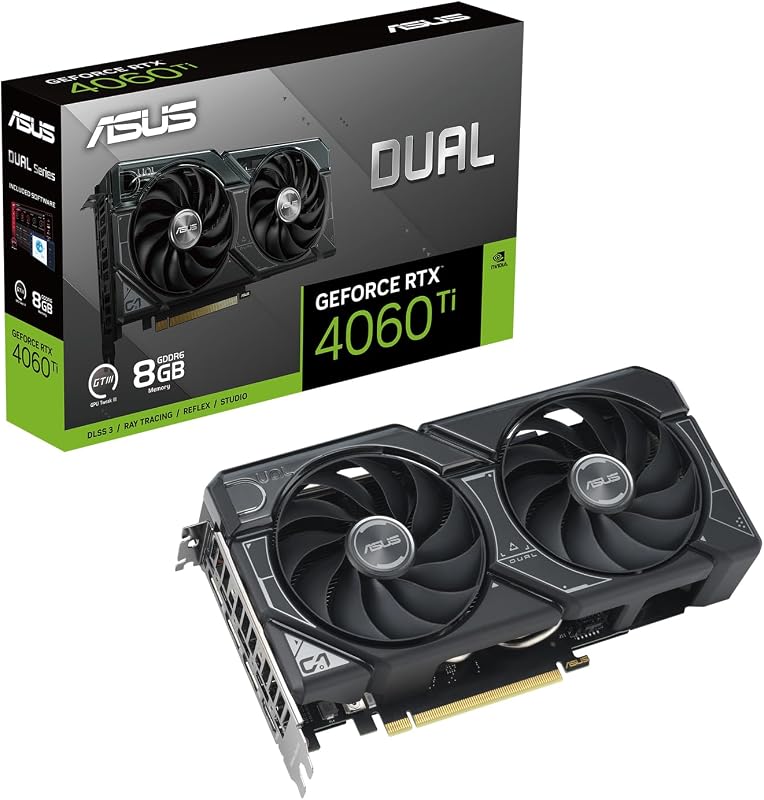
| Cooling Hardware | Dual TORX FAN 4.0 with Zero Frozr | Dual Axial-Tech Fans with Barrier Ring |
| Architectural Enhancements | Ada Lovelace Architecture with DLSS 3 | 4th Gen Tensor Cores & 3rd Gen RT Cores |
| Best For | Space-saving chassis and 8K monitor output | High-refresh gaming and maximum compute clock speeds |
Clock Speeds and Processing Muscle
Raw operational frequency dictates how rapidly a graphics processing unit cycles through complex shader instructions and geometric transformations. In this head-to-head matchup, the ASUS Dual OC iteration of the RTX 4060 Ti holds a distinct architectural advantage. It arrives from the factory operating at an aggressive 2595 MHz boost clock speed in OC mode, backed by a 2565 MHz default operating profile and an equivalent 2595 MHz memory clock speed. This sustained frequency ceiling provides substantial throughput when processing intricate rasterization jobs and managing concurrent computational threads.
By contrast, the MSI Ventus 2X Black version of the base RTX 4060 posts a specified memory clock speed of 2505 MHz. While the underlying Ada Lovelace silicon provides responsive pipeline handling, the baseline card operates at lower peak throughput across heavy compute bursts. When assessing an overall Nvidia RTX 4060 review against an Nvidia RTX 4060 Ti review, the extra frequency overhead of the Ti silicon grants more headroom during fast-paced competitive encounters where split-second render times prevent frame drops. Builders also comparing broader tier jumps, such as an nvidia rtx 4060 ti vs 4070, will recognize that within this specific mid-tier bracket, the RTX 4060 vs 4060 Ti clock speed delta serves as the decisive separator for compute-bound scenarios.
The practical result of this processing difference shows up when executing uncompressed rendering passes or running complex physics simulations. The Ti card leverages its higher clocks to eliminate momentary rendering bottlenecks that occasionally impact the base model during sudden visual transitions. For competitive players who track minimal frame metrics, that additional frequency margin translates to smoother frame pacing during intense engagements.
Edge: Nvidia RTX 4060 Ti, due to its superior 2595 MHz boost clock that delivers tangible processing advantages in demanding computational tasks.
Physical Form Factor and Enclosure Clearance
System compatibility often hinges on small dimensional differences, especially when assembling gaming rigs inside compact micro-ATX or small form factor enclosures. The MSI GeForce RTX 4060 Ventus 2X Black measures just 7.83 inches in total length. This sub-eight-inch footprint allows system builders to install the card effortlessly into tiny ITX cases or legacy desktop configurations where front-mounted intake fans, liquid cooling radiators, or internal drive cages limit horizontal clearance. However, it compensates for that short length with a broader 4.72-inch width, requiring adequate lateral space between the motherboard and the case side panel.
On the other hand, the ASUS Dual GeForce RTX 4060 Ti extends outward to 8.66 inches in length. That additional 0.83-inch span can produce clearance friction in ultra-compact cases that enforce strict GPU length restrictions. Where the ASUS card excels, however, is its trim 1.5-inch thickness profile. This slim physical depth ensures that the card occupies minimal vertical bracket space, leaving neighboring motherboard expansion slots unobstructed for secondary capture cards or dedicated sound cards. Shoppers exploring alternative hardware layouts like the nvidia rtx 4060 vs amd rx 7600 frequently encounter this same dilemma between horizontal extension and vertical clearance.
Choosing between these two form factors requires evaluating where your personal enclosure has excess volume. The MSI card is engineered specifically for enclosures that possess adequate side-panel depth but limited front-to-back horizontal travel. The ASUS card suits longer mid-tower chassis that favor thin cards to preserve airflow channels across bottom-mounted intake arrays.
Edge: Nvidia RTX 4060, because its 7.83-inch length fits a broader range of space-restricted and small form factor computer cases.
Ray Tracing and AI Rendering Pipelines
Modern visual rendering relies heavily on specialized internal silicon designed to handle machine-learning acceleration and realistic light physics. In this area, the RTX 4060 Ti specifications highlight explicit hardware enhancements, spotlighting 4th Generation Tensor Cores and 3rd Generation RT Cores. The hardware documentation notes that these 4th Generation Tensor units deliver up to four times the performance when leveraging DLSS 3 compared to traditional brute-force rendering techniques, while the 3rd Generation RT cores double ray tracing performance over earlier designs.
The standard RTX 4060 also supports full DLSS 3 frame generation and hardware-accelerated ray tracing via the shared Ada Lovelace architecture, enabling accelerated ray tracing and AI frame synthesis. However, the Ti tier integrates more dedicated silicon clusters to execute these algorithmic workloads. Gamers who evaluate the broader ecosystem, including comparisons like the nvidia rtx 4060 ti vs amd rx 7700 xt, know that hardware-level AI upscaling efficiency remains central to keeping frame latencies minimal under heavy ray-traced lighting loads.
When running games loaded with dynamic global illumination, screen-space reflections, and complex ambient occlusion, the RTX 4060 Ti handles the intensive mathematical calculations with greater ease. The base RTX 4060 remains fully capable of running DLSS 3 frame reconstruction, but the Ti card processes those artificial frames with less computational strain, resulting in lower frametime variance during visually dense scenes.
Edge: Nvidia RTX 4060 Ti, due to its advanced 4th Gen Tensor and 3rd Gen RT silicon that dramatically accelerates deep-learning frame synthesis and lighting pipelines.
Cooling Architecture and Acoustic Profiles
Thermal regulation is fundamental to sustaining peak boost clocks during marathon gaming sessions, and both manufacturers integrate proprietary engineering to manage operating temperatures. MSI outfits the RTX 4060 Ventus 2X Black with dual TORX FAN 4.0 units. These custom fan impellers feature pairs of individual blades bound together by an exterior link ring, concentrating air pressure directly inward against the substantial heat sink fins. MSI couples this design with Zero Frozr technology, which halts the cooling fans completely when operating temperatures fall beneath a set threshold, guaranteeing dead-silent idle and web-browsing operations. A vented flow-through backplate aids passive heat dissipation away from critical circuitry.
ASUS counters on the RTX 4060 Ti with an engineered Axial-tech dual-fan arrangement. This assembly utilizes a reduced-diameter hub structure that accommodates longer fan blades, bounded by an integrated outer barrier ring designed to drive laminar airflow downwards into the internal thermal stack. By maximizing localized downward pressure, the Axial-tech design forces heat out through the card perimeter and chassis exhaust vents without requiring excessively high fan speeds.
Both manufacturers demonstrate exceptional engineering tailored to dual-slot designs. MSI targets focused static pressure and zero-decibel low-load states, while ASUS optimizes volumetric air movement across extended cooling fins. Neither thermal approach introduces significant acoustic penalties or thermal throttling during extended use, making both cards exceptionally quiet partners for high-stress gaming.
Edge: Tie, as both MSI’s TORX FAN 4.0 with Zero Frozr and ASUS’s Axial-tech fans provide superior airflow concentration and silent thermal management.
Display Resolution Ceilings and Connectivity Interfaces
Video output flexibility dictates what type of monitors a graphics card can drive, spanning standard high-refresh gaming displays up to ultra-high-resolution creative panels. The MSI GeForce RTX 4060 documentation certifies support for a maximum digital display resolution of 7680 x 4320. This expansive 8K capability, routed through three DisplayPort v1.4a outputs and an HDMI 2.1a connection supporting 4K and 8K HDR feeds, makes the base card an outstanding anchor for extreme multi-monitor productivity workstations and cutting-edge visual displays.
Conversely, the ASUS Dual GeForce RTX 4060 Ti listing specifies a maximum display resolution ceiling of 3840 x 2160 (4K). For monitor output connections, the ASUS model features three DisplayPort 1.4a jacks, a modern HDMI 2.1 port, and legacy VGA support noted within the hardware listing. While 4K is more than adequate for mainstream gaming monitors and desktop setups, users who plan to connect ultra-wide workstation arrays or next-generation 8K televisions may encounter hardware ceilings. Those balancing complex system configurations against alternatives like the nvidia rtx 4060 vs intel arc a770 often weigh these specific output interfaces carefully.
For gamers standardizing on modern 1080p or 1440p displays, both graphics cards provide ample high-bandwidth display paths. Yet, for users planning to drive massive pixel canvases or extreme creative setups without adding specialized signal splitters, the MSI card offers explicit 8K output capability out of the box.
Edge: Nvidia RTX 4060, thanks to its 7680 x 4320 maximum resolution support that accommodates 8K HDR displays and expansive multi-monitor setups.
Gaming Resolution Targets: 1080p vs 1440p
Understanding which GPU to choose hinges heavily on your target monitor resolution. When evaluating the RTX 4060 or 4060 Ti for 1080p gaming, both models deliver exceptional performance across modern titles. The baseline RTX 4060 easily satisfies the render demands of 1080p displays, utilizing its 8GB GDDR6 memory buffer and 128-bit interface to feed high refresh rates in competitive shooters. Because 1080p rendering stresses compute pipelines less intensely, the base card rarely encounters architectural bottlenecks at full HD resolution.
However, when weighing the RTX 4060 or 4060 Ti for 1440p, the computational landscape shifts substantially. Rendering at 2560 x 1440 requires driving roughly 1.77 times the raw pixel count of standard 1080p. Here, the extra compute frequency of the RTX 4060 Ti becomes critical. The 2595 MHz boost clock and upgraded Tensor pipelines handle the steeper pixel shading workloads without degrading minimum frame rates. Gamers weighing whether is RTX 4060 Ti worth it will find that its extra rendering muscle justifies the selection if 1440p monitors or ultra-fast eSports panels are the primary target, especially when contrasted with upper-echelon alternatives like an nvidia rtx 4060 vs 4070 super.
In short, the RTX 4060 Ti vs RTX 4060 performance gap becomes much more pronounced as internal rendering targets expand beyond basic high-definition. While the base card comfortably rules standard 1080p gaming rigs, the Ti variant offers the extra headroom needed to push into denser visual resolutions with higher graphic presets intact.
Edge: Nvidia RTX 4060 Ti, providing the computational frequency and processing stability required for smooth 1440p rendering and competitive high-refresh panels.
Pros and Cons
Nvidia RTX 4060
Pros
- Compact card length fits smaller chassis
- Full Ada Lovelace architecture with DLSS 3
- Supports resolutions up to 7680×4320
Cons
- Lower GPU clock speeds than Ti variant
- Limited 8GB VRAM capacity
View Nvidia RTX 4060 on Amazon
Nvidia RTX 4060 Ti
Pros
- Higher 2595 MHz boost clock speed
- Enhanced 3rd-generation ray tracing cores
- 4th-generation Tensor cores accelerate DLSS 3
Cons
- Longer card footprint requires more case space
- No VRAM capacity increase over standard 4060
View Nvidia RTX 4060 Ti on Amazon
Who Should Buy Each One
Choose the Nvidia RTX 4060 If

- You are assembling a system inside a compact mini-ITX or micro-ATX chassis that requires a sub-8-inch card length.
- Your visual setup includes an ultra-high-resolution 8K monitor or an expansive multi-display workstation demanding 7680×4320 output.
- You focus primarily on 1080p competitive gaming where extreme clock overhead provides diminishing returns.
- You value zero-decibel idle operation delivered by intelligent fan-stop technologies like MSI Zero Frozr.
Choose the Nvidia RTX 4060 Ti If
- You run demanding titles on high-refresh 1080p or 1440p gaming monitors that benefit directly from a 2595 MHz boost clock.
- You want cutting-edge AI acceleration and up to 4x DLSS 3 performance scaling driven by 4th Gen Tensor Cores.
- Your motherboard configuration requires a slim 1.5-inch card thickness to preserve access to secondary PCIe slots.
- You frequently play ray-traced games where dedicated 3rd Gen RT cores prevent frame stutter.
Final Verdict
For the vast majority of performance-oriented PC builders, the Nvidia RTX 4060 Ti is the superior hardware pick. Its accelerated 2595 MHz boost clock speed, coupled with dedicated 4th Generation Tensor Cores and 3rd Generation RT Cores, establishes a noticeable lead in visual computing power. Whether navigating visually complex titles with active ray tracing or maintaining competitive frame rates on a high-refresh 1440p monitor, the Ti variant supplies the architectural horsepower necessary to sustain smooth frametimes without compromising visual fidelity.
The standard Nvidia RTX 4060 remains the smarter selection for builders working within specific physical or visual constraints. At just 7.83 inches in length, the MSI Ventus 2X model fits cleanly into compact chassis that reject larger cards, while still supplying complete DLSS 3 support, whisper-quiet Zero Frozr acoustics, and an outstanding 7680 x 4320 display ceiling. If maximum compute velocity and higher-resolution gaming take precedence, choose the RTX 4060 Ti; if space efficiency and multi-display flexibility are your primary goals, build with the base RTX 4060.
FAQ
Can the RTX 4060 handle 1440p gaming?
The Nvidia RTX 4060 can run titles at 1440p, particularly when utilizing AI-driven frame generation via DLSS 3. However, because it operates at a lower 2505 MHz memory clock speed and possesses fewer dedicated computational resources than the Ti model, you may need to reduce selective visual settings in demanding games to sustain high frame rates.
How much faster is the clock speed on the RTX 4060 Ti?
The ASUS Dual RTX 4060 Ti OC Edition reaches a factory boost clock speed of 2595 MHz in OC mode (2565 MHz default) alongside a 2595 MHz memory clock speed. The MSI RTX 4060 Ventus 2X Black lists a 2505 MHz memory clock speed, giving the Ti card a distinct frequency advantage during heavy graphical execution.
Do both graphics cards support DLSS 3 and frame generation?
Yes, both graphics cards are constructed on the Ada Lovelace GPU architecture and provide native support for DLSS 3 technology. However, the RTX 4060 Ti features advanced 4th Generation Tensor Cores that deliver up to four times the performance throughput of standard brute-force rendering pipelines when DLSS 3 is active.
Which graphics card is better suited for mini-ITX desktop cases?
The MSI GeForce RTX 4060 Ventus 2X Black is better suited for mini-ITX cases with constrained length allowances due to its compact 7.83-inch total length. The ASUS Dual RTX 4060 Ti is longer at 8.66 inches, though its slimmer 1.5-inch width makes it easier to install next to adjacent motherboard expansion cards.
What display connections are available on the MSI RTX 4060 vs ASUS RTX 4060 Ti?
The MSI RTX 4060 features three DisplayPort v1.4a ports and one HDMI 2.1a port supporting resolutions up to 7680 x 4320. The ASUS RTX 4060 Ti listing includes three DisplayPort 1.4a ports, one HDMI 2.1 port, and a listed VGA connection, supporting digital resolutions up to 3840 x 2160.
Does the RTX 4060 Ti require a different PCIe slot interface?
No, both graphics cards use a standard PCI-Express x16 physical slot form factor operating on the PCIe 4.0 interface standard, ensuring identical motherboard compatibility across contemporary desktop systems.


