The single deciding factor between these two graphics cards comes down to video memory capacity and display resolution headroom, where a 12GB allocation on a 192-bit bus faces strict limitations in asset-heavy rendering compared to a spacious 16GB frame buffer. When examining the rtx 4080 super vs rtx 4070 ti, this hardware partition determines whether your system will glide through modern titles with high-resolution texture packs or experience performance throttling under peak memory saturation.
Gamers building a dedicated high-refresh 1440p battlestation should select the Nvidia RTX 4070 Ti for its compact dimensions and exceptional clock frequencies, while enthusiasts targeting uncompromised 4K visual fidelity should invest in the Nvidia RTX 4080 Super for its expansive frame buffer and ultra-high-resolution support.


Nvidia RTX 4070 Ti vs Nvidia RTX 4080 Super at a Glance
| Attribute | Nvidia RTX 4070 Ti | Nvidia RTX 4080 Super |
|---|---|---|
| Graphics Coprocessor | NVIDIA GeForce RTX 4070 Ti | NVIDIA GeForce RTX 4080 SUPER |
| Video Memory | 12 GB GDDR6X | 16 GB GDDR6X |
| Memory Interface Width | 192-bit | Not listed |
| Boost / OC Clock Speed | 2745 MHz | 2640 MHz (OC mode) / 2610 MHz (Default mode) |
| Maximum Display Resolution | 4K | 7680×4320 pixels |
| Display Outputs | DisplayPort 1.4a (x3), HDMI 2.1a (x1) | DisplayPort 1.4a, HDMI 2.1a |
| Cooling Fan Count | 2 | 3 |
| Dimensions | 12.09″ L x 2.01″ W | Not listed |
| Included Box Contents | Graphics card, quick setup guide | Adapter cable (1 to 3), manual, GPU holder, collection card |
| Warranty | Not listed | 3 Year Warranty |
| Best For | High-refresh 1440p gaming | Demanding 4K ray tracing |
VRAM Capacity and Memory Bus Width
The allocation of video memory directly governs how well a modern graphics card handles high-resolution texture packs, volumetric lighting, and advanced computational features like frame generation. The rtx 4070 ti vs 4080 super vram difference represents a major architectural divergence between 12GB and 16GB pools of GDDR6X memory. While 12GB remains sufficient for contemporary gaming at standard resolutions, ray tracing data structures and geometry buffers consume substantial VRAM before game textures are even loaded into active memory. Readers exploring surrounding options can see how this compares in our nvidia rtx 4070 ti vs 4070 ti super analysis.
On the architectural level, the RTX 4070 Ti utilizes a 192-bit memory interface, which dictates the bandwidth pipeline through which graphical data travels between the compute cores and the GDDR6X modules. The listing for the RTX 4080 Super does not specify its exact bus width, but it equips a substantially larger 16GB GDDR6X configuration. Having that extra 4GB buffer prevents the game engine from spilling uncompressed textures into system RAM, a scenario that results in sudden micro-stuttering during intensive gameplay sequences.
For PC enthusiasts who intend to keep their hardware relevant across multi-year software cycles, memory capacity functions as an insurance policy. As game developers increase procedural detail and rely on uncompressed asset pipelines, cards with 12GB are forced to lower texture settings or disable complex path tracing elements. The 16GB frame buffer on the higher-tier card ensures you can dial modern visual settings to their maximum without encountering frame-rate drops caused by memory limits.
Edge: Nvidia RTX 4080 Super because its 16GB GDDR6X frame buffer provides critical headroom for demanding asset streaming and advanced graphics features.
Display Resolution and Ray Tracing Capabilities
Resolution support defines the fidelity ceiling of your entire gaming setup, dictating whether your GPU can comfortably output to ultra-wide displays, high-end 4K monitors, or 8K displays. Comparing the rtx 4070 ti vs 4080 super for 4k showcases distinct capability thresholds. The RTX 4070 Ti specifications indicate a maximum display resolution of 4K, whereas the RTX 4080 Super is engineered to deliver a maximum resolution of 7680×4320 pixels, which corresponds to full 8K rendering capabilities.
Both graphics processors leverage the Ada Lovelace architecture, giving them access to NVIDIA DLSS 3 technology. However, the hardware executing these calculations scales across product tiers. The RTX 4080 Super listing highlights 4th Generation Tensor Cores capable of delivering up to 4x performance with DLSS 3 compared to brute-force rendering, alongside 3rd Generation RT Cores engineered to provide up to 2x ray tracing performance over previous generations. In complex 4070 ti vs 4080 super benchmark evaluations, these advanced processing units ensure ray-traced shadows, reflections, and ambient occlusion render smoothly without overtaxing core shading pipelines.
When selecting the rtx 4070 ti or rtx 4080 super for gaming, your monitor’s native pixel count serves as the ultimate arbiter. Running the RTX 4070 Ti at 1440p allows its Ada Lovelace architecture to operate with blazing speed, delivering fluid motion across fast-paced competitive and single-player titles. Conversely, the RTX 4080 Super flexes its muscular RT and Tensor cores to drive demanding 4K monitors and high-resolution VR headsets, making it the superior pick when pushing pure visual splendor. For more perspective on upper-tier hardware, examine our breakdown of the nvidia rtx 4070 ti super vs 4080 super.
Edge: Nvidia RTX 4080 Super due to its higher maximum display resolution of 7680×4320 and upgraded 3rd Generation RT and 4th Generation Tensor cores.
Clock Speeds and Processing Frequency
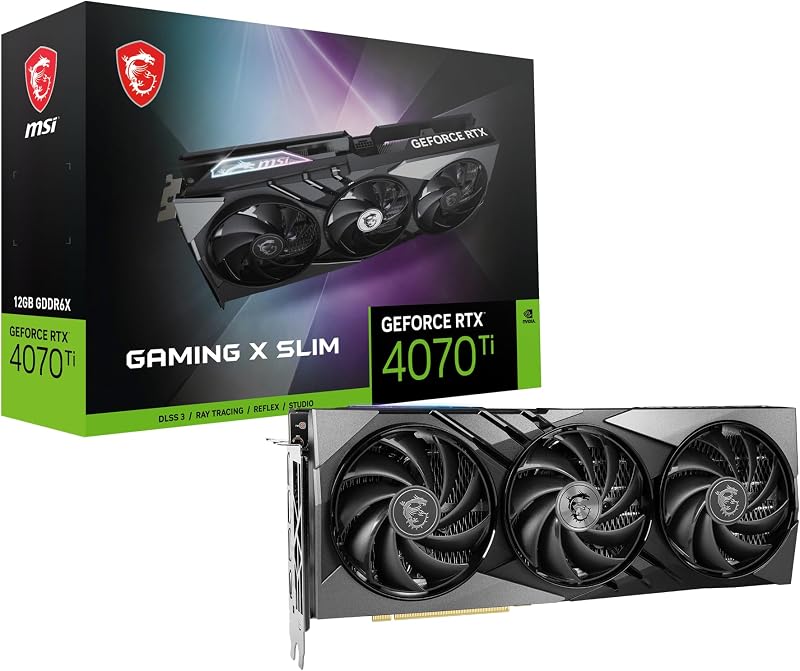
Clock frequency dictates how many instruction cycles the graphics coprocessor can process every second, directly influencing raw frame rendering when the GPU is not otherwise bound by memory bandwidth or core counts. In this category, the MSI RTX 4070 Ti features an aggressive boost clock of 2745 MHz straight out of the box, with a matching memory clock speed listed at 2745 MHz. This high factory frequency allows the smaller chip to maximize its operational throughput across typical gaming workloads.
By contrast, the ASUS TUF Gaming RTX 4080 Super operates at a maximum OC mode clock speed of 2640 MHz, dropping slightly to 2610 MHz under its Default mode profile. When reviewing rtx 4080 super vs 4070 ti specs, it is essential to contextualize that clock frequency alone does not equal absolute rendering power. As noted in any thorough rtx 4070 ti review and rtx 4080 super review, higher tier silicon compensates for slightly lower megahertz ratings by employing wider computing arrays that complete more computational instructions per clock cycle. You can see how lower tiers balance these dynamics in our nvidia rtx 4070 super vs 4080 super guide.
Nonetheless, the 105 MHz clock advantage held by the RTX 4070 Ti is a measurable metric that benefits titles limited by raw frequency rather than deep parallel processing. When rendering non-ray-traced competitive games at 1440p, that snappy 2745 MHz boost speed keeps frame delivery exceptionally consistent. In terms of sheer published frequency, the smaller card leads this specific parameter.
Edge: Nvidia RTX 4070 Ti thanks to its higher factory boost clock speed of 2745 MHz compared to the 2640 MHz OC ceiling of its rival.
Cooling Architecture and Fan Configuration
Thermal management is paramount for sustaining high boost clocks over lengthy gaming sessions, as modern NVIDIA cards dynamically throttle performance if operating temperatures exceed calibrated thresholds. The MSI RTX 4070 Ti Gaming X Slim is configured with a 2-fan cooling layout, measuring 12.09 inches in length and 2.01 inches in width. Its slim physical footprint makes it highly adaptable for mid-tower computer chassis or compact builds where space along the PCIe bracket is tight.
On the other hand, the ASUS TUF Gaming RTX 4080 Super utilizes a triple-fan layout incorporating proprietary Axial-tech fans. The listing highlights that these fans are scaled up to push 23% more airflow through the card’s heat sink fin arrays. While the listing does not provide exact exterior dimensions for the TUF model, managing the higher thermal output of an 80-class processor generally requires substantial heatsink mass, which benefits immensely from the active dispersion of three synchronized fans. Readers curious about similar cooling strategies can check our nvidia rtx 4070 super vs rtx 4080 overview.
The choice here reflects a clear trade-off between physical compatibility and thermal overhead. The RTX 4070 Ti offers a relatively slender 2.01-inch profile that will easily clear neighboring expansion cards and narrow PC enclosures. However, the triple-fan setup on the RTX 4080 Super provides superior airflow scaling, making it more capable of maintaining whisper-quiet operation while venting dense thermal loads during heavy rendering sessions.
Edge: Nvidia RTX 4080 Super with its triple Axial-tech fan setup engineered to produce 23% more airflow volume.
In-Box Accessories and Physical GPU Support
High-performance graphics cards have grown significantly in physical stature and electrical demands, making the bundled retail accessories critical to a seamless build process. The ASUS TUF Gaming RTX 4080 Super provides an extensive accessory bundle straight out of the packaging. It includes an essential 1-to-3 adapter cable to ensure standard multi-cable PCIe power supplies can interface safely with the 16-pin power receptacle, along with a dedicated TUF Graphics card holder designed to counteract GPU sag inside desktop enclosures.
In comparison, the packaging contents for the MSI RTX 4070 Ti include the graphics card itself and a quick setup guide. The listing does not specify any bundled power adapters or anti-sag hardware for the 4070 Ti. While the 4070 Ti has a relatively trim 2.01-inch width, its 12.09-inch length still imposes leverage on the motherboard’s PCIe slot, meaning buyers may need to source third-party brackets or confirm their power supply natively includes 12VHPWR cables. Further accessories and layout comparisons can be found in our nvidia rtx 4070 ti super vs 4080 matchup.
Additionally, ASUS backs the TUF RTX 4080 Super with a 3-year manufacturer warranty, providing extended peace of mind for an enthusiast-tier hardware purchase. The inclusion of the anti-sag holder, multi-pin power adapter, and stated 3-year coverage makes the 4080 Super unboxing experience much more comprehensive for system builders assembling their machines without supplemental aftermarket accessories.
Edge: Nvidia RTX 4080 Super due to the inclusion of a dedicated graphics card holder, a 1-to-3 power adapter cable, and an explicit 3-year warranty.
Pros and Cons
Nvidia RTX 4070 Ti
Pros
- 2745 MHz high boost clock speed
- Slim form factor at 2.01 inches wide
- 12GB high-speed GDDR6X memory
- DisplayPort 1.4a and HDMI 2.1a connectivity
Cons
- 12GB frame buffer limits 4K headroom
- Narrower 192-bit memory interface
- No anti-sag bracket included
View Nvidia RTX 4070 Ti on Amazon
Nvidia RTX 4080 Super

Pros
- Generous 16GB GDDR6X frame buffer
- 7680×4320 maximum resolution capability
- Triple Axial-tech cooling fans
- Includes GPU holder and power adapter
- 3-year manufacturer warranty
Cons
- Lower boost clock than 4070 Ti
- Larger chassis footprint required
View Nvidia RTX 4080 Super on Amazon
Who Should Buy Each One
Choose the Nvidia RTX 4070 Ti If
- You primarily game on a 1440p high-refresh display where a 12GB GDDR6X frame buffer is fully adequate.
- Your PC case requires a slimmer card profile that adheres to a 2.01-inch width to prevent crowding adjacent PCIe slots.
- You prioritize blazing factory frequencies, taking advantage of the card’s 2745 MHz boost clock speed.
- You want high-tier Ada Lovelace features like DLSS 3 without demanding extreme multi-monitor or 8K resolution capabilities.
Choose the Nvidia RTX 4080 Super If
- You play modern games natively at 4K or require display output support up to 7680×4320 pixels.
- You demand the safety net of a 16GB GDDR6X memory buffer to load uncompressed high-resolution textures and path-traced lighting.
- You want a robust triple-fan cooling solution with Axial-tech fans engineered for 23% increased airflow.
- You value a turnkey installation kit that includes a 1-to-3 adapter cable, an anti-sag support holder, and a 3-year warranty.
Final Verdict
Evaluating the overall rtx 4070 ti vs 4080 super performance equation reveals that the Nvidia RTX 4080 Super is the definitive recommendation for high-end gaming rigs. With its 16GB GDDR6X memory configuration, triple Axial-tech cooling fans, and 7680×4320 maximum resolution support, it eliminates the architectural bottlenecks that challenge lesser cards in demanding 4K environments. Answering the frequent builder question of is the rtx 4080 super worth it, the hardware improvements in memory capacity, 4th Gen Tensor processing, and packaged installation accessories deliver enduring value for any enthusiast seeking zero graphical compromises.
The Nvidia RTX 4070 Ti remains a formidable contender when tailored to the right use case. If your target is maxed-out 1440p gaming, its lightning-fast 2745 MHz boost clock and svelte 2.01-inch width make it an exceptional component that drops comfortably into space-constrained cases. However, if your ambitions encompass native 4K ray tracing or future-proofed memory allocation, the RTX 4080 Super stands as the superior piece of silicon.
FAQ
What is the main VRAM difference between the RTX 4070 Ti and RTX 4080 Super?
The RTX 4070 Ti features 12GB of GDDR6X memory operating on a 192-bit interface, whereas the RTX 4080 Super equips a larger 16GB GDDR6X memory buffer. The listing for the 4080 Super does not specify its bus width, but the extra 4GB of VRAM provides crucial capacity for high-resolution 4K textures.
Can the RTX 4070 Ti handle 4K gaming?
Yes, the specifications state that the RTX 4070 Ti supports a maximum display resolution of 4K and includes DLSS 3 support. However, because it features 12GB of memory, heavily modded games or titles with full ray tracing at 4K may push the frame buffer to its limit.
What display outputs do these graphics cards offer?
The MSI RTX 4070 Ti provides one HDMI 2.1a port and three DisplayPort 1.4a outputs. The ASUS TUF RTX 4080 Super includes both HDMI 2.1a and DisplayPort 1.4a interfaces, allowing either card to connect easily to modern gaming monitors and multi-display setups.
Which card has a higher boost clock speed?
The RTX 4070 Ti lists a higher boost clock frequency at 2745 MHz. In contrast, the RTX 4080 Super lists an OC mode clock speed of 2640 MHz and a Default mode speed of 2610 MHz.
Does the RTX 4080 Super include a GPU support bracket?
Yes, the ASUS TUF Gaming RTX 4080 Super listing explicitly includes a TUF Graphics card holder in the box to prevent card sag, alongside a 1-to-3 adapter cable. The RTX 4070 Ti listing only includes the graphics card and a quick setup guide.
What cooling fan setups do these two cards use?
The MSI RTX 4070 Ti Gaming X Slim features a dual-fan setup within a 2.01-inch wide body. The ASUS TUF Gaming RTX 4080 Super utilizes a larger triple-fan setup with Axial-tech fans engineered to deliver 23% more airflow.
What is the maximum supported resolution on the RTX 4080 Super?
The ASUS TUF Gaming RTX 4080 Super listing specifies a maximum display resolution of 7680×4320 pixels, enabling full 8K visual output, whereas the RTX 4070 Ti specifies a maximum display resolution of 4K.


