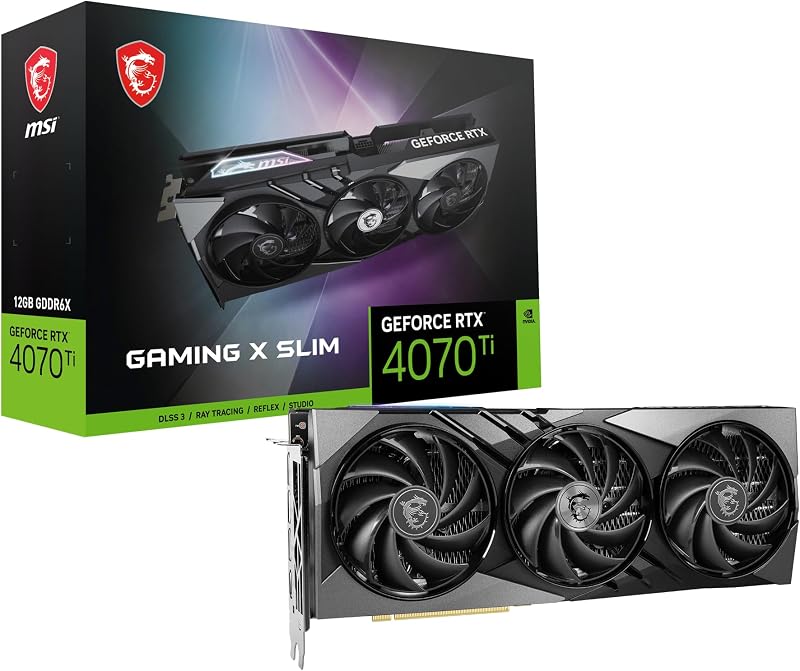
The primary dividing line between these two Blackwell graphics cards centers on memory bus capacity and form-factor footprint. The ASUS Nvidia RTX 5070 features a 12GB GDDR7 configuration engineered into an SFF-Ready 2.5-slot profile, whereas the MSI Nvidia RTX 5080 brings a 16GB GDDR7 buffer operating across a wider 256-bit memory bus with a substantial factory clock uplift.
Builders assembling a compact or space-efficient gaming rig should choose the RTX 5070 for its certified chassis compatibility and targeted cooling design. Enthusiasts demanding uncompromised 4K frame rates and expanded memory bandwidth for heavy texture loads should select the RTX 5080.


Nvidia RTX 5070 vs Nvidia RTX 5080 at a Glance
| Feature | Nvidia RTX 5070 | Nvidia RTX 5080 |
|---|---|---|
| Graphics Processor | NVIDIA GeForce RTX 5070 | NVIDIA GeForce RTX 5080 |
| Architecture | NVIDIA Blackwell | NVIDIA Blackwell |
| Video Memory | 12 GB GDDR7 | 16 GB GDDR7 |
| Memory Interface | Not listed | 256-bit |
| GPU Boost Clock | 2542 MHz | 2760 MHz |
| Memory Clock Speed | 4000 MHz | 30 GHz |
| Form Factor & Slots | 2.5-Slot (12″L x 5″W), SFF-Ready | Not listed |
| Display Connectors | Native DisplayPort 2.1b x3, Native HDMI 2.1b x1 | DisplayPort 2.1a x3, HDMI 2.1b x1 |
| Cooling Solution | 3 Axial-tech fans, Phase-change pad, Dual BIOS | MSI SUPRIM cooling design |
| Best For | Compact SFF enclosures and high-refresh 1440p gaming | Maximum settings 4K gaming and high-bandwidth rendering |
Memory Configuration and High-Resolution Bandwidth
Memory capacity and bus throughput dictate how smoothly a graphics card handles high-resolution texture packs, ray-traced reflections, and modern gaming workloads. Comparing the RTX 5070 12GB vs RTX 5080 16GB reveals a significant structural difference. The RTX 5080 integrates 16GB of GDDR7 memory tied to a 256-bit wide bus, operating at an aggressive 30 GHz memory clock. This high-speed architecture ensures that large data sets and modern game assets stream directly to the compute engines without bottlenecks, which is critical when weighing the nvidia rtx 5070 ti vs 5080 hierarchy.
By contrast, the RTX 5070 comes equipped with 12GB of GDDR7 memory and a listed memory clock speed of 4000 MHz. While this 12GB buffer easily covers dense rasterized titles and competitive esports setups, memory-intensive titles at ultra-high resolutions can encounter allocation limits sooner. When deciding between the RTX 5070 or RTX 5080 for 4k, the 4GB memory delta combined with the wide 256-bit pipeline gives the 5080 a decisive longevity advantage under heavy ray tracing workloads.
Overall, the RTX 5080 ensures smoother frame pacing when driving dense assets at native 3840×2160 or higher resolutions. Gamers who primarily play at 1440p will find the 12GB pool on the 5070 more than adequate, but the memory architecture on the 5080 establishes it as the dedicated high-bandwidth heavyweight.
Edge: Nvidia RTX 5080 because its 16GB GDDR7 frame buffer and 256-bit bus offer greater bandwidth and memory headroom for demanding workloads.
Core Clock Speeds and Graphics Compute
Operating clock frequencies determine how fast a GPU executes instructions and renders rasterized polygons during real-time gameplay. Looking into the RTX 5070 vs 5080 specs, the MSI RTX 5080 SUPRIM SOC comes factory tuned with an extreme performance clock speed of 2760 MHz. This clock speed edge translates into higher raw pixel fill rates and rapid compute turnaround for complex shader routines, directly addressing whether the investment is RTX 5080 worth it for high-end systems.
The ASUS Prime RTX 5070 operates at an engine clock speed of 2542 MHz. While this is a swift baseline frequency powered by the Blackwell architecture and DLSS 4 frame generation features, it sits 218 MHz below the factory tuning of the 5080. In synthetic processing passes and unconstrained graphical workloads, this clock speed separation yields a visible uplift in maximum delivered frame rates. Buyers balancing speed against enclosure sizing might also evaluate the nvidia rtx 5070 vs 5070 ti to see where intermediate frequencies fall.
The RTX 5080 extracts peak computational throughput from the Blackwell silicon right out of the box. The RTX 5070 remains a capable engine, but its lower clock target aligns with thermal moderation rather than pure rendering velocity.
Edge: Nvidia RTX 5080 due to its higher 2760 MHz factory boost clock delivering faster real-time rendering throughput.
Chassis Compatibility and Enclosure Flexibility
Chassis clearance often determines GPU selection just as much as processing silicon. The ASUS RTX 5070 adheres strictly to the SFF-Ready enthusiast standard, measuring 12 inches in length and 5 inches in width across a disciplined 2.5-slot profile. This precise sizing enables clean installation into small-form-factor builds, micro-ATX frames, and compact vertical cases without sacrificing clearance for intake fans or custom cable routing.
On the other hand, the MSI RTX 5080 listing does not specify precise physical dimensions or slot widths, classifying it as a premium SUPRIM tier card engineered around heavy heatsink fin stacks and structural reinforcement. Installing high-tier cards of this caliber generally requires spacious mid-tower or full-tower chassis with generous internal clearance. When builders deliberate over the RTX 5070 or RTX 5080 for small form factor systems, the RTX 5070 is the only card here verified for space-restricted cases, similar to considerations seen in the nvidia rtx 5060 vs 5080 segment.
For individuals building around volume limits or compact ITX cases, the RTX 5070 guarantees painless drop-in compatibility. The RTX 5080 demands a dedicated full-sized case environment to accommodate its thermal footprint and board scale.
Edge: Nvidia RTX 5070 thanks to its certified SFF-Ready compliance, 2.5-slot design, and documented 12-inch footprint.
Thermal Engineering and Cooling Architecture
Sustaining peak clock rates over multi-hour gaming sessions requires an effective thermal transfer assembly. The ASUS RTX 5070 features three Axial-tech cooling fans designed with a smaller central hub, longer blades, and an integrated outer barrier ring to focus downward air pressure. ASUS pairs this layout with a high-conductivity phase-change GPU thermal pad that melts and conforms directly to the core under load to lower temperatures, along with a physical Dual BIOS switch to toggle between quiet and performance acoustic curves.
The MSI RTX 5080 utilizes MSI’s SUPRIM cooling ecosystem, utilizing high-grade structural materials and premium styling aimed at managing the heat generated by its 2760 MHz clock speed and 16GB GDDR7 memory. However, the listing does not detail specific internal pad compositions, fan dimensions, or shroud slot layouts. Readers tracking general platform thermals across brands often compare setups like the nvidia rtx 5070 vs amd rx 9070 to understand varied cooling strategies.
Because the RTX 5070 explicitly documents its triple Axial-tech fan design, phase-change thermal interface, and Dual BIOS capability, it provides users with transparent, configurable cooling control inside tight airflow corridors.
Edge: Nvidia RTX 5070 due to its documented phase-change thermal pad, Dual BIOS integration, and triple Axial-tech airflow system.
Display Connectivity and Output Standards
Next-generation display ports dictate what monitors, multi-panel setups, and high-refresh panels a GPU can drive at full fidelity. Both cards support a digital maximum resolution of 7680×4320 pixels, allowing for 8K video output or multi-display high-resolution workstations. However, their port revisions differ slightly in the product documentation.
The ASUS RTX 5070 includes three native DisplayPort 2.1b outputs alongside a single native HDMI 2.1b connection with full HDCP support. In contrast, the MSI RTX 5080 specifications list three DisplayPort 2.1a connectors accompanied by one HDMI 2.1b port. While both revisions easily service high-bandwidth displays, DisplayPort 2.1b incorporates the latest physical and protocol updates for extreme refresh rate monitors. Those weighing external displays across competing lineups can see related port arrangements in the nvidia rtx 5070 ti vs amd rx 9070 xt overview.
Both models accommodate advanced high-refresh multi-screen battle stations, but the ASUS configuration provides native 2.1b revisions across all three DisplayPort jacks for maximum peripheral forward-compatibility.
Edge: Nvidia RTX 5070 because it implements native DisplayPort 2.1b connections across its primary display array.
Pros and Cons
Nvidia RTX 5070

Pros
- SFF-Ready compact 2.5-slot chassis compatibility
- Phase-change GPU thermal pad for heat transfer
- Triple Axial-tech fans with barrier rings
- Native DisplayPort 2.1b and HDMI 2.1b outputs
- Physical Dual BIOS profile switch included
Cons
- Smaller 12GB GDDR7 memory pool
- Lower 2542 MHz GPU clock frequency
View Nvidia RTX 5070 on Amazon
Nvidia RTX 5080

Pros
- Large 16GB GDDR7 video memory capacity
- Wide 256-bit memory bus interface
- High 2760 MHz factory clock speed
- Blistering 30 GHz memory clock speed
Cons
- Physical card dimensions not listed
- Lacks SFF-Ready compact build certification
View Nvidia RTX 5080 on Amazon
Who Should Buy Each One
Choose the Nvidia RTX 5070 If
- You are assembling an SFF-Ready or space-restricted PC chassis that requires a 2.5-slot profile.
- You target high-framerate 1440p gaming and want DLSS 4 support on the Blackwell architecture.
- You want a card featuring a phase-change thermal pad and a physical Dual BIOS switch.
- You need DisplayPort 2.1b ports to connect to modern ultra-high-refresh monitors.
Choose the Nvidia RTX 5080 If
- You demand uncompromised 4K resolution performance with high-density texture assets.
- You require a large 16GB GDDR7 frame buffer riding on a wide 256-bit memory bus.
- You want aggressive factory-overclocked speeds reaching 2760 MHz straight out of the box.
- You have a spacious mid-tower or full-tower chassis designed for premium performance components.
Final Verdict
For the majority of PC builders, the Nvidia RTX 5070 represents the most sensible balance of modern architecture and everyday practicality. Its SFF-Ready 2.5-slot envelope, innovative phase-change thermal interface, and native DisplayPort 2.1b connectivity make it exceptionally versatile. Operating at 2542 MHz with 12GB of GDDR7 memory, it delivers robust Blackwell computing power that fits smoothly into compact desktop enclosures without requiring massive chassis modifications.
The Nvidia RTX 5080 claims the crown when raw graphical horsepower and memory throughput cannot be compromised. With its expansive 16GB GDDR7 pool, 256-bit memory interface, and blistering 2760 MHz clock frequency, the 5080 eliminates texture bottlenecks in native 4K gaming and high-intensity production tasks. If maximum visual fidelity at extreme resolutions is your baseline, the RTX 5080 is the definitive powerhouse for your setup.
FAQ
What is the primary memory difference between the RTX 5070 and RTX 5080?
The RTX 5070 features 12GB of GDDR7 memory running at 4000 MHz, while the RTX 5080 includes 16GB of GDDR7 memory operating on a 256-bit bus at 30 GHz. The 5080 offers 4GB more capacity and substantially higher memory bandwidth for intensive graphical assets.
Can the ASUS RTX 5070 fit inside small-form-factor PC cases?
Yes. The ASUS Prime RTX 5070 is officially certified as an SFF-Ready enthusiast GeForce card. It measures 12 inches long by 5 inches wide and utilizes a 2.5-slot profile designed specifically for compact chassis compatibility.
What GPU clock speeds do these two cards achieve?
The ASUS Prime RTX 5070 lists an engine boost clock speed of 2542 MHz, whereas the MSI RTX 5080 SUPRIM SOC operates at an extreme performance clock speed of 2760 MHz right out of the box.
Do both cards use the new NVIDIA Blackwell architecture?
Yes. Both the RTX 5070 and RTX 5080 are built on NVIDIA’s Blackwell architecture, incorporating next-generation graphics features including DLSS 4 support.
What display outputs are available on these cards?
The ASUS RTX 5070 provides three native DisplayPort 2.1b ports and one native HDMI 2.1b port. The MSI RTX 5080 features three DisplayPort 2.1a ports and one HDMI 2.1b port. Both cards support a maximum digital resolution of 7680×4320 pixels.
Does the RTX 5070 include dual operating profiles?
Yes. The ASUS Prime RTX 5070 features an onboard Dual BIOS switch, allowing users to toggle directly between performance cooling profiles and quieter acoustic operation without using external software.