The single deciding factor when choosing between a 240mm and a 360mm all-in-one liquid cooler is your PC case clearance weighed against your processor’s sustained heat output. While a 240mm radiator spans roughly 11 inches to fit effortlessly in nearly every mid-tower and compact chassis, a 360mm unit measures over 15.5 inches, requiring an expansive chassis to unlock its superior heat dissipation.
Builders putting together a compact gaming PC or running a standard desktop processor should choose the 240mm AIO for its versatile fitment and dependable everyday cooling. Enthusiasts and digital creators running high-wattage processors under continuous multi-core rendering loads should choose the 360mm AIO for its larger surface area and quieter high-load operation.


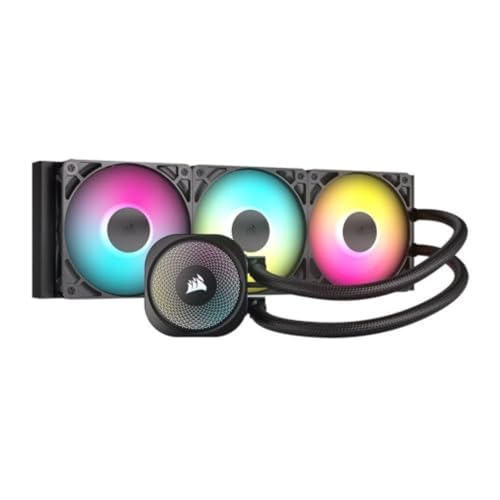

240mm AIO vs 360mm AIO at a Glance
| Attribute | 240mm AIO | 360mm AIO |
|---|---|---|
| Fan Configuration | 2 x 120mm fans | 3 x 120mm fans |
| Radiator Length | 10.87 inches (Corsair Nautilus) | 15.59 inches (Corsair Nautilus) |
| Radiator Width and Thickness | 4.72 inches x 1.06 inches | 4.72 inches x 1.06 inches |
| Maximum Fan Speed | 2100 RPM (Corsair RS120) | 2100 RPM (Corsair RS120) |
| Peak Fan Noise Level | 31.9 dB (NZXT) to 36 dB (Corsair) | 36 dB (Corsair RS120) |
| Integrated Pump Noise | 20 dBA (Corsair) | 20 dBA (Corsair) |
| Power Connection | 4-pin PWM direct motherboard header | 4-pin PWM direct motherboard header |
| Platform Compatibility | Intel LGA 1851, 1700; AMD AM5, AM4 | Intel LGA 1851, 1700; AMD AM5, AM4 |
| Warranty Coverage | 5 Years (Corsair) to 6 Years (NZXT) | 5 Years (Corsair) |
| Best For | Compact cases, mainstream gaming, clean fitment | Heavy rendering, overclocking, high-wattage CPUs |
Radiator Dimensions and Chassis Clearance
Physical size represents the most immediate functional difference between these two liquid cooling formats. When evaluating the 240mm vs 360mm radiator size, the core constraint is how the metal frame sits inside your computer case. A dual-fan unit like the CORSAIR Nautilus 240 RS ARGB features radiator dimensions of 10.87 inches long, 4.72 inches wide, and 1.06 inches thick. This compact profile allows builders to install the cooler in the top exhaust position of standard mid-towers without colliding with tall motherboard heat spreaders, oversized RAM modules, or the 8-pin EPS power cables tucked into the upper edge of the chassis.
In contrast, stepping up to a triple-fan unit like the CORSAIR Nautilus 360 RS ARGB extends the frame to a substantial 15.59 inches in length while maintaining the standard 4.72-inch width and 1.06-inch thickness. Accommodating an extra 4.72 inches of radiator length requires careful chassis planning. While many modern mid-tower frames claim 360mm support, installing one along the roof can cause interference with front panel wiring harnesses or rear exhaust fans. When front-mounted, a 360mm radiator often intrudes directly into the main chamber, limiting the maximum clearance available for lengthy modern graphics cards. Builders researching multi-fan configurations often weigh these spatial realities in a corsair icue h150i elite vs lian li galahad ii 360 overview when planning larger enclosures.
The spatial advantage of the 240mm cooler becomes undeniable in micro-ATX and small-form-factor builds. If your chassis lacks a lengthened roof cutout or dedicated side-bracket mounting rails, squeezing a 360mm unit into place is physically impossible. The 240mm form factor provides universal installation certainty, letting you change PC cases in the future without worrying about radiator bracket compatibility.
Edge: 240mm AIO, because its 10.87-inch length easily clears motherboard components and fits almost any modern mid-tower or compact chassis without restricting graphics card space.
Thermal Dissipation and Sustained Performance
Thermal headroom is where the 360mm format demonstrates its engineering strength. An all-in-one cooler relies on coolant fluid circulating across a finned aluminum array to dump thermal energy into the passing air stream. Comparing 240mm vs 360mm cooling performance comes down to radiator surface area: a 360mm cooler delivers roughly 50 percent more surface area and an extra 120mm fan compared to a 240mm cooler. This expanded area allows the larger unit to dissipate greater thermal wattage before the internal liquid coolant reaches thermal equilibrium.
Under heavy multi-threaded workloads such as video rendering, code compilation, or 3D asset generation, processors draw continuous high wattage for extended durations. In these heavy compute scenarios, the real-world 240mm vs 360mm cpu temperature difference becomes noticeable. The additional fin volume of a 360mm unit acts as a broader thermal buffer, allowing modern dynamic boost algorithms to maintain peak frequencies for longer periods. When comparing high-capacity thermal options, builders often evaluate similar cooling dynamics in the arctic liquid freezer iii 360 vs deepcool lt720 comparison to see how expansive surface areas handle massive thermal dissipation.
For standard gaming sessions, however, processor usage patterns are bursty and rarely hold every core at maximum power draw simultaneously. In typical gaming titles, a quality 240mm cooler maintains safe, stable operating temperatures well below thermal throttling thresholds. If you are deciding on a 240mm or 360mm aio for gaming, the 240mm variant provides more than enough thermal headroom for standard desktop chips, meaning the cooling advantage of a 360mm unit is primarily beneficial for extreme multi-core rendering tasks.
Edge: 360mm AIO, because its 50 percent larger surface area provides superior heat dissipation and prevents thermal throttling under prolonged high-wattage computing workloads.
Acoustics and Operating Fan Speeds
Noise management is closely tied to thermal capacity, creating an interesting contrast when comparing 360mm vs 240mm liquid cooler noise. The CORSAIR Nautilus series on both sides utilizes identical RS120 ARGB fans, which feature Magnetic Dome bearings and AirGuide technology with a rated top rotational speed of 2100 RPM and a peak acoustic output of 36 dB. At identical rotational speeds, three fans naturally generate slightly more raw sound pressure than two. However, sound production inside a working PC build is governed by the automated fan curve rather than constant maximum speeds.
Because a 360mm radiator features significantly more surface area, its three fans can spin at lower rotational speeds while moving enough air to dissipate the same amount of heat that a 240mm radiator handles. This allows builders to set relaxed, low-RPM fan curves on a 360mm unit, ensuring whisper-quiet operation during daily computing and moderate workloads. Conversely, a 240mm cooler relies on its two fans spinning faster under heavy loads to push air through its smaller fin stack, which can lead to higher audible pitch inside your case.
On the 240mm side, alternative premium designs introduce unique acoustic optimizations. The NZXT Kraken Plus 240 uses custom F120P high-static-pressure fans rated at a quiet maximum of 31.9 dB, combined with a specialized Zero RPM Mode that completely stops fan rotation during low-load tasks for dead-silent operation. Meanwhile, both Corsair sizes feature efficient low-noise pumps rated at 20 dBA, meaning pump hum remains virtually imperceptible across both form factors. Acoustic management differences are similarly analyzed in our deepcool lt720 vs msi mag coreliquid 360r v2 breakdown, highlighting how radiator size directly influences everyday system sound levels.
Edge: 360mm AIO, because its larger radiator area allows three fans to operate at lower RPMs to achieve the same cooling effect as two faster-spinning fans.
Installation, Cabling, and Build Cleanliness
Cable management and radiator mounting complexity scale directly with the number of fans installed on your cooler. Both the Nautilus 240 and 360 designs simplify system assembly by eliminating the need for standalone proprietary hardware hub controllers. Instead, both coolers utilize direct motherboard connections and daisy-chained wiring. The fans link together sequentially, requiring only a single 4-pin PWM header for speed regulation and one standard +5V ARGB header for motherboard-synchronized lighting.
Managing three daisy-chained fans across a 15.59-inch frame requires running longer cable runs along the edge of the chassis backplate. For aesthetic-focused builders, options like the CORSAIR Nautilus 360 RS ARGB White provide matching white cables and frame elements to keep visible wiring tidy inside bright enclosures. Even so, routing the extra wiring from a third 120mm fan and securing twelve separate radiator-to-chassis mounting screws demands extra patience compared to securing eight screws on a smaller dual-fan frame.
On the 240mm side, installation is exceptionally fast. With only two fans to position, aligning screw holes through the top of the chassis is effortless. Models like the Kraken Plus 240 streamline setup even further by routing pump power and data through a single breakout cable directly from the pump cap, dramatically reducing clutter around the CPU socket area. Cable routing variations across modern cooler families are detailed further in our nzxt kraken 360 vs deepcool lt720 review, reinforcing how dual-fan coolers simplify internal routing.
Edge: 240mm AIO, because handling fewer fan leads and mounting eight screws instead of twelve creates a simpler, faster cable management experience.
Socket Support and Cold Plate Integration
Compatibility with contemporary processor platforms is identical across both radiator sizes. Both the 240mm and 360mm Corsair Nautilus coolers include mounting hardware supporting Intel LGA 1851 and LGA 1700 sockets, as well as AMD AM5 and AM4 sockets. NZXT matches this broad coverage with tool-free mounting brackets that also accommodate modern platforms like LGA 1851 and AM5 straight out of the box.
Both sizes from Corsair share identical cold plate engineering, featuring an engineered convex copper contact plate paired with factory pre-applied thermal paste arranged in an optimized distribution pattern. The slightly convex curve ensures firm, uniform mechanical pressure against the central integrated heat spreader of modern desktop chips, maximizing conductive heat transfer from the silicon. Whether you are evaluating a 240mm or 360mm aio for am5 builds, mounting tension and physical cold plate surface coverage remain virtually identical. Mechanical mounting interfaces are similarly explored in the corsair icue h150i elite vs deepcool lt720 guide, which looks at socket seating across diverse cooling hardware.
Because both radiator categories utilize the same pump mechanisms, standard 12-volt operating power, and universal socket retention brackets, neither size holds an architectural advantage regarding motherboard compatibility or processor mating. The thermal performance difference between them is purely a function of external radiator area rather than how the pump blocks contact the CPU.
Edge: Tie, because both cooler sizes utilize identical mounting hardware, socket retention brackets, and convex cold plate designs for both Intel and AMD systems.
Pros and Cons
240mm AIO

Pros
- Universal chassis and compact case compatibility
- Easier top-mount clearance above motherboard heatsinks
- Lower total system weight
- Straightforward dual-fan daisy chaining
Cons
- Lower maximum heat dissipation capacity
- Fans spin faster under sustained heavy loads
View CORSAIR Nautilus 240 RS ARGB Liquid on Amazon
360mm AIO

Pros
- Fifty percent larger radiator surface area
- Superior cooling for sustained multi-threaded workloads
- Three fans move more air at lower speeds
- Lower steady-state coolant temperatures
Cons
- Demands 15.59-inch physical mounting clearance
- Restricts front drive bays and small chassis options
View CORSAIR Nautilus 360 RS ARGB Liquid on Amazon
Who Should Buy Each One
Choose the 240mm AIO If
- You are building inside a compact mid-tower, micro-ATX, or mini-ITX PC chassis with restricted roof clearance.
- You want a clean top-mounted radiator exhaust setup that avoids interference with tall memory heatsinks.
- Your primary desktop use is mainstream gaming where a 240mm cooler easily keeps temperatures well below limits.
- You prefer a faster, simpler installation with fewer cables to daisy-chain and route behind the motherboard tray.
Choose the 360mm AIO If
- You run demanding multi-threaded workloads like 4K video editing, complex 3D rendering, or sustained code compilation.
- Your PC case features dedicated front or roof 360mm mounting rails with ample graphics card clearance.
- You want to maintain whisper-quiet acoustics under medium loads by letting three fans spin at lower RPMs.
- You use a high-wattage desktop processor and want maximum thermal headroom to sustain peak boost frequencies.
Final Verdict
For the vast majority of PC builders, the 240mm AIO is the most practical, versatile choice. It delivers strong thermal dissipation for modern gaming rigs, eliminates clearance headaches above the motherboard, and fits seamlessly into almost every standard desktop enclosure. With units like the Corsair Nautilus 240 RS ARGB offering quiet 20 dBA pump operation and straightforward motherboard connectivity, a 240mm cooler provides dependable performance without demanding oversized chassis dimensions.
The 360mm AIO remains the ultimate pick for power users, content creators, and enthusiasts driving high-wattage processors under continuous multi-core loads. If you are questioning whether a 360mm cooler is worth the extra space, the 50 percent increase in fin surface area provides measurable cooling headroom and allows for quieter fan profiles under sustained operation. Provided your chassis has the required 15.59 inches of mounting clearance, a 360mm unit gives high-end desktop hardware the thermal breathing room it needs to perform at its peak.
FAQ
Is a 360mm AIO worth it over a 240mm cooler for gaming?
For standard PC gaming, a 240mm AIO is generally more than enough. Gaming workloads place bursty, moderate demands on a processor rather than locking all cores at 100 percent load for hours. A 360mm cooler will keep temperatures a few degrees lower and run slightly quieter, but a 240mm cooler easily prevents thermal throttling during gaming while fitting comfortably in a wider variety of cases.
What is the typical 240mm vs 360mm CPU temperature difference under load?
Under heavy, sustained multi-core workloads, a 360mm radiator typically keeps a high-wattage processor between 3 and 7 degrees Celsius cooler than a comparable 240mm unit. The larger radiator dissipates heat more rapidly into the room, keeping coolant temperatures lower over extended rendering or compilation tasks.
Will a 240mm AIO adequately cool modern AMD AM5 processors?
Yes. Quality 240mm liquid coolers feature convex copper cold plates and optimized thermal paste patterns specifically designed to handle the heat density of AMD AM5 processors. For daily computing, productivity, and high-frame-rate gaming, a 240mm cooler easily maintains safe boost temperatures on AM5 hardware.
Does a 360mm liquid cooler generate less noise than a 240mm cooler?
Under heavy workloads, yes. While three fans at full 2100 RPM generate more total noise than two, the 360mm radiator’s extra surface area means its fans do not need to run at full speed to dissipate heat. By using a customized fan curve, you can run three fans at lower RPMs to achieve the same cooling performance with noticeably less fan whine.
Will a 360mm radiator fit in any standard mid-tower chassis?
No. A 360mm radiator measures over 15.5 inches in total length. Many compact mid-tower cases lack the internal clearance needed for a triple-fan radiator, particularly at the top where it can collide with motherboard heatsinks or RAM. You must verify that your chassis specifications explicitly support 360mm radiator mounting before buying.
Do these liquid coolers require proprietary software controllers?
Not necessarily. The Corsair Nautilus RS ARGB series connects directly to standard 4-pin PWM and +5V ARGB headers on your motherboard, allowing full fan speed and lighting control without any proprietary hub or software. Other premium options, such as the NZXT Kraken Plus, use specialized software like NZXT CAM to drive customizable LCD screens and monitor hardware stats.


