The single difference that decides the choice between a static pressure fan and an airflow fan is how each blade geometry handles physical resistance. A static pressure fan relies on tightly spaced, broad blades engineered to push air through dense obstructions like water cooling radiators, finned heat sinks, and restrictive dust filters, whereas an airflow fan prioritizes sheer air volume across open spaces with minimal surface impedance.
Choose a static pressure fan if your setup demands focused air delivery through tight fins or restricted intake grilles to establish balanced positive vs negative case airflow. Choose an airflow fan if your goal is moving high volumes of air across open rooms, spacious equipment bays, or broad exhaust paths where air encounters zero immediate friction.


Static Pressure Fan vs Airflow Fan at a Glance
| Attribute | Static Pressure Fan | Airflow Fan |
|---|---|---|
| Primary Blade Design | Broad, tightly spaced blades with minimal tip clearance | Aerodynamic, deep-pitched blades angled for open throw |
| Air Delivery Focus | High directional pressure through restrictive obstacles | High volume circulation across wide open areas |
| Airflow Capacity | 73.47 CFM to 103 CFM | 800 CFM to 1000 CFM |
| Operating Speed | 2000 RPM to 2700 RPM | 3 to 8 speed settings (RPM not listed) |
| Acoustic Output | 30 dB to 46 dB | 25 dB to 28.2 dB |
| Bearing and Motor Type | Fluid dynamic bearing or dual ball bearing with EC or DC motor | Brushless DC motor |
| Power Requirements | 2.16W (12V DC) to 6.0W (110V to 240V AC) | 35W to 36W (120V AC corded) |
| Control Interface | 4-pin PWM or manual inline switch | Push button, remote control, or rotary dial |
| Best For | Radiators, dense heatsinks, and filtered chassis intakes | Open room circulation, living spaces, and unobstructed exhaust |
Overcoming Air Resistance and Dense Obstructions
Understanding resistance is the foundational step when evaluating an airflow fan vs static pressure fan. When an impeller rotates, the shape and pitch of its blades dictate whether the resulting column of air remains tightly focused under backpressure or disperses outward. In compact assemblies containing dense cooling fins, standard fan blades experience aerodynamic stall, causing air to reflect backward rather than penetrating the core. Static pressure designs counteract this friction by utilizing broad surfaces, aggressive pitch angles, and minimal clearance between blade tips and outer frames to drive air straight through dense obstacles.
Hardware specifications show this engineering focus clearly. The NZXT F120P utilizes seven thick blades paired with a chamfered frame to direct air into a concentrated pattern, allowing its 73.47 CFM output to penetrate tight heatsink assemblies. For industrial equipment enclosures and DIY cooling ducts, the EAKHELB 120mm EC Brushless Cooling Fan integrates pressurized blade curvature that provides an upgraded 28 percent boost in static pressure at 2700 RPM. When resolving the debate of whether to deploy a static pressure or airflow fan for radiator duties, static pressure impellers are mandatory to prevent air deflection across closely spaced cooling channels, a principle explored in depth when testing the arctic p14 vs be quiet! silent wings 4.
Airflow-centric designs operate under the opposite principle. Products engineered for broad space ventilation, like open circulators, move massive volumes of air but falter when placed flush against high-density mesh or radiator fins. Without the structural pressure head created by tight frame tolerances, their high CFM output dissipates immediately upon contacting resistance. Choosing an airflow impeller for a restricted heatsink leaves warm air trapped inside the fin stack.
Edge: Static pressure fan, because its specialized blade geometry maintains forward momentum through high-density fins and fine filters without suffering aerodynamic back-stall.
Volumetric Output and Open Air Delivery Range
While static pressure units excel against mechanical impedance, airflow fans dominate when raw volumetric displacement is required. Moving air through an open space requires aerodynamic blades designed to push a wide, continuous column of air over long distances rather than forcing air through microscopic gaps. The key measurement in open scenarios centers on total cubic feet per minute and projection distance, allowing users to refresh stagnant thermal zones rapidly.
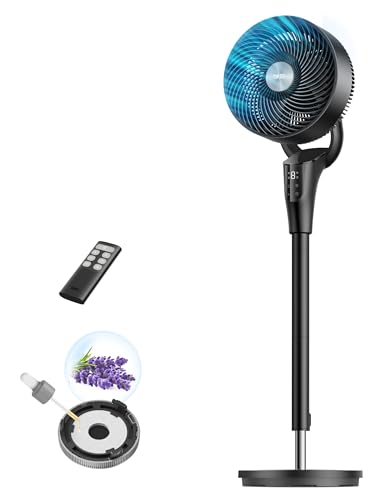
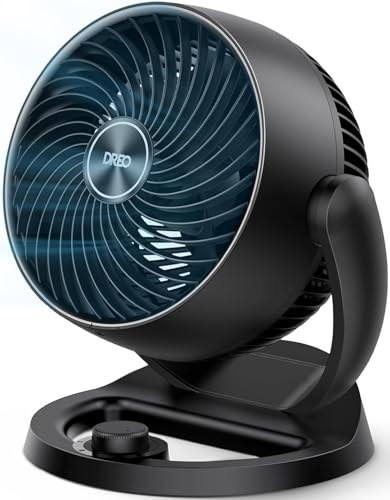
Airflow designs offer immense volume figures compared to compact pressure units. The DREO Standing Oscillating Fan delivers an impressive 1000 CFM output capable of projecting air up to 90 feet away, powered by an internal brushless DC motor. Similarly, the tabletop DREO 12-Inch Air Circulator Fan generates 800 CFM with a 70-foot projection distance using its aerodynamic WingBoost deep-pitched blade structure. When evaluating whether is an airflow fan worth it for large-scale heat displacement, the ability to exchange thousands of cubic feet of air in minutes proves unmatched by compact 120mm static pressure fans that deliver between 73.47 CFM and 103 CFM.
This massive gap in air displacement shows why volumetric flow units excel as whole-room circulators or wide-open chassis exhausts. Placing an airflow fan where no resistance impedes its path ensures rapid temperature normalization across large physical environments. Builders assessing open chassis layouts, such as those evaluated in the fractal torrent vs lian li o11 dynamic evo comparison, realize that unrestricted ventilation zones benefit far more from broad air movement than from tight, directional pressure beams.
Edge: Airflow fan, thanks to volumetric outputs reaching up to 1000 CFM and projection distances extending up to 90 feet.
Pressure Balance in Intake and Exhaust Enclosures
Thermal management inside enclosed cases depends heavily on managing positive vs negative case airflow. A positive pressure configuration occurs when intake volume exceeds exhaust volume, forcing filtered air outward through small panel seams and preventing ambient dust from seeping inside. Conversely, negative pressure happens when exhaust fans pull more air out than intakes introduce, which draws unconditioned room air through unfiltered panel gaps. Choosing the best fan for positive pressure case configurations requires matching blade geometry to the specific restrictions found on intake panels.
Intake locations almost always feature fine-mesh dust screens, perforated steel panels, or drive cages. When deciding between a static pressure or airflow fan for case intake, a static pressure unit is necessary to pull ambient air through those restrictive filters. A standard airflow fan positioned against a tight dust screen loses a significant fraction of its rated CFM due to inlet resistance. In contrast, the NZXT F120P relies on minimal blade-to-frame gaps and 2000 RPM rotation to pull fresh air cleanly through front filtration screens. Pairing this intake approach with unrestricted rear airflow exhaust creates a reliable positive vs negative case airflow fan choice, a balance seen in versatile enclosures analyzed in the fractal pop air vs nzxt h5 flow guide.
Airflow fans remain the superior choice for unrestricted exhaust ports where hot air simply needs ejection into the room without passing through filters. Using static pressure units for open top or rear exhaust grilles wastes their tight-tolerance design on areas that offer no resistance. Balancing both fan types across intake and exhaust zones yields optimal thermal equilibrium without premature component clogging.
Edge: Static pressure fan, because overcoming intake dust filters is essential to sustaining a true positive-pressure dust barrier.
Acoustic Footprint and Power Demands
Acoustic output and energy consumption are critical considerations in any cooling deployment. The sound produced by a cooling assembly stems from motor rotation, bearing friction, and turbulence created when air shears against blade edges. Comparing a static pressure fan review against an airflow fan review reveals that operating noise is directly tied to the fan motor type, rotational velocity, and mechanical load under resistance.
Static pressure fans operate at high rotational velocities to build sufficient pressure head. The EAKHELB axial fan reaches 2700 RPM to generate its pressurized airflow, producing a noticeable 46 dB acoustic rating while drawing 6.0W from an AC line. Conversely, the NZXT F120P runs at 2000 RPM on a 12V direct-current line, using a 4-pin PWM header to consume only 2.16W while keeping sound levels at 30 dB via its fluid dynamic bearing. In tight cooling enclosures, such low-noise fluid bearings maintain quiet operation, a factor often highlighted in the arctic p14 vs lian li uni fan sl120 evaluation.
Dedicated airflow circulators consume more overall electrical wattage due to their larger physical dimensions, yet they achieve remarkably low acoustic numbers in open space. The DREO standing fan draws 36W across its 8-speed range while generating a whisper-quiet 28.2 dB sound floor. The 12-inch tabletop DREO unit pulls 35W across three speeds, operating down to 25 dB through its bionic aerodynamic blade profile. However, if an airflow fan is forced to blow against a solid obstacle, blade buffeting causes noise levels to spike sharply.
Edge: Tie, because static pressure fans consume significantly lower wattage in compact electronics, while airflow units achieve quieter decibel levels in open environments.
Speed Control and Installation Flexibility
Control mechanisms dictate how effectively a user can tune cooling performance to shifting thermal loads. Automated curve management prevents hardware from spinning at maximum noise levels during light operations, while manual multi-speed switches allow steady adjustments for seasonal ventilation.
In electronic cooling and DIY equipment, pulse-width modulation provides precision speed curves. The NZXT F120P features 4-pin PWM control, enabling motherboards to dynamically modulate its 2000 RPM ceiling based directly on component temperatures. The industrial EAKHELB unit takes a different path, providing a 2-pin wiring setup with a detachable AC switch extension cord for DIY cooling projects, cabinet conversions, or refrigeration compartments. These compact units mount directly to 120mm brackets, radiator frames, and custom ventilation baffles using standard screw patterns, similar to the hardware mounting configurations seen in modern chassis like the lian li o11 dynamic evo vs nzxt h5 flow.
Airflow units offer diverse environmental adjustment features tailored to living and work areas. The DREO standing circulator features touch controls, an included remote, an 8-hour timer, 90-degree horizontal oscillation, 105-degree tilt adjustment, and an automated mode that steps up fan speed as room temperature rises. The tabletop DREO model features a 3-speed manual rotary knob, 120-degree tilt, and versatile dual mounting capabilities for tabletop or wall placement. These control systems are engineered for human comfort across rooms rather than thermal curve automation across microprocessors.
Edge: Airflow fan, offering extensive user-facing controls including remote operation, multi-axis oscillation, automated thermal sensing, and dual-mount hardware.
Pros and Cons
Static Pressure Fan

Pros
- Pushes air through dense radiators and heatsinks
- Overcomes restrictive intake dust mesh filters
- Precision dynamic motherboard PWM speed curves
- Minimal blade-to-frame clearance prevents air deflection
Cons
- Significantly lower open-air CFM volume output
- Higher decibel noise levels at peak RPM
View 120mm Fan 120x25mm EC Brushless Cooling on Amazon
Airflow Fan

Pros
- Massive air displacement reaching 1000 CFM
- Long-distance air projection up to 90 feet
- Whisper-quiet open-air operation down to 25 dB
- Remote control with multi-angle oscillation
Cons
- Stalls against dense radiator fin stacks
- Higher electrical power draw up to 36 watts
View DREO Fan Bedroom Standing Oscillating on Amazon
Who Should Buy Each One
Choose the Static Pressure Fan If:
- You need to cool water-cooling radiators or dense CPU heatsinks where air must penetrate closely spaced metal fins.
- You are mounting intake fans directly behind restrictive mesh dust filters to establish positive pressure and minimize internal dust buildup.
- You are ventilating compact electronic chassis, server racks, or custom cabinets where space constraints create elevated internal backpressure.
- You require automated 4-pin PWM speed control mapped directly to fluctuating processor temperatures.
Choose the Airflow Fan If:
- You need to circulate up to 1000 CFM of air across bedrooms, living spaces, or large workshops without facing surface resistance.
- You want broad motorized oscillation and vertical tilt adjustments to eliminate stagnant hot zones across an entire room.
- You are setting up free-flowing case exhaust ports that have zero dust filtration or finned obstructions in the immediate exhaust pathway.
- You prefer convenient remote controls, integrated sleep timers, and automated thermal wind speed regulation.
Final Verdict
The choice between these cooling solutions comes down to the presence of physical resistance along the air channel. For PC chassis, liquid cooling loops, and dense electronics enclosures, the static pressure fan is the indisputable victor. Its broad blade profile, tight frame tolerances, and targeted pressure delivery overcome the friction of radiators and intake dust screens, making it the essential design for managing internal heat dissipation and sustaining positive case airflow.
Conversely, the airflow fan reigns supreme when your cooling goal involves open-air circulation and wide-area temperature balance. When air paths are entirely free of obstruction, an airflow circulator moves vastly superior volumes of air over distances up to 90 feet with minimal noise. Assess your air channel: install static pressure fans where surfaces restrict flow, and deploy airflow fans where air can move unhindered.
FAQ
Can an airflow fan be used on a water cooling radiator?
An airflow fan can be physically mounted to a radiator if the screw spacing matches, but cooling performance will suffer significantly. In a radiator fan static pressure vs airflow scenario, the wide blade pitch and open frame design of an airflow fan allow air to stall and bounce off the dense fin stack rather than pushing through the core, resulting in elevated coolant temperatures.
What does pc fan static pressure mmh2o vs cfm mean in specifications?
Cubic feet per minute measures the total volume of air a fan moves in an uninhibited space, while millimeters of water gauge measures the static force the fan can exert against resistance. High CFM indicates rapid open-air circulation, whereas high static pressure ratings ensure air continues moving forward when blocked by filters or heatsinks.
Why is static pressure critical for positive case pressure?
Positive case pressure requires intake fans to introduce more air volume than exhaust fans remove, but intake grilles are covered with fine dust filters that create heavy airflow resistance. A static pressure fan pushes through restrictive mesh filters effectively, ensuring the chassis receives enough air volume to keep internal pressure positive.
Do static pressure fans produce more noise than airflow fans?
Static pressure fans can produce higher pitch turbulence when running at peak rotational speeds like 2000 to 2700 RPM. However, placing an airflow fan against a dense obstacle causes blade buffeting and air deflection that often generates more annoying acoustic noise than a purpose-built static pressure fan operating under the same resistance.
Where is the best position to place an airflow fan in a computer case?
The optimal position for an airflow fan is at the rear or top exhaust mount, provided there is no radiator or dense dust filter in that location. In these unrestricted exhaust positions, the fan rapidly removes rising warm air from the chassis without encountering resistance.
How do EC brushless motors compare to standard AC motors in high-pressure fans?
Electronically commutated brushless motors convert alternating current to direct current internally, providing higher energy efficiency, reduced operating heat, and greater air volume than standard shaded-pole AC motors while enabling prolonged continuous operation under high static loads.


