The core difference between the Asus TUF Gaming B650-Plus WiFi and the MSI MPG X670E Carbon comes down to the underlying AMD chipset architecture and PCIe 5.0 lane allocation. While the Asus TUF Gaming B650-Plus WiFi focuses its Gen 5 bandwidth strictly on a high-speed M.2 storage slot on the B650 platform, the MSI MPG X670E Carbon leverages the enthusiast X670 chipset to deploy PCIe 5.0 lanes across both primary graphics and M.2 storage alongside heavy-duty thermal hardware.
Builders putting together a dependable, straightforward rig for everyday gaming will get everything they require from the Asus TUF Gaming B650-Plus WiFi, whereas builders demanding extreme VRM cooling, extra SATA expansion, and complete PCIe 5.0 hardware headroom should select the MSI MPG X670E Carbon.


Asus TUF Gaming B650-Plus WiFi vs MSI MPG X670E Carbon at a Glance
| Feature | Asus TUF Gaming B650-Plus WiFi | MSI MPG X670E Carbon |
|---|---|---|
| Chipset | AMD B650 | AMD X670 |
| PCIe 5.0 Capability | PCIe 5.0 M.2 Storage Slot | PCIe 5.0 Graphics and Lightning Gen 5 M.2 |
| VRM & Power Solution | 12+2 Teamed Power Stages, ProCool Sockets | Heat-pipe, Aluminum Cover, 7W/mK Thermal Pads |
| Memory Clock Speed | 6400 MHz | 6600 MHz |
| Wireless Networking | Wi-Fi 6 | Wi-Fi 6E and Bluetooth 5.3 |
| Wired LAN | Realtek 2.5 Gb Ethernet with TUF LANGuard | 2.5 Gbps LAN |
| SATA Ports | 4 | 6 |
| High-Speed Connectivity | USB 3.2 Gen2x2 Type-C, USB4 Support | USB 3.2 Gen 2 |
| Audio Features | Two-Way AI Noise Cancelation | Optical S/PDIF Output |
| Best For | Mainstream AM5 Gaming Builds | Enthusiast Overclocking & Dual Gen 5 Builds |
PCIe 5.0 Lanes and Expansion Architecture
Motherboard expansion bandwidth dictates how many high-speed add-in cards and solid-state drives your desktop can handle concurrently without dropping lane widths. On the AM5 platform, AMD divides PCIe pathways between the central processor and the underlying motherboard chipset. The Asus TUF Gaming B650-Plus WiFi uses AMD B650 silicon, dedicating its Gen 5 signaling to an M.2 storage slot while driving the primary graphics slot at PCIe 4.0 speeds. In contrast, the MSI MPG X670E Carbon exposes dual PCIe 5.0 readiness, providing high-bandwidth Gen 5 signaling to both the primary PCIe expansion slot for upcoming graphics cards and the specialized Lightning Gen 5 x4 M.2 socket for ultra-fast solid-state drives.
When looking at the asus proart x670e-creator vs msi mpg x670e carbon ecosystem, the MPG X670E Carbon emphasizes uninterrupted high-tier throughput across its slots. For users evaluating Asus TUF B650-Plus vs MSI X670E Carbon PCIe lanes, the difference centers on long-term hardware headroom. Modern graphics cards do not fully saturate PCIe 4.0 x16 lanes today, which makes the TUF Gaming B650-Plus WiFi completely capable of handling current-generation GPUs without bottlenecks. However, users running enterprise-grade data workflows or planning multi-generational GPU upgrades benefit immediately from the widened pipe on the MPG X670E Carbon.
The secondary expansion footprint also reveals differences in total lane allocation. The B650 platform relies on a single chipset die, limiting overall high-speed connectivity across the bottom half of the board. The MSI MPG X670E Carbon utilizes two daisy-chained chipset controllers, yielding expanded bus pathways for secondary hardware. If you anticipate populating multiple high-throughput expansion cards alongside Gen 5 storage drives, the structural lane configuration of the X670 platform delivers distinct flexibility.
Edge: MSI MPG X670E Carbon provides uncompromised PCIe 5.0 lane allocation across both primary graphics and M.2 storage.
VRM Power Delivery and Thermal Cooling
Power delivery determines how cleanly and consistently electricity flows from your power supply unit into the delicate silicon of modern AMD Ryzen multi-core processors. The Asus TUF Gaming B650-Plus WiFi integrates a 12+2 teamed power stage layout supported by 8+4 pin ProCool power connectors, alloy chokes, and durable capacitors. Cooling this circuitry are enlarged VRM heatsinks alongside hybrid fan headers managed through the Fan Xpert 2 plus utility inside Armoury Crate. This layout easily supplies steady voltages for demanding tasks, bolstering real-world Asus TUF B650-Plus WiFi AM5 performance across gaming sessions and creative workloads.
The MSI MPG X670E Carbon takes power cooling engineering even further to support continuous heavy workloads and processor tuning. MSI MPG X670E Carbon VRM cooling incorporates a heavy aluminum cover, an integrated heat-pipe linking the heatsinks, and MOSFET thermal pads rated for 7W/mK efficiency, alongside additional choke thermal pads. This physical thermal mass extracts heat away from the power stages rapidly, preventing thermal throttling even when the processor draws heavy sustained current. To manage high-speed drive temperatures, MSI integrates M.2 Shield Frozr heatsinks over the storage bays.
When running intensive sustained multi-threaded rendering or long compute sessions, thermal headroom plays a crucial role in maintaining peak boost clocks. As evaluated in our gigabyte b650 aorus elite ax vs msi mpg x670e carbon breakdown, dedicated heat-pipes and high-efficiency pads make a measurable difference in enclosure ambient temperatures. While the TUF Gaming B650-Plus WiFi remains completely safe and stable for standard desktop use, the MPG X670E Carbon provides superior thermal mitigation for extreme environments.
Edge: MSI MPG X670E Carbon delivers lower power delivery temperatures through its interconnected heat-pipe and 7W/mK rated thermal pads.
Memory Speed and DDR5 Overclocking
System memory frequency and latency directly influence frame timing in CPU-bound games and data throughput during heavy file manipulation. The Asus TUF Gaming B650-Plus WiFi features four dual-channel DDR5 DIMM slots supporting memory clock speeds up to 6400 MHz and a maximum system capacity of 128 GB. This memory range matches the sweet spot for AMD Ryzen 7000 and 8000 series memory controllers, allowing builders to run high-speed kits reliably using automated tuning profiles without requiring complex manual timing adjustments.
MSI equips the MPG X670E Carbon with an optimized trace topology that lists DDR5-5600+ (OC) support alongside a peak memory clock speed specification of 6600 MHz. Pushing higher MSI MPG X670E Carbon DDR5 speed figures offers an advantage for competitive benchmarkers and overclocking enthusiasts hunting for memory bandwidth gains. Similar to the layout explored in our msi mag b650 tomahawk wifi vs asus tuf gaming b650-plus wifi comparison, both motherboards offer four physical DIMM slots to accept dense multi-module kits up to 128 GB total system RAM.
For most desktop gamers, pushing memory past 6000 MHz to 6400 MHz yields diminishing returns due to the internal clock dividers on AM5 processors. The Asus TUF Gaming B650-Plus WiFi delivers the exact memory frequencies required to extract full performance from modern gaming CPUs. However, if your hobby involves testing the limits of memory overclocking and squeezing maximum frequency out of enthusiast-grade DDR5 modules, the MPG X670E Carbon holds a slight frequency edge on paper.
Edge: MSI MPG X670E Carbon holds a minor advantage with its 6600 MHz memory clock speed specification.
Storage Capacity and High-Speed USB Connectivity
Internal storage options and high-speed external peripheral ports determine how well a motherboard adapts to expanding collections of games, assets, and backup drives. The Asus TUF Gaming B650-Plus WiFi provides four SATA 6Gb/s ports for traditional hard drives and 2.5-inch SSDs. On the external I/O panel and headers, Asus includes a lightning-fast USB 3.2 Gen2x2 Type-C connection, front-panel USB 3.2 Gen 1 Type-C support, USB4 support for high-bandwidth expansion cards, two legacy USB 2.0 ports, and a comprehensive layout reaching 20 total ports across internal and external interfaces.
The MSI MPG X670E Carbon prioritizes internal mass storage capacity by offering six total SATA ports, providing two additional drive connections over the Asus board. This makes the MSI platform appealing for users carrying over large arrays of SATA drives from an older system. On the external interface side, the MSI MPG X670E Carbon listing highlights USB 3.2 Gen 2 connectivity, one USB 2.0 connection, and seven external ports, alongside an optical S/PDIF output for digital audio receivers.
While the MSI board wins on raw SATA drive counts, the Asus TUF Gaming B650-Plus WiFi excels in modern external bus connectivity. The inclusion of native USB 3.2 Gen2x2 Type-C alongside forward-looking USB4 support gives the TUF motherboard versatile external transfer speeds for portable solid-state drives and modern capture cards. Builders who rely heavily on fast external storage devices will find the Asus configuration more functional out of the box.
Edge: Asus TUF Gaming B650-Plus WiFi due to its USB 3.2 Gen2x2 Type-C connectivity and native USB4 support.
Networking Standards and Online Gaming Features
Smooth online gaming and fast file transfers depend heavily on stable wired and wireless networking controllers. The Asus TUF Gaming B650-Plus WiFi comes equipped with Wi-Fi 6 wireless networking, Realtek 2.5 Gb Ethernet, and TUF LANGuard surge protection. Asus also integrates its proprietary Two-Way AI Noise Cancelation technology, which uses deep learning algorithms to eliminate background noise from both the user microphone and incoming team audio channels, delivering crystal-clear communications during competitive gaming.
The MSI MPG X670E Carbon elevates wireless connectivity by incorporating modern Wi-Fi 6E hardware and integrated Bluetooth 5.3 alongside its 2.5 Gbps LAN port. Wi-Fi 6E introduces access to the dedicated 6 GHz wireless frequency band, which sidesteps congested 2.4 GHz and 5 GHz bands in crowded residential areas. If you connect your gaming PC via wireless networking to an upgraded Wi-Fi 6E router, the MPG X670E Carbon provides lower signal interference and cleaner wireless latencies.
When deciding between the Asus TUF Gaming B650-Plus WiFi or MSI MPG X670E Carbon for gaming, networking habits matter. Players using dedicated wired Ethernet will find comparable 2.5 Gbps speeds on both motherboards, with the Asus board offering useful Two-Way AI Noise Cancelation for Discord calls. However, for wireless setups and modern peripheral pairings, the Wi-Fi 6E and Bluetooth 5.3 combination on the MSI MPG X670E Carbon offers superior networking hardware.
Edge: MSI MPG X670E Carbon thanks to upgraded Wi-Fi 6E frequency access and Bluetooth 5.3 integration.
Aesthetic Design and Customization Options
Component styling and lighting ecosystems allow PC builders to match their motherboard hardware with their case aesthetics. The Asus TUF Gaming B650-Plus WiFi features a military-inspired industrial design finished in dark tones with subtle geometric patterns. It includes Aura Sync RGB edge lighting along with addressable RGB headers and an RGB strip header, giving users full synchronization across compatible system fans, coolers, and memory modules via the Asus Armoury Crate software.
The MSI MPG X670E Carbon offers a more aggressive gaming appearance centered around its dark aluminum heatsinks and integrated Mystic Light technology. MSI integrates 16.8 million colors across 29 selectable lighting effects accessible with one click. Furthermore, the MPG series features a distinct front LED strip capable of showing real-time in-game notifications, while Mystic Light Extension headers support both traditional RGB and Rainbow addressable LED strips for extensive interior illumination.
Builders reviewing aesthetic options, as noted in our msi pro b650-p wifi vs asus tuf gaming b650-plus wifi analysis, often choose between understated utilitarian styling and expressive lighting. The TUF Gaming B650-Plus WiFi is ideal for clean, stealthy builds with minimal distraction. The MPG X670E Carbon caters directly to gamers who want their interior hardware to become a visual centerpiece with dynamic lighting patterns and onboard notification lighting.
Edge: MSI MPG X670E Carbon due to its extensive 29-effect Mystic Light engine and front notification LED strip.
Pros and Cons
Asus TUF Gaming B650-Plus WiFi

Pros
- Integrated USB4 support
- Fast USB 3.2 Gen2x2 Type-C connectivity
- Two-Way AI Noise Cancelation
- PCIe 5.0 M.2 storage slot
Cons
- Limited to Wi-Fi 6 without 6 GHz band
- Lacks PCIe 5.0 graphics slot
- Only four SATA ports
View Asus TUF Gaming B650-Plus WiFi on Amazon
MSI MPG X670E Carbon
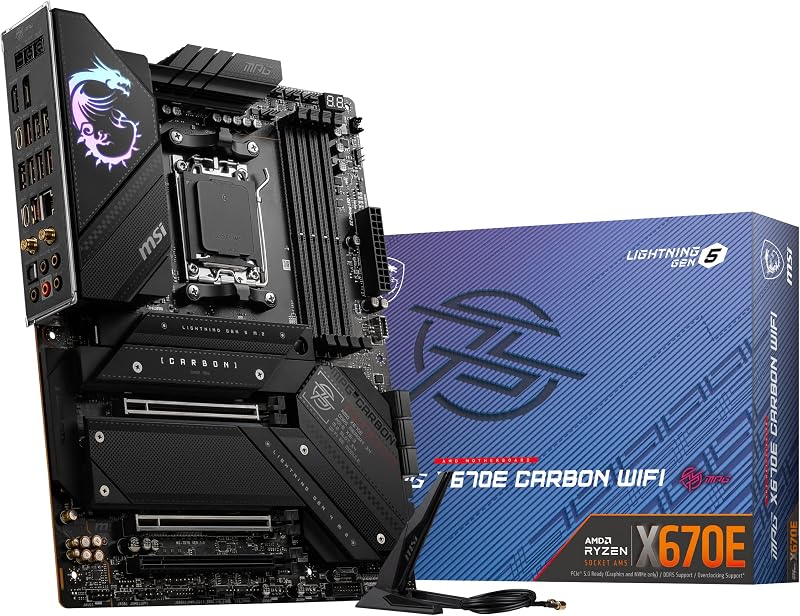
Pros
- Dual PCIe 5.0 graphics and M.2 support
- VRM heat-pipe with 7W/mK thermal pads
- Updated Wi-Fi 6E with Bluetooth 5.3
- Six SATA 6Gb/s ports
Cons
- Lacks front USB 3.2 Gen2x2 port
- Only seven total external ports listed
- Higher hardware complexity for budget builds
View MSI MPG X670E Carbon on Amazon
Who Should Buy Each One
Choose the Asus TUF Gaming B650-Plus WiFi If
- You want a reliable, no-nonsense AM5 platform for modern gaming processors without paying for unused PCIe 5.0 graphics lanes.
- You require fast external device connectivity including USB 3.2 Gen2x2 Type-C and forward-compatible USB4 support.
- You play team games frequently and can benefit from hardware-accelerated Two-Way AI Noise Cancelation on voice channels.
- You plan to use a standard wired 2.5 Gb Ethernet setup or existing Wi-Fi 6 home router.
Choose the MSI MPG X670E Carbon If
- You plan to install both a PCIe 5.0 graphics card and a Lightning Gen 5 M.2 SSD for maximum bandwidth.
- You demand heavy-duty thermal hardware featuring integrated VRM heat-pipes and 7W/mK MOSFET thermal pads.
- You connect over the air using a modern 6 GHz wireless router and need integrated Wi-Fi 6E and Bluetooth 5.3.
- You need six onboard SATA ports to house large multi-drive internal storage configurations.
Final Verdict
For the vast majority of PC builders assembling a modern AMD desktop, the Asus TUF Gaming B650-Plus WiFi represents the most practical foundation. As detailed in any comprehensive Asus TUF Gaming B650-Plus WiFi review, this board delivers robust 12+2 teamed power stages, high-speed DDR5 memory handling up to 6400 MHz, a Gen 5 M.2 NVMe slot for rapid game loading, and superior peripheral connectivity through USB 3.2 Gen2x2 and USB4 support. It gives competitive gamers and home builders rock-solid stability without unnecessary hardware overhead.
On the other hand, is MSI MPG X670E Carbon worth it for enthusiast builders? If your build plan demands full PCIe 5.0 readiness on both GPU and storage slots, advanced VRM cooling for sustained high-amperage compute tasks, Wi-Fi 6E wireless networking, and six SATA drive bays, the MSI board stands tall. Reading an enthusiast MSI MPG X670E Carbon review confirms that its interconnected heat-pipe cooling and expanded X670 lane distribution make it the superior pick for extreme multi-lane setups and high-end workstation rigs.
FAQ
Does the Asus TUF Gaming B650-Plus WiFi support PCIe 5.0 graphics cards?
No, the Asus TUF Gaming B650-Plus WiFi features PCIe 5.0 support exclusively on its primary M.2 solid-state drive slot, while the primary graphics card slot operates at PCIe 4.0 speeds. In contrast, the MSI MPG X670E Carbon features PCIe 5.0 lane bandwidth on both its primary graphics slot and its Lightning Gen 5 M.2 slot.
What processors are compatible with these two motherboards?
Both motherboards utilize the AMD AM5 processor socket. The Asus TUF Gaming B650-Plus WiFi supports AMD Ryzen 7000, 8000, and 9000 series desktop processors according to its listing. The MSI MPG X670E Carbon listing explicitly confirms support for AMD Ryzen 7000, 8000, and 9000 series processors as well.
How does VRM cooling compare on the Asus TUF B650-Plus vs MSI X670E Carbon?
The Asus TUF Gaming B650-Plus WiFi utilizes enlarged standalone VRM and PCH heatsinks over a 12+2 teamed power stage layout. The MSI MPG X670E Carbon features a more advanced cooling system with an aluminum I/O cover, an integrated heat-pipe connecting dual heatsinks, and high-efficiency MOSFET thermal pads rated for 7W/mK.
Which board offers more internal SATA connections for storage?
The MSI MPG X670E Carbon offers more internal storage connections with six SATA 6Gb/s ports. The Asus TUF Gaming B650-Plus WiFi provides four SATA ports, which is sufficient for standard builds but more restrictive if you run multiple legacy hard drives.
What is the difference in wireless standards between the two boards?
The Asus TUF Gaming B650-Plus WiFi includes standard Wi-Fi 6 connectivity, operating on the 2.4 GHz and 5 GHz frequency bands. The MSI MPG X670E Carbon upgrades to Wi-Fi 6E, granting access to the less-congested 6 GHz wireless band, and includes Bluetooth 5.3 for pairing modern wireless peripherals.
Does the MSI MPG X670E Carbon feature USB4 support?
The MSI MPG X670E Carbon listing highlights USB 3.2 Gen 2 connectivity but does not list USB4 support. The Asus TUF Gaming B650-Plus WiFi explicitly lists USB4 support alongside a high-bandwidth USB 3.2 Gen2x2 Type-C interface on its specs sheet.
How do the memory clock speed specifications differ between these boards?
The Asus TUF Gaming B650-Plus specs list a maximum memory clock speed of 6400 MHz across its four DDR5 DIMM slots. The MSI MPG X670E Carbon listing specifies DDR5-5600+ (OC) and a maximum memory clock speed rating of 6600 MHz.
Which motherboard is better suited for a standard gaming build?
The Asus TUF Gaming B650-Plus WiFi is better tailored for standard gaming builds. It delivers the necessary Gen 5 M.2 speed for storage, reliable power delivery, 2.5 Gb Ethernet, and Two-Way AI Noise Cancelation without adding the hardware complexity of dual PCIe 5.0 lanes that current gaming graphics cards do not require.


