The single difference that decides the choice between these two power supplies is whether your system requires modern ATX 3.0 power delivery with a dedicated 12VHPWR connector. The Seasonic Vertex GX-1000 delivers 1000 watts of continuous output alongside native PCIe 5.0 connectivity designed specifically for the power demands of modern graphics cards, while the EVGA 850 G5 offers an 850-watt foundation built on traditional ATX cabling for standard desktop configurations.
Builders assembling high-draw systems with current-generation graphics cards should select the Vertex GX-1000 for its native high-wattage cabling and extra overhead, whereas builders working with standard multi-rail hardware or previous-generation cards will find everything they need in the 850 G5.
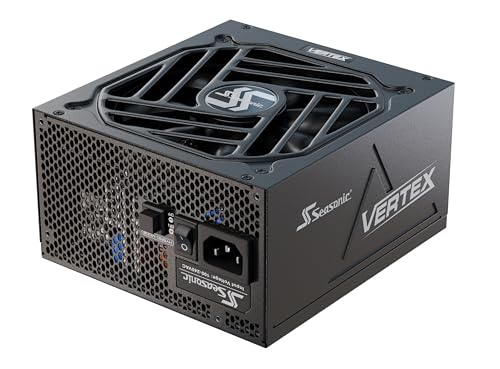

Seasonic Vertex GX-1000 vs EVGA 850 G5 at a Glance
| Feature | Seasonic Vertex GX-1000 | EVGA 850 G5 |
|---|---|---|
| Continuous Wattage | 1000 Watts | 850 Watts |
| Efficiency Certification | 80 PLUS Gold | 80 PLUS Gold (Up to 91% typical) |
| ATX Standard Compliance | ATX 3.0 and PCIe 5.0 Ready | Standard ATX (The listing does not specify ATX 3.0) |
| 12VHPWR 16-Pin Connector | Yes (Gen 5 16-Pin included) | No (The listing does not specify 16-pin) |
| Modular Cabling | Fully Modular | Fully Modular |
| Cooling Fan Size | 135mm Fluid Dynamic Bearing | Fluid Dynamic Bearing (Compact 150mm size chassis) |
| Semi-Passive Cooling Mode | Seasonic Hybrid Silent Fan Control | EVGA ECO Mode |
| Internal Capacitors | Japanese 105 °C Aluminum Electrolytic | 100% Japanese Capacitors |
| Voltage Regulation Topology | DC to DC Converter (± 3% tight regulation) | Active Clamp plus DC to DC |
| Manufacturer Warranty | 10 to 12 Years (Listing specifies 12 year title, 10 year description) | 10 Year Limited |
| Best For | Modern high-wattage rigs with PCIe 5.0 GPUs | Standard high-end gaming and desktop workstations |
Power Output and Sustained Load Capacity
Power output defines what tier of computer hardware a power supply can safely sustain during peak workloads. Modern graphics processors and high-core desktop CPUs produce extreme power draw spikes that push older units into protection shutdowns. Evaluating the EVGA 850 G5 wattage shows an 850-watt ceiling, which handles high-end components comfortably as long as they stay within traditional power envelopes. However, demanding modern hardware paired with high-performance multicore processors can consume the bulk of that 850-watt threshold under simultaneous synthetic loads or heavy rendering sessions.
The Vertex GX-1000 supplies a full 1000 watts of continuous delivery, creating an extra 150 watts of clean electrical headroom. This additional headroom keeps operating temperatures lower because the internal components operate further away from their thermal thresholds during demanding tasks. Comparing high-capacity platforms in guides such as the corsair rm1000x vs seasonic vertex gx-1000 breakdown highlights how 1000-watt units provide crucial stability for component spikes. When deciding between the Seasonic Vertex GX-1000 or EVGA 850 G5 for gaming, that 150-watt differential allows users to pair flagship components without balancing wattage margins.
The 850 G5 provides strong, clean power for standard builds, but the Vertex GX-1000 provides substantially greater electrical headroom that guarantees safety when running top-tier hardware combinations.
Edge: Seasonic Vertex GX-1000 provides 150 additional watts of continuous headroom for demanding components.
ATX 3.0 Compliance and PCIe 5.0 Connectivity
Power supply specifications have shifted dramatically to match the power profiles of modern graphics cards. The introduction of high-wattage graphics architectures introduced rapid millisecond power excursions that standard power supplies were never engineered to absorb. The Seasonic Vertex GX-1000 ATX 3.0 specification includes strict transient response targets, guaranteeing that the power supply can withstand rapid power spikes without tripping internal over-current or over-power protections. Furthermore, it incorporates a dedicated 16-pin 12VHPWR Gen 5 cable capable of routing clean power directly to modern GPUs through a single interface.
By contrast, the 850 G5 was developed around established ATX power delivery architecture. The product data for the EVGA unit does not list ATX 3.0 certification or native 12VHPWR cabling. Running a modern PCIe 5.0 graphics card on the 850 G5 requires using multi-plug adapter splitters that bundle several standard 8-pin PCIe cables into a single receiver. While functional, adapter harnesses introduce clutter to the front chamber of your PC chassis, increase internal resistance at connection points, and complicate cable routing in tight spaces.
Having a native Seasonic Vertex GX-1000 12VHPWR interface eliminates adapter clutter entirely and aligns with the power delivery guidelines set by modern GPU manufacturers, as seen in evaluations like the seasonic vertex gx-1000 vs msi mpg a850g comparison. The EVGA platform remains tied to older cable layouts that require add-on adapters for new card designs.
Edge: Seasonic Vertex GX-1000 features native ATX 3.0 compliance and a dedicated 12VHPWR cable.
Acoustic Performance and Thermal Fan Profiles
Noise control within a desktop chassis relies heavily on internal cooling components and the logic governing fan activation. The Seasonic Vertex GX-1000 noise level is regulated by an integrated 135mm Fluid Dynamic Bearing (FDB) fan coupled with Seasonic Hybrid Silent Fan Control. This system offers three operational states: Fanless Mode for silent zero-RPM computing under minimal loads, Silent Mode for quiet rotation under normal everyday tasks, and Cooling Mode for maximum airflow during intense sessions. The larger 135mm diameter moves substantial air volume at lower rotational speeds, suppressing high-frequency mechanical hum.
EVGA counters this with their own Fluid Dynamic Bearing fan and a dedicated EVGA ECO Mode toggle on the 850 G5. When ECO Mode is engaged, the 850 G5 holds its fan stationary until the unit crosses an internal thermal threshold, ensuring silent operation during basic web browsing or media streaming. However, because the 850 G5 operates within a compact 150mm chassis shell, heat dissipation under sustained loads requires the fan to spin more aggressively compared to platforms with larger internal thermal volumes, such as those evaluated in the seasonic vertex gx-1000 vs be quiet! pure power 12 m 850w analysis.
While both units offer silent zero-RPM states at idle, the larger 135mm fan profile on the Vertex GX-1000 maintains a more gradual, subdued acoustic curve when high gaming workloads engage the cooling system.
Edge: Seasonic Vertex GX-1000 thanks to its larger 135mm FDB fan and three-stage hybrid control profile.
Internal Electrical Topology and Voltage Stability
Clean electrical conversion prevents micro-stuttering, system lockups, and premature degradation of delicate semiconductor silicon. In this Seasonic Vertex GX-1000 review examination of internal architecture, the platform utilizes high-grade Japanese 105 °C aluminum electrolytic capacitors paired with a DC-to-DC converter design. Seasonic rates this unit for tight voltage regulation of ± 3 % across the critical 12V, 5V, and 3.3V rails. It also incorporates a cable-free internal connection design and gold-plated high-current terminals across the motherboard, CPU, and PCIe connections to reduce line resistance and maximize conductivity.
An EVGA 850 G5 review reveals a similarly capable core design built around an active clamp plus DC-to-DC converter topology to stabilize the 3.3V and 5V lines. EVGA specifies 100% Japanese capacitors throughout the unit to maintain filtering integrity over years of thermal cycling, alongside 80 PLUS Gold efficiency that achieves 91% or higher under typical loads. The active clamp design acts as a dependable platform for standard gaming demands, providing solid efficiency that keeps internal heat production in check.
Both manufacturers utilize top-grade Japanese capacitors to extend the operating lifespan of their hardware, as echoed in our corsair rm850x vs seasonic vertex gx-1000 architecture overview. Nevertheless, the Vertex GX-1000 pulls ahead with its explicit ± 3 % voltage regulation standard, gold-plated high-current terminals, and cable-free internal assembly.
Edge: Seasonic Vertex GX-1000 due to tighter stated voltage regulation and gold-plated terminal connections.
Form Factor, Dimensions, and Cable Management
Chassis fitment and cable routing determine how straightforward an installation will be inside mid-tower or compact PC enclosures. The 850 G5 is highlighted by EVGA for its compact 150mm chassis length, with physical listing dimensions measuring 5.9 x 5.9 x 3.4 inches and an overall weight of 7 pounds. This compact profile leaves extensive room inside standard ATX chassis basements, giving builders ample space to bundle excess cabling or preserve lower drive cages without obstructing airflow.
The Vertex GX-1000 listing records dimensions of 4.53 x 2.69 x 1.59 inches with an item weight of 4.3 pounds. Both units offer full modularity, meaning builders only connect the specific wiring runs their motherboard, storage drives, and expansion cards require. Full modularity cleans up the main compartment, eliminates unused wiring bundles, and improves intake airflow across the chassis floor.
Deciding whether the EVGA 850 G5 vs Seasonic Vertex GX-1000 fits your layout comes down to chassis geometry. If you have explored compact form-factor comparisons like the corsair sf750 vs seasonic vertex gx-1000 guide, you know that physical clearances matter. Both units deliver full modular cabling that simplifies building, making this category evenly balanced.
Edge: Tie. Both power supplies feature full modularity for clean cable management inside desktop cases.
Pros and Cons
Seasonic Vertex GX-1000
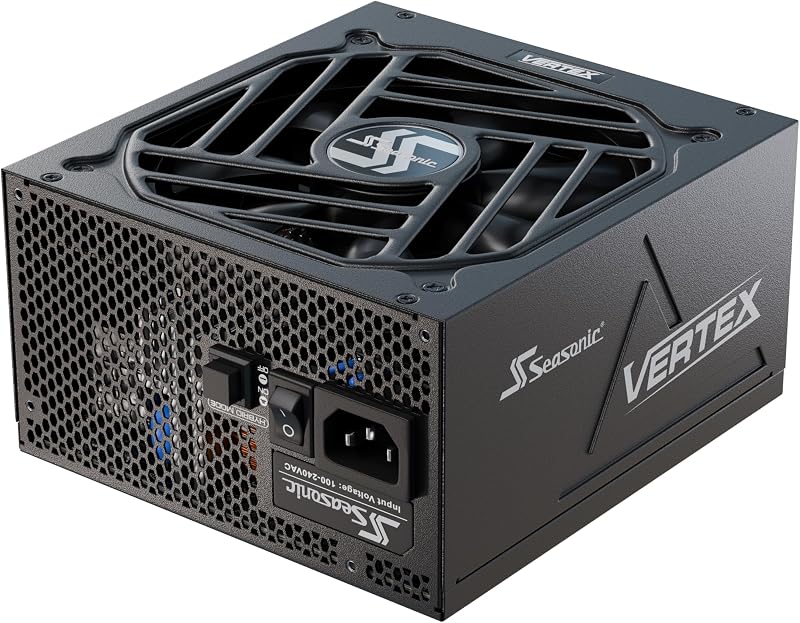
Pros
- 1000W continuous output headroom
- Native ATX 3.0 and PCIe 5.0 ready
- Includes 16-pin 12VHPWR cable
- Large 135mm FDB hybrid fan
- Tight ± 3% voltage regulation
Cons
- Listing shows contradictory 10 and 12-year warranty terms
- Unnecessary wattage for basic low-draw rigs
View Seasonic Vertex GX-1000 on Amazon
EVGA 850 G5

Pros
- Up to 91% typical Gold efficiency
- Compact 150mm chassis length
- 100% Japanese capacitors
- ECO Mode zero-RPM operation
- 10-year limited warranty
Cons
- Lacks native ATX 3.0 12VHPWR cable
- Lower 850W ceiling for flagship GPUs
- Heavier 7-pound unit weight
Who Should Buy Each One
Choose the Seasonic Vertex GX-1000 If
- You are running a modern high-end graphics card that relies on a native 16-pin 12VHPWR connection.
- You need 1000 watts of continuous power to comfortably run power-hungry multi-component gaming or creator builds.
- You want ATX 3.0 certification to protect against severe millisecond power excursions during peak loads.
- You prefer a cooling configuration with a large 135mm fan featuring three selectable operational modes.
Choose the EVGA 850 G5 If
- Your system hardware tops out within a standard 850-watt power envelope using conventional 8-pin PCIe cables.
- You want a compact 150mm chassis depth that preserves room for drive cages and cable storage inside mid-tower cases.
- You already own standard multi-rail hardware that does not require 12VHPWR adapters or PCIe 5.0 cables.
- You prioritize active clamp DC-to-DC conversion backed by 100% Japanese capacitors for traditional computing builds.
Final Verdict
For modern performance PC builders, the Seasonic Vertex GX-1000 is the clear overall choice. Its native ATX 3.0 compliance, integrated 12VHPWR connector, 1000-watt continuous output, and 135mm hybrid cooling fan resolve every power delivery requirement modern hardware demands. By removing the need for messy GPU adapter cables and providing sufficient wattage headroom for sudden power spikes, it provides long-term reliability and build safety for any top-tier gaming or workstation configuration.
The EVGA 850 G5 remains a dependable option for traditional systems where modern ATX 3.0 power delivery is unnecessary. If your graphics card uses standard 8-pin power connectors and your hardware does not exceed an 850-watt envelope, the 850 G5 delivers clean 80 PLUS Gold efficiency, fully modular convenience, and an established active clamp architecture. For next-generation builds, however, the Vertex GX-1000 stands far ahead.
FAQ
Does the EVGA 850 G5 include a native 12VHPWR cable?
No, the product listing for the EVGA 850 G5 does not include a native 12VHPWR cable. Connecting a graphics card that uses the 16-pin standard requires using standard PCIe 8-pin cables paired with an external adapter supplied by your graphics card manufacturer.
Can the Seasonic Vertex GX-1000 run silently under light loads?
Yes, the Seasonic Vertex GX-1000 includes Seasonic Hybrid Silent Fan Control. This feature includes a Fanless Mode that keeps the 135mm fluid dynamic bearing fan completely stopped during low load conditions, providing silent operation during everyday desktop tasks.
Is EVGA 850 G5 worth it for next-generation graphics cards?
When considering if is EVGA 850 G5 worth it for next-generation hardware, it depends on your specific GPU. High-end cards with extreme transient spikes and 16-pin connectors benefit significantly from native ATX 3.0 units, making the 850 G5 better suited for standard midrange or older GPUs.
What type of internal capacitors are used in the Seasonic Vertex GX-1000?
The Seasonic Vertex GX-1000 uses Japanese 105 °C aluminum electrolytic capacitors. These components are selected for their thermal resilience, electrical stability, and long operational lifespan under sustained high-wattage conditions.
What efficiency rating does the EVGA 850 G5 carry?
The EVGA 850 G5 carries an official 80 PLUS Gold certification. According to its listing specifications, it delivers up to 91% electrical efficiency or higher under typical operating loads, minimizing wasted heat inside your chassis.
How do the warranties on these two power supplies compare?
The EVGA 850 G5 includes a 10-year limited warranty from the manufacturer. The Seasonic Vertex GX-1000 product listing references a 12-year warranty in its product title and a 10-year warranty within its feature description, offering long-term protection on par with or exceeding the EVGA unit.