The core difference that determines whether to purchase the Corsair SF750 or the be quiet! Pure Power 12 M 850W is their physical form factor paired with power capacity. The Corsair unit is an ultra-compact SFX power supply offering 750 watts of 80 PLUS Platinum efficiency, whereas the be quiet! unit is a full-sized ATX power supply providing 850 watts of 80 PLUS Gold output.
Choose the Corsair SF750 if you are assembling a compact mini-ITX enclosure where clearance is strictly limited and Platinum-grade electrical efficiency is required. Choose the be quiet! Pure Power 12 M 850W if you are building in a standard mid-tower or full-tower chassis that accommodates full ATX supplies and demands an additional 100 watts of overhead for graphics hardware.


Corsair SF750 vs be quiet! Pure Power 12 M 850W at a Glance
| Feature | Corsair SF750 | be quiet! Pure Power 12 M 850W |
|---|---|---|
| Form Factor | SFX (with SFX-to-ATX bracket included) | ATX |
| Continuous Wattage | 750W | 850W |
| Efficiency Certification | 80 PLUS Platinum | 80 PLUS Gold (up to 93.2%) |
| ATX Standard Compliance | ATX 3.1 & PCIe 5.1 ready | ATX 3.1 & PCIe 5.1 ready |
| Cooling Fan Size | 92mm PWM fluid dynamic bearing | 120mm be quiet! temperature-controlled |
| Zero RPM Fan Mode | Yes | Not listed |
| 12V Rail Architecture | Not listed | 2 independent 12V rails |
| Internal Capacitors | 105°C rated Japanese capacitors | LLC topology (capacitor source not listed) |
| Modular Cable Standard | Type-5 Micro-Fit flexible cables | Standard modular flat/sleeved cables |
| Warranty | 7 years | Not listed |
| Best For | Small-form-factor and mini-ITX builds | Standard ATX towers requiring high wattage headroom |
Form Factor and Case Compatibility
The physical casing dimension represents the sharpest functional contrast between these two power supplies. The Corsair SF750 is engineered around the SFX standard, measuring substantially smaller than desktop power hardware. Small-form-factor (SFF) cases often have strict volumetric limits where an ATX unit physically cannot fit alongside graphics cards and liquid cooling radiators. Corsair packages this unit with an SFX-to-ATX adapter bracket, which allows the small casing to install inside traditional ATX chassis mounting holes if you change cases later. For builders researching a dedicated corsair rm1000x vs sf750 alternative, the SFX chassis offers singular space advantages.
The be quiet! Pure Power 12 M 850W uses standard ATX measurements designed for mainstream PC cases. Its chassis requires typical ATX mounting depth, clearance for intake airflow, and adequate clearance ahead of the modular cable interface. While an ATX chassis provides broad compatibility across mid-tower and full-tower frames, it completely locks the unit out of sub-20-liter compact enclosures. When considering a Corsair SF750 or be quiet! Pure Power 12 M for SFF build designs, the be quiet! unit simply will not install in chassis that strictly require SFX or SFX-L power bricks.
Selecting between the two comes down to volume versus installation convenience. Installing the SF750 into a large chassis leaves broad empty pockets of space around the shroud, which can make routing longer cable runs challenging despite the included bracket. Conversely, the Pure Power 12 M fills conventional PSU compartments neatly, providing standard clearances for standard computer configurations.
Edge: Corsair SF750. Its miniature SFX dimensions enable installation inside space-restricted mini-ITX builds while remaining mountable in standard cases via its included bracket.
Wattage Capacity and Rail Design
Wattage allocation determines how aggressively you can equip your computer with high-draw components. The Pure Power 12 M supplies 850 watts of continuous delivery, giving it an extra 100 watts of ceiling compared to the 750-watt output of the SF750. In systems pairing unlocked desktop processors with flagship graphics cards, that 100-watt delta provides extra thermal stability and prevents unexpected shutdowns during combined production workflows or intense gaming sessions. When looking at modern systems, shoppers often ask is be quiet! Pure Power 12 M 850W worth it for the added margin, especially when compared across options like the seasonic focus gx-750 vs be quiet! pure power 12 m 850w.
Beyond total continuous wattage, power delivery architecture separates these units. The Pure Power 12 M employs two independent 12V rails designed to absorb massive excursions. According to be quiet!, the unit easily handles brief power excursions up to double its rated capacity, balancing the instantaneous draw that modern PCIe 5.1 GPUs exhibit. This dual-rail design separates major load vectors, safeguarding system operation during heavy processing spikes.
The Corsair SF750 counterbalances with robust 750-watt delivery certified for ATX 3.1 transient resistance. Corsair specifies that the unit resists high transient power spikes while maintaining stable continuous wattage through high-grade internal components. However, 750 watts remains a firmer ceiling than 850 watts. If your configuration includes extensive drive arrays, overclocked chips, and top-tier graphics cards, the additional 100 watts from be quiet! delivers tangible headroom.
Edge: be quiet! Pure Power 12 M 850W. The 850-watt rating delivers 100 watts of higher continuous ceiling alongside two independent 12V rails that handle excursions up to twice rated power.
Energy Efficiency and Internal Components
Efficiency measures how effectively a power supply converts wall alternating current into computer direct current without excessive heat generation. Comparing Corsair SF750 vs Pure Power 12 M efficiency reveals two distinct certification tiers. The Corsair SF750 holds an 80 PLUS Platinum certification, signifying minimal wasted heat at typical operation loads. To achieve this in an ultra-dense SFX footprint, Corsair equips the SF750 exclusively with 105°C rated Japanese capacitors, known for steadfast reliability, ripple suppression, and thermal endurance under confined conditions.
The be quiet! Pure Power 12 M 850W is certified 80 PLUS Gold, hitting efficiency levels reaching up to 93.2%. While Gold efficiency provides notable operational economy, it sits one tier below Platinum standards. To optimize voltage control, be quiet! builds the unit with an LLC topology, ensuring clean voltage regulation under varying electrical loads. Similar topology benefits are seen when comparing the be quiet! pure power 12 m 850w vs msi mpg a850g.
Under heavy workloads, the higher efficiency of the SF750 generates less thermal waste per watt converted. In cramped ITX cases where internal airflow is strictly managed, lower waste heat inside the power supply helps keep overall system temperatures lower. For buyers asking is Corsair SF750 worth it based purely on electrical build quality, the premium 105°C Japanese capacitors and 80 PLUS Platinum conversion justify its standing.
Edge: Corsair SF750. Its 80 PLUS Platinum efficiency rating and 105°C rated Japanese capacitors outperform the 80 PLUS Gold certification of the Pure Power 12 M.
Cooling Fan Design and Noise Levels
Power supplies rely on targeted airflow to dissipate heat from internal switching transformers and primary heatsinks. The comparison of Corsair SF750 vs be quiet! Pure Power 12 M noise level reveals contrasting cooling philosophies. The Pure Power 12 M integrates a large 120mm be quiet! fan engineered with airflow-optimized blades designed to lower turbulence. Larger blades move a high volume of air at lower rotational speeds, maintaining quiet functionality across varying computer loads via temperature-based modulation.
The Corsair SF750 operates with a compact 92mm PWM cooling fan utilizing a fluid dynamic bearing. Because 92mm fans have smaller surface areas, they typically need to spin faster than 120mm designs when moving equivalent air volume. However, Corsair incorporates a Zero RPM Mode into the SF750. During idle tasks, web browsing, or moderate computing, the fan turns off entirely, operating completely silent with zero decibels produced.
The functional trade-off hinges on load conditions. At idle and low usage, the SF750 generates absolutely no noise due to its fan shutoff protocol. Under extended, high-wattage gaming loads, the smaller 92mm fan must spin up aggressively to cool the dense internal layout. The Pure Power 12 M keeps its 120mm fan spinning constantly under temperature control, but its larger blade profile avoids high-pitch whines, behaving exceptionally quietly across steady mid-load curves, similar to the acoustic focus examined in the be quiet! pure power 12 m 850w vs thermaltake toughpower gf3 comparison.
Edge: Tie. Corsair offers absolute silence at low loads through Zero RPM mode, while be quiet! utilizes a larger 120mm fan that produces smoother, low-pitch acoustics under heavy loads.
Cable Modularity and GPU Connectivity
Both models feature fully modular interfaces, meaning builders only connect the exact cable runs necessary for their motherboard, drives, and graphics hardware. The Corsair SF750 utilizes proprietary Type-5 Micro-Fit PSU connectors. These connectors feature substantially smaller plug housings and flexible cabling, reducing physical bulk at the power supply terminal. In small form factor enclosures, saving harness volume behind the chassis pan simplifies routing and prevents obstruction of internal airflow passages.
On the GPU connectivity front, both power supplies satisfy modern hardware requirements. The Corsair SF750 ATX 3.1 compatibility ensures it handles PCIe 5.1 hardware demands. Similarly, the Pure Power 12 M 850W conforms to the ATX 3.1 standard and incorporates native 12VHPWR connectivity directly alongside standard PCIe 6+2-pin cables. This dual connector support ensures native compatibility with modern high-end graphics cards as well as traditional graphics boards, eliminating awkward split adapters.
Where they diverge is cable length and handling. The SF750 includes shorter, highly flexible cables designed to minimize slack inside tight ITX chassis; however, routing these shorter cables across a large ATX mid-tower can lead to reach issues. The Pure Power 12 M includes standard-length ATX harness cables intended to traverse large cases with dedicated cable tie-down paths, matching modern desktop layouts seen in the corsair rm1000x vs be quiet! pure power 12 m 850w evaluation.
Edge: Corsair SF750. Its Type-5 Micro-Fit flexible cables drastically cut clutter in tight spaces, while maintaining modern ATX 3.1 and PCIe 5.1 compatibility.
Pros and Cons
Corsair SF750

Pros
- Ultra-compact SFX form factor
- 80 PLUS Platinum efficiency
- Zero RPM fan mode
- 105°C rated Japanese capacitors
- Flexible Type-5 Micro-Fit cables
Cons
- Lower 750W continuous capacity
- Shorter cables for large cases
Be Quiet! Pure Power 12 M 850W
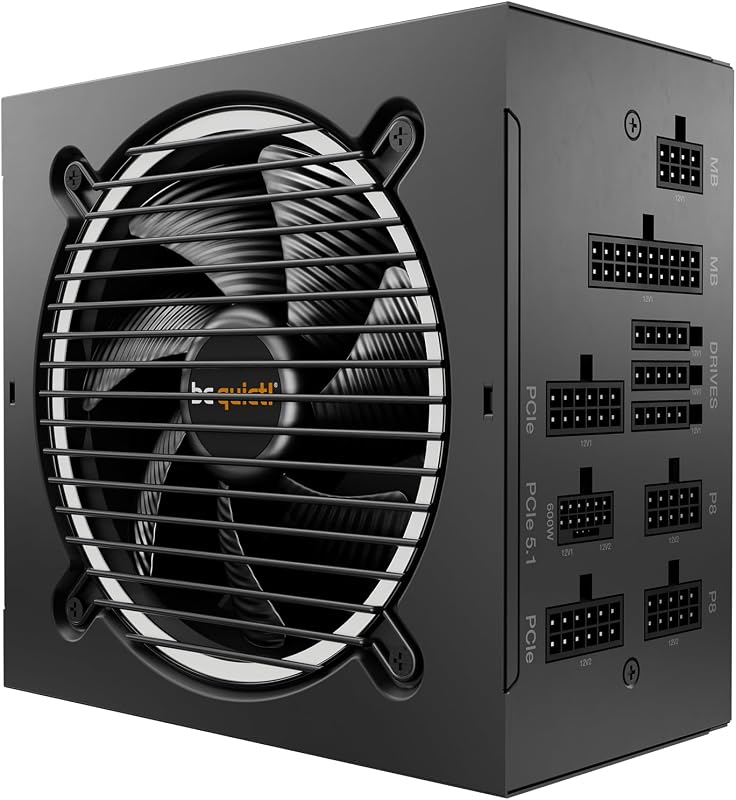
Pros
- Higher 850W continuous capacity
- Silent 120mm cooling fan
- Two independent 12V rails
- Native PCIe 5.1 12VHPWR connector
Cons
- Bulky ATX size unsuitable for SFF
- 80 PLUS Gold efficiency rating
View be quiet! Pure Power 12 M 850W on Amazon
Who Should Buy Each One
Choose the Corsair SF750 If
- You are building a compact small-form-factor or mini-ITX PC where standard ATX supplies do not fit.
- You want maximum electrical efficiency backed by an 80 PLUS Platinum certification and 105°C Japanese capacitors.
- You require totally silent, zero-fan operation during low-load everyday computing via Zero RPM mode.
- You need slim, highly flexible Type-5 Micro-Fit cables to navigate narrow chassis clearances.
Choose the be quiet! Pure Power 12 M 850W If
- You are constructing a build in a standard mid-tower or full-tower ATX enclosure.
- You need 850 watts of continuous output to run high-end graphics cards and demanding processors.
- You prefer a larger 120mm airflow-optimized fan designed to maintain quiet operation across all load levels.
- You want dual independent 12V rails capable of handling extreme GPU power excursions.
Final Verdict
In this head-to-head comparison, the Corsair SF750 stands as the superior pick for small-form-factor builders and enthusiasts who prioritize electrical efficiency. Delivering 750 watts of 80 PLUS Platinum power inside a miniature SFX frame, it packs top-tier 105°C Japanese capacitors, flexible Type-5 cabling, and a silent Zero RPM mode into a footprint that transforms mini-ITX builds. Backed by a seven-year warranty, it remains the standard reference for compact systems.
The be quiet! Pure Power 12 M 850W takes the lead when building in a standard ATX PC tower. With 850 watts of continuous output, dual independent 12V rails, and a quiet 120mm temperature-controlled fan, it provides the extra 100 watts of ceiling needed for power-hungry hardware. If your chassis accommodates a full ATX power supply and you want native ATX 3.1 graphics card compatibility with smooth acoustic performance, the Pure Power 12 M 850W is the right choice.
FAQ
Can the Corsair SF750 be installed in a regular ATX case?
Yes. The Corsair SF750 includes an SFX-to-ATX adapter bracket in the box. This bracket lines up with standard ATX power supply screw holes, allowing the smaller SFX chassis to mount securely inside standard mid-tower or full-tower desktop cases.
Does the be quiet! Pure Power 12 M 850W support modern PCIe 5.1 graphics cards?
Yes. The Pure Power 12 M 850W is fully compliant with the ATX 3.1 standard and includes a native 12VHPWR connector to power next-generation PCIe 5.1 graphics cards, alongside traditional PCIe 6+2-pin cables for broad hardware compatibility.
Which power supply is quieter under load?
The Corsair SF750 is completely silent at low loads because its 92mm fan stays off in Zero RPM mode. However, under heavy loads, the be quiet! Pure Power 12 M 850W benefits from its larger 120mm fan, which moves air at lower rotational speeds to maintain a low acoustic profile.
Are Corsair Type-5 cables compatible with standard ATX power supply ports?
No. The Corsair SF750 uses proprietary Type-5 Micro-Fit connectors at the PSU modular interface. These connectors are physically smaller than conventional modular plugs to save chassis space, so they cannot be mixed with standard Type-3 or Type-4 cables.
Is 750W enough power for gaming with high-end GPUs?
A 750-watt power supply like the SF750 handles most gaming configurations comfortably, especially with ATX 3.1 compliance managing brief transient power spikes. However, if you plan to run heavily overclocked processors alongside top-tier modern GPUs, the 850-watt output of the Pure Power 12 M provides greater headroom.
What efficiency advantage does the Corsair SF750 have over the Pure Power 12 M?
The Corsair SF750 carries an 80 PLUS Platinum certification, whereas the be quiet! Pure Power 12 M 850W is certified 80 PLUS Gold. Platinum efficiency requires lower internal power loss and produces less waste heat during power conversion.

