Deciding between the Seasonic Focus GX-750 and the MSI MPG A850G comes down to whether your graphics configuration requires an extra 100 watts of continuous delivery or if your system priorities lean toward verified Cybenetics Platinum electrical efficiency inside a shorter chassis footprint. Both units comply with modern ATX 3.1 specifications and supply native 12V-2×6 power connections, yet they serve distinctly different component budgets and thermal profiles.
Builders running high-performance graphics hardware with aggressive power demands should select the MSI power supply for its 850-watt ceiling and verified Japanese capacitor selection, whereas builders optimizing for cooler operation, compact cable routing, and higher conversion efficiency should invest in the Seasonic power supply.
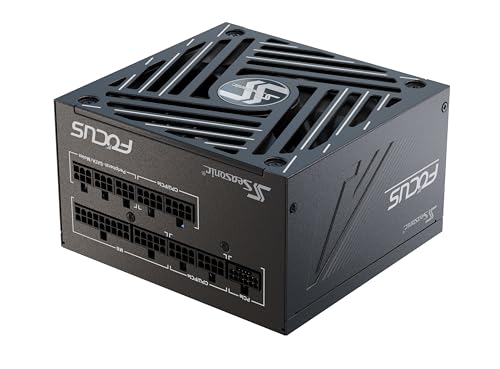

Seasonic Focus GX-750 vs MSI MPG A850G at a Glance
| Specification | Seasonic Focus GX-750 | MSI MPG A850G |
|---|---|---|
| Continuous Wattage | 750 Watts | 850 Watts |
| Efficiency Ratings | 80 PLUS Gold & Cybenetics Platinum | 80 PLUS Gold |
| Form Factor Standard | ATX 3.1 & PCIe 5.1 | ATX 3.1 & PCIe 5.1 |
| GPU Power Delivery | Native 12V-2×6 Connector | Native 12V-2×6 Connector |
| Modular Construction | Fully Modular | Fully Modular |
| Internal Thermal Architecture | OptiSink Design | Standard Heatsink Assembly |
| Cooling Fan | 135 mm Fluid Dynamic Bearing (FDB) | Low-Noise Air Cooling Fan |
| Capacitor Rating | Not listed | 100% Japanese 105°C & Solid Capacitors |
| Manufacturer Warranty | Not listed | 10-Year Limited Warranty |
| Physical Dimensions | 5.5 x 5.9 x 3.4 inches | 5.91 x 5.91 x 3.39 inches |
| Best For | Compact, high-efficiency gaming rigs | Demanding multi-rail modern GPU platforms |
Power Output and Continuous Wattage Headroom
Continuous wattage defines the operational ceiling for any dedicated desktop configuration, setting the hard boundary for component compatibility under maximum computing stress. The fundamental comparison of a 750W vs 850W power supply centers around the electrical demands imposed by high-end graphics cards and multi-core processors running simultaneous compute cycles. When high-tier components switch from idle to full load states, transient power demands can briefly exceed standard operating draws, making overall capacity a primary factor in preventing unexpected shutdowns.
The MSI MPG A850G provides 850 watts of output with an explicit current rating of 16 A, delivering a broad safety buffer for advanced graphics hardware. The listing specifically highlights compatibility for modern multi-rail loads, ensuring stable delivery when powering upper-tier gaming configurations. By comparison, the Seasonic Focus GX-750 supplies 750 watts, specifically advertised to power cards in the tier of the NVIDIA GeForce RTX 5070 Ti and AMD Radeon RX 9000 series. While 750 watts remains more than adequate for mainstream and upper-midrange setups, it leaves noticeably less headroom for high-wattage custom overclocks or multi-drive workstation arrays. Builders considering larger capacity tiers often compare configurations like the seasonic focus gx-750 vs be quiet! pure power 12 m 850w to balance these headroom demands.
Opting for the 850-watt threshold provides peace of mind if you plan to upgrade to higher-tier graphics cards during the lifespan of your machine. The additional 100 watts provided by the MSI unit allows the internal circuitry to operate further away from its maximum threshold during peak gaming sessions, which generally reduces sustained thermal stress across the internal transformer and switches.
Edge: MSI MPG A850G provides 100 watts of supplementary output headroom to support higher-tier component upgrades and demanding power draws.
Electrical Efficiency and Energy Conversion
Power supply efficiency represents the ratio of direct-current electrical power supplied to computer components relative to the alternating-current power drawn from the household wall outlet. Higher conversion efficiency means less electrical energy is lost as waste heat inside the chassis, which directly benefits operating temperatures, reduces total system noise, and lowers power consumption during marathon rendering or gaming sessions. Certification programs establish rigorous benchmarks to test efficiency curves across low, typical, and maximum load levels.
In this technical category, the Seasonic Focus GX-750 stands out by holding both an 80 PLUS Gold certification and a Cybenetics Platinum rating. Cybenetics testing enforces tighter measurement tolerances and evaluates overall power factor, standby vampire draw, and efficiency profiles across thousands of operational data points. The listing for the MPG A850G highlights an 80 PLUS Gold rating, ensuring robust energy conversion, but it does not specify a Cybenetics Platinum accreditation. The presence of Seasonic Focus GX-750 ATX 3.1 compliant circuitry paired with this dual certification provides measurable advantages in conversion quality.
For builders assembling quiet living-room systems or machines operating around the clock, the dual-certified Seasonic unit guarantees that less power gets dissipated as stray warmth into the casing. Builders wanting higher overall capacity while retaining high conversion figures frequently evaluate alternatives such as the seasonic vertex gx-1000 vs msi mpg a850g, but within this pair, the Focus GX-750 delivers the higher efficiency distinction on paper.
Edge: Seasonic Focus GX-750 secures the Cybenetics Platinum rating alongside 80 PLUS Gold for cleaner conversion and reduced thermal waste.
Internal Architecture and Component Reliability
The lifespan and electrical stability of a power supply rely entirely on the quality of its internal components, specifically the filtering capacitors, transformers, and circuit protection systems. Power supplies convert volatile incoming alternating current into ripple-free direct-current rails, a task that degrades secondary electronics over time if heat is not properly managed. Robust internal filtering preserves clean voltage delivery to sensitive motherboard VRMs and graphics memory modules.
The MSI MPG A850G makes internal build quality an explicit selling point, utilizing 100% Japanese 105°C electrolytic capacitors alongside solid capacitors. Japanese capacitors are widely recognized across PC hardware manufacturing for their elevated heat tolerance and resistance to electrolyte evaporation under extended heavy loads. MSI backs this hardware engineering with an explicit 10-year limited warranty and guarantees 10 years of EU spare part availability. Any detailed MSI MPG A850G review highlights this 10-year support commitment as a critical metric for long-term investment viability.
Conversely, the Focus GX-750 incorporates an internal OptiSink design, an engineering update that improves component surface contact and airflow channels across heat-generating parts. However, while Seasonic is renowned in power electronics, the listing does not specify the capacitor origin or temperature rating for this specific model, nor does it list warranty duration in its technical specifications. For builders questioning is MSI MPG A850G worth it, the transparency regarding Japanese components and confirmed decade-long warranty provides substantial validation.
Edge: MSI MPG A850G takes this category thanks to explicitly specified 100% Japanese 105°C capacitors and a documented 10-year limited warranty.
Cooling Technology and Acoustic Management
Maintaining low internal temperatures is required to ensure electrical longevity, yet cooling fans remain one of the few moving mechanical elements prone to wear and noise within a computer setup. Fan diameter, bearing type, and fan curve control profiles dictate whether a power supply operates near-silently under everyday computing tasks or introduces intrusive mechanical hums during extended gameplay.
Seasonic equips the Focus GX-750 with an oversized 135 mm Fluid Dynamic Bearing (FDB) fan integrated with hybrid fan control. Fluid dynamic bearings utilize lubricating fluid to reduce direct shaft friction, which enhances rotational balance and dampens acoustic resonance. The hybrid fan control allows the unit to run passively under lower load thresholds, completely spinning down the fan until internal thermals necessitate active air movement. Combined with the proprietary OptiSink layout, heat dissipates efficiently across internal channels before forced airflow is even required. Similar thermal considerations arise when comparing mid-tier chassis hardware in matchups like the corsair rm750x vs seasonic focus gx-750.
The MSI MPG A850G features a dedicated low-noise air cooling fan design aimed at maintaining steady thermal dissipation during peak gaming loads. However, the listing does not specify the exact fan diameter, bearing composition, or presence of a dedicated semi-passive mode switch on the exterior housing. While the MPG A850G remains engineered for low-noise gaming environments, Seasonic provides transparent technical data regarding its hybrid system and larger 135 mm FDB fan.
Edge: Seasonic Focus GX-750 delivers superior cooling clarity with a 135 mm FDB fan and integrated hybrid fan control.
Form Factor, Cable Handling, and Case Compatibility
Physical power supply dimensions dictate cable management flexibility and installation ease, particularly inside compact mid-tower enclosures or dual-chamber cases. Power supply depth determines how much clearance remains between the rear modular terminal ports and internal storage bays, bottom fan mounts, or liquid cooling water pumps installed under the PSU shroud.
The Focus GX-750 features a compact external chassis measuring 5.5 inches in depth, 5.9 inches in width, and 3.4 inches in height, weighing in at an agile 3.5 pounds. A 5.5-inch length (140 mm) makes it exceptionally straightforward to route modular harnesses inside tight chassis basements, freeing up physical space to stow surplus lengths of thick braided cables. When contrasting form factors against larger units, as seen in the seasonic focus gx-750 vs vertex gx-1000, compact external measurements significantly streamline the build process.
In contrast, the MSI MPG A850G measures 5.91 x 5.91 x 3.39 inches and weighs substantially more at 7.2 pounds. While 5.91 inches (150 mm depth) still fits within standard ATX enclosure specifications, it claims an extra 0.41 inches of clearance directly adjacent to the cable output headers. Both power supplies feature fully modular construction, allowing builders to connect only the essential cable runs needed for their motherboard and storage. Nevertheless, Seasonic offers a lighter and more compact physical footprint that simplifies assembly in constrained spaces.
Edge: Seasonic Focus GX-750 offers a noticeably shorter 5.5-inch chassis depth and lower weight for easier cable management.
Next-Generation Standards and PCIe 5.1 Connectivity
Modern graphics cards rely heavily on the revised ATX 3.1 and PCIe 5.1 standards to deliver high levels of power through a single compact connector. The earlier 12VHPWR connector configuration has been updated across the industry to the safer 12V-2×6 standard, featuring shortened sense pins to ensure that power delivery only engages when the harness is completely seated into the GPU receiving port.
Both power supplies come fully equipped for next-generation hardware architectures. The Seasonic Focus GX-750 features an ATX 3.1 and PCIe 5.1 platform featuring a native 12V-2×6 interface, with the product data confirming explicit readiness for upcoming architectures such as the NVIDIA GeForce RTX 5070 Ti and AMD Radeon RX 9000 graphics lines. Builders seeking modern connection standards will find native high-power capabilities directly on the rear modular panel without needing third-party splitters.
Similarly, the MSI MPG A850G PCIe 5.1 and ATX 3.1 implementation integrates a native 12V-2×6 modular cable designed specifically to power high-draw modern graphics cards safely. Both platforms provide fully modular architectures that discard permanent harness clutter, allowing users to run single-cable power to advanced GPUs while utilizing clean ATX power lines to the motherboard. Because both manufacturers integrate the latest safety-focused connector standard and full modularity, their cable functionality remains evenly matched.
Edge: Tie. Both units fully implement native ATX 3.1 specifications and 12V-2×6 modular connectivity.
Pros and Cons
Seasonic Focus GX-750

Pros
- Cybenetics Platinum efficiency rating
- Compact 5.5-inch chassis depth
- Hybrid fan control with 135 mm FDB fan
- OptiSink thermal dissipation design
- Native ATX 3.1 12V-2×6 connector
Cons
- Lower 750-watt continuous ceiling
- Warranty duration not specified in listing
View Seasonic Focus GX-750 on Amazon
MSI MPG A850G

Pros
- Higher 850-watt continuous output
- 100% Japanese 105°C and solid capacitors
- 10-year manufacturer limited warranty
- Native PCIe 5.1 12V-2×6 power connection
Cons
- Lacks Cybenetics Platinum efficiency rating
- Longer 5.91-inch chassis depth
- Heavier 7.2-pound total weight
Who Should Buy Each One
Choose the Seasonic Focus GX-750 If
- You prioritize Cybenetics Platinum electrical efficiency to keep power conversion loss to a minimum.
- You are assembling a build inside a compact mid-tower or space-constrained case requiring a short 5.5-inch unit depth.
- You want semi-passive thermal operation driven by a large 135 mm fluid dynamic bearing cooling fan.
- Your intended graphics card falls into the performance class of the RTX 5070 Ti where 750 watts provides ample operational margin.
Choose the MSI MPG A850G If
- Your system contains higher-tier components that demand the extra safety margin of an 850-watt continuous rating.
- You demand explicit long-term component security backed by 100% Japanese 105°C capacitors.
- You want guaranteed peace of mind through a manufacturer-backed 10-year limited warranty and long-term parts availability.
- You are building a high-power gaming platform intended to accommodate demanding next-generation GPU upgrades.
Final Verdict
For most PC builders assembling a modern gaming desktop with an upper-tier graphics card, the MSI MPG A850G emerges as the more practical long-term investment. Its 850-watt continuous output rating delivers the power headroom necessary to absorb transient spikes without triggering over-current protections, while the inclusion of 100% Japanese 105°C capacitors and an explicit 10-year warranty guarantees component resilience across multiple system upgrade cycles. Although it carries a slightly larger footprint inside the case shroud, the supplementary power capacity and verified internal capacitor standard make it a standout choice for high-draw modern gaming rigs.
On the other hand, the Seasonic Focus GX-750 represents the superior option for builders working with mid-range graphics configurations who place a premium on energy efficiency, acoustics, and chassis space. Holding a Cybenetics Platinum efficiency rating in addition to 80 PLUS Gold, the Focus GX-750 converts power with exceptional precision while generating minimal heat through its OptiSink thermal layout and 135 mm FDB hybrid fan. If your setup operates comfortably within a 750-watt envelope and your PC case favors a compact 5.5-inch power supply depth, Seasonic delivers the more refined engineering package.
FAQ
Can the Seasonic Focus GX-750 handle next-generation graphics cards?
Yes, the Seasonic Focus GX-750 is explicitly designed to meet ATX 3.1 and PCIe 5.1 standards, featuring a native 12V-2×6 power connector. The listing highlights full compatibility for modern graphics cards such as the NVIDIA GeForce RTX 5070 Ti and AMD Radeon RX 9000 series, provided total system power requirements remain within the 750-watt capacity limit.
What are the key differences in 750W vs 850W power supply choices?
The 100-watt difference dictates how much continuous electrical overhead remains available for high-load components. While a 750W supply easily manages modern mid-range to upper-midrange GPUs paired with standard gaming CPUs, an 850W unit like the MSI MPG A850G accommodates higher transient power spikes, aggressive processor power limits, and multi-drive storage arrays with a wider margin of safety.
Does the MSI MPG A850G include a native 12V-2×6 connector?
Yes, the MSI MPG A850G includes native PCIe 5.1 and ATX 3.1 support with a dedicated 12V-2×6 connector cable. This allows builders to power modern graphics cards using a single direct modular connection rather than relying on multiple traditional 8-pin PCIe adapter harnesses.
What does Cybenetics Platinum certification mean for the Seasonic Focus GX-750?
Cybenetics Platinum certification signifies that the Seasonic Focus GX-750 has undergone rigorous, multi-point independent efficiency testing across broad electrical load ranges. This verification indicates lower energy conversion loss, reduced thermal output, and tighter power factor management compared to units carrying only standard baseline ratings.
Is the MSI MPG A850G worth it for mid-range gaming builds?
The MSI MPG A850G is worth selecting if you plan to upgrade to higher-tier graphics cards in the future or want the security of Japanese 105°C capacitors and a 10-year warranty. However, if your mid-range system will permanently run components within a moderate wattage bracket, the efficiency and compact size of a 750-watt unit may prove more advantageous.
How do dimensions compare in this Seasonic vs MSI power supply matchup?
The Seasonic Focus GX-750 is more compact, measuring 5.5 x 5.9 x 3.4 inches and weighing 3.5 pounds, which leaves valuable space inside chassis shrouds for routing cables. The MSI MPG A850G measures 5.91 x 5.91 x 3.39 inches and weighs 7.2 pounds, requiring roughly half an inch of additional clearance in the lower compartment of your computer case.


