The decisive difference between the Noctua NH-L9i and the be quiet! Dark Rock Pro 5 comes down to form factor versus total cooling capacity. One is an ultra-compact, 37mm low-profile cooler engineered strictly for cramped enclosures, while the other is a heavyweight, dual-tower air cooler engineered to dissipate up to 280 watts of heat from demanding processors.
Builders putting together an ultra-compact small form factor rig or living room home theater PC should choose the Noctua NH-L9i for its zero-interference footprint and minimal clearance requirements. PC builders constructing an overclocked workstation or high-performance desktop in a standard mid-tower case should choose the be quiet! Dark Rock Pro 5 to ensure maximum thermal headroom under sustained processor workloads.
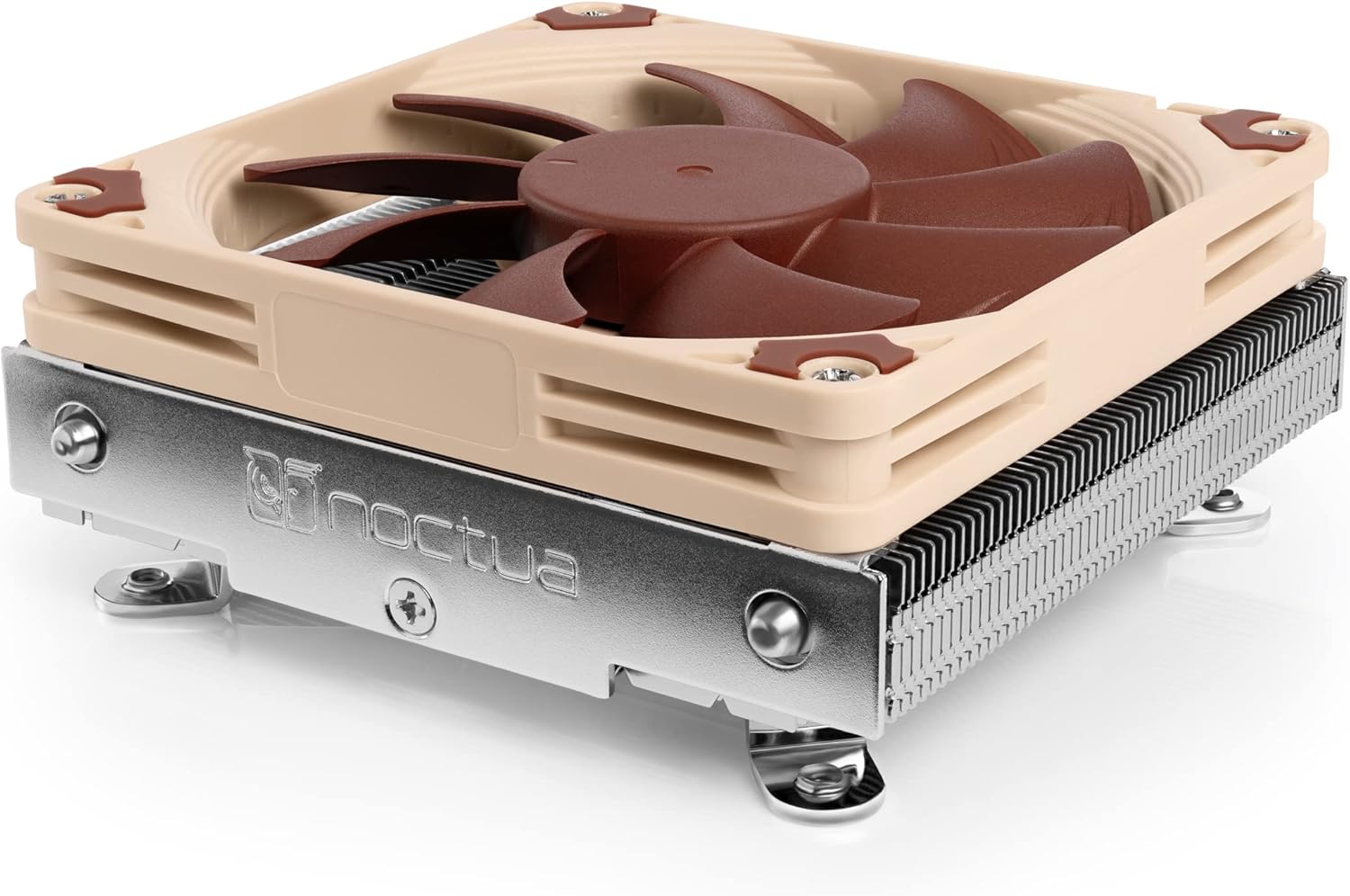

Noctua NH-L9i vs be quiet! Dark Rock Pro 5 at a Glance
| Feature | Noctua NH-L9i | be quiet! Dark Rock Pro 5 |
|---|---|---|
| Cooler Design | Ultra-low-profile monolithic heatsink | Dual-tower heatsink with ceramic coating |
| Total Height | 37 mm (1.46 inches) | 168 mm (6.61 inches) |
| Dimensions (L x W x H) | 3.74 x 3.74 x 1.46 inches | 5.70 x 5.35 x 6.61 inches |
| Heat Pipes | Copper heat pipes (quantity not listed) | 7 high-performance copper heat pipes |
| Cooling Capacity / TDP | Moderate heat load (65W class CPUs) | 280 watts |
| Included Fans | 1x 92mm NF-A9x14 slim PWM fan | 2x Silent Wings PWM fans (decoupled) |
| Maximum Fan Speed | 2500 RPM (adaptable with L.N.A) | 2000 RPM (Performance) / 1500 RPM (Quiet) |
| Noise Level | 23.6 dB | 23.3 dB |
| Socket Compatibility | Intel LGA 1150, 1151, 1155, 1156, 1200 | Intel LGA 1851, 1700, 1200, 1151, 1150, 1155; AMD AM5, AM4 |
| Manufacturer Warranty | 6-year manufacturer warranty | Not listed |
| Best For | Compact ITX and HTPC builds | Overclocked high-TDP desktop processors |
Cooling Capacity and Thermal Headroom
Thermal headroom defines how hard you can push a processor before thermal throttling reduces clock speeds. The Dark Rock Pro 5 cooling capacity is specified at an impressive 280 watts, backed by a massive dual-tower aluminum fin stack and seven high-performance copper heat pipes. This substantial physical mass absorbs and disperses enormous heat loads generated by top-tier multi-core processors running heavy rendering tasks, production suites, or sustained simulation workloads without reaching unsafe temperatures.
In contrast, the Noctua NH-L9i is explicitly tailored for moderate heat loads, serving CPUs in the 65W TDP range such as standard Core i3, i5, and non-K i7 chips (for example, the 10700, 11600, or 11700). Because it features a compact radiator base with a slim 92mm fan, it cannot absorb continuous multi-hundred-watt thermal spikes. If paired with an aggressively overclocked processor, the cooler quickly reaches its saturation threshold. Evaluating noctua nh-u12a vs be quiet! dark rock pro 5 reveals that larger fin stacks fundamentally dictate raw thermal endurance under heavy desktop loads.
The gap in thermal capability between these two units is vast because they serve entirely different functional domains. While the Dark Rock Pro 5 provides the muscle required for aggressive boost clocks, the NH-L9i focuses on keeping modest processors safely within their operating limits inside tight enclosures. If your system runs power-hungry desktop CPUs, the extra thermal mass of the dual-tower design is non-negotiable.
Edge: be quiet! Dark Rock Pro 5, delivering a 280-watt rating and seven heat pipes that vastly outperform low-profile heatsinks under heavy computational loads.
Height Clearance and Chassis Compatibility
Chassis clearance dictates which computer cases can house your chosen cooling solution. The Noctua NH-L9i height clearance stands at an ultra-compact 37mm (1.46 inches) total, which includes both the heatsink and the pre-installed NF-A9x14 slim fan. This tiny vertical footprint allows it to slip effortlessly into cramped console-style cases, 1U rackmount enclosures, thin mini-ITX boxes, and sub-10-liter boutique cases where vertical space is practically nonexistent.
On the opposite end of the spectrum, the Dark Rock Pro 5 measures 168mm (6.61 inches) tall. This commanding height requires a spacious mid-tower or full-tower chassis with substantial side-panel clearance. Builders working within tight confines will find that the Dark Rock Pro 5 simply cannot physically fit inside compact desktop cases. Anyone considering a noctua nh-d15 vs nh-l9i matchup encounters this exact spatial challenge: big twin-towers demand broad, traditional desktop cases.
When selecting a cooler for a dedicated space-saving build, physical dimensions override every other specification. The Dark Rock Pro 5 is engineered strictly for cases that accommodate tall tower coolers, whereas the NH-L9i fits in virtually any case ever manufactured that accepts standard desktop components. For constrained environments, Noctua offers unbeatable versatility.
Edge: Noctua NH-L9i, thanks to its minuscule 37mm total height that fits into ultra-slim SFF and HTPC enclosures.
Motherboard Footprint and Component Clearance
A cooler must coexist with surrounding motherboard hardware, particularly system memory modules and primary expansion slots. The Noctua NH-L9i features a compact 95x95mm footprint tailored to match Intel socket keep-out zones. Because it never extends beyond the designated CPU socket perimeter, it provides 100 percent RAM and PCIe clearance. High-profile heat spreaders on memory modules and full-length graphics cards installed in the top PCIe slot will never experience interference from the NH-L9i, making it exceptionally reliable on crowded mini-ITX motherboards.
The be quiet! Dark Rock Pro 5 has a much larger footprint, measuring 5.7 inches long and 5.35 inches wide. Its dual-tower architecture spans across the CPU area, positioning the front Silent Wings fan over memory slots. While its stepped lower cooling fins provide cutouts for standard memory sticks, very tall decorative heat spreaders can cause physical clearance issues. Builders looking at a noctua nh-l9i vs thermalright peerless assassin 120 comparison will note that large dual-tower coolers routinely require adjustments to the front fan height when pairing with high-profile RGB RAM.
Furthermore, removing or adding memory sticks after installing the Dark Rock Pro 5 typically requires unlatching the front fan or sliding off the top mesh cover. The NH-L9i leaves memory slots completely open and accessible at all times. For frustration-free component swaps and absolute hardware clearance on dense motherboards, the smaller cooler holds a distinct advantage.
Edge: Noctua NH-L9i, offering a guaranteed 95x95mm footprint that avoids overhang across memory modules and PCIe slots.
Acoustic Profile and Fan Configuration
Keeping a computer quiet while maintaining healthy temperatures is a balancing act between fan diameter, motor design, and rotational speeds. The be quiet! Dark Rock Pro 5 incorporates two Silent Wings PWM fans equipped with fluid-dynamic bearings, advanced 6-pole motors, and vibration-isolating mountings. It also introduces an integrated hardware Speed Switch beneath its removable magnetic top cover, letting users toggle between Quiet Mode (capping rotational speed at 1500 RPM) and Performance Mode (reaching up to 2000 RPM). Despite pushing 68.7 CFM of airflow, its peak noise level is rated at just 23.3 dB.
The Noctua NH-L9i relies on a single NF-A9x14 slim 92mm PWM fan that spins up to 2500 RPM to compensate for its compact fin area, producing an airflow capacity of 57.5 cubic meters per hour. The Noctua NH-L9i noise levels top out at 23.6 dB under maximum load. Noctua also bundles its NA-RC7 Low-Noise Adaptor (L.N.A), which limits top fan speeds for near-silent operation when cooling low-wattage chips. Even so, spinning a slim 92mm fan at higher speeds generates a higher-pitched sound signature than dual 120mm/135mm class fans moving air through deep dual towers.
Comparing acoustic implementations in any detailed thermalright phantom spirit 120 vs be quiet! dark rock pro 5 analysis shows that dual-fan configurations running at moderate rotational speeds move substantial air while generating a deeper, less intrusive acoustic profile. The dual Silent Wings setup and integrated hardware speed switch give the be quiet! unit a clear edge in acoustic refinement under heavy operation.
Edge: be quiet! Dark Rock Pro 5, providing larger decoupled fans, lower peak acoustic output, and a dedicated dual-mode speed toggle.
Socket Compatibility and Platform Versatility
Long-term usability often hinges on whether a cooler can transition across different processor platforms and socket generations. The be quiet! Dark Rock Pro 5 provides comprehensive out-of-the-box support for both modern Intel and AMD platforms. Its mounting system accommodates Intel LGA 1851, 1700, 1200, 1151, 1150, and 1155, alongside AMD AM5 and AM4 sockets. This multi-platform compatibility ensures builders can carry the cooler forward into modern architectures or switch between AMD and Intel systems without needing bracket upgrade kits.
This specific listing of the Noctua NH-L9i is dedicated solely to legacy and mid-generation Intel sockets: LGA 1150, LGA 1151, LGA 1155, LGA 1156, and LGA 1200. It does not include native support for modern Intel LGA 1700/1851 or any AMD sockets in this package. However, it does feature Noctua’s renowned SecuFirm2 mounting system and comes accompanied by high-grade NT-H1 thermal compound and an outstanding 6-year manufacturer warranty, demonstrating exceptional mechanical quality.
Looking at competitive alternatives in a be quiet! dark rock pro 5 vs scythe fuma 3 review highlights the importance of universal platform readiness. The Dark Rock Pro 5 offers modern out-of-the-box readiness for both current AMD Ryzen and newer Intel Core platforms, whereas this NH-L9i model remains strictly dedicated to specific Intel socket designs.
Edge: be quiet! Dark Rock Pro 5, supporting modern Intel LGA 1700/1851 and AMD AM4/AM5 sockets directly out of the box.
Gaming Performance and Thermal Throttling
When weighing the Noctua NH-L9i or be quiet! Dark Rock Pro 5 for gaming, the choice depends on your processor class and chassis airflow. Modern gaming titles create sudden processor power spikes as game engines load shaders, stream open-world assets, and process physics. The Dark Rock Pro 5 easily absorbs these bursts due to its vast thermal reservoir. With 280 watts of dissipation potential, it ensures that high-end gaming CPUs maintain maximum boost clocks indefinitely without creeping toward thermal throttle limits.
The Noctua NH-L9i can handle gaming workloads effectively when paired with sensible 65-watt processors such as an Intel Core i5-10400, 11400, or 10700 running at stock power targets. However, modern high-end gaming chips that draw significant package power during intensive multiplayer matches can overwhelm the compact 37mm cooler, causing fans to spin at their maximum 2500 RPM threshold. Any thorough Noctua NH-L9i review confirms that maintaining reasonable thermals on compact heatsinks requires strictly managed CPU power limits.
For high-refresh gaming on unlocked processors where thermal throttling ruins frame pacing, the Dark Rock Pro 5 provides rock-solid stability. The NH-L9i excels in living room entertainment systems or portable LAN rigs where form factor constraints preclude full-sized coolers, but for an uncompromising desktop gaming setup, the larger heatsink is clearly superior.
Edge: be quiet! Dark Rock Pro 5, ensuring high sustained clock speeds and preventing thermal throttling on performance gaming processors.
Pros and Cons
Noctua NH-L9i

Pros
- Only 37mm total height
- Zero RAM or PCIe overhang
- Includes NT-H1 thermal compound
- 6-year manufacturer warranty
Cons
- Limited to moderate CPU heat loads
- Restricted to specified Intel sockets
Be Quiet! Dark Rock Pro 5

Pros
- 280W rated cooling capacity
- 7 high-performance copper heat pipes
- Dual Silent Wings PWM fans
- Integrated Quiet and Performance switch
- Broad Intel and AMD socket compatibility
Cons
- Large 168mm tower requires spacious chassis
- Heavier dual-tower footprint
View be quiet! Dark Rock Pro 5 on Amazon
Who Should Buy Each One
Choose the Noctua NH-L9i If
- You are building an ultra-compact Small Form Factor (SFF) or HTPC chassis with less than 50mm of vertical cooler clearance.
- You are using an Intel Core i3, i5, or non-K i7 processor operating within moderate 65-watt heat envelopes.
- You want guaranteed 100 percent clearance over RAM modules and the primary PCIe expansion slot on crowded mini-ITX motherboards.
- You value long-term reliability backed by an extensive 6-year manufacturer warranty and a premium SecuFirm2 mounting kit.
Choose the be quiet! Dark Rock Pro 5 If
- You are running high-performance or overclocked processors that demand up to 280 watts of sustained thermal dissipation.
- You own a standard mid-tower or full-tower chassis that easily accommodates a 168mm cooler height.
- You need out-of-the-box platform compatibility for modern AMD AM5/AM4 or Intel LGA 1700/1851 sockets.
- You prefer whisper-quiet operation enabled by dual decoupled Silent Wings PWM fans and an integrated hardware Speed Switch.
Final Verdict
The be quiet! Dark Rock Pro 5 vs Noctua NH-L9i matchup represents a classic battle between raw thermal dissipation and space-saving efficiency. For the vast majority of standard desktop builders, the Dark Rock Pro 5 is the superior cooling solution. Its massive 280W rating, seven copper heat pipes, dual Silent Wings fans, and broad modern socket coverage for both AMD and Intel platforms ensure your processor runs at peak frequencies without acoustic irritation or thermal throttling.
Nevertheless, the Noctua NH-L9i remains an unmatched specialist in its own right. When space is constrained to tight confines where tall tower coolers cannot fit, is Noctua NH-L9i worth it? Absolutely. Its 37mm total height, zero-overhang footprint, and reliable SecuFirm2 mounting make it the benchmark low-profile cooler for compact ITX builds, console replacements, and media centers running moderate-wattage processors.
FAQ
What is the total Noctua NH-L9i height clearance required in an ITX case?
The Noctua NH-L9i requires just 37mm (1.46 inches) of vertical clearance, which accounts for both the cooling fin stack and the pre-installed NF-A9x14 slim fan. This makes it suitable for extremely shallow mini-ITX enclosures and low-profile desktop cases.
How much cooling capacity does the be quiet! Dark Rock Pro 5 provide?
The be quiet! Dark Rock Pro 5 is engineered with a cooling capacity rated at 280 watts TDP. This substantial headroom is achieved via seven copper heat pipes, a dense dual-tower fin array, and two Silent Wings PWM fans working in tandem.
Can the Noctua NH-L9i handle modern overclocked processors?
No, the Noctua NH-L9i is explicitly designed for processors with moderate heat loads, such as 65W class Intel Core i3, i5, and standard i7 chips. It does not have the physical mass or fin surface area to dissipate the heat produced by heavily overclocked processors under sustained multi-threaded workloads.
Does the be quiet! Dark Rock Pro 5 block RAM slots on standard motherboards?
The Dark Rock Pro 5 features a large footprint that extends over memory slots on many motherboards. While the heatsink provides cutouts on the bottom fins to clear standard-height memory modules, tall RGB heat spreaders may require adjusting the front fan position upward, increasing total height requirements.
How do the Noctua NH-L9i noise levels compare to the Dark Rock Pro 5?
Both coolers are exceptionally quiet for their respective form factors. The Dark Rock Pro 5 is rated at a maximum noise level of 23.3 dB using dual Silent Wings fans, while the Noctua NH-L9i is rated at 23.6 dB. Noctua also includes a Low-Noise Adaptor to drop fan speeds further, while the Dark Rock Pro 5 features an integrated Speed Switch with Quiet and Performance modes.
Is be quiet! Dark Rock Pro 5 worth it for small form factor ITX cases?
The Dark Rock Pro 5 is only worth it if your ITX chassis is specifically designed with at least 168mm of cooler clearance. In true ultra-compact or console-style SFF cases, the Dark Rock Pro 5 simply will not fit, making low-profile alternatives like the Noctua NH-L9i necessary.
Which processor sockets are supported by each cooler out of the box?
The be quiet! Dark Rock Pro 5 supports Intel LGA 1851, 1700, 1200, 1151, 1150, and 1155, along with AMD AM5 and AM4. The Noctua NH-L9i in this listing is dedicated to Intel LGA 1150, LGA 1151, LGA 1155, LGA 1156, and LGA 1200.


