Choosing between the DeWalt DWE7485 and the DeWalt DWE7491RS comes down to a fundamental trade-off between ultra-lightweight portability and heavy-duty sheet-cutting capacity. The compact DWE7485 uses an 8-1/4-inch blade format with a 54-pound frame built for one-person transport, while the DWE7491RS is a full-scale 10-inch jobsite workstation featuring an integrated rolling stand, 32-1/2 inches of rip capacity, and a 3-1/8-inch cutting depth at 90 degrees.
Carpenters and contractors who climb scaffolding, work in tight residential spaces, or lift their equipment into a truck bed solo should pick the DWE7485. Woodworkers, framers, and deck builders who frequently rip 4×8 sheet goods to center, dimension thick hardwoods, or require a self-standing jobsite station should select the DWE7491RS.

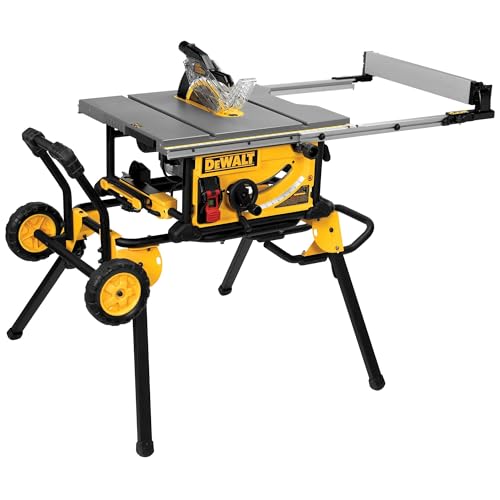
DeWalt DWE7485 vs DWE7491RS at a Glance
| Feature | DeWalt DWE7485 | DeWalt DWE7491RS |
|---|---|---|
| Blade Size | 8-1/4 inches | 10 inches |
| Motor Rating | 15 Amp (1800 Watts) | 15 Amp |
| No-Load Speed | 5800 RPM | 4800 RPM |
| Maximum Rip Capacity | 24.5 inches | 32-1/2 inches |
| Cut Depth at 90 Degrees | Not listed | 3-1/8 inches |
| Cut Depth at 45 Degrees | Not listed | 2-1/4 inches |
| Table Surface Dimensions | Not listed | 21-7/8 x 26-3/8 inches |
| Tool Weight | 54 pounds | 110 pounds (with stand) |
| Included Stand | Metal roll cage base only | Foldable rolling stand with wheels |
| Dust Collection Port | Not listed | 2-1/2 inches |
| Best For | Mobile contractors and small workshops | Cabinet installers, framing, and full sheets |
Rip Capacity and Sheet Material Support
Rip capacity determines the maximum width of material you can guide between the blade and the fence, establishing whether a saw can process full 4×8 panels without freehand rough-cutting. In any detailed dewalt dwe7485 review, the standout mechanical feature is DeWalt’s rack and pinion telescoping fence system, which keeps the fence parallel to the blade through smooth dial adjustments. On the DWE7485, that fence extends out to 24.5 inches to the right of the blade. This enables users to rip standard 4-foot panels in half down the center line, serving the vast majority of cabinet filler strips, shelving stock, and subfloor cuts on active jobsites.
Examining the dewalt dwe7485 vs dwe7491rs rip capacity reveals why the DWE7491RS commands high interest among serious carpenters. The DWE7491RS extends its telescoping fence rails out to 32-1/2 inches, giving it an extra 8 inches of ripping width over its smaller sibling. Furthermore, the DWE7491RS incorporates a patented fold-out material support shelf that bridges the gap when the fence rails are fully extended. This feature prevents wide, thin sheet goods like 1/4-inch underlayment or flexible laminate from drooping off the edge of the 21-7/8-inch by 26-3/8-inch tabletop before they meet the teeth. Buyers weighing the DeWalt DWE7491RS vs DW745 often discover that wide rip capacity is the primary reason to upgrade to the modern 10-inch platform.
For operations involving large cabinetry, wide built-in shelving, or framing lumber, the extended capacity on the DWE7491RS prevents the dangerous workarounds required when a saw maxes out under 25 inches. If your daily tasks strictly involve dimensional 2x lumber, trim molding, or splitting 4×8 plywood into 24-inch halves, the DWE7485 handles those cuts comfortably. However, the additional fence travel on the DWE7491RS gives woodworkers complete independence from secondary cutting tracks or circular saw breakdown stations.
Edge: DeWalt DWE7491RS, thanks to its class-leading 32-1/2-inch rip width and built-in material support arm.
Blade Size and Cutting Depth
The distinction between the dewalt 8 1 4 vs 10 table saw formats goes far beyond outer diameter, dictating material penetration limits and tooling versatility. The DWE7485 is built around an 8-1/4-inch blade format, a design DeWalt adopted to comply with updated international safety standards while reducing rotational mass. While the manufacturer product listing does not specify the maximum cut depth at 90 or 45 degrees for the DWE7485, the physical limit of an 8-1/4-inch blade cannot match the vertical clearance of a 10-inch arbor assembly. Users evaluating the DeWalt DWE7485 vs DW745 will recall that older jobsite units utilized 10-inch plates, making the dwe7485 blade size a conscious shift toward compact, low-draw efficiency.
By contrast, the DWE7491RS uses standard 10-inch blades and provides clear, factory-rated cutting depth metrics: 3-1/8 inches at a 90-degree bevel and 2-1/4 inches when tilted to 45 degrees. These dimensions are critical for trim carpenters and framing contractors. A 3-1/8-inch cut depth allows you to slice through true 3-inch thick stock or double-layered dimensional lumber in a single pass. When cutting compound angles or beveling standard 2×4 framing stock at 45 degrees, the 2-1/4-inch clearance ensures the teeth cleanly exit the underside of the piece without binding or requiring flipped passes.
When assessing the dwe7485 vs dwe7491rs for woodworking, blade selection and depth margins make a noticeable impact on fine joinery. The DWE7491RS ships with a 10-inch, 24-tooth carbide blade suited for general framing and rough ripping, and its 10-inch arbor geometry accepts the broad catalog of aftermarket 10-inch finishing, melamine, and specialty crosscut blades. The DWE7485 excels at rapid single-pass cuts through nominal 1x and 2x stock, but thick timber, posts, and heavy hardwood slabs require the greater vertical reach of the 10-inch platform.
Edge: DeWalt DWE7491RS, providing a confirmed 3-1/8-inch cutting depth that clears thick stock and 45-degree bevels easily.
Portability, Weight, and Jobsite Setup
Jobsite mobility highlights the starkest contrast in this dewalt dwe7491rs vs dwe7485 comparison. The DWE7485 weighs 54 pounds and measures 22.75 inches long by 22.75 inches wide and 13 inches high. Built with an integrated metal roll cage base, it protects internal components from drops, vehicle vibrations, and rough handling. A single technician can lift the DWE7485 out of an SUV trunk, carry it up two flights of stairs by its frame, and set it on a workbench, sawhorse pair, or tailgate without assistance. Contractors comparing the DeWalt DWE7485 vs Skil TS6307-00 consistently highlight this bare-tool portability as a major factor for rapid setup.
The DWE7491RS takes the opposite design approach, prioritizing stationary stability once deployed. It weighs 110 pounds, more than double the weight of the DWE7485. However, that total weight includes the heavy-duty dwe7491rs rolling stand. The stand features integrated wheels, wide folding tubular steel legs, and large kick-out levers that let you collapse the saw into an upright hand truck configuration. Once folded, you can roll the machine across uneven ground, gravel, or thresholds like rolling luggage, avoiding the physical strain of carrying a heavy table saw across wide open commercial jobsites.
Your choice depends on your workspace footprint. In a tight two-car garage or multi-story renovation project, lifting a 110-pound rolling assembly into a vehicle or navigating narrow stairwells can be exhausting. For those wondering whether to choose the dewalt dwe7485 or dwe7491rs for small workshop environments, the DWE7485 can be tucked under a bench or hung on heavy wall brackets when idle. The DWE7491RS requires substantial floor space, even when stored vertically on its stand bumpers, but it eliminates the need to source an auxiliary table on the jobsite.
Edge: DeWalt DWE7485 for raw carry weight and vehicle flexibility; DeWalt DWE7491RS for single-action ground wheeling without auxiliary stands.
Motor Performance and Rotational Speed
Both table saws run on corded electric power drawing 15 amps at 120 volts, but their internal gearboxes distribute that power through different drive characteristics. The DWE7485 motor consumes 1800 watts and spins its 8-1/4-inch blade at an impressive no-load speed of 5800 RPM. Because the smaller blade diameter has lower rotational inertia, the motor spins up quickly and maintains high rim velocity through dense grain, producing exceptionally clean cuts with minimal tear-out on pre-finished trim and plywood panels.
The DWE7491RS motor delivers its 15 amps of current to spin a 10-inch blade at 4800 RPM. While the RPM figure is lower than that of the DWE7485, the larger blade circumference produces substantial peripheral cutting speed at the tooth tips. The gearing is optimized for torque rather than raw rotational velocity, allowing the blade to maintain momentum when cutting through dense hardwood flooring, framing lumber, or 2×12 deck boards. Tradespeople reviewing the DeWalt DWE7491RS vs Skil TS6307-00 will recognize this motor tuning as tailored for continuous, heavy stock removal without thermal bogging.
Motor management also includes electrical safety systems. The DWE7485 includes a built-in power-loss reset switch, which ensures the tool will not accidentally start up if a power outage occurs or a generator cuts out while the paddle switch remains in the “on” position. The DWE7491RS listing highlights an integrated blade brake system, which reduces spin-down time between consecutive cuts to maintain safety and accelerate repetitive batch work.
Edge: Tie. The DWE7485 spins faster at 5800 RPM for clean veneer cuts, while the DWE7491RS provides the low-end torque and blade brake needed for thick lumber.
Dust Extraction and Onboard Component Storage
Managing jobsite dust and securing loose accessories are vital for both indoor residential finish work and mobile crew productivity. A key question for indoor contractors is: is dewalt dwe7491rs worth it for dust management? The DWE7491RS comes factory-equipped with a 2-1/2-inch dust collection port mounted on the rear of the blade shroud. This standard port size mates directly with jobsite wet/dry vacuums and dedicated shop extractors, allowing you to evacuate chips directly from below the blade table when trimming interior moldings or sheet stock inside occupied spaces.
The manufacturer listing for the DWE7485 does not specify the presence or diameter of a dedicated dust collection port. If working in enclosed workshops, users may need to rely on ambient collection or aftermarket shrouds to manage airborne debris. However, both units excel at onboard tool organization, preventing lost parts when moving between jobs. The DWE7485 incorporates dedicated storage brackets directly within its roll-cage frame to secure the modular blade guard assembly, non-through cut riving knife, anti-kickback pawls, blade-change wrenches, miter gauge, and push stick.
The DWE7491RS features an equally comprehensive onboard storage system, adding a cord wrap bracket to manage the heavy-duty power cable during transport. Both models also utilize DeWalt’s Site-Pro modular guarding system, which allows tool-free adjustments to the riving knife, clear blade guard, and anti-kickback pawls. In an in-depth dewalt dwe7491rs review, this tool-free architecture ensures operators can switch between through-ripping, non-through dados, and groove cuts without searching for hand tools.
Edge: DeWalt DWE7491RS, due to its documented 2-1/2-inch dust extraction port and integrated cord wrap system.
Pros and Cons
DeWalt DWE7485

Pros
- Weighs only 54 pounds for easy transport
- High-speed 5800 RPM 15-amp motor
- Compact 22.75-inch square frame
- Power-loss reset prevents unintended restarts
Cons
- Rip capacity capped at 24.5 inches
- No rolling stand included in package
- Cut depth specifications not listed
DeWalt DWE7491RS

Pros
- Expansive 32-1/2-inch rip capacity
- Includes foldable rolling stand with wheels
- Generous 3-1/8-inch depth of cut at 90 degrees
- Standard 2-1/2-inch dust collection port
Cons
- Heavy 110-pound total package weight
- Requires substantial storage floor space
View DeWalt DWE7491RS on Amazon
Who Should Buy Each One
Choose the DeWalt DWE7485 If
- You need a 54-pound table saw that one person can easily carry up stairs, onto scaffolding, or into small vehicle trunks.
- Your workshop or garage storage space is tightly constrained, requiring a saw that fits under standard shelving.
- You primarily cut 1x and 2x dimensional lumber, trim molding, and sheet materials that do not exceed 24.5 inches in width.
- You want a fast 5800 RPM blade speed for smooth crosscutting and finish ripping on light stock.
Choose the DeWalt DWE7491RS If
- You regularly rip full 4×8 plywood and OSB panels beyond the 24.5-inch mark, taking full advantage of the 32-1/2-inch rip fence.
- You cut 3-inch thick stock or require a deep 2-1/4-inch cut capacity at 45-degree bevel angles.
- You prefer a complete mobile cutting station with an integrated, foldable rolling stand rather than setting the saw on sawhorses.
- You connect your tools directly to a vacuum using a standard 2-1/2-inch dust extraction hose.
Final Verdict
For high-production residential remodeling, deck building, and serious home woodworking, the DeWalt DWE7491RS is the superior tool. Its broad 32-1/2-inch rip capacity, generous 3-1/8-inch depth of cut, integrated 2-1/2-inch dust port, and included folding rolling stand make it a complete, self-sufficient workstation. It readily accommodates the wide panel breakdowns and thick dimensional timbers that stall smaller benchtop saws, justifying its 110-pound footprint for users who prioritize total jobsite capability over ultra-compact storage.
Conversely, the DeWalt DWE7485 is the ideal solution for solo tradespeople, mobile service vans, and compact basement workshops where portability reigns supreme. At just 54 pounds, it delivers a robust 15-amp, 5800 RPM motor, rack and pinion fence precision, and 24.5 inches of rip capacity inside a durable metal roll cage. If you do not require cut depths over 3 inches or sheet cuts wider than 24.5 inches, the DWE7485 offers classic DeWalt cutting accuracy in an easily portable package.
FAQ
Can the DeWalt DWE7485 accept standard 10-inch table saw blades?
No, the DWE7485 is engineered exclusively for 8-1/4-inch blades. Attempting to mount a 10-inch blade on this machine will physically interfere with the blade arbor, inner chassis shroud, and riving knife assembly.
Does the DeWalt DWE7491RS come with the rolling stand included in the box?
Yes, the DWE7491RS listing includes the foldable rolling table saw stand along with the push stick, miter gauge, rip fence, blade wrenches, blade guard assembly, and a 10-inch 24-tooth carbide blade.
Can the fence on the DWE7485 rip down the center of a standard 4×8 sheet?
Yes, the DWE7485 features a maximum rip capacity of 24.5 inches. Because a standard sheet of plywood or OSB is 48 inches wide, a 24.5-inch capacity allows you to rip panels down the exact center with a half-inch margin of clearance.
What is the benefit of the rack and pinion fence system on both models?
The rack and pinion fence rails engage gear teeth on both the front and rear of the table. When you turn the adjustment dial, both ends move in exact synchronization, preventing the fence from skewing out of parallel alignment with the blade.
Does the DWE7485 include a stand?
No, the DWE7485 does not include a rolling stand or stationary legs. It is built with a heavy-duty metal roll cage base designed to rest directly on a workbench, sawhorses, or flat jobsite surface.
What dust collection connection is available on the DWE7491RS?
The DWE7491RS includes a factory-installed 2-1/2-inch dust collection port on the back of the machine, which fits standard workshop vacuums and dust extraction hoses.


