When choosing between the DeWalt DCS380 and the Milwaukee 2720-20, the primary deciding factor comes down to physical cutting adaptability versus sustained demolition muscle. The DeWalt DCS380 features an inventive 4-position blade clamp that allows blades to mount facing up, down, left, or right for tight flush cutting, whereas the Milwaukee 2720-20 leans into high-output power with a 400-watt brushless motor designed to power through aggressive tear-outs without bogging down.
Choose the DeWalt DCS380 if you are a remodeler, plumber, or general contractor who frequently cuts in awkward angles, between framing studs, or flush against subfloors. Choose the Milwaukee 2720-20 if your daily routine centers on heavy demolition where raw motor wattage, electronic overload management, and jobsite convenience features take precedence.


DeWalt DCS380 vs Milwaukee 2720-20 at a Glance
| Feature | DeWalt DCS380 | Milwaukee 2720-20 |
|---|---|---|
| Motor Type | Brushless | POWERSTATE Brushless |
| Voltage System | 20V MAX | 18V (M18) |
| Power Rating | 100 watts | 400 watts |
| Stroke Speed | 0-3,000 SPM | Not listed |
| Stroke Length | 1-1/8 inches | Not listed |
| Blade Clamp Mechanism | Keyless 4-position lever-action | Tool-free clamp (multi-position not specified) |
| Bare Tool Weight | 2.41 kg | 7.4 pounds |
| Contamination and Motor Protection | Double oil sealed shaft | REDLINK PLUS Intelligence |
| Convenience Features | Pivoting adjustable shoe, rubber grip | Adjustable shoe, LED light, hanging hook |
| Warranty Coverage | 3 Year Limited Warranty | 5 Year Limited Warranty |
| Best For | Flush cutting and tight remodel spaces | Heavy demolition and high-demand cutting |
Motor Power and Demolition Output
Demolition cutting puts punishing loads on a reciprocating saw motor. When plunging into layered sheetrock, nail-embedded studs, or heavy timber, motor wattage dictates whether the blade maintains forward cutting momentum or bogs down under load. In this Milwaukee 2720-20 vs DeWalt DCS380 power comparison, the specifications reveal a massive divergence in motor output. The Milwaukee 2720-20 is rated at 400 watts, driven by its proprietary POWERSTATE brushless motor. This platform is engineered to deliver cutting power comparable to traditional corded tools, enabling operators to lean into heavy structural lumber and multi-layer tear-outs without the motor stalling or experiencing drastic speed drops.
By contrast, the DeWalt DCS380 is rated at 100 watts. While its brushless motor provides smooth operation and adequate power for standard wood cutting and routine remodeling tasks, it lacks the raw electrical throughput found in the Milwaukee design. If you are comparing the dewalt dcs380 vs milwaukee 2821-20 or older brushed units, the DCS380 remains an efficient tool, but its 100-watt rating means users must let the saw work at its own pace during dense timber demolition rather than forcing the shoe hard against the work surface.
When deciding whether to grab the DeWalt DCS380 or Milwaukee 2720-20 for demolition, the extra wattage of the Milwaukee gives it a commanding advantage in structural teardowns. Sustained heavy cutting generates heat, and a 400-watt motor handles that thermal stress with greater headroom than a 100-watt motor. For heavy framing, deck removals, and rough commercial demolition, Milwaukee provides the brute force needed to power through tough materials quickly.
Edge: Milwaukee 2720-20 delivers quadrupled wattage with its 400-watt motor, making it far better equipped for grueling demolition tasks.
Blade Clamp Flexibility and Flush Cutting Ability
Reciprocating saws rarely work in wide-open spaces; they are primarily problem solvers used inside stud bays, under sinks, between floor joists, and against ceilings. This is where blade clamp mechanics become critical to jobsite success. The DeWalt DCS380 4-position blade clamp is one of the most practical mechanical designs in the cordless tool category. Instead of forcing you to insert the blade in only the standard down-facing orientation, the keyless lever-action mechanism lets you lock the blade facing up, down, left, or right.
This four-way positioning dramatically improves flush cutting. If you need to trim a bottom plate flush with a concrete slab or cut a vertical stud flush against exterior sheathing, you can turn the DeWalt blade 90 degrees sideways or invert it 180 degrees. This allows the body of the saw and the battery pack to sit comfortably outside the obstruction while the blade rides parallel to the flat surface. It prevents the awkward wrist strain and dangerous blade bending that often occurs when trying to wedge a traditional reciprocating saw into a confined corner.
The Milwaukee 2720-20 features a tool-free blade change mechanism, but the listing does not specify multi-directional blade positions. Without the ability to lock the blade horizontally, operators must physically tilt the entire 7.4-pound tool on its side to execute horizontal flush cuts. In tight stud cavities or close quarters, the bulky body of the saw can collide with adjacent wall framing, limiting your reach and making clean flush cuts much harder to achieve. For finish remodelers and mechanical trades, the DeWalt blade clamp remains unmatched in direct utility.
Edge: DeWalt DCS380 wins handily because its 4-position clamp allows true flush cutting without forcing awkward tool angles.
Stroke Speed, Stroke Length, and Cutting Velocity
A reciprocating saw cuts by converting rotary motor action into a back-and-forth linear stroke. The rate of material removal is governed by two fundamental metrics: strokes per minute (SPM) and stroke length. The DeWalt DCS380 delivers a verified stroke length of 1-1/8 inches paired with a variable speed trigger capable of producing 0 to 3,000 SPM. A 1-1/8-inch stroke length is the industry standard for aggressive cutting, ensuring that each stroke pulls the blade teeth across a wide swath of wood fibers to eject chips rapidly.
The variable speed trigger on the DeWalt gives the user total control over that 3,000 SPM range. When starting a delicate plunge cut into wood siding or easing into a metal pipe, you can feather the trigger slowly to prevent the blade tip from walking or vibrating off your cut line. Once the blade bites into the work, pulling the trigger to full throttle unleashes the full 3,000 SPM for rapid stock removal. If you are examining other compact saws, such as in our dewalt dcs367 vs milwaukee 2720-20 comparison, you will notice that this 1-1/8-inch stroke length is essential for full-size saw performance.
For the Milwaukee 2720-20 brushless sawzall, the listing highlights that it cuts faster than corded counterparts, but the exact stroke length and SPM are not listed in the provided product specifications. While the 400-watt motor supplies immense torque to keep the blade cycling under friction, the lack of published stroke metrics leaves the DeWalt DCS380 as the confirmed platform for those who demand a documented 1-1/8-inch stroke and up to 3,000 SPM of trigger-modulated velocity. In direct DeWalt DCS380 vs Milwaukee 2720-20 stroke length assessments, DeWalt provides the clear, verified specification.
Edge: DeWalt DCS380 takes the edge by providing a confirmed 1-1/8-inch stroke length and a 0-3,000 SPM variable speed trigger.
Tool Weight, Ergonomics, and Jobsite Convenience
Reciprocating saws are physically demanding tools that frequently require two hands and awkward body postures. The physical weight of the bare tool directly determines how long an operator can cut overhead before shoulder fatigue sets in. The DeWalt DCS380 weighs 2.41 kg (approximately 5.3 pounds), making it relatively nimble for a full-length saw. Its handle features a rubber overmolded comfort grip that absorbs linear vibration and provides a secure, non-slip purchase even when working with sweaty hands or dusty gloves.
The Milwaukee 2720-20 is a significantly heavier piece of equipment, weighing in at 7.4 pounds for the bare tool. When you add a heavy lithium battery pack, that extra mass becomes noticeable during extended ceiling work or when reaching out horizontally across floor joists. As explored in similar brand pairings like the dewalt dcs367 vs milwaukee 2821-20, weight distribution alters how comfortable a saw feels during long work shifts. The handle on the Milwaukee is constructed from durable plastic, which provides rigidity but lacks the complete tactile cushioning of an extensive rubber overmold.
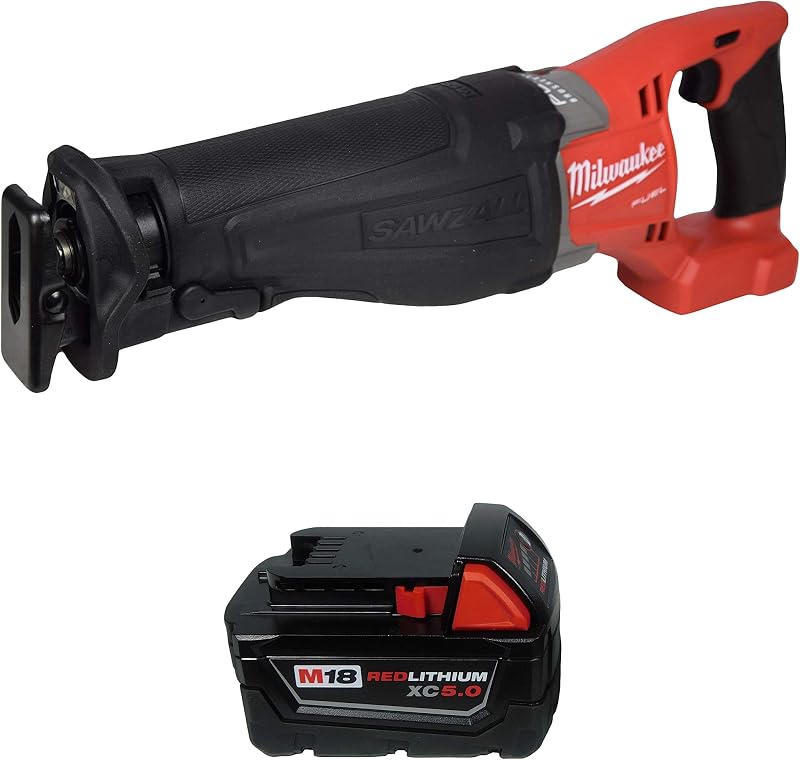
However, the Milwaukee 2720-20 compensates for its heavier frame with two invaluable jobsite convenience features: an integrated LED work light and a built-in hanging hook. The integrated LED illuminates dark stud bays, basements, and attic rafters, allowing you to track your cut line without wearing a headlamp. The fold-out hanging hook lets you hang the 7.4-pound tool directly onto a ladder rung, staging pipe, or 2×4 framing stud between cuts, preventing you from having to lower the tool to the floor. The DeWalt includes a pivoting adjustable shoe for depth control and blade life extension, but lacks an LED work light and hanging hook.
Edge: DeWalt DCS380 is easier to maneuver overhead at 2.41 kg, though the Milwaukee 2720-20 offers superior jobsite utility with its integrated LED and hanging hook.
Durability, Electronics, and Warranty Protection
Reciprocating saws operate in hostile environments filled with abrasive plaster dust, wet sawdust, and severe mechanical vibration. Long-term durability depends on how well the internal drivetrain is sealed and how intelligently the motor is managed under strain. The DeWalt DCS380 addresses mechanical contamination with a double oil sealed shaft. This dual-seal barrier prevents gritty particulate matter from migrating up the reciprocating shaft and into the gear chamber, directly extending the mechanical life of the reciprocating assembly.
Milwaukee takes a high-tech electronic approach to tool protection. The Milwaukee 2720-20 incorporates REDLINK PLUS Intelligence, an advanced hardware and software ecosystem that enables continuous communication between the tool, motor, and battery. This electronic safeguard monitors current draw and operating temperature in real time, automatically preventing tool damage caused by overloading, overheating, or deep battery discharge. When tackling abusive cutting tasks across your cordless lineup, as seen when comparing platforms like the dewalt dcs570 vs milwaukee 2730-20, electronic intelligence helps preserve expensive brushless motors from sudden thermal failure.
Warranty coverage provides the final peace of mind for professional users. The DeWalt DCS380 includes a standard 3 Year Limited Warranty, which provides solid protection against factory defects. However, Milwaukee backs the 2720-20 with a 5 Year Limited Warranty. When questioning is Milwaukee 2720-20 worth it for grueling commercial jobs, that additional two years of manufacturer backing combined with REDLINK PLUS electronic monitoring gives Milwaukee a decisive advantage in long-term ownership security for this DeWalt DCS380 vs Milwaukee M18 reciprocating saw matchup.
Edge: Milwaukee 2720-20 wins with active REDLINK PLUS electronic overload protection and a superior 5-year warranty period.
Pros and Cons
DeWalt DCS380

Pros
- Versatile 4-position blade clamp
- Fast 1-1/8-inch stroke length
- Lighter weight at 2.41 kg
- Double oil sealed shaft protection
Cons
- Lower 100-watt power rating
- Lacks integrated LED work light
Milwaukee 2720-20
Pros
- High-output 400-watt brushless motor
- REDLINK PLUS electronic overload protection
- Integrated LED light and hanging hook
- Generous 5-year limited warranty
Cons
- Heavier tool weight at 7.4 pounds
- Stroke length not listed in specifications
View Milwaukee 2720-20 on Amazon
Who Should Buy Each One
Choose the DeWalt DCS380 If
- You need the versatility of a 4-position blade clamp to make clean flush cuts against subfloors, ceiling joists, and wall studs.
- You want a lighter 2.41 kg saw that minimizes shoulder and arm fatigue during overhead pipe cutting or long framing days.
- You prefer physical mechanical safeguards like a double oil sealed shaft to resist drywall dust and abrasive debris.
- You already own DeWalt 20V MAX batteries and want a nimble reciprocating saw featuring a proven 1-1/8-inch stroke length.
Choose the Milwaukee 2720-20 If
- You need the heavy-duty muscle of a 400-watt POWERSTATE brushless motor to power through aggressive demolition tear-outs.
- You work in unlit basements, attics, or crawl spaces where an integrated LED work light is essential.
- You want the jobsite convenience of an integrated rafter hook to hang your tool between cuts while working on ladders.
- You want advanced REDLINK PLUS electronic overload protection supported by a comprehensive 5-year manufacturer warranty.
Final Verdict
For most contractors, carpenters, and residential remodelers, this DeWalt DCS380 review confirms that Side A provides the best overall cutting flexibility. While reciprocating saws are inherently rough tools, remodeling demands surgical adaptability. The 4-position keyless blade clamp on the DCS380 transforms difficult flush cuts into straightforward operations without requiring you to twist your wrists or flex blades to the snapping point. Paired with a controllable 0-3,000 SPM variable speed trigger, a rapid 1-1/8-inch stroke, and a manageable 2.41 kg chassis, the DeWalt DCS380 excels as a versatile, problem-solving saw for everyday residential construction.
On the other hand, our Milwaukee 2720-20 review demonstrates that Side B remains the undisputed powerhouse for heavy demolition and rough structural work. If your projects involve tearing down old decks, cutting through nail-laminated framing, or performing relentless commercial tear-outs, the 400-watt POWERSTATE brushless motor provides the raw output needed to prevent bogging down. With the added durability of REDLINK PLUS Intelligence, an integrated LED work light, a built-in hanging hook, and an industry-leading 5-year warranty, the Milwaukee 2720-20 is the superior investment when brute force and electronic durability matter more than multi-position flush cutting.
FAQ
Does the Milwaukee 2720-20 have a 4-position blade clamp like the DeWalt DCS380?
No, the Milwaukee 2720-20 features a tool-free blade clamp, but the listing does not specify multi-position or 4-position mounting options. The DeWalt DCS380 includes a patented lever-action clamp that allows you to lock the blade in four distinct orientations (up, down, left, right), making it significantly better suited for tight flush cutting against adjacent framing.
What is the difference in power between the DeWalt DCS380 and Milwaukee 2720-20?
According to the manufacturer listing specifications, the DeWalt DCS380 is rated at 100 watts, while the Milwaukee 2720-20 is rated at 400 watts. This substantial difference in electrical power allows the Milwaukee 2720-20 to maintain high blade speed and avoid stalling under heavy mechanical resistance during aggressive demolition cuts.
What are the stroke length and speed ratings on the DeWalt DCS380 vs Milwaukee 2720-20?
The DeWalt DCS380 listing specifies a 1-1/8-inch stroke length and a variable speed trigger delivering 0 to 3,000 strokes per minute (SPM). For the Milwaukee 2720-20, the listing highlights that it cuts faster than corded reciprocating saws, but the specific stroke length and stroke speed are not listed in the product specifications.
Is the Milwaukee 2720-20 worth it for heavy framing and demolition work?
Yes, the Milwaukee 2720-20 is specifically designed for punishing demolition tasks. Its 400-watt brushless motor, REDLINK PLUS electronic overload protection, adjustable shoe, and 5-year limited warranty make it an exceptional choice for heavy structural tear-outs where lesser motors might overheat or bog down.
Do either of these reciprocating saws come with a battery and charger included?
Both models in these listings are sold as bare tools. The DeWalt DCS380 listing specifies that it is a tool-only package (model DCS380B) requiring a DeWalt 20V MAX battery, while the Milwaukee 2720-20 listing specifies that it comes as a bare tool without the M18 REDLITHIUM XC5.0 battery pack or charger.
How do the warranties compare between the DeWalt DCS380 and the Milwaukee 2720-20?
The DeWalt DCS380 comes backed by a 3 Year Limited Warranty. In contrast, the Milwaukee 2720-20 includes a 5 Year Limited Warranty, providing two additional years of factory warranty protection against defects in materials and craftsmanship.