The choice between virtual surround sound and traditional stereo comes down to acoustic processing versus native signal purity. Virtual surround uses digital signal processing, psychoacoustic time delays, and phase modulation to project sound across three dimensions from a compact array, whereas traditional stereo routes unadulterated left and right audio channels directly to dedicated drivers to maintain natural harmonic fidelity and precise phase coherence.
Choose virtual surround if your priority is room-filling spatial immersion for movies and multichannel gaming without placing physical speakers in every corner of your room. Choose stereo if your listening focuses on music reproduction, uncolored sound staging, and straightforward, plug-and-play audio setups.



Virtual Surround vs Stereo at a Glance
| Feature | Virtual Surround | Stereo |
|---|---|---|
| Channel Architecture | Simulated multi-channel (up to 7.1ch with 3 main channels and 4 surround units) | Dedicated 2-channel (Left / Right) or 4-speaker stereo output |
| Signal Processing | Digital signal processing (DSP), psychoacoustic phasing, SurroundX algorithms | Direct analog or digital conversion without spatial virtualization |
| Soundstage Characteristics | Expanded 3D spatial field with simulated rear, front-to-back, and overhead depth | Linear, accurate horizontal soundstage between physical speakers |
| Dialogue and Vocal Handling | Dedicated center dialogue channel processing and AI vocal tuning | Phantom center image created by balancing left and right channels |
| Acoustic Tuning and EQ | Up to 121 preset EQ matrices and 10-band customizable frequency EQ | Basic tone adjustments or fixed stereo curves depending on receiver unit |
| Connectivity Options | Bluetooth 5.3, Optical, AUX, USB (HDMI not supported on select soundbars) | Bluetooth 5.0, 3.5mm AUX, USB, CD playback, FM radio, or RCA outputs |
| Peak Power Output | Up to 330 watts peak power (Aura A40 soundbar configuration) | 45 watts output wattage (Leadfan X7 car unit) or portable boombox wattage not listed |
| Best For | Home theater immersion, modern action gaming, and cinematic spatial effects | Critical music listening, legacy media playback, and simple dual-channel setups |
Spatial Audio Immersion and Soundstage Expansion
Spatial audio immersion defines how convincingly an audio format creates the sensation of an open, physical environment around the listener. In a standard listening space, human hearing determines the distance and direction of sounds based on Head-Related Transfer Functions (HRTF), measuring microscopic timing differences and frequency attenuations as sound waves reach each ear. Stereo audio relies strictly on two physical channels placed in front of the listener, constructing a horizontal stage that spans between the left and right speakers. While a well-mastered stereo track presents excellent left-to-right instrument panning, it cannot naturally project audio behind the listener or simulate vertical height without physical acoustic boundaries or multi-speaker arrays.
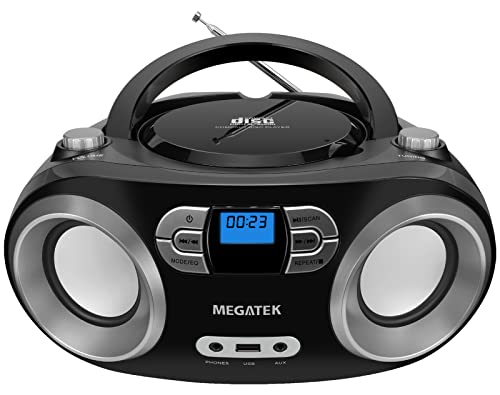
Virtual surround sound circumvents physical room limitations by using sophisticated digital algorithms that deliberately manipulate phase arrival times, frequency curves, and artificial reflections to deceive human ears into perceiving sound sources behind or above them. Hardware like the ULTIMEA 7.1ch Sound Bar w/Subwoofer demonstrates this design philosophy by combining three dedicated front channels with four surround speakers. Powered by SurroundX technology and AI audio tuning, this system actively synchronizes audio drivers across front-to-back projection paths and offers 13 adjustable surround levels. In comparison, traditional stereo devices such as the MEGATEK Portable CD Player Boombox deliver clear stereo sound restricted to a direct two-channel presentation without digital boundary widening.
The practical result of this difference becomes immediately obvious when comparing stereo sound vs 7.1 virtual surround in larger living rooms. While traditional stereo confines acoustic energy to the physical plane between the two speakers, virtual surround spatial immersion spreads ambient sound effects into the perimeter of the room. When evaluating modern acoustic gear, as discussed in the steelseries arctis nova pro wireless vs hyperx cloud ii audio analysis, expanding the perceived soundstage creates an enveloping atmosphere for media consumption. However, this wider acoustic field comes at the cost of slight imaging diffusion, whereas stereo keeps sound sources tightly localized along its horizontal axis.
Edge: Virtual Surround. Advanced digital signal processing and dedicated surround satellite speakers project an expansive, three-dimensional acoustic environment that traditional dual-channel stereo cannot replicate in open living spaces.
Acoustic Clarity and Signal Accuracy
Acoustic clarity measures how faithfully an audio system reproduces the original recording without adding unwanted harmonic distortion, phase cancellation, or algorithmic artifacts. When evaluating audio fidelity, the purity of the source signal is paramount. Every layer of digital signal processing applied to an audio track introduces the risk of comb filtering-a phenomenon where identical sound waves slightly out of phase cancel out specific frequencies, resulting in a hollow or metallic acoustic tone. Maintaining vocal clarity and crisp instrumental separation requires an audio system that preserves clean transient responses across the entire audible frequency spectrum.
In a detailed virtual surround sound review, the extent to which digital signal processing alters the original source material becomes clear. The ULTIMEA Aura A40 employs AI audio tuning alongside 121 preset equalizer matrices and a 10-band equalizer to fine-tune sound across styles like Bass, Pop, Classical, and Rock. While these digital tools help maintain 99.99% detail accuracy according to its manufacturer specifications, virtualizing audio across multiple simulated channels requires continuous phase manipulation. Conversely, a standard stereo audio review demonstrates that two-channel hardware, such as the Leadfan X7 car receiver with its 45-watt 4-channel stereo output, routes unadulterated audio directly to the speaker drivers, preserving harmonic stability without algorithmic phase shifting.
For purists seeking natural timbre, stereo avoids the processing overhead inherent in spatial upmixing. While virtual surround sound clarity has improved through AI-assisted dialogue enhancement and dedicated center channels, complex acoustic instruments, jazz ensembles, and vocal harmonies can sound unnatural when stretched across a virtual 7.1 matrix. Stereo keeps vocal frequencies centered and instruments balanced exactly as the sound engineer recorded them in the studio, ensuring unmatched dynamic authenticity.
Edge: Stereo. By routing untouched audio signals directly to speaker channels without artificial phase shifting or spatial processing, stereo maintains higher harmonic fidelity and natural tonal clarity.
Movie Performance and Cinematic Effects
Modern film soundtracks are mixed in complex multichannel formats like 5.1, 7.1, or object-based audio systems where sound designers place specific audio events around the viewer. Film audio tracks demand three distinct acoustic capabilities: pinpoint dialogue intelligibility anchored to the center of the screen, powerful low-frequency effects for cinematic impacts, and ambient spatial cues that put the audience inside the scene. When deciding between virtual surround or stereo for movies, the way each format handles multi-channel audio tracks dictates the overall home theater experience.
Comparing a virtual surround soundbar vs stereo highlights significant hardware and architectural differences. The ULTIMEA Aura A40 soundbar addresses cinematic demands with three dedicated front channels engineered specifically for dialogue clarity, accompanied by a subwoofer capable of reaching down to an 18 Hz frequency response and delivering 330 watts of peak power. Its hybrid satellite setup features two wired front surround speakers and two rear surround speakers that pair wirelessly with the soundbar, projecting audio from front to back across 13 adjustable surround levels. In contrast, standard stereo setups downmix multichannel film audio into two flat channels, forcing dialogue, orchestral scores, and background explosions through the same two speakers simultaneously.
This downmixing creates real performance limitations during action-heavy cinema scenes. In a stereo configuration, a phantom center image is created by splitting speech equally between the left and right speakers, which frequently causes dialogue to become muffled beneath loud musical scores and explosive sound effects. Virtual surround sound systems solve this problem by isolating dialogue on a dedicated physical center channel while steering ambient atmospheric sounds outward. The result is a dramatically more engaging cinematic presentation where whispers remain intelligible and off-screen vehicles convincingly pan across the room.
Edge: Virtual Surround. Dedicated center dialogue channels, low-frequency subwoofers reaching down to 18 Hz, and multi-speaker SurroundX algorithms render dynamic cinematic soundscapes that two-channel stereo cannot match.
Gaming Performance and Directional Sound Cues
Video game audio serves two distinct purposes: atmospheric world-building in single-player narrative campaigns, and tactical directional awareness in competitive multiplayer titles. Competitive players rely on acoustic cues to pinpoint enemy footsteps, weapon reloads, and ballistic trajectories in high-stakes environments. The debate between virtual surround or stereo for gaming revolves around whether spatial virtualization provides a competitive tactical advantage or introduces unnecessary audio clutter that masks vital information.
Virtual surround sound processing expands the field of view in gaming by simulating acoustic distance and environmental reverberation. In gaming headset hardware comparisons, such as the logitech g pro x 2 vs hyperx cloud ii evaluation, spatial processing software allows players to feel the scale of open-world environments. Systems like the ULTIMEA Aura A40 feature dedicated Game EQ modes among their six tailored presets to boost environmental effects and spatial separation. However, virtualized processing can introduce slight positional ambiguity, as psychoacoustic algorithms alter audio frequencies to simulate distance, sometimes making a nearby enemy sound farther away than they actually are.
Stereo, on the other hand, provides direct, zero-latency panning along the horizontal stereo field. In high-speed tactical shooters where gamers pair precision audio with fast peripherals-a balance explored in our steelseries aerox 5 vs glorious model o 2 guide-unaltered stereo audio gives players instantaneous, razor-sharp feedback on whether a threat is to their immediate left or right. While stereo lacks the vertical height and simulated rear depth of virtual surround, its spatial tracking remains completely predictable and free from processing artifacts.
Edge: Tie. Virtual surround creates superior atmospheric immersion in narrative and open-world titles, while stereo offers sharper, uncolored directional precision for competitive multiplayer gaming.
Setup Complexity, Connectivity, and Tuning
The convenience of an audio setup depends heavily on cable management, hardware footprint, connectivity options, and how much configuration is required to achieve optimal sound quality. Living rooms, bedrooms, and vehicle interiors each impose strict spatial constraints that determine whether an elaborate multi-speaker virtual system is practical or if a self-contained stereo unit makes more sense. Examining stereo vs virtual surround through the lens of user setup reveals vastly different operational demands.
Virtual surround systems that feature satellite speakers require careful physical placement and signal pairing. The ULTIMEA Aura A40 utilizes a hybrid connection: the soundbar connects to two front surround speakers via dedicated FR and FL cables, while two rear surround speakers connect together via a rear cable and synchronize wirelessly to the main soundbar. In addition, deep customization requires the Ultimea smart app, which controls 121 preset EQ matrices, 10-band equalizer settings, and over-the-air (OTA) firmware updates via Bluetooth 5.3. On the physical port side, the unit includes optical, AUX, and USB inputs, but the listing explicitly notes that it does not support HDMI, meaning users must rely on optical or analog connections for TV audio.
Stereo hardware simplifies daily operation by eliminating multi-speaker cable routing and app dependencies. The Leadfan X7 double-DIN car stereo integrates a 7-inch 1024×600 touchscreen, Bluetooth 5.0, front USB, SD, and AUX ports, plus rear RCA outputs that allow users to connect external amplifiers and subwoofers directly without configuring wireless sync channels or wireless satellite pairing. Meanwhile, self-contained units like the MEGATEK boombox offer total portability with CD-R/RW playback, FM radio, and AC or battery power. When asking is virtual surround worth it, buyers must weigh the time required to manage speaker cables and smartphone app equalization against the straightforward, plug-and-play simplicity of standard stereo hardware, a dynamic similarly evaluated in our hyperx cloud ii vs corsair virtuoso pro product comparison.
Edge: Stereo. Stereo systems avoid multi-speaker wiring layouts, wireless satellite pairing procedures, and mobile app tuning requirements, delivering instant operation with minimal setup friction.
Pros and Cons
Virtual Surround

Pros
- 330-watt peak power output
- 121 preset EQ matrices
- Dedicated center dialogue channel
- 13 adjustable surround levels
- Subwoofer reaches 18 hertz response
Cons
- Does not support HDMI connections
- Requires wired cables between front speakers
- Spatial DSP can alter music timbre
View ULTIMEA 7.1ch Sound Bar w Subwoofer on Amazon
Stereo

Pros
- Pure two-channel phase coherence
- Simple plug-and-play operation
- Direct RCA amplifier and subwoofer expansion
- Supports legacy CD and FM playback
Cons
- Lacks 3D spatial soundstage immersion
- No dedicated center dialogue channel
- Downmixes multichannel movie soundtracks
View USB Playback Clear Stereo Sound AUX on Amazon
Who Should Buy Each One
Choose Virtual Surround If
- You want room-filling cinematic audio for movies and television without installing a full AV receiver and seven separate in-wall speakers.
- You frequently play open-world, role-playing, or story-driven video games where atmospheric 3D soundscapes heighten the sense of exploration.
- You appreciate deep acoustic customization, such as fine-tuning 10-band equalizer curves and selecting from 121 EQ matrices using a smartphone app.
- You struggle with muffled dialogue in movies and need dedicated center-channel speaker drivers with AI audio tuning to isolate vocal tracks.
Choose Stereo If
- Your primary audio activity is critical music listening, where unmanipulated two-channel phase coherence and authentic instrument timbre matter most.
- You want a simple, plug-and-play sound system that operates without companion smartphone apps, OTA firmware updates, or wireless pairing steps.
- You require a compact, self-contained audio solution for a vehicle, desktop, or workshop that plays legacy media like CDs or FM radio broadcasts.
- You play competitive multiplayer shooters where direct, uncolored left-to-right stereo panning provides the fastest tactical audio feedback.
Final Verdict
For home theater spaces and modern multimedia entertainment centers, virtual surround is the best choice for most listeners. By combining dedicated multi-channel driver arrays-such as the 330-watt peak output and 18 Hz low-frequency capabilities of the ULTIMEA system-with digital SurroundX processing and AI vocal tuning, virtual surround expands audio far beyond physical enclosure boundaries. It delivers the atmospheric depth, directional panning, and dialogue isolation needed to bring modern Hollywood movies and open-world video games to life without requiring an entire room full of traditional audio components.
However, stereo remains the preferred solution for listeners who value harmonic accuracy, acoustic simplicity, and signal purity. If your entertainment focuses on streaming music, spinning compact discs, or maintaining a straightforward two-channel audio system in a car or bedroom, stereo completely eliminates digital phase artifacts and complicated speaker wiring. By delivering unmanipulated audio straight from the source to your ears, stereo guarantees dependable fidelity and effortless operation every time you press play.
FAQ
Does virtual surround sound work without physical rear speakers?
Virtual surround sound uses digital signal processing and psychoacoustic algorithms to simulate rear and lateral sound cues by manipulating audio phase and arrival times. However, systems that include physical satellite speakers, such as the ULTIMEA 7.1ch system with its front and rear surround modules, achieve substantially more convincing spatial immersion than single-piece soundbars that rely entirely on bouncing audio off room walls.
Why do audiophiles prefer stereo for listening to music?
Most commercial music tracks are recorded, mixed, and mastered specifically for two-channel stereo playback. Applying virtual surround processing to stereo music forces the audio through digital upmixing algorithms that can introduce artificial reverb, comb filtering, and phase distortion, altering the original tonal balance and instrument placement intended by the artist.
Is virtual surround or stereo better for competitive gaming?
Stereo is generally preferred for competitive multiplayer gaming because it delivers direct, uncolored left-to-right spatial panning with zero processing latency. While virtual surround creates a larger and more atmospheric soundstage for narrative single-player titles, its simulated reflections can slightly obscure the exact distance and location of critical footsteps in fast-paced tactical shooters.
Can a virtual surround soundbar connect to TVs that lack HDMI ARC?
Yes, many virtual surround soundbars support multiple legacy audio connections. For example, the ULTIMEA Aura A40 listing states that it does not support HDMI, but it provides optical, AUX, USB, and Bluetooth 5.3 inputs, allowing it to connect directly to TVs, gaming consoles, and computers through standard digital optical or analog 3.5mm cables.
What is the difference between true 7.1 surround and 7.1 virtual surround?
A true 7.1 surround sound system requires seven separate physical speakers positioned around the listening area alongside an independent subwoofer, with each speaker fed by a dedicated discrete audio channel from an AV receiver. A 7.1 virtual surround system uses fewer physical speakers and relies on digital signal processing algorithms like SurroundX to psychoacoustically simulate the missing surround channels.
Does stereo audio provide dedicated dialogue enhancement?
Standard stereo creates a phantom center channel by playing vocal frequencies at identical volume levels through both the left and right speakers simultaneously. Unlike virtual surround systems that feature dedicated physical center speakers and AI dialogue tuning to boost vocal clarity independently, a stereo system cannot raise speech volume without increasing the overall volume of the entire soundtrack.