The core difference between the HyperX Cloud II and the Corsair Virtuoso Pro lies in acoustic architecture: the Cloud II uses a traditional closed-back ear cup that isolates background noise and channels audio through hardware virtual 7.1 surround sound, whereas the Virtuoso Pro employs an open-back design paired with high-resolution graphene drivers to present a natural, breathable soundscape.
Choose the Cloud II if you play in loud environments and want passive noise blocking with plug-and-play USB hardware processing. Choose the Virtuoso Pro if you prioritize an expansive acoustic presentation for streaming, voice monitoring, and audio creation in a controlled home setting.


HyperX Cloud II vs Corsair Virtuoso Pro at a Glance
| Feature | HyperX Cloud II | Corsair Virtuoso Pro |
|---|---|---|
| Acoustic Architecture | Closed-Back (Passive Isolation) | Open-Back (Free Airflow) |
| Driver Size & Material | 53mm Dynamic | 50mm Graphene |
| Frequency Response | 15 Hz – 25,000 Hz | 20 Hz – 40,000 Hz |
| Audio Processing | Hardware-driven Virtual 7.1 Surround Sound | Stereo with Elgato Wave Link & VST Integration |
| Microphone | Detachable Noise-Cancelling (Discord / TeamSpeak Certified) | Detachable Uni-Directional Noise-Cancelling |
| Primary Connection | USB Control Box (or 3.5mm) | 3.5mm Audio Cable |
| Weight | 11.29 ounces | 11.84 ounces |
| Frame Construction | Durable Aluminum Frame | Not listed |
| Included Accessories | USB control box, extra ear cushions, airplane adapter, mesh bag | Audio cable, black carrying case |
| Best For | Competitive esports isolation and immersion | Content creation, streaming, and open acoustic listening |
Acoustic Design and Soundstage Performance
The acoustic format of an ear cup shapes everything you hear during long competitive sessions. The Cloud II utilizes a closed-back frame engineered to physically seal your ears from your surroundings. This closed chamber locks the audio inside, preventing sound leakage and offering passive noise cancellation that blocks ambient household chatter, clicking mechanical switches, or computer cooling fans. For gamers who must maintain focus inside noisy tournament halls or shared living spaces, this physical isolation is indispensable for tracking subtle environmental cues like footfalls or weapon reloading.
In contrast, the corsair virtuoso pro open back gaming headset takes the opposite approach by using an airy open-back architecture. The outer ear cups are vented to permit free airflow, eliminating the compressed resonance chamber typical of closed gaming gear. This design produces a wide, lifelike corsair virtuoso pro soundstage that mimics listening to high-end desktop monitors rather than miniature speakers clamped against your ears. Positional audio feels naturally distant rather than artificially simulated inside your skull, allowing audio engineers and content creators to place sound objects with high spatial precision.
The trade-off is isolation versus transparency. The Cloud II prevents your microphone from picking up game audio bleeds and shields you from room noise, but sound can feel narrow and localized right between your ears. The Virtuoso Pro gives your ears breathing room, keeping them cool during marathons and letting you hear your own voice naturally without digital sidetone. However, every room sound leaks into your ears, and your game audio leaks outward into the room. If you want to see how open acoustics compare to high-end wireless gear, reading a breakdown like the corsair virtuoso pro vs astro a50 x shows how fundamental this physical cup difference remains across price categories.
Edge: Corsair Virtuoso Pro for users with quiet rooms who demand natural acoustics, while Cloud II wins for players needing physical noise isolation.
Driver Technology and Audio Fidelity
Headset drivers transform electrical signals into mechanical waves, and their physical material governs frequency precision. Inside the Cloud II sits a pair of large 53mm dynamic drivers tuned with a frequency response spanning 15 Hz to 25,000 Hz. These large drivers focus heavily on delivering low-end impact. In tactical titles, explosions carry physical reverberation and bass transients feel solid. The extended low-end response down to 15 Hz produces deep sub-bass rumble, giving games a cinematic weight that keeps players absorbed in the action.
Corsair counters with state-of-the-art 50mm graphene drivers on the Virtuoso Pro, pushing an expansive frequency bandwidth of 20 Hz to 40,000 Hz. Graphene is exceptionally rigid and lightweight compared to traditional mylar or neodymium assemblies, which minimizes diaphragm distortion across dynamic peaks. This ultra-wide top end reaches 40 kHz, allowing the Virtuoso Pro to resolve intricate micro-details-such as brass casing bounces, delicate reverb tails, and multi-layered dialogue-with clean separation. In any serious corsair virtuoso pro review, audio resolution and clean instrument separation stand out as its strongest attributes.
When assessing the HyperX Cloud II vs Corsair Virtuoso Pro for pure listening fidelity, the Virtuoso Pro behaves like a studio monitor headset. It reveals compression artifacts and subtle mixing errors that the Cloud II tends to smooth over. The Cloud II delivers a gamer-friendly acoustic profile with warmer mids and punchier low frequencies, while the Virtuoso Pro delivers clinical accuracy, making it better suited for critical media listening and stream mix mastering. Those considering newer iterations of the Cloud platform can look into our hyperx cloud alpha wireless vs corsair virtuoso pro comparison to see how battery-driven platforms stack against wired open drivers.
Edge: Corsair Virtuoso Pro, owing to its high-resolution 40 kHz graphene driver technology that avoids high-volume diaphragm distortion.
Surround Sound Processing and Spatial Audio
Surround sound implementations determine how intuitively you perceive threats around your character. The Cloud II tackles directional processing via an included hardware-driven USB audio control box that processes virtual 7.1 surround sound on PC and Mac. Because the sound card handles the algorithmic expansion internally, you get one-touch virtual surround activation without installing bloated driver packages or system-hogging background suites. In practical gameplay, this virtual surround adds artificial room reflection and distance simulation to expand the boundary of the closed ear cups.
The Virtuoso Pro bypasses built-in virtual 7.1 hardware cards completely, opting instead for pure, unaltered stereo output driven directly through its 3.5mm connection. Instead of synthetic processing on the cord, Corsair relies on the physical open-back chamber to supply natural soundstage depth. For creators managing complex streaming pipelines, the headset integrates directly into the Elgato Wave Link ecosystem, supporting Wave microphones, Wave XLR interfaces, and Stream Deck + hardware. This configuration lets users apply third-party VST spatial plugins or Windows Sonic spatial audio directly at the software mixing stage.
Comparing hyperx cloud ii surround sound vs virtuoso pro reveals two divergent design philosophies. The Cloud II provides a turnkey hardware button that expands positional depth instantly for non-technical gamers playing on PC, Mac, or PS4. The Virtuoso Pro gives power users clean uncompressed stereo audio, letting modern game engines or Elgato software modules calculate positional placement without double-processing artifacts. If you prefer uncolored spatial accuracy, native open stereo proves cleaner than simulated virtual channels.
Edge: HyperX Cloud II for fast, single-button hardware surround deployment; Corsair Virtuoso Pro for clean spatial compatibility with modern software engines.
Microphone Quality and Streaming Integration
Clear communication is mandatory for competitive squad play and digital broadcasting. HyperX equips the Cloud II with a detachable, noise-cancelling microphone that carries official TeamSpeak and Discord certifications. The capsule focuses primarily on speech intelligibility, filtering out room echo and low-frequency rumble so teammates hear critical calls above chaotic gunfights. Because the mic attaches directly into the left ear cup via a standard 3.5mm terminal, it can be quickly detached when you use the headset purely for single-player gaming or media consumption.
The Corsair Virtuoso Pro features a detachable uni-directional noise-cancelling microphone built directly into its specialized cable assembly. What sets the Virtuoso Pro apart for broadcasters is its deep synergy with Elgato Wave Link and NVIDIA Broadcast software. Users can route microphone signals through GPU-accelerated background noise suppression, artificial room echo cancellation, and parametric EQ VST plugins. For creators asking whether the hyperx cloud ii or corsair virtuoso pro for streaming fits their setup best, Corsair’s modular software routing makes it easy to integrate into professional broadcast boards.
Evaluating hyperx cloud ii vs corsair virtuoso pro mic hardware comes down to simplicity versus workflow depth. The Cloud II microphone is completely plug-and-play, delivering solid, interference-free communications across consoles and PCs with zero setup time. The Virtuoso Pro provides a broadcast-ready foundation that flourishes when tied to digital audio workstations and Elgato hardware controllers. Readers evaluating closed broadcast options should also read our razer blackshark v2 pro vs corsair virtuoso pro breakdown to compare broadcast mics across disparate cup architectures.
Edge: Corsair Virtuoso Pro for content creators utilizing Elgato and NVIDIA Broadcast tools; Cloud II for zero-friction console and PC squad chat.
Comfort, Build Quality, and Portability
Physical construction dictates how a headset feels after six hours of continuous wear. The Cloud II has long held a reputation in esports for endurance, featuring an 11.29-ounce build anchored by a solid, flexible aluminum frame. The headband is padded with dense leatherette, and the ear cups house signature memory foam that molds around glasses and jawlines. HyperX also bundles an extra pair of ear cushions in the box, giving users the choice to swap materials when preferences change. A lightweight travel mesh bag and an airplane headphone adapter round out the travel-ready package.
The Virtuoso Pro weighs 11.84 ounces, making it slightly heavier than the Cloud II, but it distributes that mass effectively through soft memory foam ear cushions and an open-ear enclosure that relieves acoustic pressure buildup against the eardrums. Because open-back ear cups facilitate continuous ambient airflow, the Virtuoso Pro eliminates the heat and sweat buildup common to sealed leatherette headsets during intense gaming or long streaming sessions. The headset ships with a durable black carrying case, offering rigid protective storage for the open grills and delicate graphene drivers during transport.
Material differences define their practical durability. The Cloud II uses exposed aluminum forks that flex easily and survive accidental drops, baggage transit, and aggressive handling. The Virtuoso Pro provides luxurious long-form listening comfort and superior ear temperature management, but its open-mesh grills expose sensitive internal driver diaphragms to dust, moisture, and pet hair if left unprotected on a messy desk. If you want to see how HyperX refined its comfort design in subsequent generations, review the logitech g pro x 2 vs hyperx cloud iii guide.
Edge: Tie. Cloud II wins on rugged structural resilience with its aluminum frame; Virtuoso Pro wins on thermal comfort and pressure relief during extended sessions.
Platform Compatibility and Connectivity
Connectivity options determine how seamlessly a headset interfaces across your hardware fleet. The Cloud II utilizes a dual-mode connection system. It connects directly via a 3.5mm analog plug to mobile devices, Nintendo Switch, PS4, and Xbox One (requiring a Microsoft adapter on older gamepads). Alternatively, you can connect through the included USB audio control box, which delivers amplified volume, microphone gain toggles, and virtual 7.1 surround sound support on PC, Mac, and PS4 systems. The listing confirms it does not support legacy Xbox 360 or PS3 consoles.
The Virtuoso Pro streamlines its input by utilizing a dedicated 3.5mm analog headphone jack and detachable cable. By sticking to pure wired 3.5mm analog transmission, Corsair ensures universal compatibility across PC, Mac, PlayStation, Xbox, Nintendo Switch, audio interfaces, and external DAC/amp setups. While the product listing mentions infrared under its wireless specifications field, the primary connectivity is entirely wired, meaning there are no internal batteries to recharge, no latency degradation, and no pairing rituals.
This difference highlights how each device handles amplification. The Cloud II provides its own internal DAC and sound card via the USB control box, making it independent of low-grade motherboard audio chips on PC. The Virtuoso Pro relies completely on the output power of whatever device you plug it into; while its 3.5mm cable works everywhere, pairing it with a high-grade interface like the Elgato Wave XLR unlocks its 40 kHz graphene driver potential. Gamers weighing wired simplicity against advanced wireless options can read our logitech g pro x 2 vs hyperx cloud alpha wireless comparison for more platform routing perspectives.
Edge: HyperX Cloud II, thanks to its bundled USB DAC control box that provides amplified volume and independent controls out of the box.
Pros and Cons
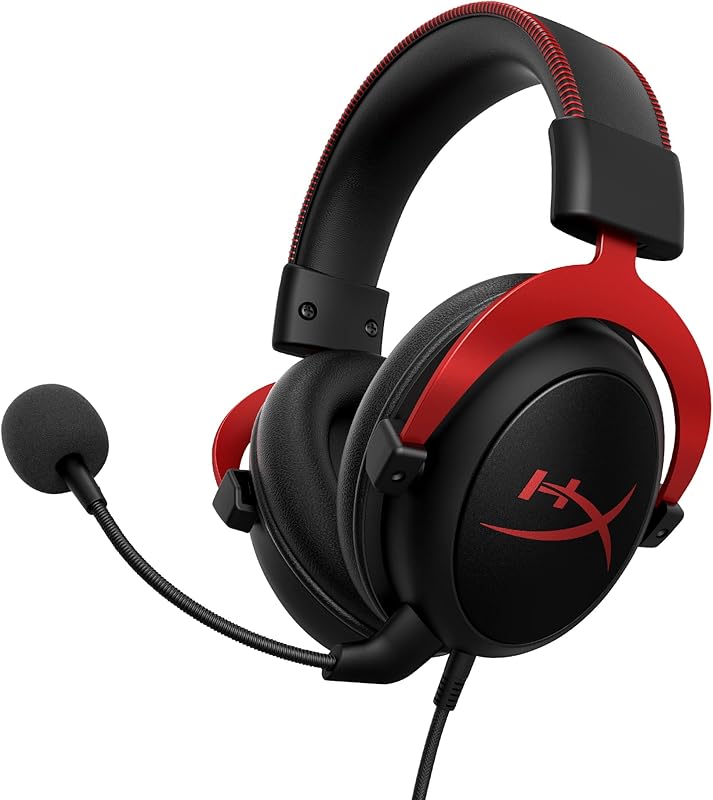
HyperX Cloud II
Pros
- Closed-back design provides effective passive noise isolation
- Hardware-driven USB virtual 7.1 surround sound card
- Rugged build with durable aluminum frame
- Includes extra ear cushions and airplane adapter
Cons
- Narrower soundstage than open-back headphones
- Closed cups cause ear heat buildup during marathons
View HyperX Cloud II on Amazon
Corsair Virtuoso Pro

Pros
- Expansive natural soundstage via open-back ear cups
- High-fidelity 50mm graphene drivers reaching 40 kHz
- Deep integration with Elgato Wave Link and VSTs
- Continuous airflow keeps ears cool during long sessions
Cons
- Sound leaks into the surrounding room
- Zero passive noise isolation in loud environments
View Corsair Virtuoso Pro on Amazon
Who Should Buy Each One
Choose the HyperX Cloud II If
- You play games in noisy environments, dorm rooms, or shared living spaces where you need physical passive noise isolation to concentrate.
- You want plug-and-play virtual 7.1 surround sound processing on PC or PS4 without installing complex software packages.
- You need an exceptionally durable aluminum frame that can withstand daily knocks and frequent transport in a backpack.
- You prefer a warm, bass-forward sound signature that emphasizes low-end explosion impacts and cinematic sound design.
Choose the Corsair Virtuoso Pro If
- You stream, broadcast, or create content in a quiet room and want an airy open-back soundstage that lets you monitor your own voice naturally.
- You use Elgato equipment like the Wave Link mixer, Wave XLR, or Stream Deck + and want direct software integration with VST audio plugins.
- You demand audiophile-grade detail resolution across high frequencies using 50mm graphene drivers reaching up to 40,000 Hz.
- Your ears overheat easily inside closed leatherette ear cups and you want continuous thermal airflow during long sessions.
Final Verdict
The choice between these two headsets ultimately comes down to acoustic isolation versus acoustic airiness. For the vast majority of competitive players asking which is better-hyperx cloud ii or corsair virtuoso pro for gaming-the Cloud II remains the practical champion. Its closed-back design shuts out external distractions, its aluminum construction handles relentless daily abuse, and its integrated USB control box provides instant 7.1 spatial widening on PC without configuration headaches. It delivers an impactful, bass-rich experience tailored specifically for players who want to jump straight into matches without tweaking audio curves.
However, when evaluating whether the corsair virtuoso pro is worth it, creators and serious desktop audio enthusiasts will find Corsair’s open-back model in a completely different acoustic tier. By deploying 50mm graphene drivers with an extended 40 kHz frequency ceiling and blending them with Elgato Wave Link software compatibility, the Virtuoso Pro provides reference-grade separation, uncompressed sound staging, and exceptional vocal feedback. If you possess a quiet room and prioritize natural fidelity for streaming, content production, and pristine stereo gaming, the Virtuoso Pro is the superior acoustic investment.
FAQ
Does the Corsair Virtuoso Pro leak sound into the room?
Yes. Because the Virtuoso Pro uses an open-back design with vented outer ear cups, audio escapes into your immediate environment. If you play at loud volumes in the same room as someone else, or sit right beside an ultra-sensitive studio condenser microphone, sound leakage will be audible.
Can I use the HyperX Cloud II virtual 7.1 surround sound on consoles?
The USB sound card control box supports virtual 7.1 surround sound on PC, Mac, and PS4. When connected via standard 3.5mm analog to an Xbox controller, Nintendo Switch, or mobile device, the headset functions as a stereo headset without hardware 7.1 processing.
Is the Corsair Virtuoso Pro microphone detachable?
Yes. The Virtuoso Pro features a detachable uni-directional noise-cancelling microphone built into its audio cable assembly. This allows you to remove the boom mic entirely if you prefer to use a standalone desktop USB or XLR microphone for streaming.
Does the HyperX Cloud II require driver software to function?
No. The Cloud II is a driverless, hardware-driven device. Its USB audio control box handles all amplification, volume adjustments, microphone muting, and virtual 7.1 surround toggling directly on the cord, eliminating the need to install third-party background software.
Which headset is lighter for long gaming marathons?
The Cloud II is slightly lighter at 11.29 ounces compared to the Virtuoso Pro at 11.84 ounces. However, the Virtuoso Pro reduces long-term physical fatigue through its open-back ear cups, which allow continuous airflow to keep your ears cooler than closed leatherette pads.
Can I connect the Corsair Virtuoso Pro directly to an audio interface?
Yes. The Virtuoso Pro terminates in a standard 3.5mm audio jack, allowing you to connect it directly to audio interfaces, headphone amplifiers, mixers like the Elgato Wave XLR, or standard PC audio outputs without proprietary adapters.