Choosing between the HyperX Cloud III and the HyperX Cloud Alpha Wireless comes down to a fundamental choice between universal wired accessibility and marathon battery autonomy. The Cloud III eliminates charging entirely while delivering multi-platform connectivity across consoles and computers via 3.5mm, USB-C, and USB-A connections, backed by an enlarged 10mm microphone capsule. In contrast, the Cloud Alpha Wireless frees your desk from cables through a 2.4GHz wireless connection and delivers an industry-leading 300-hour battery life alongside dual chamber audio drivers.
Gamers who switch between consoles, PC, and mobile platforms or demand uncompressed wired vocal capture should select the Cloud III, while dedicated desktop players wanting weeks of cable-free gaming without battery anxiety should choose the Cloud Alpha Wireless.


HyperX Cloud III vs Cloud Alpha Wireless at a Glance
| Feature | HyperX Cloud III | HyperX Cloud Alpha Wireless |
|---|---|---|
| Connection Type | Wired (3.5mm, USB-C, USB-A) | Wireless (2.4GHz via USB Adapter) |
| Battery Life | Unlimited (Passive Wired) | Up to 300 Hours |
| Acoustic Driver Design | Angled 53mm Drivers | Dual Chamber Drivers |
| Frequency Response | Not listed | 15 Hz – 21 kHz |
| Surround / Spatial Audio | Spatial Audio | DTS Headphone:X Spatial Audio |
| Microphone Hardware | Detachable 10mm Noise-Cancelling with LED Mute Indicator | Detachable Noise-Cancelling with Pop Filter |
| Frame Construction | Flexible Aluminum Frame | Durable Aluminum Frame |
| Ear Cushion Material | Plush Signature Memory Foam | Signature Memory Foam & Breathable Leatherette |
| Software Support | Not listed | HyperX NGENUITY Software |
| Platform Compatibility | PC, PS5, Xbox Series X|S, Xbox One, Switch, Mac, Mobile | PC, Multi-platform |
| Best For | Multiplatform Console & PC Players | Long-Session PC Gamers Seeking Cord Freedom |
Battery Life and Power Management
Battery maintenance fundamentally dictates the daily rhythm of gaming headsets. When examining HyperX Cloud III vs Cloud Alpha Wireless battery life, the two headsets represent completely opposite philosophies of power management. The Cloud Alpha Wireless features an internal rechargeable power cell rated for up to 300 hours of continuous gaming on a single charge when tested at 50% headphone volume. This extraordinary capacity allows users to complete entire game campaigns or game for multiple weeks at a time without ever plugging the headset into a wall outlet or host port. When recharging is eventually required, the package provides a dedicated USB charge cable to replenish the headset.
The Cloud III sidesteps the entire battery paradigm by utilizing an analog and wired digital architecture. Because it draws power directly through its 3.5mm auxiliary lead or connected USB adapters, the headset never powers off mid-match, never degrades in performance as an internal cell ages, and requires zero downtime for charging. For competitive tournaments or marathon gaming where plugging in a peripheral to charge is unacceptable, the wired reliability of the Cloud III is an absolute safeguard. Readers evaluating extended battery capacity in wireless peripherals can observe how this compares to other premium wireless alternatives in our logitech g pro x 2 vs hyperx cloud alpha wireless analysis.
Deciding if the convenience of cutting the cord is worth monitoring power depends on your play style. The Cloud Alpha Wireless lets you walk away from your desk, stretch, or grab a drink without taking off your earcups, while its 300-hour reservoir makes battery exhaustion a rare event. For players who simply refuse to manage charge cycles, firmware power states, or peripheral sleep timers, the Cloud III remains ready at all times simply by plugging in a cable.
Edge: HyperX Cloud Alpha Wireless for its unprecedented 300-hour battery capacity that delivers unmatched cord-free endurance.
Platform Compatibility and Connection Interfaces
Connection versatility determines how freely a headset integrates into a varied gaming ecosystem. The Cloud III stands out as an exceptionally versatile multiplatform solution. HyperX equips the Cloud III with a baseline 3.5mm analog connection, accompanied by a detachable USB to 3.5mm cable and a USB-C adapter. This hardware combination allows the headset to plug natively into PC, PlayStation 5, Xbox Series X|S, Xbox One, Nintendo Switch, Mac, and mobile devices. Because it handles standard 3.5mm analog inputs directly on console controllers alongside digital USB-A and USB-C audio ports on desktops and laptops, switching hardware takes mere seconds without requiring pairing modes or dongle reassignments.
The Cloud Alpha Wireless is engineered around an ultra-low-latency 2.4GHz wireless connection transmitted through an included USB wireless adapter. While the listing notes multi-platform compatibility, the headset is tailored heavily around PC gaming, where access to the dedicated HyperX NGENUITY software unlocks its full suite of features. Furthermore, because the Cloud Alpha Wireless relies on its 2.4GHz USB wireless dongle and lacks an analog 3.5mm interface, it cannot plug directly into analog audio jacks such as standard Xbox controllers or mobile devices lacking USB host audio support. Players wondering how HyperX wired headsets slot into diverse hardware environments can also reference our hyperx cloud iii vs astro a50 x guide.
When assessing HyperX Cloud III or Cloud Alpha Wireless for PS5 and other console ecosystems, the Cloud III holds a distinct advantage. It connects directly to the DualSense controller via the 3.5mm plug or slots into the console USB ports using the supplied adapters, whereas the Cloud Alpha Wireless requires an open USB port to host its dongle and cannot interface with Xbox consoles. If you maintain a shared desk with multiple consoles alongside your computer, the wired Cloud III provides universal hardware access that the wireless model cannot match.
Edge: HyperX Cloud III due to its exhaustive compatibility spanning PC, Xbox, PlayStation, Switch, and mobile via 3.5mm, USB-C, and USB-A.
Acoustic Architecture and Sound Quality
The internal engineering of headphone acoustic cavities shapes how you perceive explosive bass, directional footstep audio, and mid-range dialogue. Analyzing Cloud Alpha Wireless sound quality reveals HyperX Dual Chamber Drivers, a system engineered to tune the midrange and high frequencies separately from the bass-heavy low frequencies. By separating the bass frequencies into a distinct acoustic chamber within the circumaural earcup, the Cloud Alpha Wireless prevents low-frequency resonance from muddying delicate vocal callouts or high-register sound effects. The drivers also feature a broad frequency response spanning 15 Hz to 21 kHz, covering sub-bass rumble all the way through upper treble details.
The Cloud III uses newly retuned 53mm dynamic drivers that are physically angled within the earcups. HyperX audio engineers angled these 53mm drivers to channel audio directly into the listener’s ear canals, optimizing sound projection and enhancing directional immersion. Angling the drivers also aligns the acoustic wave directly with the natural anatomical shape of the human ear, reducing unintended internal reflections inside the earcup housing. While the product listing does not specify the precise frequency response range for the Cloud III, the acoustic tuning accents the dynamic audio layers common in competitive and cinematic gaming. Readers exploring the lineage of this acoustic profile can read our hyperx cloud ii vs cloud alpha wireless breakdown.
Between the two sound signatures, the Cloud Alpha Wireless provides dedicated physical separation between bass and mid-to-high registers via its dual chambers, making it an analytical choice for separating gunfire from footsteps. The Cloud III, with its larger 53mm angled transducers, directs sound straight into the ear for a punchy, highly direct acoustic presentation. Choosing between HyperX Cloud III wired vs Cloud Alpha Wireless for pure listening depends heavily on whether you prefer dual-chamber bass isolation or the direct sound channeling of angled 53mm drivers.
Edge: HyperX Cloud Alpha Wireless for its dual chamber driver technology that cleanly isolates bass resonance from critical mid and high frequencies.
Microphone Hardware and Voice Chat Clarity
Vocal communication is critical for competitive squad coordination and remote work calls. Evaluating HyperX Cloud III mic quality highlights a significant hardware revision for the wired lineage: an upgraded 10mm microphone. This enlarged capsule is built with an integrated internal mesh filter designed specifically to omit disruptive plosives, breath noises, and ambient sound without needing a separate exterior foam cover. HyperX also integrated an LED mic mute indicator directly onto the microphone boom, giving gamers immediate visual confirmation of their mute status without requiring them to tab out of a game or check desktop software.
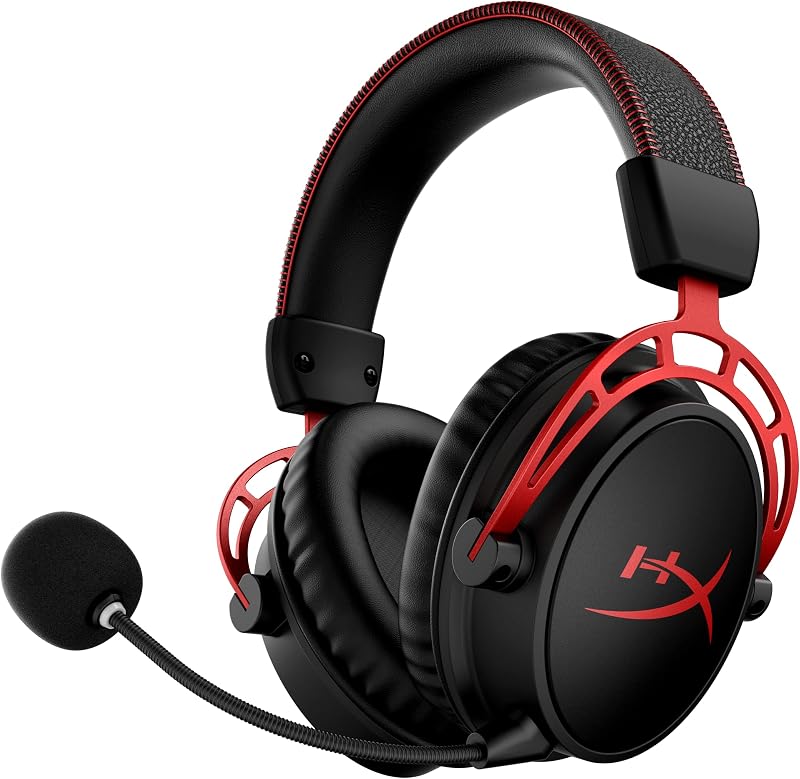
The Cloud Alpha Wireless utilizes a detachable noise-cancelling microphone accompanied by a traditional external pop filter. The flexible boom allows players to position the capsule at an ideal distance from the mouth, while the noise-cancelling element works to filter out ambient room interference such as computer fans and distant keystrokes. However, the Cloud Alpha Wireless does not incorporate an on-mic LED mute status indicator, meaning players must rely on audio cues or on-screen software prompts to know whether their voice channel is live. Those interested in how modern gaming microphones perform across brands can check our comparison of the steelseries arctis nova 5 vs hyperx cloud iii.
In a direct Cloud Alpha Wireless vs HyperX Cloud III voice hardware comparison, the physical upgrades on the Cloud III offer clear operational benefits. The 10mm capsule provides a broader capture area for natural voice tone, the internal mesh filter replaces clumsy foam covers that can tear or get lost, and the red LED mute ring ensures you never speak while muted. For players whose primary priority is clean, reliable voice transmission to their squad, the Cloud III delivers a superior hardware package.
Edge: HyperX Cloud III thanks to its larger 10mm capsule, internal mesh pop filter, and convenient LED mic mute indicator.
Spatial Audio and Software Ecosystem
Positional spatial audio allows gamers to pinpoint opponent movements across three dimensions, from vertical elevation to rear flanking audio. The Cloud Alpha Wireless incorporates DTS Headphone:X Spatial Audio. This spatial engine creates a virtual 3D soundstage with precise sound localization, assisting players in locating threats in competitive shooters and expanding environmental scale in open-world titles. Furthermore, the Cloud Alpha Wireless connects to the HyperX NGENUITY software on PC, allowing users to tune graphic equalizer settings, monitor accurate battery percentages, and modify internal headset behaviors. A wider look at competitive PC headset suites is available in our hyperx cloud iii vs razer blackshark v2 pro article.
The Cloud III provides integrated Spatial Audio support engineered to enhance the dynamic sounds of gaming without requiring complex setup. Because the headset functions seamlessly across diverse consoles and mobile devices, its spatial processing works cleanly through native platform rendering pipelines, including console 3D audio engines and desktop spatial formats. However, the listing does not specify an integrated standalone NGENUITY software control layer for the Cloud III, leaning instead on immediate plug-and-play functionality that keeps setup friction to an absolute minimum.
For PC enthusiasts searching for HyperX Cloud III or Cloud Alpha Wireless for PC gaming, software customization is a major deciding factor. The Cloud Alpha Wireless grants direct access to equalizers and custom sound profiles through NGENUITY alongside licensed DTS Headphone:X processing. While the Cloud III delivers immediate spatial clarity across every machine it touches, desktop power users who prefer customizing their acoustic profile will appreciate the software ecosystem built around the wireless Alpha.
Edge: HyperX Cloud Alpha Wireless due to DTS Headphone:X spatial processing and HyperX NGENUITY software support.
Build Quality, Comfort, and On-Ear Controls
Physical construction and weight distribution dictate whether a gaming headset remains comfortable through long gaming sessions. Both headsets share the core structural DNA of the HyperX brand, utilizing a flexible, durable aluminum frame designed to withstand flexing, travel, accidental drops, and heavy daily use. This metal spine ensures neither headset suffers from the plastic headband creaking or hinge snapping common in budget gaming peripherals. For additional context on how HyperX frames stack up against other metal-reinforced designs, see our review of the steelseries arctis nova pro wireless vs hyperx cloud iii.
In terms of ergonomics and cushioning, both models utilize HyperX signature memory foam packed inside the headband and earcups. The Cloud Alpha Wireless pairs its plush foam with breathable leatherette cushions designed to stay lightweight and mitigate heat buildup during marathon sessions. The Cloud III utilizes plush signature memory foam throughout its headband and oval ear cushions, crafted specifically to avoid disrupting high-intensity speedruns or competitive matches. Both headsets feature over-ear circumaural earcups that fully enclose the ear, passive noise isolation, and long-term clamping pressure designed for adult head sizes.
Control schemes differ slightly in execution. The Cloud III provides simple physical controls directly on the earcup, granting players immediate access to volume adjustments and a microphone mute switch without digging through software menus. The Cloud Alpha Wireless also places volume and mute functions on its earcups alongside its wireless power button. Because both headsets feature premium aluminum frames, plush signature memory foam, and intuitive physical control access, their physical build and comfort levels remain closely matched.
Edge: Tie. Both headsets feature signature HyperX memory foam padding, aluminum structural durability, and convenient on-earcup controls.
Pros and Cons
HyperX Cloud III

Pros
- Zero battery management or downtime
- Universal 3.5mm, USB-C, and USB-A connectivity
- Upgraded 10mm mic with LED mute indicator
- Angled 53mm dynamic audio drivers
- Wide compatibility across consoles and PC
Cons
- Tethered by physical audio cables
- No dedicated NGENUITY software suite
View HyperX Cloud III on Amazon
HyperX Cloud Alpha Wireless
Pros
- Massive 300-hour battery life
- Dual chamber drivers isolate bass rumble
- DTS Headphone:X spatial audio
- Cord-free 2.4GHz wireless freedom
- HyperX NGENUITY software customization
Cons
- No analog 3.5mm audio connectivity
- Requires open USB port for wireless adapter
View HyperX Cloud Alpha Wireless on Amazon
Who Should Buy Each One
Choose the HyperX Cloud III If
- You play across multiple platforms including PC, PS5, Xbox Series X|S, Nintendo Switch, and mobile.
- You want a plug-and-play wired headset that never requires charging, battery management, or firmware monitoring.
- You require an upgraded 10mm microphone with an internal mesh filter and a visual LED mute indicator for clear team communication.
- You prefer angled 53mm drivers that project sound directly into your ear canals without acoustic reflections.
Choose the HyperX Cloud Alpha Wireless If
- You prioritize cord-free freedom with an unprecedented battery life of up to 300 hours on a single charge.
- You primarily game on PC and want full access to the HyperX NGENUITY software suite for equalizers and battery tracking.
- You want dual chamber drivers that physically separate low-end bass rumble from distinct mid and high frequencies.
- You rely on DTS Headphone:X Spatial Audio to achieve pinpoint positional cues and immersive 3D soundstaging.
Final Verdict
For most multi-system gamers and esports enthusiasts, the HyperX Cloud III is the most practical pick. Its wired 3.5mm, USB-C, and USB-A architecture provides universal compatibility across PC, Xbox, PlayStation, Switch, and mobile platforms without requiring dongles or battery tracking. Combined with retuned angled 53mm drivers, an upgraded 10mm microphone capsule with a built-in mesh filter, and a physical LED mute light, the Cloud III delivers a dependable, high-fidelity experience that is completely immune to battery degradation or wireless latency.
The HyperX Cloud Alpha Wireless earns the victory for dedicated PC gamers seeking total cable liberation. Its staggering 300-hour battery life eliminates the primary annoyance of wireless gaming headsets, letting you play for weeks without reaching for a charging cord. Supported by DTS Headphone:X Spatial Audio, dual chamber driver acoustics that separate bass from treble, and NGENUITY customization, the Cloud Alpha Wireless is worth it if wireless convenience and uninterrupted playtime represent your highest gaming priorities.
FAQ
Can the HyperX Cloud Alpha Wireless be used with an analog 3.5mm cable?
No. The Cloud Alpha Wireless is a purely wireless headset that relies on its included 2.4GHz USB wireless adapter and USB charge cable. The listing does not include a 3.5mm audio jack or auxiliary cable for wired analog listening.
Does the HyperX Cloud III work on Xbox Series X and Xbox One?
Yes. The Cloud III features a native 3.5mm connection that plugs directly into standard Xbox controllers, providing full audio and voice chat compatibility across Xbox Series X|S and Xbox One consoles.
How long does the Cloud Alpha Wireless battery last during normal use?
The Cloud Alpha Wireless is rated for up to 300 hours of gaming on a single charge when tested at 50% headphone volume. Real-world battery life may vary depending on listening volume and operating conditions.
What does the LED indicator on the HyperX Cloud III microphone do?
The 10mm microphone on the Cloud III features a built-in LED light that illuminates to give you a clear visual indicator whenever your voice chat is muted, preventing accidental hot-mic incidents during games or calls.
Does the Cloud Alpha Wireless support software equalizer adjustments?
Yes. PC users can download the HyperX NGENUITY software to adjust equalizer settings, check accurate battery levels, and customize DTS Headphone:X Spatial Audio configurations.
Are the ear cushions on these headsets user-replaceable?
Both headsets feature over-ear circumaural earcups packed with HyperX signature memory foam, but the listing specifies standard factory-installed cushions rather than quick-release modular replacement parts.
Which headset has better microphone noise cancellation?
Both headsets feature detachable noise-cancelling microphones. However, the Cloud III features an upgraded 10mm capsule with a built-in internal mesh filter designed to eliminate breath pops, whereas the Cloud Alpha Wireless utilizes a traditional external foam pop filter.