The deciding factor between Breville and De’Longhi comes down to workflow integration: Breville builds complete, bean-to-cup manual espresso workstations with built-in conical burr grinders, whereas De’Longhi prioritizes ultra-compact counter footprints that brew using pre-ground coffee or convenient pods.
Choose Breville if you want a dedicated countertop brewing station where you control bean grinding, dosing, and manual milk texturing. Choose De’Longhi if you need a space-saving machine that pulls authentic shots quickly with minimal cleanup.


Breville vs De’Longhi at a Glance
| Feature | Breville | De’Longhi |
|---|---|---|
| Grinder Integration | Integrated conical burr grinder with grind size dial | None; requires external grinder, pre-ground coffee, or pods |
| Coffee Input Compatibility | Whole coffee beans | Ground espresso coffee and E.S.E. pods |
| Water Tank Capacity | 67 fluid ounces (approx. 2 liters) | 1 liter (Dedica) to 2.3 pounds capacity (ECP3420) |
| Counter Footprint (Width) | 12.5 inches | 5.9 inches (Dedica) to 9.6 inches (ECP3420) |
| Machine Weight | 22.1 pounds | 9.3 pounds to 10.6 pounds |
| Heating & Temperature Regulation | Digital temperature regulation (PID) | High performance Thermoblock with adjustable controls |
| Extraction Pressure Mechanism | Low-pressure pre-infusion with 1600W element | 15-bar professional pump system |
| Milk Frothing System | Powerful manual microfoam steam wand | Advanced Cappuccino System manual frother |
| Included Portafilter & Baskets | 54mm portafilter with single and dual wall baskets | Three-in-one filter holder (1-shot, 2-shot, pod) |
| Best For | Enthusiasts seeking a hands-on bean-to-cup experience | Space-conscious kitchens and rapid everyday brewing |
Integrated Grinding vs Pre-Ground Versatility
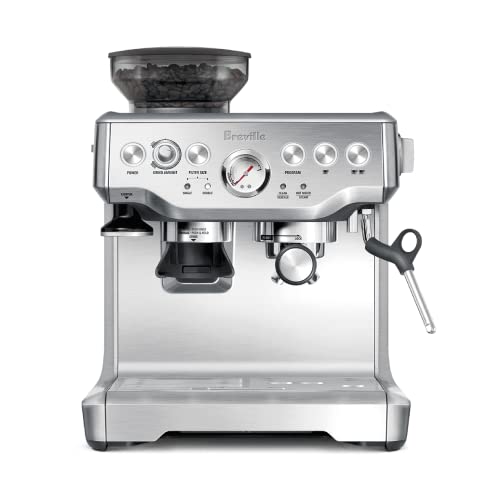
The coffee preparation method forms the biggest mechanical contrast between these two manufacturers. When examining a Breville BES870XL Barista Express or the matching Breville BES870BTR Barista Express in Black Truffle, you get a built-in stainless steel conical burr grinder with a half-pound bean hopper. The integrated grinding cradle grinds directly into the 54mm portafilter on demand. An intuitive grind size dial lets you dial in the extraction for any roast style, ensuring the freshest possible grounds for every single or double shot. This bean-to-cup workflow lets you produce espresso from raw beans in under a minute without buying a separate motorized appliance.
By contrast, De’Longhi espresso units omit internal grinders entirely to keep hardware simple and accessible. Both the De’Longhi 15-Bar Pump Espresso Machine (ECP3420) and the slim De’Longhi Dedica feature a three-in-one filter holder designed to accommodate single-shot ground coffee, double-shot ground coffee, or pre-packaged Easy Serve Espresso (E.S.E.) pods. This configuration appeals to drinkers who favor quick cleanup or prefer buying pre-ground specialty coffee. In any direct comparison of a breville barista express vs de’longhi dedica, the presence of the built-in grinder defines how you interact with the machine every morning.
While the integrated grinder on the Breville offers unmatched freshness and dose control, it also demands regular maintenance and hopper cleaning. De’Longhi sidesteps this maintenance by using separate input formats. However, pulling ground coffee from a pre-ground bag never matches the crema and aroma extracted from whole beans crushed seconds before water contact.
Edge: Breville delivers superior cup quality and convenience through its integrated on-demand conical burr grinder.
Countertop Space and Kitchen Footprint
Espresso setups can rapidly crowd kitchen worktops, making physical dimensions a pivotal consideration. Breville builds substantial, commercial-inspired appliances. The Barista Express measures 13.8 inches deep, 12.5 inches wide, and 15.9 inches tall, weighing in at a heavy 22.1 pounds. Constructed from durable steel, it demands a permanent spot on your counter, particularly because vertical clearance is needed to access the top-loading half-pound bean hopper.
De’Longhi excels at engineering compact, space-efficient profiles suitable for urban apartments, shared offices, and crowded counters. The De’Longhi Dedica measures just 5.9 inches wide, 13 inches deep, and 12 inches tall, weighing only 9.3 pounds. Even the wider De’Longhi ECP3420 pump machine maintains a modest 9.6-inch width and 7.25-inch depth at 10.6 pounds. When evaluating breville bambino plus vs de’longhi dedica formats for tight quarters, De’Longhi machines tuck effortlessly under standard low-hanging cabinetry and can easily be moved into storage when not in use.
The space trade-off is straightforward: Breville demands significant counter space but eliminates the need for a standalone grinder. De’Longhi saves maximum surface area, though if you ever decide to grind whole beans at home, you will have to allocate extra space for a separate grinder alongside the brewer.
Edge: De’Longhi wins for compact kitchens, offering narrow profiles as slim as 5.9 inches wide.
Extraction Control and Temperature Stability
Great espresso hinges on accurate water temperature and balanced pressure delivery throughout the brew cycle. Breville equips the Barista Express with digital temperature regulation (PID) paired with a 1600-watt heating system. The PID controller stabilizes water temperature at the brew head, preventing bitter scorched notes or sour under-extracted shots. Furthermore, Breville utilizes a low-pressure pre-infusion cycle that slowly introduces water to the coffee puck before building pressure, drawing out uniform flavor across the entire bed of coffee.
De’Longhi approaches extraction through high-pressure pump mechanics, featuring a 15-bar professional pressure pump and an efficient Thermoblock heating system running between 1100 and 1450 watts. The 15-bar pump provides ample pressure to push water evenly through fine grounds or dense E.S.E. pods. The Dedica also incorporates an illuminated control panel with flow-stop functionality, allowing you to customize shot volume for single or double extractions. When shoppers look for a comprehensive breville barista pro vs de’longhi dedica overview, temperature consistency during continuous brewing often sets the premium category apart.
For purists dialing in specialty single-origin roasts, Breville’s PID control and gradual pre-infusion provide far greater extraction precision. De’Longhi’s 15-bar system delivers dependable pressure, but it lacks the fine digital temperature regulation that prevents temperature dips during back-to-back shots.
Edge: Breville takes the lead with digital PID temperature regulation and gradual low-pressure pre-infusion.
Milk Texturing and Steam Wand Performance
Crafting silky lattes and dense cappuccinos requires a steam assembly that can incorporate fine air bubbles into cold milk. Breville designs its manual steam wand specifically for creating microfoam. Powered by a 1600-watt heating core, the stainless steel wand generates the velocity needed to spin milk into velvety foam suitable for latte art. The machine also includes a dedicated stainless steel milk jug in the box, giving you everything required to begin practicing free-pour designs immediately.
De’Longhi utilizes its Advanced Cappuccino System across both the ECP3420 and the Dedica. This manual frother blends steam and milk using an exterior aeration sleeve designed to whip up thick, rich froth with minimal technique. It is engineered for foolproof operation: turning the selector introduces hot steam and air to create tall, airy foam ideal for traditional Italian cappuccinos. However, because it aerates aggressively, creating silky, pourable microfoam for latte art is considerably more difficult than with a commercial-style wand.
If your morning routine revolves around flat whites or artistic latte pouring, Breville gives you true barista-grade manual texturing control. If your priority is quick, stiff foam for a morning cappuccino without mastering wand positioning, De’Longhi provides a simpler, less demanding frothing process.
Edge: Breville wins for authentic microfoam texturing and latte art capability.
Accessories and Included Equipment
A major difference between these two brands lies in what comes out of the box. Breville ships the Barista Express as a fully stocked kit. Inside, you find a 54mm stainless steel portafilter, four filter baskets (both single and dual-wall versions for 1-cup and 2-cup doses), an integrated removable tamper, a stainless steel milk frothing pitcher, the Razor dose trimming tool, a water filter holder, a water filter, and a comprehensive cleaning kit with tablets, brush, and an Allen key.
De’Longhi keeps its unboxing package streamlined and utilitarian. The De’Longhi espresso machines include the portafilter handle and a versatile 3-in-1 filter basket set that accommodates single shots, double shots, and E.S.E. pods. You do not receive a stainless steel frothing pitcher, precision leveling tools, or dedicated water filtration cartridges in the basic bundle. The bottom tray of the ECP3420 and Dedica can be removed to accommodate taller glasses or travel mugs up to 5 inches high, which adds practical daily convenience.
The extensive Breville package eliminates the need to purchase aftermarket espresso tools. De’Longhi gives you the core components to brew immediately, but you will need to supply your own milk pitcher and upgraded tamping tools to get the best results.
Edge: Breville provides a vastly superior out-of-the-box accessory package.
Maintenance, Cleaning, and Reservoir Capacity
Routine maintenance directly impacts machine longevity and daily convenience. Breville equips the Barista Express with a large 67-ounce (2-liter) removable water tank fitted with a replaceable resin water filter. The generous capacity supports multiple brew and steam cycles before needing a refill. However, cleaning the integrated grinder, descaling the thermocoil system, and clearing the shower screen requires regular attention using the included cleaning disc and cleaning tablets.
De’Longhi focuses on rapid cleanup and dishwasher compatibility. The removable water tank on the ECP3420 holds 2.3 pounds of water, while the Dedica holds 1 liter, both featuring easily visible water levels. The removable double-layer drip trays and water reservoirs on both De’Longhi units are dishwasher-safe, simplifying end-of-day maintenance. For those exploring a breville barista express vs de’longhi magnifica comparison, the ease of rinsing De’Longhi components stands out as a clear advantage for busy households.
While Breville provides better overall water capacity with integrated filtration, De’Longhi makes everyday cleaning faster thanks to dishwasher-safe components and zero grinder residue to sweep out.
Edge: De’Longhi wins for low-maintenance upkeep and dishwasher-safe components.
Pros and Cons
Breville

Pros
- Integrated precision conical burr grinder
- Digital PID temperature regulation
- Manual microfoam steam wand for latte art
- Large 67-ounce water reservoir
- Complete barista accessory kit included
Cons
- Heavy 22.1-pound steel construction
- Requires 12.5 inches of counter width
- Demands regular grinder maintenance
View Breville BES870XL Barista Express Espresso Machine on Amazon
De’Longhi

Pros
- Ultra-compact profile as slim as 5.9 inches
- 15-bar professional pressure pump
- Supports ground coffee and E.S.E. pods
- Dishwasher-safe drip tray and tank
Cons
- Lacks an integrated coffee grinder
- Aerating wand struggles with fine latte art
- Smaller water capacity requires frequent refills
View De’Longhi 15-Bar Pump Espresso Machine on Amazon
Who Should Buy Each One
Choose the Breville If
- You want a complete bean-to-cup workstation with an integrated conical burr grinder and grind size dial.
- You aim to learn manual milk texturing and pour latte art using a powerful microfoam steam wand.
- You prefer heavy-duty stainless steel construction, digital PID temperature regulation, and low-pressure pre-infusion.
- You appreciate an all-inclusive accessory package that includes a milk jug, tamper, Razor trimming tool, and filter baskets.
Choose the De’Longhi If
- Your kitchen counter has limited space and requires an ultra-slim footprint between 5.9 and 9.6 inches wide.
- You prefer brewing with pre-ground espresso or E.S.E. pods to skip grinding and tamping mess.
- You want dishwasher-safe removable drip trays and simple water tanks for effortless daily maintenance.
- You want thick, rich cappuccino foam quickly via the Advanced Cappuccino System without learning barista techniques.
Final Verdict
For anyone serious about espresso extraction and milk texturing, Breville represents the superior home coffee setup. Machines like the Barista Express combine fresh conical burr grinding, precise PID temperature control, and a commercial-style microfoam steam wand into a unified steel chassis. While it demands a larger counter presence and a more hands-on cleaning routine, the resulting shot clarity, crema density, and latte art capabilities make it the premier choice for coffee enthusiasts.
De’Longhi remains the smarter selection for kitchens where counter space is precious and speed is critical. With its ultra-compact 5.9-inch wide frame, 15-bar pump system, and compatibility with convenient E.S.E. pods, models like the Dedica and ECP3420 deliver delicious everyday espresso with zero fuss. If you want authentic drinks without turning your kitchen into a full-scale coffee laboratory, De’Longhi provides unbeatable space efficiency and everyday practicality.
FAQ
Can I use pre-ground coffee in the Breville Barista Express?
Yes. The Breville Barista Express includes dual-wall pressurized filter baskets specifically engineered to extract pre-ground coffee properly, in addition to single-wall baskets designed for freshly ground beans from its integrated grinder.
Do De’Longhi manual espresso machines include a built-in grinder?
No. Compact De’Longhi manual models like the Dedica and ECP3420 do not feature an integrated grinder. They are designed for pre-ground espresso coffee or standard E.S.E. pods, though you can pair them with a separate standalone coffee grinder.
Which brand is easier to use for absolute beginners?
De’Longhi is generally easier for beginners because it eliminates the variable of dialing in grind sizes. You simply load pre-ground coffee or a pod into the three-in-one filter holder, press a button, and use the automated froth selector on the steam arm.
Can you create latte art with a De’Longhi steam wand?
While the De’Longhi Advanced Cappuccino System produces excellent thick, creamy froth for traditional cappuccinos, its aerating sleeve makes it difficult to produce the silky, uniform microfoam required for intricate latte art compared to Breville’s commercial-style wand.
Are parts on Breville and De’Longhi machines dishwasher safe?
De’Longhi states that the removable drip tray and water tank on models like the ECP3420 and Dedica are dishwasher safe. Breville recommends hand washing its portafilter, baskets, water tank, and milk jug to protect their finishes and seals.
How much counter width do I need for each machine?
The Breville Barista Express requires at least 12.5 inches of counter width and nearly 16 inches of vertical clearance. The De’Longhi Dedica requires only 5.9 inches of width, making it one of the slimmest manual espresso makers on the market.