The decisive difference between these two mixers comes down to operating scale and motor design: the KitchenAid Artisan uses a 325-watt motor in a compact tilt-head frame designed for everyday home cooking, whereas the KitchenAid KSM8990CU relies on a heavy-duty 500-watt commercial DC motor within an 8-quart bowl-lift architecture built for non-stop batch production.
Home bakers producing regular cakes, cookies, and occasional bread loaves will find the KitchenAid Artisan best suited for their counter space and routine culinary tasks. High-volume bakers, caterers, and culinary professionals managing heavy bread doughs or dense mixtures should choose the KitchenAid KSM8990CU for its sustained torque and certified commercial build.


KitchenAid Artisan vs KitchenAid KSM8990CU at a Glance
| Feature | KitchenAid Artisan | KitchenAid KSM8990CU |
|---|---|---|
| Bowl Capacity | 5 Quarts | 8 Quarts |
| Motor Type and Power | 325 Watts | 500 Watts High Efficiency DC Motor |
| Head and Frame Design | Tilt-Head with Bowl Lock | Rigid Bowl-Lift with Lever Mechanism |
| Speed Settings and Controls | 10 Speeds, Knob Control | 10 Speeds, Knob Control with Speed Protection |
| Planetary Action | 59 Touchpoints | Gear-Driven System |
| Product Dimensions | 14.1″D x 8.7″W x 13.9″H | 14.63″D x 13.31″W x 16.44″H |
| Total Weight | 22.8 Pounds | 25.0 Pounds |
| Commercial Certification | Not listed | NSF Certified |
| Included Equipment | 5 Qt Bowl, Flat Beater, Dough Hook, Wire Whip, Pouring Shield | 8 Qt Stainless Steel Bowl (Listing does not specify beaters) |
| Best For | Everyday home baking and medium batches | Commercial kitchens and large-scale batch baking |
Capacity and Batch Size
Bowl capacity defines the ceiling of what you can accomplish in a single mixing cycle. The KitchenAid Artisan features a 5-quart stainless steel bowl equipped with an ergonomic handle. KitchenAid rates this capacity to handle up to 9 dozen cookies in one run, calculated using standard 28-gram dough portions with the flat beater. For standard residential baking-such as a double layer cake, a standard pie filling, or a couple of quick bread loaves-a 5-quart volume fits neatly inside the sweet spot of home recipe proportions.
The KitchenAid KSM8990CU steps directly into professional territory with an 8-quart stainless steel bowl. Comparing the KitchenAid 5 qt vs 8 qt stand mixer capacities reveals a 60 percent volume advantage for the commercial model. This expanded reservoir allows operators to mix double or triple batches of dense doughs, multiple layer cakes, or immense volumes of frosting without overflowing the rim. While the KSM8990CU can handle smaller mixtures, its massive bowl geometry is engineered primarily to keep large volumes contained during vigorous agitation. When evaluating batch requirements against intermediate platforms, examining the kitchenaid ksm8990cu vs kitchenaid bowl-lift 7 qt clarifies how volume thresholds dictate commercial kitchen output.
In practice, the KitchenAid Artisan vs KSM8990CU capacity trade-off boils down to your typical baking volume. Everyday family cooks may find the 8-quart bowl cumbersome to wash in standard sinks, whereas cottage bakers will find the 5-quart Artisan frustratingly small when fulfilling large orders.
Edge: KitchenAid KSM8990CU delivers substantially higher batch capacity for heavy production environments.
Motor Power and Performance
Raw motor performance governs how well a mixer maintains its speed when loaded with dense ingredients. The KitchenAid Artisan operates on a 325-watt motor operating at 120 volts. It utilizes 59 touchpoints around the bowl to incorporate ingredients thoroughly. For standard batters, whipping egg whites, and creaming room-temperature butter, this configuration provides dependable mixing dynamics. However, when working on heavy bread doughs for extended periods, standard residential motors experience increased mechanical resistance.
By contrast, the KitchenAid KSM8990CU features a 500-watt commercial DC motor. Unlike traditional AC motors found in most home units, this high efficiency DC motor is specifically engineered to run longer with less heat build-up. The gear-driven architecture delivers high torque at lower rotation speeds, preventing the unit from bogging down or overheating during intensive kneading. Deciding between the KitchenAid Artisan or KSM8990CU for bread reveals that the KSM8990CU can knead stiff, low-hydration sourdoughs repeatedly throughout a workday without thermal shutdown.
Looking at KitchenAid Artisan vs KSM8990CU motor power, the difference is not just 175 watts of input power; it is the fundamental torque curve and thermal management of a commercial DC motor. Readers exploring motor variations across domestic models can also study our kitchenaid artisan vs kitchenaid ksm55sxxx comparison to understand how alternative residential motors behave.
Edge: KitchenAid KSM8990CU provides commercial-grade DC motor torque and superior thermal endurance under sustained loads.
Design and Bowl Accessibility
The physical method used to access the bowl drastically alters the daily workflow. The Artisan uses a tilt-head design where the top motor block pivots backward on a rear hinge. A side lever locks the head securely in place while mixing and unlocks it so you can tilt the assembly upward. This provides open, unobstructed clearance above the bowl, making it simple to scrape the sidewalls, add flour in stages, or swap out attachments between mixing steps.
The KSM8990CU relies on a fixed-column bowl-lift design. The heavy motor head stays permanently rigid at the top of the metal housing. Instead of pivoting the head away, you position the bowl onto supporting locating pins and use an integrated side lever to smoothly raise the bowl upward into mixing position. This structural rigidity is crucial in a KitchenAid tilt head vs commercial bowl lift evaluation: the fixed head eliminates mechanical play, preventing the mixer neck from flexing or bouncing when working through heavy, dense yeast doughs.
The operational compromise of the bowl-lift design is accessibility. Because the motor head remains stationary over the bowl, adding dry ingredients or scraping down the sides requires sliding utensils around the stationary attachment, or lowering the bowl down on its tracks. For commercial durability comparisons between lift-style mixers, the kitchenaid ksm55sxxx vs ksm8990cu review highlights how mechanical lift assemblies manage workload pressures.
Edge: Tie; the Artisan excels at quick, convenient bowl access, while the KSM8990CU provides unyielding structural stability for heavy doughs.
Dimensions and Countertop Placement
Kitchen workspace often dictates which mixer can realistically live in your kitchen. The KitchenAid Artisan measures 14.1 inches deep, 8.7 inches wide, and 13.9 inches tall, with a total weight of 22.8 pounds. At under 14 inches of vertical height, the Artisan slides comfortably underneath standard residential upper kitchen cabinets, which typically hang 18 inches above the counter. However, you must pull it forward when tilting the head back, as the elevated head extends the total operational height significantly.
The KitchenAid KSM8990CU demands a much more permanent and spacious station. It measures 14.63 inches deep, 13.31 inches wide, and 16.44 inches tall, tipping the scales at 25.0 pounds. Because it is nearly 5 inches wider than the Artisan and stands over 16 inches high, it claims a noticeable footprint on any prep table. The benefit of the bowl-lift architecture here is that its operating height does not change during use, allowing it to function under upper storage shelving that has sufficient vertical clearance. For those evaluating space constraints across smaller formats, the kitchenaid artisan mini vs kitchenaid ksm8990cu breakdown demonstrates just how compact residential options can be.
Moving a 25-pound commercial mixer in and out of a pantry cupboard is impractical for casual sessions. The Artisan remains manageable to reposition, whereas the KSM8990CU is best treated as a stationary countertop fixture.
Edge: KitchenAid Artisan fits standard residential cabinetry layouts with a noticeably narrower footprint.
Attachments, Safety, and Commercial Certification
A comprehensive KitchenAid Artisan review highlights the versatility of its out-of-the-box package. The Artisan KSM150PSPA package includes a 5-quart stainless steel bowl with a comfortable handle, a coated flat beater, a coated dough hook, a 6-wire whip, and a pouring shield to direct dry ingredients neatly into the bowl. Furthermore, its front attachment hub supports over 10 optional powered attachments, ranging from pasta rollers to meat grinders, converting the stand mixer into a multi-use culinary hub. The Artisan also comes backed by a 1-year hassle-free replacement warranty.
In a KitchenAid KSM8990CU commercial mixer review, the defining feature is professional compliance. The KSM8990CU is NSF Certified, meaning it meets public health and sanitation standards required for use in commercial food service establishments. It also includes an integrated speed control protection feature, which prevents accidental startup while wiping down the controls during kitchen sanitation routines. Built from stainless steel and zinc components, it is engineered to withstand harsh commercial environments. However, the listing does not specify included attachments beyond the 8-quart stainless steel bowl.
Shoppers comparing equipment tiers across planetary-drive units can also see the kitchenaid artisan mini vs bowl-lift 7 qt analysis to evaluate equipment packages. For home cooks who want an all-in-one bundle ready for immediate multi-recipe baking, the Artisan offers a complete suite of residential tools right out of the box.
Edge: KitchenAid Artisan provides a complete accessory bundle for residential versatility, while the KSM8990CU delivers essential commercial NSF compliance.
Pros and Cons
KitchenAid Artisan
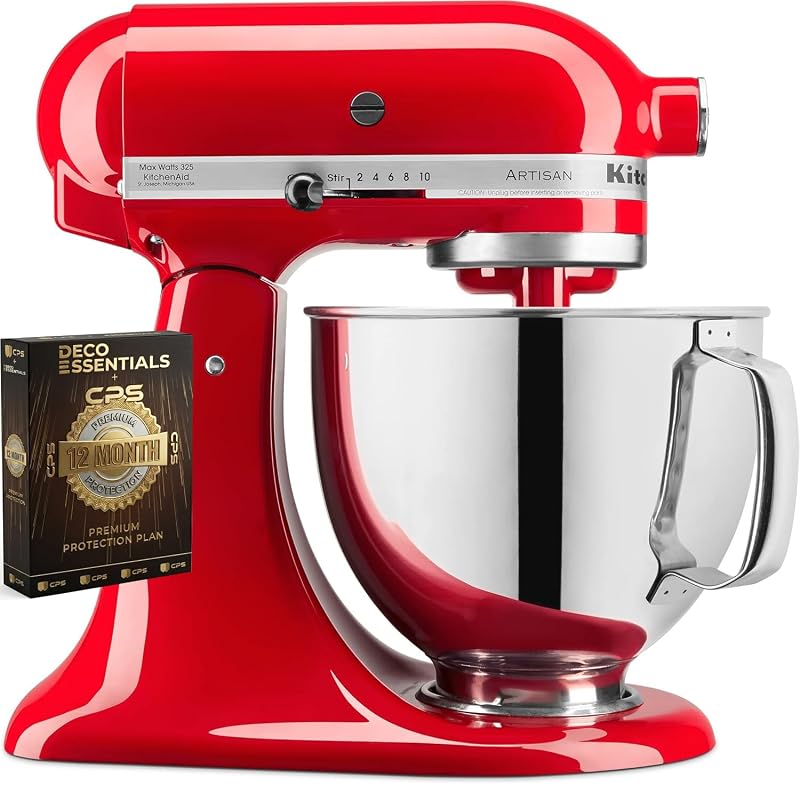
Pros
- Compact footprint fits under standard cabinets
- Includes beater, dough hook, whip, and shield
- Convenient tilt-head design for bowl access
- Dishwasher-safe 5-quart bowl with handle
Cons
- Lower 325-watt motor power
- Smaller 5-quart capacity limits large batches
View KitchenAid Artisan on Amazon
KitchenAid KSM8990CU
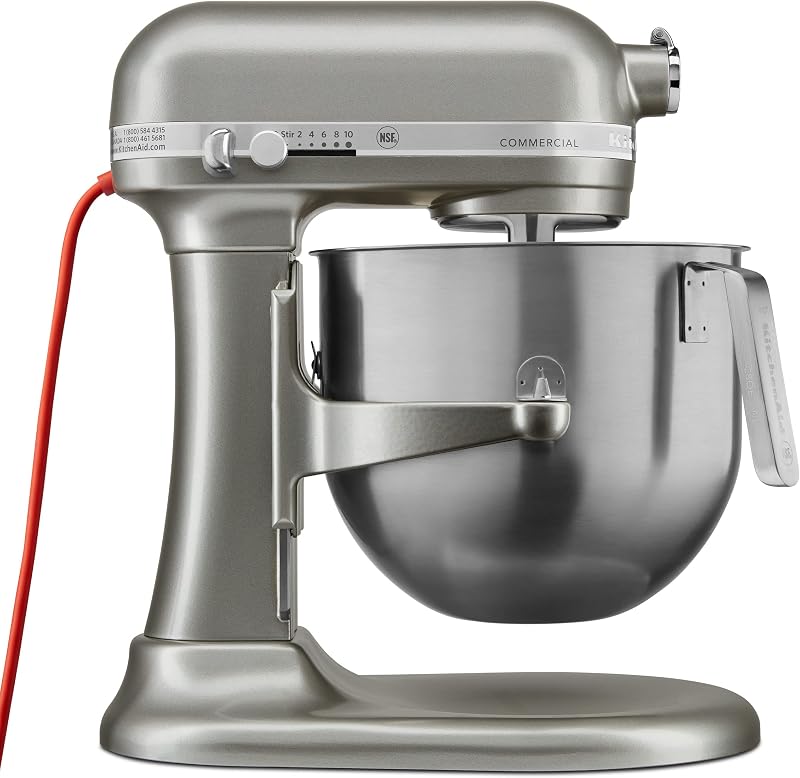
Pros
- High efficiency 500-watt DC motor
- Massive 8-quart stainless steel bowl
- NSF certified for commercial kitchen use
- Rigid bowl-lift design stabilizes heavy kneading
Cons
- Significantly wider countertop footprint
- Listing does not specify included mixing accessories
View KitchenAid KSM8990CU on Amazon
Who Should Buy Each One
Choose the KitchenAid Artisan If
- You bake standard family-sized recipes, such as single batches of bread, cakes, or up to 9 dozen cookies at a time.
- You have standard kitchen cabinetry and need a mixer with a compact 8.7-inch width that can be stored or moved easily.
- You want a complete setup out of the box that includes a coated flat beater, dough hook, wire whip, and pouring shield.
- You prefer a tilt-head mechanism that allows quick, open overhead access for adding ingredients and scraping the bowl.
Choose the KitchenAid KSM8990CU If
- You operate a commercial bakery, catering enterprise, or licensed cottage food kitchen that mandates NSF Certified equipment.
- You regularly mix double or triple batches that require the massive volume of an 8-quart stainless steel bowl.
- You frequently knead dense artisan bread doughs and need a 500-watt commercial DC motor that runs cool under heavy torque.
- You require a stationary bowl-lift platform that eliminates head movement and mechanical flex during continuous heavy mixing.
Final Verdict
For standard household kitchens, the KitchenAid Artisan remains the most sensible choice. Its 325-watt motor, 5-quart capacity, and 59 planetary touchpoints offer ample performance for typical family baking, from whipping meringues to mixing cookie doughs. The tilt-head architecture makes adding ingredients straightforward, while its compact dimensions ensure it integrates seamlessly into residential counters without monopolizing prep space. Combined with a complete suite of included beaters and a pouring shield, it delivers everything an everyday baker needs.
When asking is KitchenAid KSM8990CU worth it, the answer is a decisive yes for anyone pushing past residential volume limits. If your weekly routine involves kneading multiple loaves of dense sourdough, mixing catering-scale batches of batter, or operating in an environment requiring NSF sanitation certification, the KSM8990CU is built for that exact workload. Its 500-watt high-efficiency DC motor delivers unmatched low-end torque without overheating, and the rigid 8-quart bowl-lift frame provides the mechanical stability necessary for continuous commercial service.
FAQ
Can the KitchenAid Artisan handle regular bread dough kneading?
Yes, the KitchenAid Artisan can handle standard bread dough recipes using its included coated dough hook. However, it is optimized for single-loaf batches of standard hydration doughs. If you plan to knead dense, heavy whole-grain or artisan sourdough loaves frequently in large volumes, the high-torque commercial DC motor in the KSM8990CU is better equipped for that sustained physical resistance.
Is the KitchenAid KSM8990CU practical for small mixing tasks?
The KitchenAid KSM8990CU can complete standard kitchen tasks, but its wide 8-quart bowl is optimized for larger ingredient volumes. When whipping very small quantities, such as a single egg white or a half-cup of cream, the broad base of the 8-quart bowl may require careful beater-to-bowl height adjustment to ensure the attachment makes effective contact with the ingredients.
What does NSF Certified mean on the KitchenAid KSM8990CU?
NSF certification means the mixer meets the strict public health, sanitation, and safety standards established by NSF International for commercial food service equipment. This certification confirms that the mixer uses food-safe materials, is easy to clean and sanitize, and is legally compliant for use in professional, inspected food operations.
Why does the KitchenAid KSM8990CU use a DC motor instead of an AC motor?
A direct-current (DC) motor delivers higher torque output at low speeds while generating significantly less internal heat than an alternating-current (AC) motor. This engineering allows the KSM8990CU to power through heavy, dense doughs for extended periods without thermal overload or speed degradation.
How tall is the KitchenAid Artisan when the tilt-head is fully raised?
While the KitchenAid Artisan measures 13.9 inches tall with the head locked in the down position, tilting the head back increases its total operational height to approximately 18 inches. This means you will generally need to slide the mixer out from under standard 18-inch hanging wall cabinets before opening the head to access the bowl.
What is the function of the speed control protection on the KSM8990CU?
The speed control protection feature is a safety mechanism designed to prevent accidental startup. In fast-paced commercial kitchens, surfaces are wiped down frequently; this feature reduces the risk that an employee’s cleaning cloth or hand will inadvertently catch the knob control and turn the mixer on while cleaning the housing.


