Choosing between an all-in-one culinary workstation and a focused high-capacity blending setup comes down to how much prep work you want a single motor base to handle. The decisive difference between these two appliances is food processing versatility: one machine functions as an automated kitchen system that shreds cheese, slices produce, and kneads bread dough in a dedicated processing bowl, while the other prioritizes straightforward, high-volume pitcher blending and personal smoothie prep without extra clutter.
Choose the Ninja BL660 if you want a reliable, no-nonsense blender equipped with two personal travel cups for daily morning routines and a large family pitcher for frozen drinks. Choose the Ninja TB401 if you want an intelligent, multi-bowl culinary hub that eliminates blending guesswork with automatic ingredient detection and replaces a standalone food processor.

Ninja BL660 vs TB401 at a Glance
| Feature | Ninja BL660 | Ninja TB401 |
|---|---|---|
| Motor Power | 1100 Watts | 1800 Peak Watts (1200 Watts operating) |
| Main Pitcher Capacity | 72 oz. (64 oz. max liquid capacity) | 72 oz. (64 oz. max liquid capacity) |
| Food Processing Bowl | Not included | 8-Cup bowl with feed chute lid and pusher |
| Single-Serve Containers | Two 16 oz. to-go cups with spout lids | One 24 oz. single-serve cup with spout lid |
| Automated Sensing | None (Manual speeds and Single-Serve) | BlendSense Technology and Liquid Detect |
| Speed Options | 3 Speeds, Pulse, Single Serve | 10 Variable Speeds, Pulse, BlendSense |
| Specialty Prep Blades | Stacked Total Crushing blade assembly | Chopping blade, dough blade, slicing/shredding disc |
| Dough Capacity | Not designed for dough | Up to 2 lbs. of dough |
| Cleaning | Top-rack dishwasher-safe parts | Top-rack dishwasher-safe parts |
| Best For | Smoothies, frozen drinks, and shared travel cups | Full meal prep, slicing, shredding, and hands-free blending |
Food Processing and Meal Prep Versatility
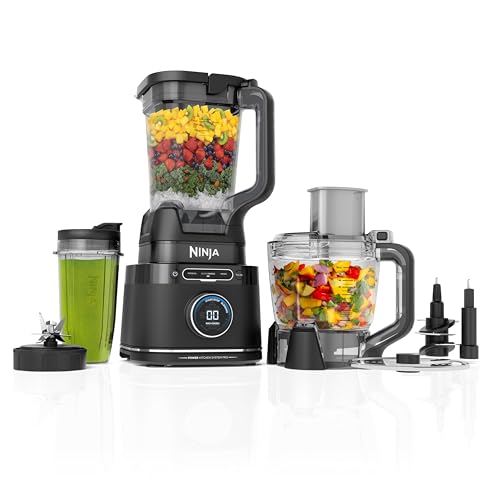
The culinary gap between these two models becomes immediately apparent when preparing solid ingredients for dinner rather than blending liquid beverages. While shoppers frequently debate the ninja bn701 vs tb401 for family food prep, examining the TB401 alongside simpler blenders highlights how dedicated attachments transform kitchen workflow. The TB401 is an integrated kitchen system featuring an 8-cup food processor bowl complete with a feed chute lid, a two-part ingredient pusher, a dedicated chopping blade, a dough blade, and a reversible slicing and shredding disc. These tools allow home cooks to grate blocks of cheese, slice cucumbers evenly, chop onions without turning them into mush, and knead up to two pounds of yeast dough directly on the motorized base.
By comparison, evaluating the ninja bl660 or tb401 for food processing reveals fundamental mechanical limitations on the older model. The BL660 relies entirely on its 72-ounce pitcher and a tall stacked blade assembly for chopping chores. Because it lacks a wide flat-bottomed processing bowl, feed chute, or slicing disc, attempting to prep vegetables requires careful manual pulsing to avoid over-processing the bottom layer while leaving top ingredients untouched. It does not include a dough blade and cannot knead bread or pastry dough. Home cooks who regularly prep slaws, grated cheeses, and baked goods will find that the specialized accessories of the TB401 eliminate the need to purchase, store, and clean a separate standalone food processor.
For cooks who only need occasional coarse chopping-such as pulsing tomatoes, garlic, and cilantro into a chunky salsa or blending a smooth marinara sauce-the tall pitcher of the BL660 is functional enough. However, the absence of guided thickness control, continuous feeding through a chute, and mechanical kneading makes food preparation far more hands-on. If your culinary ambitions stop at blending liquids, pureeing soups, and crushing ice, you will never miss the food processor bowl. If you want a genuine sous-chef on your counter, the modular versatility of the TB401 provides distinct culinary utility.
Edge: Ninja TB401, thanks to its dedicated 8-cup processing bowl, feed chute, dough blade, and slicing/shredding disc.
Motor Power and Wattage Performance
Motor strength dictates how effectively an appliance handles dense frozen fruit, fibrous greens, and heavy doughs without stalling or overheating. In any thorough ninja bl660 review, the 1100-watt motor base stands out as a reliable standard for residential countertop blenders. That motor delivers plenty of mechanical force to drive the stacked Total Crushing blades through solid ice cubes, transforming them into fluffy snow within seconds. It blends frozen berries and leafy greens smoothly, provided there is enough liquid to keep the vortex circulating around the central spindle.
When examining the ninja bl660 vs tb401 wattage specifications, the TB401 represents a significant step up in available mechanical force. It features an 1800-peak-watt motor base (rated at 1200 operating watts on a standard 120-volt connection). That surplus peak wattage is essential for powering through heavy, resistant mixtures that can bog down smaller motors. When kneading thick doughs up to two pounds or pushing dense root vegetables through the shredding disc, the TB401 draws on that motor headroom to maintain blade speed without laboring. Homeowners comparing powerful systems often evaluate the ninja bn701 vs bl660 for similar heavy-duty crushing needs, but the TB401 pushes raw motor capability even further.
In day-to-day use, this power disparity matters most during heavy-load tasks. For regular fruit smoothies, milkshakes, and standard cocktail ice, the 1100-watt motor of the BL660 provides ample muscle. However, when processing nut mixtures, emulsifying thick spreads, or handling prolonged dough kneading, the TB401 runs cooler, powers through stubborn pockets of frozen ingredients with less manual stirring, and reduces overall processing time.
Edge: Ninja TB401, offering an 1800-peak-watt motor base that resists stalling under dense mixtures and heavy doughs.
Smart Automation and Speed Controls
Control schemes determine whether you must stand over your blender adjusting settings or can simply walk away while the machine does the thinking. The head-to-head dynamic of ninja tb401 blendsense vs bl660 showcases two entirely different eras of appliance engineering. The BL660 adheres to a classic, straightforward interface featuring physical pushbuttons for three manual speeds (Low, Medium, High), a Pulse button, and a dedicated Single Serve button. To achieve your desired texture in the main pitcher, you manually select a speed, monitor the mixture as it swirls, and hit the power button again to stop. It is an uncomplicated layout with zero learning curve, ideal for cooks who prefer direct, tactile oversight.
In contrast, the TB401 incorporates BlendSense technology, an intelligent control system that actively reads ingredient resistance and container contents to build a customized blending program on the fly. The system senses the density, volume, and texture of the mixture, automatically modulating motor speed, incorporating deliberate pauses to let ingredients settle, and calculating the exact run time needed for a silky result. Furthermore, when using the personal cup, the TB401 features Liquid Detect, which alerts you visually if the mixture contains insufficient fluid to establish a proper blending vortex, saving you from burned motor smells or stuck blades. For manual control, it replaces basic multi-speed buttons with a variable speed dial offering 10 distinct speed settings in the full-size pitcher.
These advanced controls make a significant difference for multitasking home cooks. With the TB401, you can drop whole frozen strawberries and fibrous kale into the container, engage the BlendSense dial, and walk across the kitchen to pack lunchboxes while the machine manages the blending cycle automatically. Anyone reading a modern ninja tb401 review will note that hands-free operation is one of its primary conveniences. With the BL660, you must babysit the blender, manually pulsing or toggling through the three speeds until large chunks are pulverized.
Edge: Ninja TB401, delivering fully automated BlendSense programming, Liquid Detect safety cues, and 10 manual variable speeds.
Single-Serve Blending and Cup Accessories
For many households, personal cups get used far more often than the full-sized pitcher. When deciding between the ninja bl660 or tb401 for smoothies on a hurried morning, the accessory package makes a noticeable impact on daily logistics. The BL660 arrives with two 16-ounce single-serve to-go cups and matching spout lids, powered by an interchangeable Pro Extractor Blades assembly. Having two personal cups out of the box makes the BL660 exceptionally practical for couples, roommates, or parents who need to blend two individual breakfast shakes back-to-back without hand-washing a single cup in between.
The TB401 takes a different approach to personal blending by including a single, larger 24-ounce single-serve cup with its own spout lid and Hybrid Edge Blades assembly. The 24-ounce capacity is a welcome upgrade for fitness enthusiasts who blend oversized protein shakes containing protein powder, oats, fruit, yogurt, and ice-ingredients that quickly overcrowd smaller 16-ounce vessels. Readers evaluating modular cup options often cross-shop guides like the ninja bl660 vs ss351 to balance cup volume against accessory count, and the TB401 brings substantial individual portion capacity to the table.
The trade-off here hinges on volume versus quantity. The TB401 provides superior single-cup volume and intelligent feedback via Liquid Detect, but it only ships with one cup. If two people in your household head out the door with smoothies simultaneously, one person will have to wait for the cup to be washed, or you will need to pour drinks into third-party travel mugs. The BL660 delivers turnkey dual-user convenience straight from the box, making morning beverage prep seamless for two people despite the slightly smaller individual portion size.
Edge: Ninja BL660, because including two personal cups and lids provides superior convenience for multi-user households.
Pitcher Design and Batch Blending
When hosting gatherings, preparing weekly meal-prep purees, or blending frozen margaritas for a crowd, both appliances rely on Ninja’s signature full-size pitcher architecture. Each model includes an extra-large 72-ounce pitcher constructed from durable, BPA-free plastic, providing a maximum liquid capacity of 64 ounces. Both lids lock securely in place with a locking handle mechanism and feature convenient pour spouts for mess-free serving without removing the entire top cover.
Internally, both pitchers employ a vertical spindle fitted with multiple tiers of sharpened blades-designated as Total Crushing technology. Unlike traditional blenders that pull ingredients down toward a small spinning blade cluster at the very bottom of the jar, this multi-tiered vertical blade design attacks ice cubes and whole fruits throughout the entire height of the container simultaneously. Whether you are using the 1100-watt base of the BL660 or the 1800-peak-watt motor of the TB401, crushing a full pitcher of solid ice into uniform snow takes only seconds. Shoppers exploring high-power alternatives like the ninja ss351 vs tb401 will find that this 72-ounce Total Crushing pitcher remains the gold standard for high-volume frozen party drinks.
Cleanup across both pitchers is identical. Because the vertical blade tower lifts straight out of the pitcher in one piece, you never have to wrestle with unscrewing a sharp bottom blade ring or cleaning beneath trapped seals. Both pitchers, their locking lids, and the removable blade assemblies are top-rack dishwasher safe. Since the physical capacity, blade mechanics, and pouring convenience of the main 72-ounce vessels are essentially identical, neither machine holds a distinct functional advantage when batch blending in the main pitcher.
Edge: Tie, as both models utilize identical 72-ounce Total Crushing pitchers with 64-ounce max liquid limits and removable blade towers.
Countertop Space and Storage Footprint
Countertop real estate and cabinet organization are crucial considerations when introducing multi-component appliances into a modern kitchen. The BL660 maintains a relatively trim footprint with product dimensions measuring 17 inches high, 6 inches wide, and 8 inches deep. Because its accessory bundle is tightly focused-consisting only of the motor base, the tall pitcher, two slim 16-ounce cups, and two blade assemblies-it stores neatly under standard kitchen cabinets or tucks into a modest pantry shelf without dominating available space.
The TB401 requires substantially more storage planning. In addition to the motor base and full-size 72-ounce pitcher, this all-in-one kitchen system includes an 8-cup food processor bowl with its own feed chute lid and pusher, an assortment of specialty blades (Hybrid Edge, chopping, and dough blades), a reversible metal slicing and shredding disc, and a 24-ounce personal blending cup. Similar space tradeoffs appear in comparisons like the ninja bn701 vs ss351, where multi-bowl accessories require dedicated drawer or cabinet storage.
If you live in an apartment with compact cabinetry, the modular array of the TB401 can quickly create kitchen clutter if you do not have dedicated drawer space for the blades and disc. Conversely, the BL660 keeps things minimalistic. Its two travel cups can easily live in a drinkware cabinet, leaving just the base and main pitcher on the counter. Homeowners who prioritize compact storage and quick access will appreciate the streamlined footprint of the BL660.
Edge: Ninja BL660, offering a more compact accessory footprint that requires significantly less cabinet and drawer storage.
Pros and Cons
Ninja BL660

Pros
- Includes two 16-ounce personal cups with spout lids
- Reliable 1100-watt ice-crushing motor base
- Simple, tactile manual speed controls
- Compact footprint with minimal accessory clutter
Cons
- Lacks dedicated food processor bowl and slicing disc
- Cannot knead dough or shred cheese
- No automated ingredient-sensing blending programs
Ninja TB401

Pros
- Includes 8-cup processing bowl with slicing and shredding disc
- High-performance 1800-peak-watt motor base
- BlendSense technology automatically adjusts speed and runtime
- Processes up to 2 pounds of dough with included blade
- 10 variable manual speed settings in full-sized pitcher
Cons
- Only includes one personal travel cup
- Requires extra storage space for multiple prep attachments
Who Should Buy Each One
Choose the Ninja BL660 If
- You primarily make morning smoothies, shakes, and iced beverages for two people who need separate travel cups immediately.
- You prefer simple, tactile pushbutton controls without automated sensor programming or digital dials.
- You have limited kitchen cabinet space and do not want to store extra food processing bowls, discs, and blades.
- You already own a dedicated food processor or simply have no interest in shredding cheese, slicing vegetables, or kneading bread dough in a blender.
Choose the Ninja TB401 If
- You want a single appliance that replaces both a high-powered blender and a full-size food processor on your kitchen counter.
- You regularly prepare ingredients for meals, such as slicing veggies, shredding cheese, chopping produce, or mixing up to two pounds of dough.
- You prefer hands-free blending where BlendSense technology automatically monitors texture and adjusts blending cycles for you.
- You blend large 24-ounce personal smoothies and want the added security of Liquid Detect to prevent blend stalls.
Final Verdict
The ultimate choice between the ninja tb401 vs bl660 hinges entirely on whether you want an all-in-one culinary workstation or a focused, straightforward drink maker. The BL660 remains an enduring favorite for good reason: it delivers 1100 watts of ice-crushing power, simple manual buttons, a massive 72-ounce batch pitcher, and two personal cups that make morning routines effortless for active households. It handles smoothies, frozen drinks, and basic purees with total reliability, making it the superior pick for shoppers who want dependable beverage performance without paying for attachments they will never use.
However, if you want complete culinary versatility, asking is ninja tb401 worth it yields a clear answer. With its 1800-peak-watt motor base, smart BlendSense automation, 10-speed variable dial, and dedicated 8-cup food processor bowl complete with a slicing disc and dough blade, the TB401 is by far the more capable kitchen machine. It replaces multiple countertop appliances and streamlines whole-meal preparation from start to finish. For cooks who want intelligent automation and total food prep capability, the Ninja TB401 is the definitive winner.
FAQ
Can the Ninja BL660 knead dough or shred cheese?
No, the BL660 cannot knead dough or shred cheese. It does not include a dough blade, slicing/shredding disc, or food processing bowl with a feed chute. Its tall stacked blades are designed for crushing ice, pureeing liquids, and coarse pulsing, but attempting to knead dough in its pitcher will overload the blade spindle and motor.
How does BlendSense technology work on the Ninja TB401?
BlendSense technology actively monitors the resistance on the blades and the consistency of the ingredients inside the container. It automatically calculates the optimal blending speed, introduces strategic pauses to allow ingredients to settle into the vortex, and determines the precise runtime required for completely smooth results, eliminating manual guesswork.
Are the cups and pitchers interchangeable between the Ninja BL660 and TB401?
No, the containers and blade assemblies are not cross-compatible. The TB401 uses Ninja’s newer container locking collar and blade base design (including Hybrid Edge blades and updated safety interlocks) designed to handle its 1800-peak-watt motor base, while the BL660 uses its own proprietary 16-ounce cup threading and pitcher base tabs.
Which blender is better for green smoothies with tough fibrous greens?
The TB401 performs noticeably better with tough fibrous greens like kale, celery, and ginger. Its 1800-peak-watt motor base and Hybrid Edge blade assembly break down cellular fibers more thoroughly than the 1100-watt motor and stacked blades of the BL660, and its BlendSense system automatically extends blending time until greens are completely liquefied.
Are the blades and containers safe for the dishwasher?
Yes, all removable parts on both the BL660 and the TB401-including the pitchers, food processor bowl, personal cups, lids, and removable blade assemblies-are BPA-free and top-rack dishwasher safe. Always exercise extreme caution when handling the blade assemblies during cleaning, as the edges are exceptionally sharp.
What does the Liquid Detect feature on the Ninja TB401 do?
Liquid Detect is a smart sensing safety feature active when blending in the TB401 single-serve cup. If you load too many frozen solids or dry ingredients without adequate liquid, the blender senses the lack of fluid circulation and alerts you that more liquid is needed to establish a proper blending vortex, preventing motor strain and air pockets.


