The single deciding factor between these two espresso machines comes down to heating technology and workflow feedback: the Breville Barista Pro integrates a ThermoJet heating system that reaches extraction temperature in 3 seconds alongside a digital LCD screen, whereas the Breville Barista Express relies on a traditional heating system with an analog dial interface and a manual extraction pressure gauge.
Choose the Barista Express if you want hands-on physical dials and classic gauge feedback during your morning extraction routine. Choose the Barista Pro if you prioritize instantaneous heat-up speed, animated digital display cues, and faster steam readiness for consecutive milk drinks.
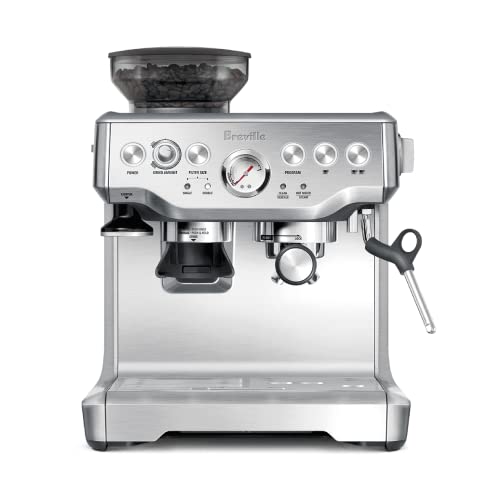
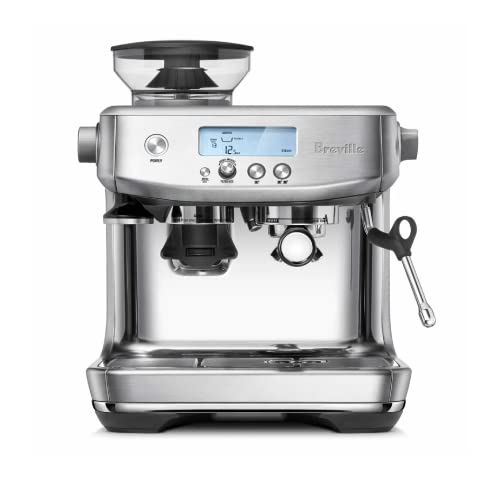
Breville Barista Express vs Barista Pro at a Glance
| Feature | Breville Barista Express | Breville Barista Pro |
|---|---|---|
| Model Number | BES870XL | BES878BSS |
| Heating System | PID Temperature Regulation | ThermoJet (3-second heat up) with PID (+/- 2°C) |
| User Interface | Physical Dials and Analog Pressure Gauge | Backlit LCD Screen with Progress Animations |
| Power Output | 1600 Watts | 1680 Watts |
| Bean Hopper Capacity | 1/2 lb | 1/2 lb |
| Water Reservoir | 67 oz | 67 oz (2 Liters) |
| Coffee Input Type | Whole Beans | Whole Bean, Ground |
| Machine Dimensions | 13.8″D x 12.5″W x 15.9″H | 13″D x 14″W x 16″H |
| Weight | 22.1 lbs | 19.5 lbs |
| Manufacturer Warranty | 1-Year Limited Warranty | 2-Year Limited Warranty |
| Best For | Traditional tactile workflow and gauge-focused brewers | Rapid morning routines and digital extraction guidance |
Heating Speed and Thermal Performance
Heating architecture dictates how rapidly you can produce your first beverage and how smoothly the machine alternates between espresso extraction and milk texturing. The Barista Express uses a 1600-watt heating assembly governed by a digital temperature control (PID) system. This setup monitors and regulates the thermal state of the water so espresso extracts at the proper temperature. While the listing notes that the machine goes from whole beans to espresso in under a minute, conventional thermal blocks require a brief warm-up phase to thoroughly heat the internal lines and portafilter before pulling the initial shot. When you examine a classic breville barista express vs de’longhi dedica matchup, the Express provides reliable brew consistency through its integrated PID loop, but it requires patience between pulling shots and building full steam pressure.
The Barista Pro upgrades this internal architecture with Breville’s ThermoJet heating system running at 1680 watts. The ThermoJet coil achieves brewing temperature in 3 seconds flat, eliminating the standard morning waiting period. In addition to near-instant startup, the ThermoJet design enables an instantaneous transition from espresso brewing to steam texturing. In the BES870XL vs BES878BSS comparison, this transition speed fundamentally changes multi-drink preparation. Instead of waiting for internal heating components to climb from extraction temperatures to steam temperatures, the Pro moves between functions almost instantaneously, preventing shot degradation while you prep your milk jug.
Digital temperature control on the Barista Pro explicitly maintains water delivery within plus or minus 2 degrees Celsius. This tight thermal window pairs with low-pressure pre-infusion, gradually soaking the puck before full extraction pressure kicks in. While both machines feature PID regulation and low-pressure pre-infusion to maximize extraction balance, the Pro combines this precision with immediate readiness. For users comparing the Barista Express vs Barista Pro heat up time, the ThermoJet system transforms the entire pace of your kitchen routine.
Edge: Breville Barista Pro, because its ThermoJet system reaches operating temperature in 3 seconds and switches between brewing and steaming without delay.
Display Interface and Extraction Feedback
The control panel interface determines how you interact with grind settings, extraction timing, and dose adjustments. The Barista Express features an analog design centered around a circular pressure gauge located squarely in the middle of the front console. This physical dial tracks internal brewing pressure throughout extraction, giving real-time visual feedback on whether your grind size and tamping density have placed the extraction in the optimal zone. Surrounding buttons allow you to choose single or double cup options, activate power, and engage steam or hot water functions. Grind size adjustments rely on a manual side-mounted dial, while grind amount uses a front rotary dial with a manual override option. In discussions such as the breville barista express vs gaggia classic pro debate, many purists celebrate this mechanical, gauge-driven layout because it teaches the tactile relationship between resistance and water flow.
In contrast, the Barista Pro replaces the analog face with an intuitive backlit LCD screen accompanied by push buttons. This digital display renders grinding and extraction progress animations that actively show cycle duration. Instead of guessing how long your shot has been pouring or using an external stopwatch, the LCD panel provides exact numeric and graphical readouts of your grind run time and extraction stages. The screen supplies descriptive information for customizing volumetric shot output for 1 or 2 cups, navigating maintenance alerts, and adjusting grind settings directly through push-button prompts.
For shoppers wondering whether the Breville Barista Express or Pro for beginners is the superior match, the visual guidance of the Pro simplifies the learning curve. The animated feedback clearly reveals what the machine is executing at every second of the cycle. However, the Pro eliminates the physical analog pressure gauge found on the Express. Beginners on the Pro rely on flow rate and extraction timing shown on the screen rather than a needle displaying brewing pressure. Both approaches offer clear diagnostic value, but the Pro delivers a contemporary digital readout while the Express retains classic mechanical telemetry.
Edge: Tie. The Barista Pro offers descriptive digital animations and precise extraction timers, while the Barista Express provides a dedicated analog pressure gauge that mechanical purists prefer.
Steam Wand Power and Milk Texturing
Milk frothing capability defines whether an espresso machine can create genuine silky microfoam for specialty drinks. The Barista Express features a manual steam wand engineered to produce textured microfoam for cappuccinos and lattes. Because it relies on Breville’s 1600-watt single-system heating design, the machine requires several seconds after shot extraction to purge excess water and elevate operating temperatures to steam production levels. Once up to pressure, the wand delivers steady dry steam capable of rolling milk in the included stainless steel milk jug to form glossy foam suitable for pouring hearts and rosettas. Many home baristas performing a detailed Breville Barista Express review highlight that while steaming takes a bit of patience, the manual wand produces authentic cafe-quality results.
When assessing Breville Barista Pro vs Express steam power, the Barista Pro demonstrates a clear mechanical advantage. Driven by the 1680-watt ThermoJet assembly, the Pro generates immediate steam pressure without the extended lag time typical of standard single-boiler configurations. Instant switching from shot pulling to steaming prevents your freshly extracted crema from dissipating while waiting for the wand to prime. The steam output provides high velocity, allowing milk to achieve a vortex in the supplied 480 ml stainless steel milk jug in less total time.
For enthusiasts asking about the Breville Barista Express or Pro for latte art, both units provide true manual microfoam rather than stiff, aerated froth common on automated panarello wands. Both machines include the necessary stainless steel milk jugs right in the box. However, the Pro speeds up the entire texturing sequence through immediate thermal response and brisk steam delivery. If you routinely make multiple milk-based drinks back-to-back for family or guests, the expedited steam preparation on the Pro substantially reduces total assembly time.
Edge: Breville Barista Pro, due to instantaneous steam transition and higher thermal throughput that reduces frothing wait times.
Grinder Features and Dosing Controls
Both models belong to Breville’s all-in-one Barista Series, incorporating an onboard conical burr grinder that deposits freshly ground coffee directly into the portafilter cradle. In the Barista Express vs Pro grinder comparison, both units feature a 1/2-pound capacity bean hopper that locks securely into place. Both machines utilize stainless steel conical burrs engineered to minimize grind heat and protect delicate coffee oils across varying roast profiles. Grinding on demand directly into the 54mm portafilter ensures maximum flavor extraction, adhering to the third-wave specialty coffee formula highlighted in Breville’s specifications.
Where the two machines diverge is their grind control interfaces and input flexibility. The Barista Express relies on a step-adjusted side grind size dial alongside a front-facing grind amount knob. This allows manual dosing adjustments based on volume and timer calibration, complete with a manual push override directly inside the portafilter cradle. The Barista Express listing focuses strictly on whole-bean input, feeding beans through the hopper down into the burr chamber. Similar to comparisons like the breville bambino plus vs barista express, having the grinder physically built into the chassis saves kitchen space and streamlines puck preparation.
The Barista Pro integrates its grinder controls directly into the central LCD system. Grinding run times can be adjusted in discrete digital increments using the interface buttons, providing precise repeatability between doses. Furthermore, the product specifications indicate that the Barista Pro supports both whole bean and pre-ground coffee input types, offering extra versatility if a household member drinks decaf or pre-ground specialty coffee. Both machines package Breville’s Razor Precision Dose Trimming Tool to level off the portafilter basket after tamping, guaranteeing an accurate coffee bed depth before insertion into the group head.
Edge: Breville Barista Pro, because its digital display enables fine-tuned dosing time increments and the machine accommodates both whole bean and ground coffee inputs.
Dimensions, Build Quality, and Included Equipment
Evaluating physical footprints and build parameters helps determine how these appliances fit on kitchen counters and hold up over years of service. The Barista Express carries dimensions of 13.8 inches deep, 12.5 inches wide, and 15.9 inches tall, weighing in at 22.1 pounds. Its exterior is constructed from brushed stainless steel, giving the chassis substantial heft that keeps the unit planted firmly when locking in the 54mm portafilter. The Express includes an extensive accessory kit: single and dual-wall filter baskets (1-cup and 2-cup options), the Razor trimming tool, an integrated tamper that docks magnetically into the machine, a stainless steel milk jug, a cleaning disc with tablets, a cleaning brush, an Allen key, and an in-tank water filter with holder. Breville backs the BES870XL with a 1-year limited product warranty.
The Barista Pro features slightly altered exterior dimensions, measuring 13 inches deep, 14 inches wide, and 16 inches tall, while weighing a lighter 19.5 pounds. Despite the lighter overall weight, it utilizes stainless steel construction with an attractive brushed finish. The Pro includes single and dual-wall 1-cup and 2-cup filter baskets, the Razor tool, a 480 ml stainless steel milk jug, a cleaning kit, and a water filter. When reviewing the overall ownership value in a Breville Barista Pro review, one significant spec stands out: the Barista Pro includes a 2-year limited product warranty, providing twice the standard factory coverage window of the Express.
Water management is nearly identical between the units. Both models feature large 67-ounce removable water reservoirs (also specified as 2 liters on the Pro listing) equipped with water filtration systems to reduce scale buildup. Both machines also include Breville’s special promotional offer of 2 free bags of specialty coffee upon registration. If you want a more compact width and heavier countertop anchor, the Express has a slight edge in density, but the Pro delivers a more expansive factory warranty on its components.
Edge: Breville Barista Pro, thanks to a 2-year limited warranty compared to the 1-year coverage on the Express.
Pros and Cons
Breville Barista Express

Pros
- Analog pressure gauge for extraction feedback
- Sturdy 22.1-pound steel chassis
- Integrated magnetic tamper dock
- Comprehensive accessory kit included
Cons
- Slower transition to steam mode
- Only 1-year limited warranty
View Breville Barista Express on Amazon
Breville Barista Pro

Pros
- ThermoJet 3-second rapid heat-up
- Instant transition to steam power
- Backlit LCD screen with progress animations
- Extended 2-year limited warranty
Cons
- Lacks an analog pressure gauge
- Slightly wider countertop footprint
View Breville Barista Pro on Amazon
Who Should Buy Each One
Choose the Breville Barista Express If
- You prefer physical control dials and an analog extraction pressure gauge over a digital screen.
- You want a heavier, slightly narrower 22.1-pound machine that stays planted when locking the portafilter.
- You enjoy the classic ritual of reading a sweeping needle to diagnose your espresso extraction flow.
- You want an integrated magnetic dock for your espresso tamper directly on the machine chassis.
Choose the Breville Barista Pro If
- You value rapid morning workflow and want your machine ready to brew within 3 seconds of power-up.
- You make multiple lattes or cappuccinos back-to-back and need instantaneous switching between espresso and steam.
- You prefer clear digital feedback with an LCD screen that animates grinding and extraction progress.
- You want the added peace of mind of an included 2-year limited manufacturer warranty.
Final Verdict
For the majority of home espresso enthusiasts, the Breville Barista Pro stands out as the superior overall performer. Its ThermoJet heating system completely rewrites the morning workflow by reaching full extraction temperature in 3 seconds and transitioning to steam power without hesitation. Combined with a modern backlit LCD display that guides you through grind duration and shot timing, higher 1680-watt power delivery, and a 2-year factory warranty, the Pro eliminates the primary friction points of traditional domestic espresso making. When evaluating whether the Breville Barista Pro is worth it, the significant reduction in heating delays and the improved digital feedback justify choosing the updated BES878BSS platform.
However, the Breville Barista Express remains a legendary, highly capable machine for a very specific type of coffee enthusiast. If you find tactile joy in physical knobs, toggle buttons, and an authentic mechanical pressure gauge that shows extraction resistance in real time, the Express delivers an exceptionally engaging brewing experience. It uses the same 54mm portafilter size, features low-pressure pre-infusion, includes digital PID temperature management, and comes packaged with a comprehensive set of accessories. If you do not mind waiting a short moment for the heating elements to prime, the Barista Express continues to deliver genuine third-wave cafe results at your own kitchen counter.
FAQ
What is the main difference between the Barista Express and Barista Pro?
The primary differences lie in the heating mechanism, interface, and warranty. The Barista Pro features a 1680-watt ThermoJet system that heats up in 3 seconds and switches instantly to steam, an LCD screen with animations, and a 2-year warranty. The Barista Express uses a 1600-watt heating system with digital PID, an analog pressure gauge, manual dials, and a 1-year warranty.
Is the Breville Barista Pro worth it over the Barista Express?
The Barista Pro is worth choosing if you value rapid workflow, faster steam transitions for milk drinks, digital shot timing, and an extended 2-year warranty. However, if you prefer diagnosing shots using an analog pressure gauge and like tactile rotary dials, the Barista Express remains an exceptional choice.
How does the Barista Express vs Barista Pro heat up time compare?
The Barista Pro achieves brewing temperature in 3 seconds using its ThermoJet heating system and transitions instantaneously from pulling espresso to generating steam. The Barista Express relies on a conventional heating setup that takes longer to reach full thermal stability and requires a brief pause when transitioning to steaming mode.
Which machine is better for beginners learning espresso?
The Barista Pro is often considered easier for modern beginners because its LCD screen provides visual feedback, grind time tracking, and extraction progress animations. However, many learners appreciate the Barista Express because its analog pressure gauge visually shows whether the coffee grind and tamp created the correct internal extraction resistance.
Can both machines make latte art microfoam?
Yes, both machines feature manual stainless steel steam wands capable of texturing milk into silky microfoam suitable for latte art. The Barista Pro produces steam faster due to its ThermoJet architecture, while the Barista Express produces the same style of microfoam but requires more time to transition from brewing to steaming.
What accessories are included in the box with each model?
Both models come with single and dual-wall 1-cup and 2-cup filter baskets, the Razor precision dose trimming tool, a stainless steel milk jug, water filters, and cleaning kits. The Barista Express listing specifically highlights an integrated tamper and a 54mm stainless steel portafilter, while the Pro specifies a 480 ml milk jug and dual-input compatibility for whole bean and ground coffee.
How do the manufacturer warranties compare?
The Breville Barista Express includes a 1-year limited product warranty, whereas the Breville Barista Pro includes an extended 2-year limited product warranty directly from the manufacturer.
Related reading: breville barista express vs de’longhi magnifica.


