The single deciding difference between the Weber Spirit E-325 and the Weber Genesis E-325 comes down to total cooking capacity versus exterior footprint. With 641 square inches of primary cooking space, the Genesis provides nearly double the usable grate area of the Spirit, but it requires a fixed cabinet structure that weighs roughly twice as much and occupies significantly more patio room.
Choose the Spirit E-325 if you cook for immediate family and need folding side tables to preserve open floor space on a compact balcony or townhome deck. Choose the Genesis E-325 if you routinely host gatherings, cook entire multi-course meals outdoors, and have dedicated yard space to accommodate a heavy, stationary grilling station.


Weber Spirit E-325 vs Weber Genesis E-325 at a Glance
| Feature | Weber Spirit E-325 | Weber Genesis E-325 |
|---|---|---|
| Cooking Surface Area | 360 square inches | 641 square inches |
| Burner Count | 3 main burners | 3 main burners plus 1 extra-large sear zone |
| Ignition System | Snap-Jet individual ignition | Not listed |
| Burner Engineering | Boost Burners (40% power boost) | PureBlu tapered burner tubes |
| Exterior Dimensions | 26.6″D x 48.3″W x 46.2″H | 27″D x 57.7″W x 48.1″H |
| Weight | 98.1 pounds | 188 pounds |
| Side Tables | Folding hammertone metal tables | Fixed metal side tables |
| Modular Ecosystem | Weber Works snap-on rails | WEBER CRAFTED Outdoor Kitchen Collection |
| Cookbox Material | Cast aluminum | Stainless steel |
| Warranty | 10-year limited warranty | Not listed |
| Best For | Small patios and everyday family meals | Large gatherings and expansive outdoor meal prep |
Cooking Surface Area and Grate Capacity
Usable grate surface dictates not just how many burgers you can cook at once, but also your ability to configure distinct two-zone cooking zones for roasting and searing. When evaluating the Weber Spirit E-325 vs Genesis E-325 cooking area, the gap between the two models represents an entirely different class of meal preparation. The Spirit provides 360 square inches of primary grilling space across its porcelain-enameled cast-iron grates. That is ample room for roughly 15 to 18 hamburger patties or four large ribeye steaks with enough margin to move food around comfortably. Shoppers deciding on scale can see a similar footprint divergence when examining the weber spirit e-325 vs weber genesis e-435 comparison.
The Genesis E-325 changes the cooking dynamic with 641 square inches of cooking space across its cast-iron grates. This extra area means you can sear protein directly over high heat while using indirect heat on the opposite side to roast root vegetables, bake sides, or hold cooked meats without crowding the box. The Genesis listing also highlights an included warming rack that toasts buns or keeps finished food warm while the lower grates remain free for continuous grilling. In everyday terms, 641 square inches allows you to cook for an entire party in a single wave, whereas 360 square inches often forces you to cook in consecutive batches.
That extra cooking surface comes with spatial trade-offs inside the cookbox. Heating 641 square inches requires significantly more internal energy and natural gas or propane flow, meaning you will run through fuel faster when warming up the entire chamber. For quick weekday dinners consisting of two chicken breasts or three burgers, the Spirit gets to temperature faster because the internal air volume is substantially smaller. However, for anyone who wants to cook proteins and vegetable sides side-by-side on the same grates, the Spirit runs out of room quickly.
Edge: Weber Genesis E-325 because its 641-square-inch cooking surface provides genuine full-meal cooking flexibility that the 360-square-inch Spirit cannot match.
Burner Engineering and Sear Zone Performance
A high-temperature sear zone caramelizes proteins rapidly to lock in moisture and produce deep grill marks without overcooking the meat center. In this Weber Spirit E-325 vs Genesis sear zone comparison, the two grills approach intense heat generation through distinct engineering methods. The Spirit E-325 incorporates specialized Boost Burners managed by two red control knobs that unleash 40 percent more power in what Weber describes as the largest Sear Zone in its class. Individual burners are ignited with one-hand Snap-Jet ignition, allowing you to fire up specific burners by simply pressing and turning the corresponding knob.
The Genesis E-325 takes a structural approach to heat delivery with its proprietary PureBlu burner system. These burners feature a tapered tube design that maintains consistent internal gas pressure, producing a uniform flame height and even heat distribution across the entire grate surface. Crucially, the PureBlu system includes raised flame ports that direct the flame upward while letting meat drippings, ash, and seasoning fall away into the cookbox beneath, actively minimizing burner corrosion and clogs. This burner foundation feeds into a dedicated extra-large sear zone designed to brown multiple large steaks or a dozen burgers at the exact same moment. This marks a notable architectural evolution from earlier configurations detailed in our look at the weber spirit ii e-310 vs genesis e-325s.
In real-world use, the Spirit delivers an aggressive, concentrated blast of heat concentrated over its sear zone thanks to the 40 percent boost function. For a buyer reading a Weber Spirit E-325 review to see if a compact grill can produce steakhouse crusts, the Boost Burners deliver real power. Yet the Genesis provides a broader, more reliable thermal footprint. The PureBlu tapered tubes prevent cold spots across the 641-square-inch cooking zone, and the raised flame ports ensure the burners remain clog-free through seasons of heavy drippings.
Edge: Weber Genesis E-325 due to its clog-resistant PureBlu tapered burners and a broader sear zone that accommodates multiple cuts simultaneously.
Dimensions, Footprint, and Patio Space Requirements
Grill dimensions govern everyday livability on your deck, patio, or outdoor kitchen area. When asking whether to choose a Weber Spirit or Genesis for small patio installations, physical footprint is the defining constraint. The Spirit E-325 measures 26.6 inches deep, 48.3 inches wide, and 46.2 inches high, with an assembled weight of 98.1 pounds. Critically, the Spirit features hammertone metal side tables that fold down flat against the cart frame. When folded, the grill shrinks its horizontal footprint considerably, allowing it to slide into narrow patio corners, alcoves, or condo balconies without blocking foot traffic.
By contrast, the Genesis E-325 measures 27 inches deep, 57.7 inches wide, and 48.1 inches high, tipping the scale at a hefty 188 pounds. Its side tables are rigid, fixed structures designed to hold heavy platters, cutting boards, and condiment caddies. Because the Genesis tables do not fold, you need nearly five linear feet of dedicated clearance on your patio at all times. Furthermore, weighing 188 pounds-nearly double the weight of the Spirit-the Genesis is intended to stay in one place. Rolling it across pavers or soft decking requires substantial effort compared to rolling the 98-pound Spirit.
If you have tight patio clearances, the Weber Spirit E-325 dimensions make it significantly more practical. Homeowners who move their grill into a garage or shed between seasons will appreciate the manageable weight and folding shelves of the Spirit. The Genesis requires a permanent outdoor home. For grillers evaluating truly space-limited alternatives, comparing compact platforms like the weber spirit e-325 vs weber q 2800n+ or portable units like the weber spirit e-325 vs weber traveler highlights just how streamlined the Spirit line is engineered to be.
Edge: Weber Spirit E-325 because its folding side tables and sub-100-pound weight make it vastly superior for compact outdoor spaces.
Modular Ecosystems and Cooking Versatility
Modern gas grills increasingly serve as outdoor cooktops rather than simple burger burners, and both models feature proprietary accessory systems to expand their culinary range. The Spirit E-325 incorporates the Weber Works side rail system. This configuration allows you to snap specialized accessories directly onto the side of the grill frame, such as bottle holders, extra tool hooks, and flexible lighting attachments. These accessories (sold separately) keep the prep tables clear of clutter, which is critical given the smaller total workspace on the Spirit.
The Genesis E-325 focuses its modular capability directly onto the cooking surface through the WEBER CRAFTED Outdoor Kitchen Collection. The porcelain-enameled cast-iron grates are designed to accommodate a frame kit that accepts custom-fit grillware (sold separately), including a flat-top outdoor griddle, a glazed baking pizza stone, a dual-sided sear grate, and a Dutch oven. Instead of simply grilling food on open bars, the Genesis transforms into a full outdoor range capable of baking crusty artisan breads, frying eggs and bacon, or braising stews. Grilling enthusiasts evaluating accessory-ready models in our weber spirit ii e-310 vs genesis e-435 breakdown will recognize this as the cornerstone of the premium Weber lineup.
The distinction between these two ecosystems comes down to prep convenience versus cooking versatility. The Spirit’s Weber Works system improves storage and organization around the cart exterior. The Genesis WEBER CRAFTED system fundamentally expands what culinary techniques you can execute inside the cookbox. For anyone wondering is Weber Genesis E-325 worth it, the ability to turn the grill into an authentic griddle or pizza oven provides functional utility that a traditional rack cannot offer.
Edge: Weber Genesis E-325 due to the WEBER CRAFTED system that turns the cookbox into a multi-method cooking station.
Materials, Build Quality, and Grease Management
Grease containment and weather resistance determine the long-term durability and maintenance burden of an outdoor cooker. The Spirit E-325 features a cookbox constructed from cast aluminum, an alloy that naturally resists rust and paint peeling even when subjected to constant outdoor moisture and corrosive sea air. Its grates are porcelain-enameled cast iron, backed by stainless steel Flavorizer Bars that catch falling drippings, vaporize them into savory smoke, and funnel remaining fats downward. The grease management system relies on a large drip pan and a slide-out removable grease tray, while the overall unit is backed by a 10-year limited manufacturer warranty.
The Genesis E-325 utilizes a stainless steel body frame with a painted exterior finish. Like the Spirit, it uses porcelain-enameled cast-iron grates and classic FLAVORIZER Bars to eliminate flare-ups while boosting grilled flavor. The Genesis grease management system features a pull-out grease tray located directly beneath the cookbox, designed to slide forward smoothly for fast disposal without requiring you to reach through the cart interior. The Genesis listing does not specify a stated warranty duration, whereas the Spirit explicitly guarantees 10 years of limited coverage.
Both grills make routine maintenance relatively straightforward via slide-out trays, but the materials tell a clear story. The Spirit’s cast-aluminum cookbox will never rust out from moisture or grease pooling, making it exceptionally resilient over a decade of use. The Genesis provides robust stainless steel construction, but the documented 10-year warranty and aluminum cookbox on the Spirit offer superior peace of mind on long-term chassis durability.
Edge: Weber Spirit E-325 because of its rust-proof cast-aluminum cookbox and confirmed 10-year limited warranty.
Pros and Cons
Weber Spirit E-325
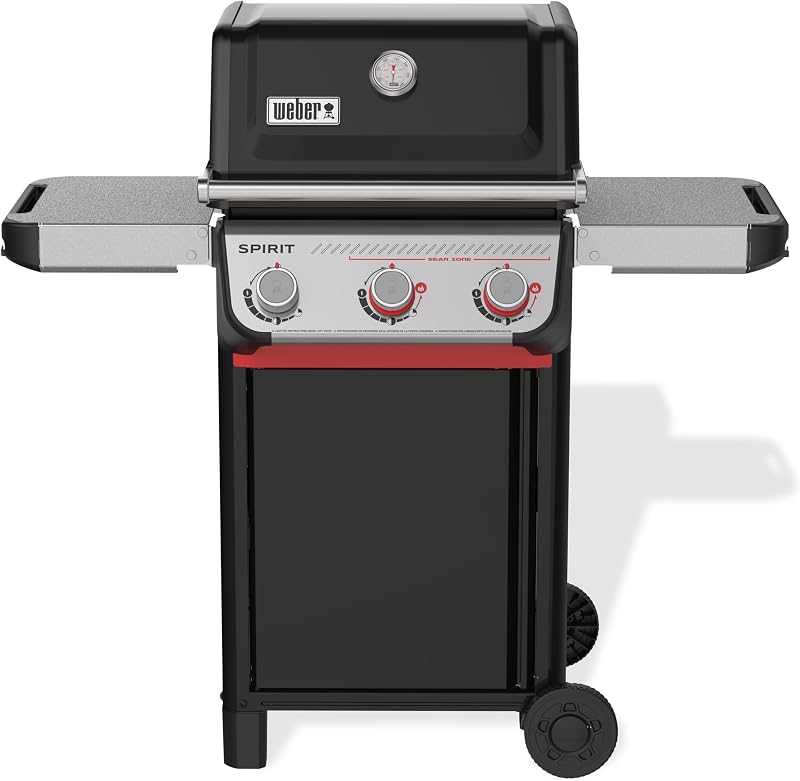
Pros
- Folding hammertone metal side tables
- Cast-aluminum cook box prevents rust
- 10-year limited warranty coverage
- Boost Burners add 40% sear power
- Lightweight 98.1-pound easy-roll cart
Cons
- Smaller 360 square inch cooking area
- Lacks WEBER CRAFTED grillware compatibility
View Weber Spirit E-325 on Amazon
Weber Genesis E-325

Pros
- Massive 641 square inch cooking space
- PureBlu tapered burners prevent clogs
- WEBER CRAFTED accessory collection compatible
- Extra-large dedicated sear zone
- Built-in warming rack included
Cons
- Heavy 188-pound stationary frame
- Fixed side tables do not fold
View Weber Genesis E-325 on Amazon
Who Should Buy Each One
Choose the Weber Spirit E-325 If
- You cook on a small patio, balcony, or compact deck where folding side tables are required to preserve walking space.
- You primarily grill for a family of two to four people and rarely need to cook more than 15 burgers at a single time.
- You want a lightweight 98-pound grill that can be easily moved, stored, or relocated without heavy lifting.
- You prioritize documented 10-year warranty protection and a corrosion-proof cast-aluminum cookbox.
Choose the Weber Genesis E-325 If
- You regularly entertain guests or cook multi-dish meals requiring 641 square inches of simultaneous cooking space.
- You plan to use specialized modular cookware like an outdoor griddle, pizza stone, or Dutch oven via the WEBER CRAFTED collection.
- You want clog-resistant PureBlu burners featuring raised flame ports that prevent corrosion from food debris.
- You have a spacious, dedicated deck area that can accommodate a 188-pound stationary station with wide, fixed prep tables.
Final Verdict
For most grillers seeking a complete outdoor cooking center that can handle everything from weeknight dinners to massive backyard parties, the Genesis E-325 is the superior performer. Its 641-square-inch cooking surface, clog-resistant PureBlu tapered burners, and compatibility with the WEBER CRAFTED Outdoor Kitchen Collection provide a complete cooking platform rather than just a basic grill. While it demands a permanent footprint on your patio, the extra grate area and advanced burner engineering eliminate the bottleneck of cooking food in separate shifts.
However, the Spirit E-325 remains the smarter, more practical purchase for anyone dealing with space constraints or standard family meal requirements. With its folding hammertone side tables, sub-100-pound weight, 40-percent boost Sear Zone, and cast-aluminum cookbox backed by a 10-year warranty, it delivers legendary Weber grilling performance in an agile frame. If your patio cannot comfortably surrender five feet of permanent width to a heavy cooker, the Spirit E-325 gives you high-intensity searing without consuming your outdoor living space.
FAQ
How do the cooking areas of the Spirit E-325 and Genesis E-325 compare?
The Spirit E-325 provides 360 square inches of primary cooking surface, which fits roughly 15 to 18 burgers comfortably. The Genesis E-325 features 641 square inches of cooking space, giving you nearly double the active area to cook multiple proteins and vegetable sides simultaneously.
Do the side tables fold down on both grills?
No. Only the Spirit E-325 features folding side tables made from hammertone metal, allowing you to drop both shelves to fit narrow spaces. The Genesis E-325 features fixed, rigid side tables designed for heavy food prep that cannot be folded down.
What is the difference between Boost Burners and PureBlu burners?
The Spirit E-325 uses Boost Burners controlled by two dedicated red knobs to deliver 40 percent more thermal output across its sear zone. The Genesis E-325 uses PureBlu burners with tapered tubes that equalize internal gas pressure for even heat, along with raised flame ports that prevent falling food debris from clogging the gas outlets.
Can you use WEBER CRAFTED accessories on the Spirit E-325?
No. The WEBER CRAFTED Outdoor Kitchen Collection requires custom-fit grates and frame kits that are compatible with the Genesis line. The Spirit E-325 instead utilizes the Weber Works system, which attaches snap-on accessories like tool hooks and bottle holders to the exterior side rails.
What type of ignition system do these grills use?
The Spirit E-325 is equipped with Snap-Jet individual ignition, which lets you light each burner independently with one hand by pressing and turning the control knob. The Genesis E-325 listing confirms electronic multi-burner operation, but does not specify the branded name of its ignition system.
How heavy are these two grills to move across a patio?
The Spirit E-325 weighs 98.1 pounds, making it easy for one person to roll or reposition across a deck. The Genesis E-325 weighs 188 pounds, requiring substantially more effort to push and making it better suited for a permanent, stationary location.