The decisive difference between a mulching mower and a bagging mower is what happens to your grass clippings after the cut: a mulching mower shreds grass into fine micro-particles that decompose directly into the turf, while a bagging mower vacuums clippings off the lawn entirely into a rear container for clean removal.
Choose a mulching mower if you want a fast, low-maintenance cut that naturally fertilizes your soil and eliminates the labor of bagging yard waste. Choose a bagging mower if your yard is prone to spreading weeds, thick autumn leaves, or overgrown wet grass that demands an immaculate, debris-free finish.


Mulching Mower vs Bagging Mower at a Glance
| Attribute | Mulching Mower | Bagging Mower |
|---|---|---|
| Primary Clipping Action | Recuts clippings repeatedly into fine mulch | Directs clippings into rear airflow collection bin |
| Deck Design | Enclosed cutting chamber to keep clippings circulating | Rear discharge chute engineered for high vacuum lift |
| Blade Geometry | Curved mulching blade with multiple cutting edges | High-lift blade designed for upward suction force |
| Turf Nutrient Return | Recycles nitrogen, potassium, and moisture to soil | Zero nutrient return; removes all organic matter |
| Weed Seed Management | Redistributes weed seeds evenly across the lawn | Captures and isolates weed seed heads and diseased grass |
| Handling Wet Turf | Prone to clumping and deck clogging under wet blades | Lifts damp turf and deposits it directly into collection bag |
| Fall Leaf Clearance | Pulverizes light dry leaf cover into organic mulch | Vacuums and removes heavy leaf layers from turf |
| Typical Included Attachments | Mulch plug and side discharge chute | Fabric collection bag, rear frame, and mulch plug |
| Best For | Routine weekly cuts on healthy, established residential turf | Overgrown yards, weed control, pool surrounds, and autumn leaf cleanup |
Clipping Management and Lawn Nutrition
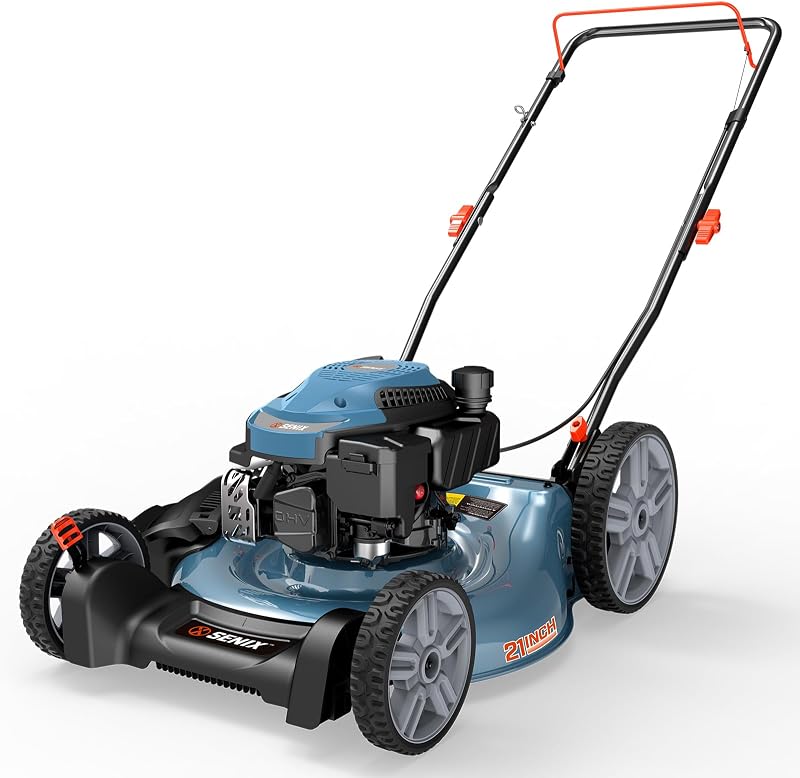
When comparing a mulching vs bagging lawn mower, the most profound difference lies in how each system treats plant tissue. A mulching mower relies on an enclosed deck and a specialized cutting system that keeps grass clippings suspended in the cutting chamber. As the blade spins, it slices the grass blades multiple times, reducing them to tiny particles. These micro-clippings fall between the standing blades of turf down to the soil surface, where they quickly decompose and release water, nitrogen, phosphorus, and potassium back into the root zone. A gas-powered option like the SENIX 144 cc Gas Lawn Mower demonstrates this setup, utilizing a 21-inch 2-in-1 deck with a 4-cycle 144cc engine engineered to pulverize clippings and return them directly to the soil or route them through side discharge. Similarly, the compact PowerSmart EasyCut 18-Inch Gas Lawn Mower features a specialized blade and an 18-inch steel deck with side discharge to manage dense grass without collecting waste.
In contrast, grass collection vs mulching represents an entirely different turf philosophy. Bagging systems use aerodynamic lift to pull clippings off the lawn immediately after they are severed. The WORX Cordless Lawn Mower exemplifies this approach on smaller parcels, capturing clippings in a 0.85-bushel collection bag equipped with a full-bag indicator. Removing grass clippings eliminates the risk of clumping on top of the lawn canopy, but it permanently extracts valuable organic matter from your yard ecosystem. Turf grass clippings consist of roughly 80 to 85 percent water and contain significant amounts of nitrogen. When you bag every cut, you remove that natural fertility, which often means you must supplement your turf with additional store-bought fertilizer to maintain soil health. Homeowners weighing these factors frequently review our breakdown in the honda hrn216vka vs toro recycler 21 comparison to evaluate how deck recirculation impacts grass vitality.
The operational trade-off is clear: mulching provides continuous, free nourishment to your lawn while eliminating the chore of hauling waste bags, but it requires that your grass is cut frequently enough that clippings remain small. Bagging removes organic nutrition from the lawn bed, requiring external feeding, but it completely avoids surface debris.
Edge: Mulching Mower. Returning fine clippings naturally feeds your turf with moisture and recycled nitrogen, reducing supplemental fertilizer needs.
Mowing Efficiency and Cleanup Speed
Mowing efficiency determines how much of your weekend is spent pushing a machine across grass. In any bagging vs mulching mower assessment, mulching is consistently faster because it turns mowing into a single-step job. You start the engine or motor, walk the lawn, and finish. There are no secondary cleanup chores, no full bags to detach, no heavy loads to haul to the curb, and no extra yard bags to purchase. Mowers like the SENIX push mower with its 21-inch cutting width cover substantial ground per pass, and because the machine continually recycles clippings back into the turf, your forward momentum is never interrupted.
Bagging introduces repetitive stops into your lawn care routine. Every time the grass catcher fills, you must release the bail handle, walk to a compost bin or yard waste bag, empty the clippings, shake out the mesh, reattach the bag, and restart your pass. On a mower such as the BILT HARD 21 Inch Lawn Mower, which features a 144cc 4-stroke engine delivering 3.4 HP and 5.75 ft.lb of torque, the 3-in-1 capability lets you switch into rear bagging mode for thorough collection. However, filling a standard rear bag can happen every two to four passes in fast-growing grass. The WORX WG779 cordless mower uses a 0.85-bushel bag sized for yards up to 1/8 acre, which requires frequent emptying if the grass has grown even an inch past regulation height. You can read similar observations regarding collection interruptions in our toro super recycler vs craftsman m220 analysis.
Over an entire mowing season, the time spent stopping, carrying, dumping, and bagging clippings adds up to hours of extra physical labor. If your goal is to finish lawn maintenance as quickly as possible, a mulching setup delivers an unmatched time-saving advantage.
Edge: Mulching Mower. Mulching completely eliminates the recurring stops required to empty, carry, and dispose of heavy collection bags.
Deck Design, Blade Dynamics, and Airflow
The mechanical difference between these two mower designs centers on the mulching mower blade difference and the internal geometry of the cutting deck. A mulching deck is engineered as a closed, dome-shaped chamber. It features internal baffles or curved kickers that redirect the airflow downward. A dedicated mulching blade typically has multiple cutting edges, curved lift surfaces, and serrated teeth that chop clippings repeatedly before forcing them toward the ground. In the PowerSmart DB8618C, a durable steel deck and specialized blade work in tandem to chop and efficiently discharge grass clippings across five distinct height positions ranging from 1.5 to 3.9 inches.
Bagging mowers require an open airflow path and high-lift blade dynamics. Rather than circulating clippings within a sealed deck, a bagging mower functions like a high-velocity vacuum. The blade features aggressive upturned wings at the back edges that generate strong upward suction, pulling grass blades upright for a level cut and hurling them through a discharge chute into the porous fabric bag. The WORX 40V walk-behind mower enhances this process using Intellicut technology, which automatically increases cutting speed when it senses dense grass, maintaining the airflow velocity required to pack clippings into the 0.85-bushel bag. Users converting a 2-in-1 or 3-in-1 machine often evaluate the mulch plug vs grass catcher setup, where inserting the plug blocks the exit tunnel to force mulching action, while removing it exposes the discharge tunnel to the catcher. Airflow differences of this type are detailed in our honda hrn216vka vs troy-bilt tb130 guide.
While convertible mowers allow you to switch modes, dedicated bagging systems generate significantly more suction than closed mulching decks. This powerful upward airflow results in an exceptionally uniform cut across uneven patches of grass, standing every blade upright before cutting.
Edge: Bagging Mower. High-lift blades and open rear airflow create superior vacuum lift, yielding a remarkably crisp and uniform cut.
Handling Adverse Turf: Wet Grass and Heavy Leaves
Weather and seasonal shifts expose the functional limits of mulching decks. Choosing a mulching or bagging mower for wet grass reveals a distinct operational contrast. When grass is damp with morning dew or rain, mulching blades struggle to circulate the heavy, moisture-laden vegetation. Instead of breaking down into tiny particles, wet clippings stick to the underside of the deck, forming thick green cakes that bog down the engine. These clumps eventually drop onto the lawn in heavy mats, which can block sunlight and kill the turf beneath them. The SENIX 21-inch mower mitigates this by providing side discharge alongside mulching, giving users a way to clear thick grass when conditions prevent a clean mulch, while the BILT HARD gas mower relies on its 144cc engine and 3-in-1 versatility to pivot between bagging, mulching, and side discharge as yard conditions shift.
When considering a mulching or bagging mower for leaves in the autumn, volume dictates the winner. Light, scattered leaves can be easily mulched into soil-enriching organic dust. But when heavy leaf fall coats the lawn, mulching fails to break down the sheer mass of material. A thick layer of shredded leaves left on turf can suffocate root systems and foster fungal disease over winter. In our toro recycler 21 vs troy-bilt tb130 evaluation, high-debris handling is a central performance metric. A bagging mower acts as an effective yard vacuum, sweeping up fallen foliage and gathering it into the collection bag for garden composting or curbside pickup.
Whenever you are forced to mow damp turf or tackle heavy seasonal leaf drops, a bagging mower handles the extra volume and moisture far better without leaving suffocating mats on your lawn.
Edge: Bagging Mower. Bagging systems excel at picking up damp grass and thick layers of autumn leaves without clumping or smothering turf.
Weed Control and Lawn Aesthetics
The visual quality of your lawn after a cut and the long-term spread of invasive plants represent critical considerations in any mulching mower review or bagging mower review. If your yard suffers from dandelions, crabgrass, plantain, or clover, mulching can worsen the problem. When a mulching blade strikes weed seed heads, it chops them and blows the viable seeds across the entire yard, effectively seeding your lawn with weeds on every pass. Similarly, if your lawn suffers from fungal infections like brown patch or dollar spot, mulching spreads the spores across healthy areas.
Is a bagging mower worth it for homeowners who demand a spotless lawn? Yes, especially if you entertain outdoors or have kids and pets. Bagging removes all clippings, seed heads, and debris from the surface. You avoid the unsightly clippings that cling to wet shoes and get tracked into the house, garage, or swimming pool. The WORX WG779 offers clean, quiet cutting at just 87.8 decibels with a lightweight 29.1-pound frame, making it simple to maintain a manicured, debris-free finish on compact lots without tracking clippings across patios. For an in-depth look at precision lawn finishes, see our honda hrn216vka vs toro super recycler comparison.
While mulching supports biological soil health, bagging delivers an immaculate, manicured finish and physically isolates weed seeds and lawn diseases away from your turf.
Edge: Bagging Mower. Bagging isolates weed seeds, prevents turf diseases from spreading, and leaves an immaculate surface free of trackable clippings.
Pros and Cons
Mulching Mower
Pros
- Returns recycled nitrogen to soil
- Eliminates stopping to empty bags
- Faster mowing with zero cleanup
- Reduces need for synthetic fertilizer
Cons
- Clumps heavily in wet grass
- Spreads weed seeds and fungal spores
View SENIX 144 cc Gas Lawn Mower on Amazon
Bagging Mower

Pros
- Leaves pristine debris-free lawn finish
- Isolates weed seeds and diseases
- Vacuums autumn leaves and damp clippings
- Prevents clippings tracking indoors
Cons
- Requires frequent stops to empty
- Removes natural nutrients from turf
View WORX Cordless Lawn Mower 40V 14″ on Amazon
Who Should Buy Each One
Choose a Mulching Mower If
- You maintain a strict mowing schedule and cut regularly so you never remove more than the top third of the grass blade.
- You want to reduce synthetic fertilizer applications by recycling natural nitrogen and organic matter back into the soil.
- You want to complete your yard chores as fast as possible without carrying, emptying, or hauling collection bags.
- Your lawn is largely weed-free and you rarely have to mow under wet or overly dense turf conditions.
Choose a Bagging Mower If
- Your yard has heavy weed infestations or fungal turf issues that mulching would spread to healthy grass.
- You frequently mow damp grass or need to vacuum heavy autumn leaves off your turf at the end of the season.
- You have a swimming pool, outdoor patio, or pets, and you want to prevent clippings from being tracked indoors.
- You maintain a dedicated backyard compost pile that relies on nitrogen-rich green waste for soil blending.
Final Verdict
For the vast majority of homeowners maintaining an established, healthy residential lawn, a mulching mower is the smartest, most practical investment. It cuts your yard maintenance time substantially by eliminating the repetitive chore of stopping to empty heavy grass bags. Beyond saving time and eliminating paper yard waste bags, mulching continuously returns valuable nitrogen, trace nutrients, and moisture back into the soil, keeping your lawn green and resilient through the heat of summer.
However, a bagging mower remains indispensable for property owners who prioritize an immaculate, debris-free aesthetic or who must manage challenging lawn conditions. If your yard is overrun with weed seeds, if you regularly cut damp morning grass, or if you need an efficient way to clear thick autumn leaf falls, the vacuum suction and collection capability of a bagging mower justify the extra handling effort. For maximum flexibility, choosing a 2-in-1 or 3-in-1 model with an included mulch plug and grass catcher gives you the freedom to mulch during dry summer routines and bag during weed outbreaks or fall cleanups.
FAQ
Does mulching grass clippings cause thatch buildup?
No, mulching grass clippings does not cause thatch. Lawn thatch is composed of woody plant parts like roots, rhizomes, and crown tissue that break down slowly. Grass clippings are approximately 80 to 85 percent water and contain easily decomposable leafy tissue that breaks down within days when processed by a proper mulching blade.
Is a mulching or bagging mower better for wet grass?
A bagging mower is significantly better for wet grass. Mulching wet grass causes heavy, soggy clippings to stick to the mower deck, forming large mats that drop onto the lawn and smother living grass. A bagging mower creates high-velocity airflow that lifts damp blades and pulls them into the collection bag, leaving the turf clean.
How does a mulching blade differ from a standard bagging blade?
A mulching blade features an aerodynamic shape with multiple cutting edges, curved surfaces, and often serrated ridges designed to keep clippings circulating under the deck for repeated chopping. A bagging blade is a high-lift blade featuring pronounced upturned rear wings that act like a fan, generating powerful upward suction to propel grass into the rear chute and collection bag.
Can I use a bagging mower to pick up autumn leaves?
Yes, a bagging mower functions effectively as a lawn vacuum for fallen leaves. The high-lift blade chops the leaves while the airflow pulls the shredded foliage directly into the collection bag. This eliminates the need for manual raking and produces pre-chopped leaf material that is ideal for garden compost or mulch beds.
What is the difference between a mulch plug and a grass catcher?
A mulch plug is a plastic or rubber insert that seals the mower deck’s rear discharge opening, preventing clippings from escaping and forcing them to circulate across the blade until finely shredded. A grass catcher is a mesh bag attached to a metal frame that mounts onto the rear or side discharge chute to capture clippings for removal.
Can any lawn mower both mulch and bag?
Not every mower can perform both operations. Dedicated mulching mowers lack rear exit tunnels and collection attachment points, while dedicated bagging mowers may lack the deck baffles required to recut grass. However, 2-in-1 and 3-in-1 mowers include interchangeable components, such as a mulch plug and collection bag, allowing you to alternate between mulching, bagging, and side discharge.


