The primary deciding factor between the PetSafe Smart Feed and the WOPET Automatic Feeder centers on whether you require cloud-connected scheduling with a massive food hopper or prefer a standalone, offline dispenser equipped with a personal voice call. PetSafe equips pet owners with remote smartphone monitoring, voice assistant support, and a spacious 6-liter reservoir, while WOPET focuses on simple on-device timing, a built-in desiccant compartment, and battery outage protection inside a compact 3-liter housing.
Choose the PetSafe model if you manage multiple pets or work erratic hours and need real-time feeding adjustments directly from your phone. Choose the WOPET unit if you want an uncomplicated, offline kibble dispenser for a single cat or small dog without dealing with wireless pairing or mobile applications.


PetSafe Smart Feed vs WOPET Automatic Feeder at a Glance
| Feature | PetSafe Smart Feed | WOPET Automatic Feeder |
|---|---|---|
| Hopper Capacity | 6 Liters (24 Cups) | 3 Liters (12.6 Cups) |
| Connectivity | Wi-Fi (My PetSafe App & Alexa) | USB / Corded Electric (Offline) |
| Maximum Daily Meals | Up to 12 Meals | Up to 6 Meals |
| Dispensing Portions | 1/8 Cup to 4 Cups | 1 to 8 Portions (~15g each) |
| Food Compatibility | Dry and Semi-Moist Kibble | Dry Kibble (2mm to 15mm) |
| Cleaning Requirement | Top-Rack Dishwasher Safe | Hand Wash Only |
| Bowl Material | Stainless Steel | Plastic |
| Special Capabilities | Slow Feed Mode & Amazon Dash | 10s Voice Recording & Desiccant Slot |
| Power Architecture | Wall Adaptor Included | Dual-Power (Adapter + Battery Backup) |
| Best For | Connected multi-pet households | Offline single-pet routine feeding |
Connectivity and Remote App Control
Modern pet care often demands real-time adjustments when work shifts run late or household schedules change unexpectedly. A connected feeder lets you alter portion sizes, pause scheduled meals, or trigger an instant snack from an office desk or airport terminal. Standalone units, by contrast, rely on fixed internal programming that runs purely on a hardware timer. Deciding between these architectures changes how much hands-on interaction you have with the machine once you finish the initial setup.
The Smart Feed integrates a Wi-Fi radio designed to connect directly with the My PetSafe app on iOS 12.0 or later and Android 9.0 or later. Through this interface, owners can monitor meal history, adjust schedules on the fly, or completely disable automatic dispensing if a pet requires medical fasting. It also pairs with Amazon Echo smart speakers, allowing you to dispense a meal simply by asking Alexa. Furthermore, the feeder features Amazon Dash Replenishment integration to track food levels and automatically reorder kibble when supplies dwindle. If you are comparing connected ecosystems, examining the petsafe smart feed vs petlibro granary reveals similar app-driven conveniences across smart dispensers.
In contrast, the WOPET FT70 operates without any wireless network hardware. The listing indicates USB corded electric connectivity, which powers the internal digital clock and control panel rather than a mobile application. There is no remote dashboard, meaning any schedule alterations require you to walk up to the machine and tap its physical buttons. When evaluating the WOPET FT70 vs PetSafe Smart Feed, the lack of cloud connectivity eliminates the hassle of home network troubleshooting, but it completely removes your ability to manage meals away from home. Completing the PetSafe Smart Feed wifi setup grants complete operational freedom from anywhere in the world.
Edge: PetSafe Smart Feed because it provides comprehensive remote scheduling via the My PetSafe app, Alexa voice compatibility, and automated Amazon Dash food replenishment.
Food Tank Capacity and Kibble Compatibility
Hopper volume dictates how frequently you must open a pet food bag to refill the machine, which becomes crucial during extended work trips or weekend getaways. Beyond raw volume, the internal conveyor or rotor mechanism dictates what style and size of kibble the dispenser can push through without suffering mechanical blockages. Dry kibble comes in wildly varied shapes, and semi-moist foods present stickier textures that challenge lower-powered dispensing chutes.
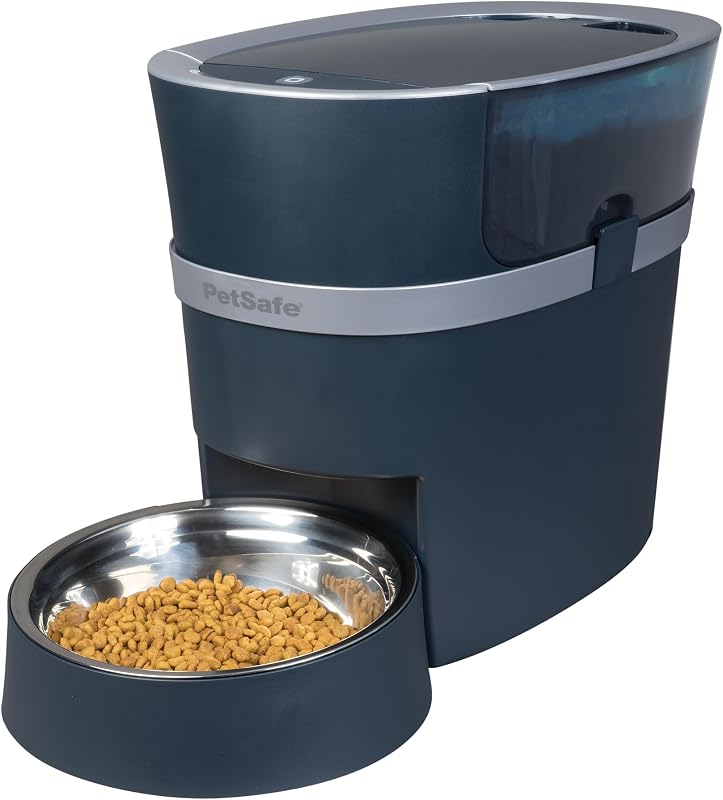
Holding up to 24 cups (6 liters) of food, the Smart Feed easily outclasses smaller pet appliances in volume. It is designed to process both standard dry kibble and semi-moist varieties. To achieve this, PetSafe uses a unique conveyor system that moves food upward and over into the bowl rather than dropping it past a basic spinning wheel. This specialized conveyor design dispenses most shapes and sizes of dry and semi-moist pet food while actively preventing jams. For homes exploring alternative high-capacity hardware, the petlibro granary vs wopet automatic feeder matchup provides additional perspective on how tank volumes impact refill schedules.
The WOPET Automatic Feeder carries a 3-liter reservoir, holding approximately 12.6 to 13 cups of dry food. The manufacturer notes that this capacity supplies enough kibble for cats and small dogs for up to 10 days. However, the WOPET dispenser uses a patented rotor mechanism restricted strictly to dry kibble sized between 2mm and 15mm in diameter. It cannot accept semi-moist foods due to the risk of jamming the rotating paddles. To protect dry kibble from moisture over those 10 days, WOPET includes a built-in desiccant compartment and a twist-lock lid. In the PetSafe Smart Feed capacity vs WOPET comparison, PetSafe offers roughly double the holding volume and broader food texture compatibility.
Edge: PetSafe Smart Feed due to its generous 6-liter reservoir that holds twice as much food and accommodates both dry and semi-moist kibble without jamming.
Portion Customization and Slow Feeding Features
Accurate portioning serves as the frontline defense against pet obesity, digestive distress, and post-meal vomiting. Cats and small dogs possess sensitive stomachs that react poorly to massive food dumps. An effective feeder must distribute exact quantities throughout the day while offering pacing options for pets that tend to gulp their dinner within seconds of dispensing.
The PetSafe feeder excels in meal tailoring, allowing owners to schedule anywhere from 1 up to 12 meals every day. Portion flexibility is remarkably broad, spanning from 1/8 cup all the way up to 4 cups per feeding event. Crucially, the Smart Feed includes an engineered Slow Feed setting designed specifically for pets who eat too quickly. When activated, this mode takes any meal larger than 1/8 cup and dispenses it in tiny, metered amounts over a 15-minute window. This gradual delivery stops pets from scarfing down meals and vomiting afterward. For owners who frequently evaluate slow-pacing dispensers, looking at the petsafe smart feed vs arf pets comparison showcases how portion division varies across established brands.
On the WOPET side, the scheduling system allows between 1 and 6 meals per day. Each meal can be programmed with 1 to 8 portions, with each portion measuring approximately 15 grams. While this granular 15-gram portioning provides decent control over daily caloric intake, the machine lacks an automated slow-dispensing mode. Meals dump out in a single continuous dispensing cycle rather than pacing out over several minutes. In a PetSafe vs WOPET slow feed evaluation, PetSafe provides a clear therapeutic advantage for fast eaters through its 15-minute staggered dispensing program.
Edge: PetSafe Smart Feed thanks to its expansive 12-meal ceiling, precise 1/8-cup increments, and dedicated 15-minute Slow Feed mode.
Alert Systems and Mealtime Voice Recordings
How an automatic feeder communicates with both pet and owner dictates its daily convenience. Owners need assurance that food is flowing smoothly, while pets often benefit from familiar auditory cues that indicate food has landed safely in the dish. The methods used to bridge this communication divide vary widely between cloud-tethered units and self-contained timers.
PetSafe focuses its notification strategy on the pet parent. Equipped with low and empty food sensors, the feeder dispatches push notifications directly to your smartphone whenever the hopper runs low on kibble or empties completely. The system also pushes instant error alerts to your mobile device if a conveyor blockage or hardware malfunction prevents a meal from dispensing. However, the PetSafe Smart Feed does not offer any voice recording hardware. When food dispenses, the pet hears only the mechanical hum of the conveyor and the sound of kibble dropping into the metal dish. Similar hardware tradeoffs appear when researching the wopet automatic feeder vs arf pets, where audio features are weighed against smart sensors.
WOPET takes the opposite approach by prioritizing immediate auditory comfort for the animal. The FT70 features an integrated voice recorder that lets you capture a 10-second personal message. This recording plays automatically right before each scheduled serving, calling your cat or dog to the dish with your own voice. For anxious animals, hearing a familiar phrase eases stress during mealtime. For the owner, WOPET provides on-chassis warning systems consisting of a food-stuck alarm and a low-battery indicator. However, because it lacks Wi-Fi, it cannot send alerts to your phone if you are away from the house. In the WOPET Automatic Feeder vs PetSafe Smart Feed matchup, you trade remote digital alerts for a localized, comforting pet meal call.
Edge: Tie because PetSafe delivers superior remote smartphone notifications for errors and low food levels, while WOPET provides an intimate 10-second voice recording that calls your pet to dinner.
Cleaning Requirements and Dishwasher Compatibility
Pet food leaves greasy residue, crumbs, and biological buildup inside hoppers, chutes, and bowls over time. Without regular cleaning, this organic matter turns rancid and fosters bacterial growth that can cause feline chin acne or digestive infections. The ease with which a feeder breaks down for sanitizing directly influences how hygienic your pet’s feeding environment remains over years of use.
PetSafe engineered the Smart Feed with maintenance convenience as a primary objective. The appliance breaks down into distinct modules: the lid, the central food hopper, the bowl holder, and the food bowl itself. All of these components are officially top-rack dishwasher-safe. Pet owners can simply dismantle the reservoir, place the parts alongside regular dinnerware, and run a standard sanitizing cycle. Even better, the included feeding bowl is manufactured from hygienic stainless steel rather than porous plastic, which significantly reduces the harboring of oils and bacteria. Shoppers interested in overall pet appliance maintenance should also review the petlibro granary vs arf pets analysis to see how other manufacturers approach material selection.
Maintenance on the WOPET Automatic Feeder requires considerably more manual effort. Constructed entirely from plastic, the product care instructions state explicitly that the unit is hand wash only. While the food tank is detachable and removable for quick cleaning, placing any of these plastic housing components into a high-heat dishwasher risks warping the patent rotor alignment or compromising the seal. Furthermore, the feeding bowl is molded plastic rather than stainless steel, requiring vigilant hand scrubbing to keep pet saliva and food oils from embedding in microscopic surface scratches. Any detailed PetSafe Smart Feed review will emphasize the immense time savings and hygiene benefits of dishwasher-safe parts over manual hand washing.
Edge: PetSafe Smart Feed because its hopper, lid, bowl holder, and premium stainless-steel bowl are completely top-rack dishwasher safe.
Power Sources and Outage Reliability
An automatic pet feeder must remain completely dependable regardless of household electrical stability. If a severe storm knocks out neighborhood power or an outlet trips a breaker while you are away on business, an appliance without a reliable secondary power backup will leave your animals stranded without their scheduled nutrition.
The WOPET Automatic Feeder incorporates a robust dual-power architecture built specifically for failover reliability. It operates primarily via corded electric power using an included adapter that connects to a standard USB power interface. If an electrical outage strikes, the machine detects the loss of current and intelligently switches over to backup batteries (not included) without interrupting its internal clock. It also features a memory function that retains your programmed feeding schedule, meaning the feeder dispenses scheduled meals right on time even in total darkness. When wondering is WOPET Automatic Feeder worth it, this failsafe power architecture provides peace of mind for travelers.
The PetSafe Smart Feed package includes a standard wall adaptor for continuous power. However, the provided product data does not specify backup battery support for this model. While its Wi-Fi functionality allows it to monitor and track feeding through cloud servers under normal conditions, a home power failure will disable both household internet routers and the feeder’s wall connection unless external uninterruptible power supplies exist. For homes prone to frequent blackouts, WOPET’s hardware-level dual-power failover offers an inherent layer of operational security.
Edge: WOPET Automatic Feeder because its integrated dual-power system seamlessly switches to backup battery power during electrical blackouts without losing schedule memory.
Pros and Cons
PetSafe Smart Feed
Pros
- Massive 6-liter hopper holds 24 cups
- Wi-Fi app scheduling and Alexa voice control
- Slow Feed mode spaces meals over 15 minutes
- Top-rack dishwasher safe with stainless bowl
- Amazon Dash Replenishment automatically reorders food
Cons
- Requires active Wi-Fi connection for smart features
- No custom voice recording playback
- Listing does not specify battery backup inclusion
View PetSafe Smart Feed on Amazon
WOPET Automatic Feeder

Pros
- 10-second personal voice recording calls pets
- Dual-power system automatically switches to battery backup
- Built-in desiccant compartment keeps kibble fresh
- Compact footprint weighing just 3 pounds
Cons
- Hand wash only plastic components
- No Wi-Fi connectivity or remote smartphone control
- Restricted to 6 meals per day maximum
View WOPET Automatic Feeder on Amazon
Who Should Buy Each One
Choose the PetSafe Smart Feed If
- You manage a multi-pet home or need to feed small dogs and cats from a large 6-liter food reservoir.
- You want complete smartphone control to adjust meals, trigger snacks via Alexa, or track low food levels remotely.
- Your pet eats too quickly and requires a Slow Feed mechanism that stretches meal dispensing over 15 minutes.
- You demand top-rack dishwasher-safe cleaning components and a hygienic stainless-steel food bowl.
Choose the WOPET Automatic Feeder If
- You want an offline, plug-and-play feeder for a single cat or small dog that operates without Wi-Fi setup.
- You want to comfort an anxious pet by playing a custom 10-second voice recording before every meal.
- Your area suffers from frequent electrical storms and you need guaranteed battery backup failover.
- You need a lightweight, compact 3-pound dispenser that fits into tight living spaces with built-in desiccant storage.
Final Verdict
For the vast majority of households, the PetSafe Smart Feed emerges as the superior automatic dispenser. Its cavernous 6-liter hopper holds double the food volume of its rival, catering effectively to multi-pet dynamics and busy schedules. Between its seamless My PetSafe smartphone app, Alexa voice compatibility, automated Amazon Dash Replenishment, and specialized 15-minute Slow Feed feature, it solves everyday feeding challenges with modern convenience. Furthermore, the inclusion of a stainless-steel bowl and fully top-rack dishwasher-safe components makes long-term hygiene effortless compared to plastic alternatives.
Nevertheless, the WOPET Automatic Feeder remains an excellent, focused choice for single-cat apartments or homes prioritizing simple offline reliability. If you have no interest in pairing devices to a wireless network, want a 10-second personal voice call to soothe your pet, or need guaranteed dual-power battery backup during local power failures, the WOPET FT70 delivers essential feeding routines without unnecessary technical overhead. For owners evaluating PetSafe Smart Feed or WOPET for cats, choose PetSafe for expansive control and WOPET for straightforward offline dependability.
FAQ
Can the WOPET Automatic Feeder connect to home Wi-Fi?
No, the WOPET Automatic Feeder does not feature Wi-Fi connectivity. It utilizes corded electric power with a USB interface and is programmed manually using the onboard controls and digital display on the front of the unit.
Does the PetSafe Smart Feed work with wet or semi-moist food?
The PetSafe Smart Feed is specifically engineered to handle dry and semi-moist pet foods. Its unique internal conveyor system moves varied kibble shapes and semi-moist textures without jamming, though it is not designed for fully wet canned foods.
How does the PetSafe slow feed setting prevent rapid eating?
When the Slow Feed feature is enabled through the My PetSafe mobile application, any scheduled meal greater than 1/8 cup is dispensed gradually in small increments over a 15-minute period. This stops pets from gulping down their food all at once and reduces the risk of vomiting.
What keeps food fresh inside the WOPET Automatic Feeder?
The WOPET feeder preserves food freshness through a twist-lock lid that seals the 3-liter hopper and an integrated desiccant compartment that actively reduces ambient moisture inside the dry kibble reservoir.
Can you record a voice message on the PetSafe Smart Feed?
No, the PetSafe Smart Feed does not include an onboard microphone or speaker for custom voice recordings. Instead, it alerts owners to feeding activities, low food levels, and errors via push notifications delivered straight to their smartphones.
What size kibble can the WOPET Automatic Feeder dispense?
The WOPET feeder is built with a patented rotor mechanism that accommodates dry kibble sizes ranging between 2mm and 15mm in diameter. Kibble outside this size range or semi-moist foods may cause dispensing jams.


