Choosing between the Vornado 660 and the Midea Duo portable AC comes down to a fundamental mechanical distinction: the difference between moving ambient air to generate evaporative skin cooling and running an active refrigeration system that extracts thermal energy and humidity from an enclosed space. The Vornado 660 is a dedicated whole-room air circulator designed to eliminate hot spots and distribute existing airflow continuously, whereas the Midea Duo is an inverter-driven portable air conditioner engineered to physically drop the ambient dry-bulb temperature in rooms up to 550 square feet.
Pick the Vornado 660 if you want an energy-efficient circulator that enhances an existing climate system without window venting. Choose the Midea Duo portable AC if you are managing a poorly insulated or unconditioned hot room where simple airflow is insufficient to bring the temperature down.


Vornado 660 vs Midea Duo portable AC at a Glance
| Feature | Vornado 660 | Midea Duo portable AC |
|---|---|---|
| Appliance Category | Air Circulator Fan | Portable Air Conditioner |
| Cooling Mechanism | Aerodynamic Vortex Circulation | Refrigeration (R 410A) |
| Rated Cooling Capacity | Not listed | 14,000 BTU (12,000 BTU SACC) |
| Maximum Airflow Reach | Up to 100 feet | Up to 26 feet |
| Airflow Volume | 584 CFM | Not listed |
| Power Consumption | 45 watts | 1,300 watts |
| Minimum Noise Rating | 54 dB | 42 dB |
| Speed and Modes | 4 speed settings | Variable-speed inverter compressor |
| Control Interfaces | Top-mounted push buttons | SmartHome app, voice control, remote |
| Installation Required | None (freestanding/tabletop) | Packaged window exhaust kit |
| Best For | Circulating air and supplementing HVAC | Active heat extraction in uncooled rooms |
Cooling Mechanism and Thermal Reduction
Evaluating Vornado 660 vs Midea Duo cooling power requires recognizing that only one of these appliances actively reduces air temperature. The Vornado 660 uses aerodynamic components-including deep-pitched blades, an inlet guide cone, and an enclosed spiral grill-to propel a concentrated column of air across distances up to 100 feet. This focused stream pushes against walls and ceilings to create continuous circulation, which speeds up sweat evaporation on human skin. However, in a closed space with no source of cool air, the Vornado 660 simply moves warm air around, leaving the room temperature unchanged.
The Midea Duo portable AC operates as a complete thermal transfer system utilizing R 410A refrigerant and a variable-speed rotary scroll compressor. Rated at 14,000 BTU (12,000 BTU SACC), it draws hot room air over an evaporator coil, absorbs the thermal energy into the refrigerant, and vents the concentrated heat outside through a dedicated exhaust hose. This cycle actively drops the indoor dry-bulb temperature and extracts excess moisture. Readers weighing a honeywell hyf290b vs midea duo portable ac encounter the same mechanical reality: a standard fan cannot alter room thermodynamics.
When selecting a Vornado 660 or Midea Duo for hot room environments that lack existing air conditioning, the operational gap is absolute. The Vornado circulator offers welcome airflow during mild weather or when helping a central AC vent push cool air into stagnant corners, but it cannot counteract external solar heat gain. The Midea Duo provides genuine climate control by physically chilling up to 550 square feet of living space.
Edge: Midea Duo portable AC because its 14,000 BTU refrigeration system actively lowers indoor temperatures rather than just moving ambient air.
Energy Consumption and Operating Efficiency
The power demands of these two machines reflect their distinct cooling methods. The Vornado 660 uses an efficient brushless motor that pulls a maximum of 45 watts from a standard 120-volt outlet. Running this circulator around the clock uses negligible electrical power, making it practical for non-stop operation in living spaces, home offices, and bedrooms.
The Midea Duo portable AC operates at a peak draw of 1,300 watts at 115 volts. Because it incorporates an advanced inverter compressor rather than a standard single-speed compressor, it modulates motor speed to maintain set points without continuous on-off cycling. Midea claims this inverter system saves over 40% energy compared to the U.S. federal standard, supported by a Seasonal Energy Efficiency Ratio (SEER) of 8.9 and an estimated annual energy consumption of 475.97 kWh. Those exploring a dyson tp09 vs vornado 660 will note that while specialized fans keep power draws minimal, active compressor-based cooling requires significantly more electricity.
If your primary consideration is running costs, the Vornado 660 is exceptionally efficient. It delivers 584 CFM of whole-room airflow for a fraction of the electricity required by any portable refrigeration compressor, including high-efficiency inverter models.
Edge: Vornado 660 because its 45-watt motor consumes a tiny fraction of the electrical energy demanded by a 1,300-watt compressor unit.
Acoustic Performance and Operational Noise
Perceived sound levels often determine whether an appliance is suitable for sleeping areas. The listed Midea Duo inverter noise level drops as low as 42 dB during steady-state cooling. Because the variable-speed rotary scroll compressor ramps up and down smoothly, it eliminates the abrupt mechanical clatter common to older portable air conditioners. Once the room reaches the target temperature, the Midea Duo settles into a low, steady hum comparable to quiet conversation or background library ambiance.
The Vornado 660 is rated at 54 dB on its highest output setting. While it features four speed settings that provide whisper-quiet operation on the lowest power level, increasing the speed to drive its 584 CFM maximum airflow introduces audible wind rush. This sound is smooth aerodynamic white noise rather than mechanical vibration, but on higher settings, the sheer velocity of moving air generates a noticeable acoustic presence. Similar dynamics appear when comparing the vornado 660 vs honeywell hyf290b, where air speed directly dictates decibel output.
For shoppers deciding between the Vornado 660 or Midea Duo for bedroom installation, the noise profile is a critical trade-off. The Vornado offers very quiet low speeds with gentle motor sounds, but on high, it registers louder than the lowest output of the Midea Duo. The Midea Duo produces complex mechanical noise including compressor hum and refrigeration flow, yet its 42 dB low-frequency operation remains remarkably subdued for a 14,000 BTU cooling unit.
Edge: Midea Duo portable AC because its low-speed inverter sound floor of 42 dB is quieter than the peak 54 dB airflow noise of the Vornado.
Airflow Dynamics and Room Coverage
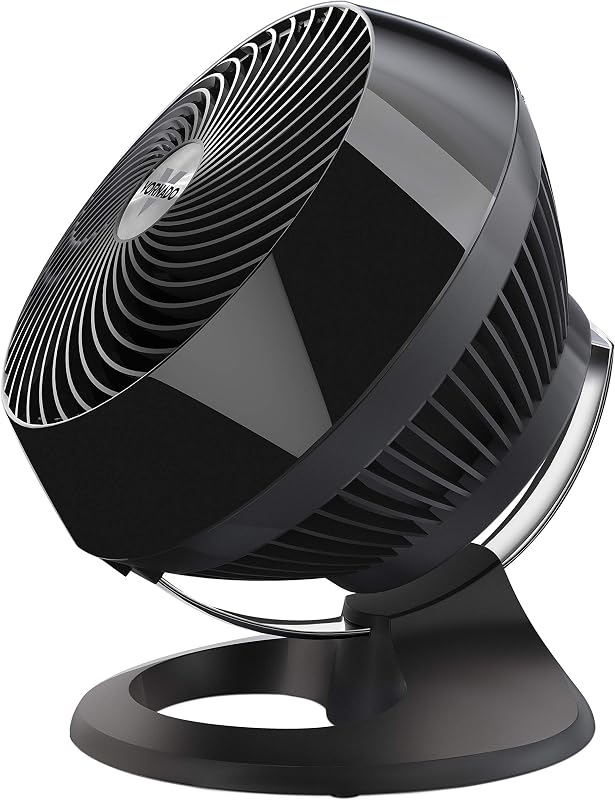
Air delivery designs differ sharply between these units. The Vornado 660 is engineered specifically around vortex aerodynamics, using three deep-pitch blades and a directional spiral grill to generate a focused beam of air. This air column travels up to 100 feet, bouncing off distant boundaries to create continuous circulation throughout an entire room. With a capacity of 584 CFM, it eliminates stagnant pockets and balances temperatures across large living areas or split-level spaces.
The Midea Duo portable AC utilizes an internal air duct system designed to project conditioned air up to 26 feet into a room. To distribute cooling evenly, it incorporates a dynamic 102-degree cool swing louver that sweeps chilled air across the room. While this mechanical louver helps disperse air and prevent uncomfortable cold drafts, the overall velocity and projection distance are lower than the long-distance beam of the Vornado.
In terms of coverage, the Midea Duo is rated to cool spaces up to 550 square feet, addressing thermal comfort by lowering the air temperature. The Vornado 660 does not alter room heat, but its 100-foot throw and 584 CFM airflow rate ensure far superior air mixing and draft generation across wider layouts. Readers comparing the dyson tp09 vs midea duo portable ac will recognize that dedicated air movers focus on air velocity, whereas portable air conditioners balance airflow with thermal conditioning.
Edge: Vornado 660 because its 584 CFM capacity and 100-foot projection throw move air much farther and more aggressively than the Midea unit.
Installation, Mobility, and Control Convenience
The Vornado 660 requires zero installation. Weighing very little and designed for freestanding or tabletop placement, it can be unboxed, plugged into any 120-volt receptacle, and pointed where needed. Its chrome glide bar provides 90 degrees of tilt adjustment, letting users direct the air stream horizontally across a floor, vertically toward a ceiling, or anywhere between. Controls are streamlined: four top-mounted push buttons adjust power levels, and the removable front grill makes cleaning dust off the blades straightforward.
The Midea Duo requires dedicated window venting. It employs an innovative hose-in-hose design that places the outdoor intake and exhaust channels inside a single assembly. This dual-hose configuration creates balanced internal pressure, preventing hot outdoor air from being pulled indoors through window and door cracks. While the vertical pull-out window kit streamlines setup, the unit remains tied to a window location, limiting placement flexibility compared to a compact fan.
Where the Midea Duo pulls ahead is control technology. The unit is Wi-Fi enabled and connects to the SmartHome app on iOS and Android devices, allowing remote scheduling, temperature adjustment, and mode switching. It also supports voice commands through Amazon Alexa and Google Assistant devices, and includes a full-featured handheld remote. The Vornado 660 relies entirely on manual push buttons on the housing, offering no remote or smart automation.
Edge: Tie because the Vornado 660 provides immediate zero-setup portability, while the Midea Duo balances its mandatory window installation with modern smart app and voice controls.
Pros and Cons
Vornado 660
Pros
- Up to 100 ft airflow beam
- Low 45-watt energy draw
- 584 CFM high-velocity volume
- 5-year replacement warranty
- 90-degree chrome glide tilt
Cons
- Cannot actively lower room temperature
- No remote or smart controls
- Reaches 54 dB on high
Midea Duo Portable AC

Pros
- 14,000 BTU active refrigeration
- Variable-speed inverter compressor
- Ultra-quiet 42 dB low sound
- Duo hose-in-hose balanced intake
- Smart app and voice controls
Cons
- High 1,300-watt power draw
- Requires dedicated window exhaust
- Airflow reach limited to 26 ft
View Midea Duo portable AC on Amazon
Who Should Buy Each One
Choose the Vornado 660 If
- You already have a working central HVAC or mini-split system and need to eliminate stagnant hot spots across a large room.
- You want high-velocity air movement without dealing with window brackets, exhaust hoses, or seasonal storage hassles.
- You want to keep daily power consumption under 45 watts to minimize utility expenses.
- You need an appliance that can sit on a desk, tabletop, or floor and aim directly at the ceiling via a 90-degree tilt bar.
Choose the Midea Duo portable AC If
- You are trying to cool an unconditioned room up to 550 square feet where standard fans fail to reduce heat.
- You want a quiet cooling appliance with an inverter compressor capable of operating at 42 dB during sleep hours.
- You require smart integration to adjust temperatures and schedules via smartphone apps, Alexa, or Google Assistant.
- You want balanced dual-hose efficiency that exhausts heat outdoors without pulling unconditioned air through home crevices.
Final Verdict
For spaces experiencing excessive thermal loads and high humidity, the Midea Duo portable AC is the clear functional winner. Its 14,000 BTU inverter cooling system, balanced duo-hose assembly, 42 dB quiet operation, and comprehensive smart app controls allow it to solve genuine cooling emergencies that no air mover can touch. If you need to drop indoor temperatures during hot summer months, the Midea Duo is worth the setup requirement and higher power consumption.
For well-insulated rooms or homes with functioning air conditioning, the Vornado 660 is the more practical and economical companion. Drawing just 45 watts, pushing 584 CFM across a 100-foot vortex beam, and featuring a convenient 90-degree chrome glide bar, it provides whole-room circulation with zero setup. When passive air circulation is all that is required to stay comfortable, the Vornado 660 delivers dependable airflow backed by a 5-year replacement promise.
FAQ
Can the Vornado 660 actually lower the room temperature?
No, the Vornado 660 does not contain a refrigeration circuit, compressor, or cooling coils, so it cannot drop the dry-bulb temperature of a room. It cools your body through convective and evaporative airflow. To physically extract heat from the space, an active refrigeration appliance like the Midea Duo portable AC is required.
How difficult is it to install the Midea Duo portable AC?
The Midea Duo uses a packaged window kit with a vertical pull-out design that simplifies assembly. Because it features a duo hose-in-hose structure, you only need to secure a single combined duct frame into your window opening. Setup requires basic window adjustment without cutting or specialized construction tools.
Is the Midea Duo portable AC quiet enough for light sleepers?
Yes, the Midea Duo inverter noise level drops to 42 dB on low cooling settings. Its variable-speed rotary scroll compressor avoids the loud on-off clicks and vibrations common to traditional single-speed portable air conditioners, producing a steady hum comparable to a quiet library environment.
Which unit is better for a bedroom during hot summer months?
Choosing between the Vornado 660 or Midea Duo for bedroom comfort depends on your home’s existing climate control. If your bedroom gets excessively warm and lacks central AC, the Midea Duo is necessary to drop the room temperature and dehumidify the air. If the bedroom already receives cool air from an HVAC duct, the Vornado 660 is ideal for quietly circulating that chilled air across the bed.
Can you use the Vornado 660 alongside the Midea Duo portable AC?
Yes, pairing the two units can improve cooling distribution in irregularly shaped rooms. While the Midea Duo projects cold air up to 26 feet using its 102-degree swing louver, placing the Vornado 660 in front of the chilled air path allows its 100-foot vortex stream to propel cold air into distant hallways or adjoining spaces.
What regular maintenance do these appliances require?
The Vornado 660 features a removable front grill that allows you to wipe down its three blades and vacuum the motor housing to clear dust buildup. The Midea Duo portable AC includes an Air Fresh Filter and a washable dust filter that must be rinsed periodically to protect the internal evaporator coils and maintain cooling performance.