The defining difference in the aluminum vs fiberglass ladder decision comes down to electrical conductivity versus physical weight. Aluminum is an efficient conductor of electricity that introduces lethal shock hazards near live wiring, whereas fiberglass features composite, non-conductive structural rails that insulate the user from electrical currents. In contrast, aluminum provides unmatched portability and handling ease, frequently cutting the frame weight in half compared to dense composite construction.
Homeowners, painters, and general DIY enthusiasts should choose an aluminum ladder for effortless maneuvering around domestic spaces and straightforward transport. Electricians, commercial maintenance technicians, and contractors working around power lines or breaker panels should choose a fiberglass ladder for non-negotiable safety and jobsite code compliance.


Aluminum Ladder vs Fiberglass Ladder at a Glance
| Feature | Aluminum Ladder | Fiberglass Ladder |
|---|---|---|
| Primary Material | Lightweight tubular aluminum alloy | Fiberglass reinforced polymer with polyester veil |
| Electrical Conductivity | Conductive (dangerous around electricity) | Non-conductive composite rails |
| Load Capacity | 330 lbs (Duty Rating Type IA equivalent) | 300 lbs (ANSI Type IA) |
| Typical Weight Profile | 10.4 lbs (6-step) to 27.4 lbs (14ft multi-position) | The listing does not specify exact product weight |
| Step Rise Spacing | The listing does not specify | 12 inches between steps |
| Safety Standards | EN131, ANSI, ISO9001, GS TUV certified | ANSI and OSHA compliant |
| Step Fastening and Bracing | Plastic-wrapped metal joints and balance bars | Six large-head semi-tubular steel rivets per step |
| Top Cap Utility | Integrated tool tray on step stool units | Molded top with handyman tool slots and parts tray |
| Weather and UV Resistance | Immune to UV breakdown; corrosion-resistant | Protected by polyester veil; vulnerable to UV resin bloom |
| Best For | General DIY maintenance, indoor reaching, and easy hauling | Electrical maintenance, jobsite safety, and heavy-duty utility work |
Electrical Safety and Conductivity
Electrical safety is the single most critical factor separating these two structural materials. Aluminum is an exceptional conductor of electricity. If an aluminum rail makes contact with an energized service feed, a worn power tool cord, or an overhead power line, electric current travels instantly through the ladder and straight into the user standing on it. For this reason, selecting an werner mt-22 vs louisville fe3220 or similar high-reach setup requires understanding that metallic rails are strictly unsuitable around active circuitry. When considering an aluminum or fiberglass ladder for electrical work, safety regulations and basic common sense mandate that metal frames remain far away from utility drops and live panels.
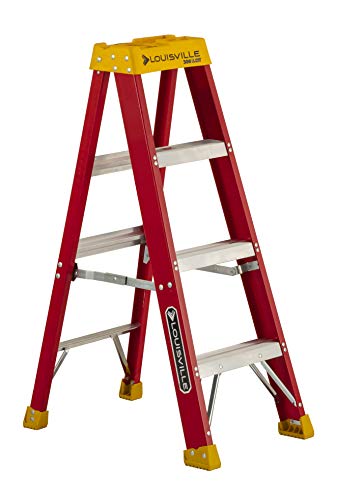
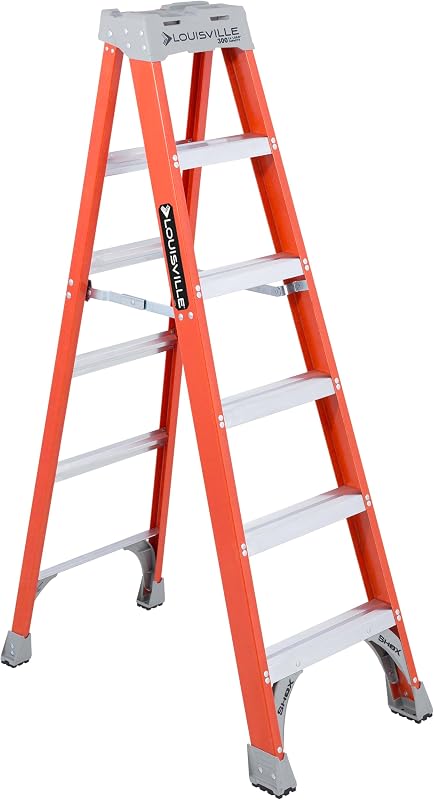
Fiberglass ladders are built specifically to solve this hazardous scenario. Models such as the Louisville Ladder 6 ft Fiberglass Step Ladder, FS1506, Type IA, 300 lbs feature non-conductive full-channel rails covered with a specialized polyester veil. This dense composite matrix prevents the transmission of electrical currents, providing an isolated working platform. When working on indoor lighting fixtures or industrial ceiling installations, the smaller Louisville Ladder 4 ft Fiberglass Step Ladder, L-3016-04, Type IA, 300 lbs offers the same non-conductive safety assurance, combining structural rigidity with peace of mind. Both options meet or exceed the rigorous workplace criteria established by ANSI and OSHA.
Choosing a non conductive ladder vs aluminum is not merely a matter of convenience; it is often a strict requirement under commercial safety codes. Even if an electrical task appears minor, accidentally cutting into a live wall line or brushing an overhead cable with an aluminum extension structure can result in severe injuries or fatalities. While fiberglass rails can become somewhat conductive if coated in standing water, oil, or conductive grime, a clean and dry fiberglass ladder remains the universal industry safeguard for electrical maintenance.
Edge: Fiberglass Ladder provides life-saving electrical insulation that makes it mandatory for any work near live circuits or power lines.
Weight, Portability, and Ease of Transport
Physical weight dictates how easily a ladder can be extracted from a closet, transported in a vehicle, and positioned in tight spaces. For everyday household chores, lightweight agility dramatically reduces physical strain. Heavy tools often lead to skipped tasks or improper setup when users rush because an awkward piece of equipment is exhausting to drag across the house. Comparing fiberglass ladder weight vs aluminum highlights the immediate handling benefits of low-density metallic frames.
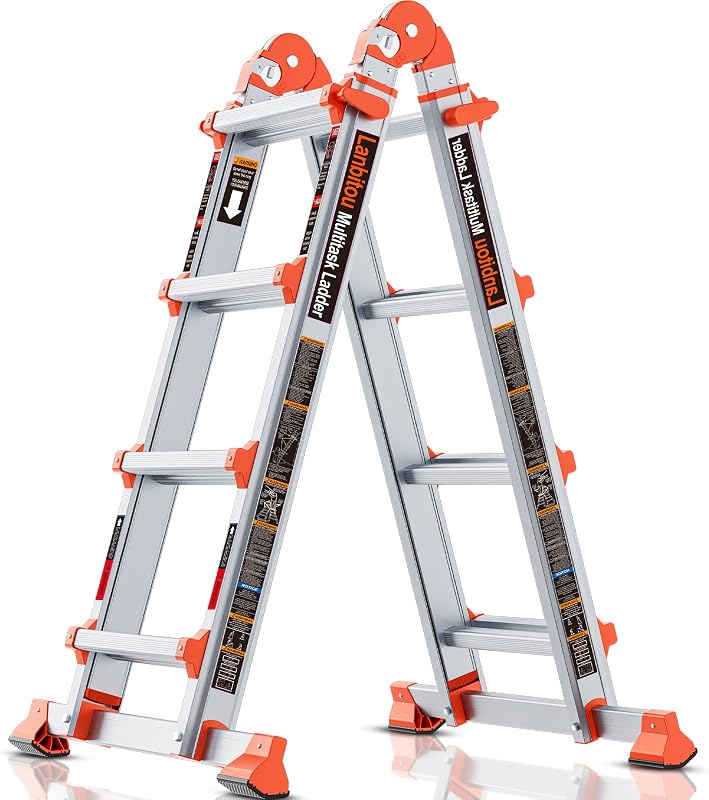
Lightweight aluminum engineering excels in this area. The NEWBULIG 6 Step Ladder, 330lbs Capacity Folding Aluminum Step Stool weighs just 10.4 pounds while unfolding to provide a working height of up to 76.5 inches. Its slim profile enables effortless one-handed carrying up staircases and fits neatly inside cramped storage closets or small car trunks. Even heavy-duty convertible aluminum designs remain manageable. The LANBITOU Ladder A Frame Extension 14Ft Multi Position for Home 330lbs integrates thick 2mm aluminum wall construction and anti-slip balance bars, yet weighs just 27.4 pounds while converting into a full 14-foot extension ladder.
Fiberglass is a fundamentally denser, heavier composite compound consisting of glass fibers embedded in hardened thermoset resins. Although the Louisville Ladder listings do not specify their exact product weights, trade professionals routinely acknowledge that fiberglass models weigh considerably more than equivalent aluminum frames. Hauling a tall fiberglass step ladder onto roof racks or up narrow stairwells demands significantly more physical effort. For DIYers focused on general portability rather than industrial electrical risk, analyzing an little giant vs werner comparison demonstrates how lighter frames speed up routine residential tasks.
Edge: Aluminum Ladder wins clearly by offering featherlight carrying weights that make home storage and multi-room tasks virtually effortless.
Load Capacity, Stability, and Rigidity
A ladder must inspire complete confidence underfoot, supporting the combined weight of the user, heavy power tools, and building supplies without disconcerting wobble or deflection. High weight ratings reflect reinforced engineering, robust joint connections, and wide base geometries that keep the platform planted on smooth floors or uneven turf. Looking closely at structural metrics reveals how both material choices deliver professional-grade load capabilities through completely different mechanical designs.
The aluminum ladder weight capacity found on modern residential and light commercial ladders is remarkably high. Both the NEWBULIG step stool and the LANBITOU multi-position unit carry a certified 330-pound load capacity. LANBITOU utilizes a 2mm tube wall thickness-double that of many basic alternatives-which withstood experimental testing up to 450 kilograms. It further enhances base rigidity using two anti-slip balance bars featuring a sloping mesh tread design to bite firmly into surfaces without marring interior walls. NEWBULIG complements its aluminum build with wide flaring legs and slip-resistant wide pedal handrails to secure stability across all six steps.
Fiberglass designs achieve exceptional structural stiffness due to the natural resistance of composite polymer rails. Both Louisville Ladder examples boast a 300-pound Type IA duty rating, which explicitly accounts for the user plus heavy gear. Louisville Ladder constructs the FS1506 with six large-head semi-tubular steel rivets securing every single step to the side channels. It also integrates heavy-duty bottom back braces and angled feet with thick rubber tread across all four legs. The red L-3016-04 utilizes similar slip-resistant rubber tread feet and a stiff molded top that eliminates side-to-side twist. While aluminum may exhibit subtle mechanical flex under maximum loads, fiberglass feels exceptionally rigid and planted under heavy work boots.
Edge: Tie, as aluminum delivers higher overall weight capacities (330 lbs) while fiberglass offers superior structural rigidity with zero rail flexing.
Durability, Weathering, and Environmental Resistance
Ladders must withstand harsh storage conditions, humidity, temperature extremes, and physical bumps in workshops or service vans. A buyer wondering if fiberglass ladders are better than aluminum must assess where the ladder will live and what elements it will encounter over years of ownership. Exposure to moisture, sun, and abrasive knocks will degrade metals and composite polymers in vastly different ways.
Aluminum is naturally corrosion-resistant. It generates an invisible microscopic oxide film upon exposure to air, stopping progressive rust in its tracks. As noted in the LANBITOU specifications, the unit can be kept outdoors because it resists weather, wear, and corrosion without warping or twist deformation. Aluminum can sit in an uninsulated shed, an open porch, or the back of a truck bed through relentless downpours and blazing summer sun without structural degradation. Its primary physical vulnerability is impact damage: sudden lateral blows can dent thin-walled aluminum channels, which permanently weakens the metal.
Fiberglass provides outstanding resistance to chemical spills, impact dings, and localized dents that would compromise hollow metal rails. However, composite polymers are inherently vulnerable to prolonged ultraviolet (UV) sunlight. The Louisville Ladder FS1506 combats this issue by encasing its non-conductive full-channel rails in a protective polyester veil. Even with this veil, years of continuous direct sunlight exposure will gradually degrade the resin binder, exposing raw glass strands in a process known as fiber blooming. These exposed fibers can shed into the skin of the user, requiring protective maintenance coats or indoor storage. For long-term exposed storage, an aluminum ladder review consistently emphasizes the zero-maintenance advantage of raw aluminum.
Edge: Aluminum Ladder edges ahead for low-maintenance longevity, as it never suffers from UV degradation or fiber shedding when stored in outdoor environments.
Versatility and Configuration Options
A versatile ladder simplifies complex projects by adjusting to different heights, surfaces, and functional demands. Homeowners and trade professionals frequently encounter obstacles such as stairwells, vaulted ceilings, uneven garden terrain, and cramped utility closets. Evaluating whether a fiberglass ladder is worth it depends heavily on whether you need a dedicated single-purpose climbing frame or an adaptable multi-position tool.
Aluminum ladders dominate the multi-position and folding market because their lightweight material allows for complex hinges and telescoping sections without becoming too heavy to lift. The LANBITOU system quickly converts into an extended A-frame, stair ladder, tall extension ladder, or compact storable unit. When folded, it measures only 9 inches thick, 29 inches long, and 47 inches high, sliding effortlessly into vehicle trunks or behind workbench doors. Meanwhile, step units like the NEWBULIG integrate convenient wide-pedal handrails and a built-in top tool tray to keep screwdrivers, fasteners, or paint buckets within arm’s reach.
Fiberglass models are generally engineered as dedicated step ladders or heavy-duty straight extension ladders. The Louisville Ladder FS1506 and L-3016-04 represent the classic A-frame step ladder format with 12-inch step rises and stable four-point stances. To boost utility on the job, Louisville Ladder integrates a molded top equipped with a handyman’s tool slots and parts tray, keeping screwdrivers, pliers, and screws readily accessible. When deciding on an aluminum or fiberglass ladder for painting, these molded trays are essential for holding paint cans. However, the rigid composite construction prevents these fiberglass models from transforming into staircase adapters or ultra-compact folding packages.
Edge: Aluminum Ladder wins due to its unmatched versatility, multi-position folding capabilities, and compact storage dimensions.
Pros and Cons
Aluminum Ladder
Pros
- Lightweight frames under 28 pounds
- Generous 330-pound load capacity
- Corrosion and weather resistant metal
- Versatile multi-position folding configurations
Cons
- Conducts electricity hazardously
- Prone to dents from heavy side impacts
View LANBITOU Ladder A Frame Extension 14Ft on Amazon
Fiberglass Ladder
Pros
- Non-conductive rails for electrical safety
- Rigid 300-pound Type IA duty rating
- Six steel rivets per step connection
- Molded top with handyman tool slots
Cons
- Noticeably heavier to transport
- Resin degrades under prolonged UV sun exposure
View Louisville Ladder 6 ft Fiberglass Step on Amazon
Who Should Buy Each One
Choose the Aluminum Ladder If
- You need an ultra-lightweight frame that anyone can carry easily between rooms without straining back or arm muscles.
- You want a multi-configuration system that converts into a stair ladder, extension ladder, or compact folding package.
- You plan to store the ladder in an unheated garage, shed, or outdoor area where sunlight and weather would degrade composite resins.
- You are handling interior painting, hanging window treatments, or clearing gutters well away from power feeds and electrical service lines.
Choose the Fiberglass Ladder If
- You are an electrician, maintenance worker, or DIYer tackling any project close to overhead wiring, breaker boxes, or outdoor service drops.
- You require strict compliance with workplace jobsite safety standards mandated by ANSI and OSHA.
- You prefer a completely rigid climbing feel with zero rail flexing, reinforced by heavy-duty steel rivets and back bracing.
- You work in busy commercial workshops or construction zones where metal tools and equipment could dent lightweight aluminum channels.
Final Verdict
For most homeowners and general DIYers, the aluminum ladder is the superior overall choice. Units like the werner mt-22 vs little giant king kombo and the versatile LANBITOU multi-position frame solve everyday residential access problems with ease. Weighing a fraction of composite models and folding into remarkably tight storage profiles, an aluminum ladder removes the friction of pulling out heavy equipment for simple chores like dusting ceiling fans, replacing bulbs, or painting walls. Furthermore, its natural immunity to sunlight breakdown ensures decades of dependable use in standard home storage environments.
However, when electrical risks enter the equation, the fiberglass ladder is the undisputed winner and an absolute necessity. Aluminum creates a severe shock and electrocution hazard the moment live electricity or overhead lines are nearby. Commercial tradespeople and electricians rely on the non-conductive reliability of the Louisville Ladder FS1506 and L-3016-04 to protect lives on job sites every day. If your work involves power tools in damp spaces, electrical panels, or service wiring, the increased weight of a fiberglass ladder is a small, necessary trade-off for essential life safety.
FAQ
Can an aluminum ladder be used safely for electrical work?
No, an aluminum ladder should never be used for electrical work or in close proximity to exposed electrical lines. Aluminum conducts electrical current with minimal resistance. If the ladder contacts a live wire or damaged tool cable, the current will flow through the frame and electrocute the user. For electrical tasks, safety regulations strictly require a non-conductive fiberglass or wooden ladder.
Why is a fiberglass ladder heavier than an aluminum ladder?
Fiberglass ladders are heavier because they are manufactured from dense structural composite materials, combining glass fiber filaments with solid cured thermoset resin. This structural density gives fiberglass its non-conductive properties and high torsional rigidity. Aluminum is a low-density metal, allowing manufacturers to create hollow, high-strength extrusions that weigh considerably less for the same working length.
How does UV sunlight affect a fiberglass ladder?
Prolonged exposure to the ultraviolet rays in sunlight breaks down the outer resin coating of a fiberglass ladder over time. While quality models feature protective coatings like polyester veils, continuous outdoor storage eventually causes fiber blooming, where tiny glass fibers become exposed and shed upon contact. Storing fiberglass ladders indoors or in shaded areas preserves their structural integrity and keeps the finish smooth.
Which ladder material is better for exterior house painting?
An aluminum ladder is generally better for exterior house painting unless you are working directly adjacent to an overhead electrical service drop. Painting requires moving the ladder frequently along the perimeter of the home, where aluminum’s light weight significantly reduces fatigue. However, if exterior walls run close to power lines, a fiberglass ladder is mandatory to eliminate electrical hazards.
What should I look for in ladder load ratings?
Ladder load ratings indicate the maximum safe working weight, which includes the user plus all clothing, tools, paint cans, and hardware carried onto the rungs. A Type IA rating signifies an industrial load capacity of 300 pounds, while reinforced aluminum models like the LANBITOU and NEWBULIG provide an elevated 330-pound rating. Always select a duty rating that comfortably exceeds your body weight plus your heaviest gear.
Do fiberglass ladders dent like aluminum ladders?
No, fiberglass rails do not dent under localized impact the way aluminum channels can. When struck by a dropped tool or bumped against building corners, fiberglass absorbs the energy and retains its shape. However, severe impacts can cause cracking, chipping, or internal structural delamination in fiberglass, which requires immediate inspection before further climbing.
Related reading: little giant king kombo vs louisville fe3220.