Deciding between high-end desktop silicon comes down to raw compute density versus specialized memory bandwidth: the primary difference between the AMD Ryzen 9 7900X and the AMD Ryzen 9 7950X3D is that the flagship 7950X3D pairs 16 cores with an expansive 144MB cache configuration using AMD 3D V-Cache technology at a 120-watt rating, whereas the 7900X utilizes a 12-core layout with a 76MB combined cache pool operating at 170 watts.
Buyers focused on balanced multithreaded productivity with integrated graphics should select the Ryzen 9 7900X, while enthusiasts prioritizing the highest tier of multi-core capability and massive cache volume should invest in the Ryzen 9 7950X3D.
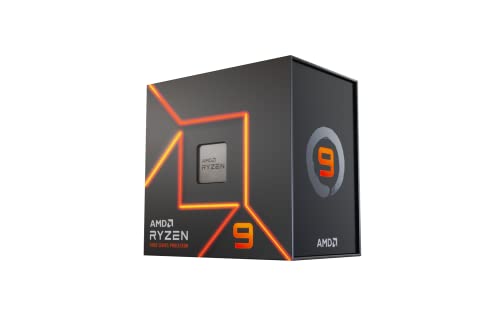

AMD Ryzen 9 7900X vs AMD Ryzen 9 7950X3D at a Glance
| Attribute | AMD Ryzen 9 7900X | AMD Ryzen 9 7950X3D |
|---|---|---|
| Processor Core Count | 12 cores | 16 cores |
| Concurrent Threads | 24 threads | 32 threads |
| Clock Speed | 4.70 GHz base, 5.6 GHz max | 5.7 GHz max boost |
| Total Cache Memory | 76 MB (12 MB L2 + 64 MB L3) | 144 MB |
| Secondary Cache (L2) | 12 MB | 16 MB |
| Operating Wattage | 170 watts | 120 watts |
| Manufacturing Process | 5 nm | Not listed |
| Integrated Graphics | AMD Radeon Graphics | Not listed |
| Operating System Support | Linux, Windows | Windows 10, Windows 11 |
| Socket Compatibility | Socket AM5 | Socket AM5 |
| Best For | High-demand general productivity | Extreme gaming and workstation multitasking |
Core Counts and Multithreaded Processing Capacity
Compute throughput in modern desktop processors depends heavily on core layout and concurrent thread handling. The Ryzen 9 7900X features a 12-core, 24-thread configuration built on a 5 nm manufacturing process. This dodeca-core architecture distributes heavy parallel tasks across 24 concurrent threads, providing dependable execution for 3D modeling, code compilation, and multithreaded rendering workflows. When deciding whether to choose the 7900X or 7950X3D for productivity, the baseline multithreading capability of the 12-core model handles heavy compute demands without unnecessary idle resource overhead.
The Ryzen 9 7950X3D expands compute resources by providing 16 physical cores and 32 processing threads. This step up to 32 threads gives the system a 33 percent increase in simultaneous execution pipelines over the 12-core chip. Heavy rendering engines, software virtualization, and complex simulation packages scale linearly with available physical cores, enabling the 7950X3D to process simultaneous heavy background tasks without degrading foreground responsiveness. Readers comparing this tier to alternative configurations such as the amd ryzen 9 7900x vs 7950x will note that moving to 16 cores transforms workflow turnaround times on heavily parallel software suites.
Selecting between these physical architectures depends entirely on your workload saturation. The 12-core 7900X easily satisfies everyday creative applications, photo editing, and software development. However, the four additional physical cores and eight additional threads on the 7950X3D offer a measurable headroom advantage for dedicated rendering and workstation multi-tasking.
Edge: AMD Ryzen 9 7950X3D provides four additional physical cores and eight more execution threads for superior multithreaded throughput.
Cache Memory and AMD 3D V-Cache Technology
Cache architecture dictates how fast execution units retrieve data without querying primary system RAM. The 7900X equips 12 MB of L2 cache alongside 64 MB of L3 cache, creating a 76 MB secondary cache footprint. This 76 MB structure provides high hit rates and short access latency, ensuring fluid system operation across standard computational suites and mixed gaming environments.
In contrast, the Ryzen 9 7950X3D features a massive 144 MB cache footprint powered by AMD 3D V-Cache technology. This specialized stacking method layers physical memory directly onto the compute die, expanding the available pool that processor cores query instantly. In the debate between the 7900X vs 7950X3D cache capabilities, the 144 MB pool drastically minimizes memory pipeline stalls in data-intensive game engines and complex instruction loops. Those exploring specialized gaming processors like the amd ryzen 7 7800x3d vs ryzen 9 7950x3d recognize how vertical cache stacking transforms framerate consistency and minimum frame times.
For demanding titles, evaluating the Ryzen 9 7900X or 7950X3D for gaming highlights the clear impact of vertical cache integration. The 7900X relies entirely on standard planar cache sizes, which perform admirably but still defer larger instruction blocks to system memory. The 7950X3D holds larger working data sets directly on the processor package, unlocking superior frame pacing and throughput in titles that saturate memory bandwidth.
Edge: AMD Ryzen 9 7950X3D dominates with 144 MB of total cache using stacked 3D V-Cache technology.
Power Consumption and Operating Wattage
Power consumption directly impacts motherboard component stress, power supply requirements, and thermal management. A head-to-head inspection of the Ryzen 7900X vs 7950X3D wattage figures shows an intriguing design contrast: the 7900X is rated at 170 watts, whereas the larger 16-core 7950X3D carries a lower specification of 120 watts.
The 170-watt envelope of the 7900X allows its 12 cores to sustain aggressive power delivery under heavy sustained loads, which generates substantial thermal energy that requires a robust cooling assembly. The 7950X3D operates under tighter power limits due to the thermal properties of stacked 3D silicon, capping its operating draw at 120 watts while distributing that power across 16 cores. Buyers evaluating competing high-end chips like the intel core i9-14900k vs amd ryzen 9 7950x3d will appreciate that the 7950X3D achieves top-tier compute density while restricting overall draw.
Thermal logistics remain critical for both components. The product listing for the 7950X3D specifies that a cooler is not included and explicitly recommends a liquid cooler to manage heat dissipation. While the 7900X also requires a capable aftermarket cooling setup to handle its 170-watt draw, the 7950X3D achieves superior multi-core power efficiency by delivering more threads at a lower thermal threshold.
Edge: AMD Ryzen 9 7950X3D wins by delivering higher processing capability within a leaner 120-watt power envelope.
Clock Speeds and Frequency Potential
Clock frequencies determine how quickly individual cores execute sequential instructions. The 7900X lists a base clock speed of 4.70 GHz alongside a 5.6 GHz maximum overclocking speed. The relatively high base frequency provides reliable single-threaded cadence for tasks that fail to leverage parallel architectures, such as everyday office applications, older software utilities, and standard operating system processes.
The Ryzen 9 7950X3D listing highlights a maximum boost speed of 5.7 GHz, providing an extra 100 MHz of burst velocity over the 7900X. Furthermore, the listing identifies unlocked memory overclocking support, letting users tune DDR5 system memory to optimize data fabric throughput. When comparing the amd ryzen 9 7950x vs 7950x3d or the standard 7900X, maximum boost clock capability defines how quickly the system handles brief, burst-heavy processing demands.
While the 7950X3D reaches a higher peak velocity of 5.7 GHz, the 7900X provides a verified 4.70 GHz base clock for sustained baseline operations where the 7950X3D product details do not specify base frequency. However, the higher ceiling and unlocked memory control give the 7950X3D the definitive velocity advantage under demanding conditions.
Edge: AMD Ryzen 9 7950X3D achieves the higher single-core ceiling with a 5.7 GHz maximum boost speed.
Platform Features and System Integration
Both processors integrate into the modern Socket AM5 ecosystem, ensuring compatibility with standard physical mounting hardware. Each chip features an identical physical footprint of 1.57 inches long by 1.57 inches wide. Motherboard builders can pair either processor with Socket AM5 boards, which support next-generation DDR5 memory channels to maximize throughput.
The listing for the 7950X3D specifically emphasizes support for PCIe 5.0 on select 600 Series motherboards alongside DDR5 support. It notes compatibility with Windows 10 and Windows 11 operating systems. The 7900X specifications highlight support for both Linux and Windows platforms, providing broader verified operating system flexibility. Readers who have read an amd ryzen 7 7700 vs ryzen 9 7900x comparison know that the 7900X also includes integrated AMD Radeon Graphics, providing video output capabilities without requiring a discrete graphics card.
The inclusion of integrated AMD Radeon Graphics gives the 7900X a notable logistical edge for troubleshooting, office deployments, or workstation builds where a dedicated discrete graphics accelerator is unnecessary. The 7950X3D listing does not specify integrated graphics, focusing instead on peak platform bandwidth with PCIe 5.0 and advanced DDR5 memory profiles.
Edge: Tie. The 7900X specifies integrated Radeon Graphics and Linux support, while the 7950X3D emphasizes PCIe 5.0 and DDR5 tuning on 600-series boards.
Pros and Cons
AMD Ryzen 9 7900X

Pros
- Integrated AMD Radeon Graphics controller
- 12 cores and 24 threads
- Verified Linux and Windows support
- High 4.70 GHz base clock speed
Cons
- Higher 170-watt power rating
- Smaller 76 MB total cache pool
- Lower 5.6 GHz maximum boost
View AMD Ryzen 9 7900X on Amazon
AMD Ryzen 9 7950X3D

Pros
- Massive 144 MB total cache memory
- 16 cores and 32 concurrent threads
- Efficient 120-watt power consumption
- Higher 5.7 GHz maximum boost clock
- AMD 3D V-Cache technology
Cons
- Liquid cooler explicitly recommended
- Base clock speed not listed
View AMD Ryzen 9 7950X3D on Amazon
Who Should Buy Each One
Choose the AMD Ryzen 9 7900X If
- You need a capable 12-core, 24-thread CPU for everyday multithreaded rendering, media production, and general office compute.
- You require integrated AMD Radeon Graphics for display output without installing a discrete GPU.
- Your environment relies on official verified platform compatibility across both Linux and Windows environments.
- You want high single-core responsiveness backed by a specified 4.70 GHz base clock and 5.6 GHz boost speed.
Choose the AMD Ryzen 9 7950X3D If
- You demand extreme frame pacing and high cache allocation via 144 MB of total memory and AMD 3D V-Cache.
- You run professional workstation software that fully saturates 16 physical cores and 32 simultaneous execution threads.
- You prefer a leaner 120-watt power profile that reduces overall electrical draw compared to 170-watt designs.
- You plan to use a high-end liquid cooling setup alongside PCIe 5.0 hardware on a 600-series Socket AM5 motherboard.
Final Verdict
When compiling an AMD Ryzen 9 7950X3D vs 7900X assessment, the Ryzen 9 7950X3D represents the superior high-performance component for users seeking an uncompromising blend of gaming prowess and heavy multithreaded compute. By uniting 16 cores, 32 threads, 144 MB of cache, and a lower 120-watt operating target, it sets the standard for Socket AM5 flagship performance. Enthusiasts questioning is the Ryzen 9 7950X3D worth it will find that its massive 3D V-Cache architecture and higher 5.7 GHz boost frequency unlock tangible benefits in modern simulation titles and dense multi-core workloads.
The AMD Ryzen 9 7900X remains a compelling option for builders who do not require top-tier cache stacking or 16 physical cores. With its 12 cores, 24 threads, 5 nm efficiency, verified Linux support, and integrated AMD Radeon Graphics controller, it provides a solid foundation for versatile desktop computing. If your primary focus centers on conventional workstation productivity rather than cache-bound gaming engines, the 7900X delivers dependable performance across every standard metric.
FAQ
How does the 7900X vs 7950X3D cache size affect system performance?
The 7900X features a 76 MB cache configuration comprising 12 MB of L2 and 64 MB of L3 cache, which provides standard high-speed access for general application suites. The 7950X3D incorporates 144 MB of total cache using stacked AMD 3D V-Cache technology. This massive memory buffer reduces the frequency with which processor cores must fetch instructions from external RAM, which substantially enhances frame rates in gaming and accelerates memory-sensitive calculations.
Is the Ryzen 9 7950X3D worth it over the Ryzen 9 7900X for gaming?
The Ryzen 9 7950X3D provides a clear advantage in gaming environments due to its 144 MB cache pool. Game engines are highly sensitive to latency and data retrieval times, making the stacked 3D V-Cache especially beneficial for smoothing out frame pacing and raising minimum frame rates compared to the standard 76 MB cache layout of the 7900X.
What are the differences in Ryzen 7900X vs 7950X3D wattage ratings?
The Ryzen 9 7900X operates at an official rating of 170 watts, whereas the Ryzen 9 7950X3D is rated at 120 watts. The 7950X3D achieves higher core density at a lower wattage limit due to the thermal and architectural constraints associated with vertically stacked 3D cache silicon.
Should you pick the 7900X or 7950X3D for productivity workflows?
For multithreaded productivity software that scales with core count, the 7950X3D is the superior choice because it provides 16 cores and 32 threads compared to the 12 cores and 24 threads on the 7900X. However, for workflows that do not require 32 threads, the 7900X offers a high 4.70 GHz base frequency and robust performance for everyday creative tasks.
Do both processors fit into the same Socket AM5 motherboards?
Yes, both the Ryzen 9 7900X and the Ryzen 9 7950X3D use the Socket AM5 interface and measure 1.57 inches by 1.57 inches. They can be installed on compatible Socket AM5 motherboards, with the 7950X3D listing highlighting support for PCIe 5.0 on select 600 Series models.
Does either processor include a bundled thermal cooling solution?
Neither processor includes a bundled heatsink or fan in the packaging. The Ryzen 9 7950X3D listing explicitly states that a cooler is not included and recommends pairing the processor with a liquid cooling solution to handle thermal dissipation effectively.