The fundamental dividing line between the Breville Barista Pro and the Gaggia Classic Pro is machine architecture: Breville integrates an adjustable conical burr grinder and a 3-second rapid heating system into a single appliance, whereas Gaggia delivers a standalone, Italian-built semi-automatic machine centered around commercial 58mm espresso components that requires a separate dedicated coffee grinder.
Choose the Breville Barista Pro if you want an all-in-one station that delivers fast morning espresso with push-button volumetric dosing and zero heating delays. Choose the Gaggia Classic Pro if you want a modular, self-serviceable espresso platform built from heavy-duty commercial parts that you can repair, modify, and master over years of manual brewing.

Breville Barista Pro vs Gaggia Classic Pro at a Glance
| Feature | Breville Barista Pro | Gaggia Classic Pro |
|---|---|---|
| Machine Type | Manual bean-to-cup espresso machine | Semi-automatic espresso machine |
| Built-In Grinder | Precision conical burr grinder with dose control | Not included (requires separate grinder) |
| Heating System | ThermoJet heating system | Uncoated aluminum boiler |
| Warm-Up Time | 3 seconds | Under 10 minutes |
| Portafilter Size | Proprietary (includes Razor trimming tool) | 58mm commercial stainless steel |
| Pressure System | Low-pressure pre-infusion with gradual ramp | 9 bar extraction |
| Display / Controls | LCD screen with animated feedback and buttons | Traditional mechanical rocker switches |
| Water Tank Capacity | 67 oz (2.0 liters) | 71 oz (2.1 liters) |
| Dimensions (D x W x H) | 13 x 14 x 16 inches | 8 x 9.5 x 14.2 inches |
| Country of Origin | Not listed | Made in Italy |
| Best For | Fast, streamlined all-in-one daily espresso | Purist commercial-style espresso hobbyists |
Grinding and Daily Workflow Integration
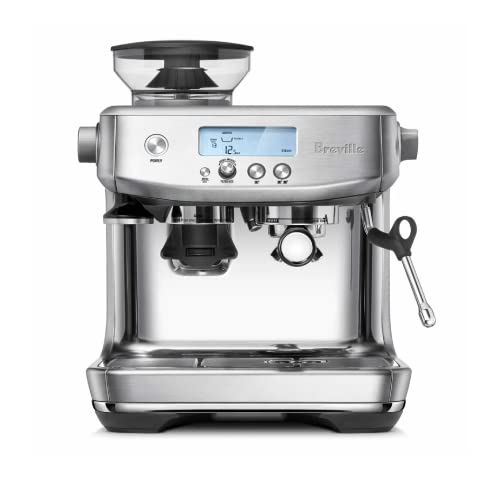
The daily workflow is where these two machines diverge most sharply. The Breville Barista Pro packages every step of coffee preparation inside a single chassis. Its integrated precision conical burr grinder feeds directly into your portafilter on demand. The half-pound bean hopper sits on top, letting you keep whole beans sealed and ready. Dose control allows you to dial in the amount of coffee ground with a single touch, while the animated LCD interface guides your progress from grinding through extraction. For anyone seeking a condensed morning routine, this bean-to-cup layout eliminates the need to measure out beans into an external unit, clean stray grounds off multiple counter surfaces, or coordinate two independent machines. Readers weighing all-in-one upgrades often look at the breville barista express vs barista pro to see how this updated interface accelerates the routine.
By contrast, the Gaggia Classic Pro arrives with no built-in grinding mechanism whatsoever. It accepts pre-ground coffee, whole beans through a standalone grinder, or ESE pods using its included pressurized basket adapter. Pulling fresh, café-quality shots on the Gaggia requires budgeting counter space and money for an external burr grinder capable of fine espresso adjustments. This separation creates more steps each morning: measuring, grinding externally, dosing, and transferring. However, it also means the coffee grinder and espresso maker are fully isolated. If an external grinder requires maintenance, your espresso machine remains operational. For home baristas interested in trying different specialized grinders over time, the Gaggia workflow preserves full modular freedom that an integrated machine cannot match.
When executing a standard morning drink, the Barista Pro moves from bean to cup in under sixty seconds. The built-in grinder delivers coffee straight into the basket, the included Razor precision dose trimming tool ensures repeatable headspace, and the volumetric buttons pull the shot automatically. On the Gaggia, you operate the grinder separately, tamp, lock in the commercial handle, flip the brew switch, and monitor the extraction manually before flipping the switch off. In any practical Breville Barista Pro review, the integrated convenience is the standout quality, while a dedicated Gaggia Classic Pro review emphasizes hands-on control and deliberate process.
Edge: Breville Barista Pro, because its integrated conical burr grinder and single-chassis layout create a seamless, mess-free workflow right out of the box.
Heating System and Readiness Speed
Temperature readiness dictates how quickly you can make a drink when running out the door. The Breville Barista Pro heat up time is virtually instantaneous thanks to its proprietary ThermoJet heating system. This high-efficiency 1680-watt unit reaches full extraction temperature in just 3 seconds. There is no waiting for a brass or aluminum reservoir to soak up heat, and the digital PID temperature regulation keeps incoming brew water stable within plus or minus 2 degrees Celsius. Crucially, the ThermoJet design also allows instantaneous transition from brewing temperature to steam temperature. You can extract an espresso shot and begin frothing milk immediately without waiting for steam pressure to build.
The Gaggia Classic Pro relies on an uncoated aluminum boiler rated at 1200 watts. This traditional boiler design takes a completely different engineering approach: it heats a reservoir of water inside metal housing, requiring under 10 minutes from a cold start to become fully ready to brew. While 10 minutes is respectable for a boiler-based prosumer machine, it requires planning ahead compared to the near-instant Breville. Furthermore, transitioning from espresso brewing temperature up to steam temperature on an aluminum boiler requires venting and waiting for steam pressure to accumulate inside the chamber, then purging the boiler before pulling a second shot to avoid overheating the group head.
The trade-off comes down to instant convenience versus thermal mass. The ThermoJet system draws more peak power at 1680 watts but uses that energy on-demand in seconds. The Gaggia uses 1200 watts over a sustained warm-up window to heat its internal boiler and metal group assembly. For early mornings where every minute matters, waiting ten minutes for a boiler machine can be an unwelcome friction point. Those exploring similar fast-heating options frequently evaluate the breville bambino plus vs barista pro to see how ThermoJet tech scales across different form factors.
Edge: Breville Barista Pro, due to its 3-second ThermoJet warm-up and instantaneous switching between espresso and steam modes.
Portafilter Design and Extraction Control
The core brewing components heavily influence Barista Pro vs Classic Pro espresso quality. The Gaggia Classic Pro 58mm portafilter is one of its most celebrated features. Built from heavy commercial stainless steel, it matches the exact 58mm diameter used in commercial coffee shops worldwide. This size allows for wider, shallower coffee pucks that promote even saturation when dialed in correctly. Inside the machine, Gaggia installs an authentic commercial three-way solenoid valve. This valve vents hydraulic pressure instantly when you end extraction, sucking excess water out of the portafilter basket so you are left with a dry, solid puck that knocks out cleanly. Gaggia also tunes this edition specifically for 9 bar espresso extractions, the widely recognized gold standard for traditional shot pressure.
The Breville Barista Pro takes a different approach to extraction mechanics. It utilizes Breville’s proprietary portafilter format alongside a comprehensive basket selection: both single-wall (non-pressurized) and dual-wall (pressurized) baskets in single and double-cup sizes. To assist with shot balance, the Barista Pro features low-pressure pre-infusion, which wets the coffee bed at gentle pressure before ramping up to full extraction to minimize channel formation. Its digital PID controller lets you fine-tune the brew temperature, and the interface offers programmable 1-cup and 2-cup volumetric settings so water stops automatically when the target volume is reached.
For shoppers deciding between the Breville Barista Pro or Gaggia Classic Pro for beginners, the Breville provides a far softer learning curve. Its dual-wall baskets allow newcomers to produce crema even with imperfect grind sizes, while the volumetric settings eliminate the need to weigh shots manually during extraction. However, espresso purists often find that the Gaggia Classic Pro 58mm portafilter and commercial 9 bar system provide greater headroom for shot refinement. The 58mm group accepts a massive aftermarket of commercial distribution tools, precision baskets, and tampers that standard proprietary sizes cannot accommodate. Those comparing commercial-style hardware often inspect the breville barista express vs gaggia classic pro for similar reasons.
Edge: Gaggia Classic Pro, because its genuine 58mm commercial stainless steel portafilter, 9 bar factory extraction, and commercial three-way solenoid valve match true prosumer hardware standards.
Milk Texturing and Steam Capabilities
Creating velvety microfoam for milk-based drinks requires consistent steam pressure and an ergonomic wand. When deciding between the Breville Barista Pro or Gaggia Classic Pro for latte art, both machines deliver capable manual tools, but the operating dynamics differ. The Breville Barista Pro includes a manual microfoam steam wand powered by the ThermoJet unit. Because the ThermoJet produces steam almost immediately after brewing finishes, you can froth your milk without delay. The package also includes a 480 ml stainless steel milk jug, meaning you have the exact pouring vessel required for latte art without purchasing extra accessories.
The Gaggia Classic Pro features a commercial steam wand equipped with a two-hole tip designed to roll milk into a smooth vortex. Because it vents steam directly from its uncoated aluminum boiler, the steam output carries solid volume and dry heat. The commercial wand assembly mirrors the geometry and handling of full-sized commercial units, making it an excellent trainer for anyone who wants to learn authentic barista technique. It produces the silky, tight-bubble microfoam required for intricate pours and smooth cappuccinos.
The trade-off lies in sequence timing. On the Barista Pro, steam is available in seconds, and its electronic pump pulsing maintains continuous steam output. On the Gaggia Classic Pro, you must flip the steam switch, wait for the boiler to reach steaming temperature, texture the milk, and then switch the pump back on to refill the boiler chamber with fresh water. If you forget to refill the boiler, you risk running it dry. The Gaggia provides commercial-style steam pressure, but the Breville makes the overall milk preparation process noticeably faster and more forgiving.
Edge: Tie. The Gaggia Classic Pro offers a true commercial wand design, while the Breville Barista Pro provides instant steam readiness and includes a matched 480 ml frothing pitcher.
Build Quality, Footprint, and Serviceability
Materials and construction dictate how these appliances fit on your counter and how long they will remain in service. The Gaggia Classic Pro features a heavy solid steel housing finished in Thunder Black and is manufactured in Italy. Measuring 8 inches deep, 9.5 inches wide, and 14.2 inches tall, it occupies a remarkably compact footprint, making it easy to slide under low cabinets. Inside, it uses heavy-duty, self-serviceable commercial components, including an improved pump mounting system designed specifically for quieter brewing. Because the machine relies on mechanical switches and standard commercial plumbing parts, parts can be easily replaced, cleaned, and repaired by the owner for years down the line.
The Breville Barista Pro is wrapped in brushed stainless steel and presents a modern kitchen aesthetic centered around its digital LCD screen. However, housing both a bean hopper, conical grinder, and ThermoJet unit increases its overall dimensions to 13 inches deep, 14 inches wide, and 16 inches tall. It weighs 19.5 pounds, very close to the Gaggia at 20 pounds, but it demands significantly more horizontal and vertical clearance. Breville supports the machine with a 2-year limited product warranty. While the exterior stainless steel is attractive and durable, the integrated digital electronics, LCD progress animations, and proprietary heating circuit make home repair far more complex than on mechanical Italian platforms.
If longevity through user maintenance is your priority, the Gaggia Classic Pro represents a classic mechanical philosophy. It can be opened with basic hand tools to replace gaskets, valves, or switches. The Barista Pro functions more like a sophisticated modern home appliance: full-featured, sleek, and highly automated, but less suited to user-level rebuilds once out of warranty. Buyers exploring compact semi-automatics frequently weigh the breville bambino plus vs gaggia classic pro to compare form factors without built-in grinders.
Edge: Gaggia Classic Pro, thanks to its Made in Italy solid steel housing, compact 9.5-inch width, and modular, self-serviceable commercial internal architecture.
Pros and Cons
Breville Barista Pro

Pros
- Integrated precision conical burr grinder
- 3-second ThermoJet heat-up time
- Digital PID temperature stability
- Animated LCD progress interface
- Included 480 ml milk jug
Cons
- Larger 14-inch counter footprint
- Higher 1680-watt electrical draw
View Breville Barista Pro on Amazon
Gaggia Classic Pro

Pros
- Commercial 58mm stainless portafilter
- Commercial three-way solenoid valve
- Solid steel housing made in Italy
- Compact 9.5-inch counter width
- Self-serviceable commercial internal parts
Cons
- Requires separate standalone grinder
- 10-minute boiler warm-up time
View Gaggia Classic Pro on Amazon
Who Should Buy Each One
Choose the Breville Barista Pro If
- You want an all-in-one setup with a built-in conical burr grinder that saves you from buying and aligning a separate machine.
- Your morning schedule demands extreme speed, taking advantage of the 3-second ThermoJet warm-up and instantaneous steam transition.
- You prefer automated assistance, including digital PID temperature stability, animated LCD feedback, and volumetric 1-cup and 2-cup dosing buttons.
- You want a complete starter kit out of the box, including single and dual-wall baskets, a 480 ml milk jug, a water filter, and the Razor trimming tool.
Choose the Gaggia Classic Pro If
- You want an authentic 58mm commercial stainless steel portafilter that works with industry-standard tampers, precision baskets, and tools.
- You appreciate traditional Italian craftsmanship featuring solid steel housing, mechanical rocker switches, and an uncoated aluminum boiler.
- You prioritize long-term machine repairability and want commercial components with a 3-way solenoid valve that can be serviced over time.
- You already own or plan to purchase a dedicated, high-end espresso grinder to control your grind quality independently.
Final Verdict
For the vast majority of home coffee drinkers, the Breville Barista Pro is the more practical, user-friendly, and efficient machine. By integrating an adjustable conical burr grinder, low-pressure pre-infusion, a digital PID controller, and the blazing-fast 3-second ThermoJet heating system into one brushed stainless steel appliance, it eliminates almost every traditional barrier to pulling great espresso at home. You can step up to the counter half-asleep, grind fresh beans on demand, pull a shot with volumetric precision, texture milk with the included 480 ml pitcher, and be cleaning your group head in less time than it takes a traditional boiler machine to warm up.
However, the Gaggia Classic Pro remains an undisputed benchmark for hands-on espresso enthusiasts and purists. If your goal is to master the craft of espresso extraction using standard 58mm commercial tools, the Gaggia provides an unmatched commercial foundation. Its solid steel Italian construction, 9 bar extraction pressure, commercial steam wand, and 3-way solenoid valve give you the mechanical bones of a commercial espresso bar in a compact 9.5-inch footprint. When paired with a quality standalone grinder, the Classic Pro rewards patience and manual technique with exceptional espresso quality and indefinite serviceability.
FAQ
Breville Barista Pro or Gaggia Classic Pro for beginners: which is easier to learn on?
The Breville Barista Pro is significantly easier for beginners. It features an integrated conical burr grinder with dose control, animated LCD screen guidance, volumetric push-button extraction, and dual-wall pressurized baskets that produce rich crema even if your grind size is not dialed in perfectly. The Gaggia Classic Pro requires manual timing, a separate grinder, and traditional single-wall commercial baskets that demand exact puck preparation technique from day one.
Breville Barista Pro heat up time: how fast does it actually get ready?
The Breville Barista Pro reaches brewing temperature in just 3 seconds thanks to its ThermoJet heating system. It also transitions to milk steaming mode instantaneously. By comparison, the Gaggia Classic Pro uses a traditional uncoated aluminum boiler that requires under 10 minutes from a cold start to become fully ready to brew.
Is Gaggia Classic Pro worth it without a separate grinder?
The Gaggia Classic Pro does not include an integrated grinder, so it is only worth buying if you already own an espresso-capable burr grinder, plan to purchase one, or intend to brew using pre-ground coffee or ESE pods via its included pressurized basket adapter. To get the full potential from its commercial 58mm portafilter, a quality external grinder is essential.
Is Breville Barista Pro worth it over machines without grinders?
The Breville Barista Pro is worth it if you want to minimize counter clutter and avoid the expense of a secondary appliance. Having a precision conical burr grinder built into the same unit saves counter width and streamlines the entire brewing workflow from whole beans to extraction in under a minute. Those considering other brands often compare the breville barista pro vs de’longhi magnifica to see how integrated systems stack up against super-automatics.
What size portafilter does the Gaggia Classic Pro use?
The Gaggia Classic Pro uses a full-sized 58mm commercial stainless steel portafilter. This matches standard commercial café group heads, allowing you to use professional-grade tampers, precision filter baskets, puck screens, and levelers designed for commercial machines.
How do the water tanks compare on the Gaggia Classic Pro vs Breville Barista Pro?
Both machines feature generous water reservoirs. The Breville Barista Pro has a 67 oz (2.0 liter) removable water tank that includes an integrated water filter. The Gaggia Classic Pro features a slightly larger 71 oz (2.1 liter) reservoir. Both provide ample capacity for multiple consecutive shots and milk steaming sessions before needing a refill.
Can you make latte art with both machines?
Yes, both machines can create velvety microfoam for latte art. The Breville Barista Pro features a manual microfoam steam wand powered by its instant ThermoJet system and comes with a 480 ml stainless steel milk jug. The Gaggia Classic Pro utilizes a commercial two-hole steam wand that delivers commercial-style steam pressure directly from its aluminum boiler. Those exploring smaller footprints often check the breville barista pro vs de’longhi dedica to compare steaming power across compact models.