The decisive factor when choosing between a corded drill and a cordless drill comes down to uninterrupted endurance versus untethered mobility. A corded drill delivers constant power straight from an electrical outlet so you never have to pause for a depleted battery pack, while a cordless drill relies on rechargeable lithium-ion cells that grant absolute freedom to work anywhere without extension cords trailing behind you.
Choose a corded drill if you work primarily at a dedicated workshop bench and demand steady power for non-stop repetitive drilling. Choose a cordless drill if you need a versatile tool for general household repairs, outdoor installations, and climbing ladders where wall outlets are out of reach.


Corded Drill vs Cordless Drill at a Glance
| Feature | Corded Drill | Cordless Drill |
|---|---|---|
| Power Source | 120V AC electrical outlet | 20V MAX Lithium-Ion battery pack |
| Motor Output | 5.5A to 8.0A (up to 1800W max power) | 300 Unit Watts Out (UWO) |
| Maximum Chuck Size | 3/8-inch (10 mm) | 1/2-inch (13 mm) |
| Rotational Speed | 0 to 2,500 rpm | Two speeds (0-450 and 1,500 rpm) |
| Torque Rating | 150 to 360 in-lb | 530 to 650 in-lb (up to 1,700 in-lb with impact driver) |
| Drilling Capacity (Wood) | 0.38 to 0.5 inches | 30 millimeters (approx. 1.18 inches) |
| Drilling Capacity (Metal) | 0.38 inches | 13 millimeters (approx. 0.51 inches) |
| Integrated Work Lighting | Not listed | LED light with 20-second delay |
| Continuous Runtime | Unlimited (constant power) | Limited by 1.3Ah battery pack charge |
| Best For | Stationary bench work and prolonged drilling | General DIY, home repairs, and mobile jobsite tasks |
Corded Drill Power vs Cordless Runtime and Stamina
Runtime expectations dictate how smoothly a workday proceeds. In any direct comparison of corded drill vs cordless drill runtime, the corded platform represents an endless power reservoir. Because a corded unit draws its current directly from a 120-volt wall outlet, the tool can run continuously without any drop in motor performance. This steady supply proves invaluable when boring repetitive holes in dense materials where pausing to swap batteries breaks work rhythm. Much like comparing stationary and battery tools in our cordless vs corded vacuum analysis, the absence of a battery eliminates runtime anxiety completely.
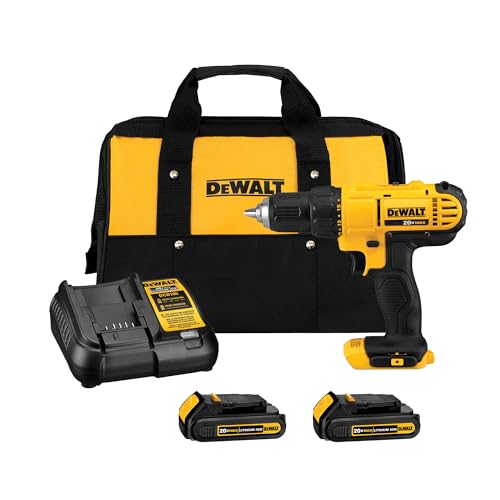
Cordless platforms depend entirely on battery chemistry and cell capacity. Standard cordless packages, such as the DEWALT 20V Max Cordless Drill Driver Set (DCD771C2), include two compact 1.3Ah lithium-ion batteries. While having a second battery on the charger prevents total downtime, a 1.3Ah pack will inevitably drain during demanding, continuous tasks. If you are mixing compounds, driving hundreds of long fasteners, or drilling large holes in hardwood, cordless drill battery life drains noticeably faster than during intermittent fastener driving. Once both packs lose their charge, work halts until the charger replenishes them.
When assessing corded drill power vs cordless alternatives, raw continuous stamina belongs to corded engineering. Tools like the DEWALT Corded Drill (DWD115K) utilize an 8.0-amp motor that maintains output through thick lumber without thermal throttling or battery sag. Cordless drills have closed the power gap for short bursts, but they cannot match the uninterrupted operational cycle of a direct electrical connection.
Edge: Corded drill provides indefinite operational runtime without battery degradation or recharging pauses.
Corded vs Cordless Drill Torque and Speed Control
Rotational speed and rotational force govern how effectively a power drill drives screws and bores through dense materials. Speed is measured in revolutions per minute, while torque defines the rotational muscle behind the chuck. In a practical cordless vs corded drill review, gear management makes a substantial difference. Cordless models generally feature multi-speed transmissions that let you toggle between low-speed, high-torque driving and high-speed drilling modes.
The BLACK+DECKER Corded Drill (DR260C) operates at a single variable speed reaching 1,500 rpm with a maximum torque of 360 in-lb, while the DEWALT DWD115K pushes rotational velocity up to 2,500 rpm with 150 in-lb of torque using its variable-speed reversing trigger. In contrast, modern cordless drill drivers feature mechanical gearboxes. The DCD771 platform uses a high-speed transmission delivering two distinct ranges: 0-450 rpm for heavy fastening and 0-1,500 rpm for drilling, generating between 530 and 650 in-lb of torque from a 300 UWO motor. You can read more about how this motor architecture compares across models in our dewalt dcd771 vs dcd796 breakdown.
When tasks demand raw fastening power, cordless combo kits step even further ahead. The DEWALT 20V MAX Cordless Drill and Impact Driver Combo Kit (DCK240C2) pairs the primary drill with a dedicated 1/4-inch impact driver rated at an impressive 1,700 in-lb of torque. In terms of corded vs cordless drill torque, cordless drill drivers consistently deliver higher twisting force at low speeds, preventing stripped screw heads and driving wide fasteners without bogging down.
Edge: Cordless drill offers superior low-end torque and the mechanical versatility of dual-speed transmissions.
Chuck Capacity and Bit Retention
The chuck mechanism determines the shank sizes your drill can accept and how securely those bits stay locked during high-resistance boring. Standard consumer corded drills are predominantly equipped with 3/8-inch (10 mm) chucks. Both the BLACK+DECKER DR260C and the DEWALT DWD115K utilize 3/8-inch configurations. The DWD115K improves bit retention by implementing an all-metal, ratcheting, keyless design, which helps prevent bit slippage during metal boring. However, a 3/8-inch chuck physically restricts you from mounting larger 1/2-inch shank accessories.
Cordless drill drivers in the 20V MAX tier upgrade to a larger 1/2-inch single-sleeve ratcheting chuck. This wider opening accepts standard 1/2-inch large-diameter drill bits, hole saws with thicker arbors, and heavy-duty mixing paddles. The heavy gripping strength of a single-sleeve ratcheting collar lets users tighten accessories securely with one hand, locking the bit firmly in place. Similar chuck capabilities and internal clutch designs are detailed in our dewalt dcd771 vs dcd996 comparison.
Drilling capacity ratings directly reflect this mechanical advantage. The 1/2-inch chuck on the cordless DCD771 supports wood-boring diameters up to 30 mm (about 1.18 inches) and metal capacities up to 13 mm (about 0.51 inches). By comparison, the corded DWD115K listing rates wood drilling capacity at 0.5 inches and metal at 0.38 inches, while the DR260C is specified for 0.38 inches across both wood and metal. The larger chuck capacity of the cordless platform provides greater hardware flexibility.
Edge: Cordless drill accommodates larger 1/2-inch shank bits and provides broader drilling capacity.
Maneuverability, Ergonomics, and Working in Tight Spaces
Physical handling determines how fatigued you feel after an afternoon of maintenance work. Corded drills offer the distinct advantage of a lighter bare-tool chassis because they do not carry a heavy lithium-ion battery under the handle. For instance, the DEWALT DWD115K uses a balanced mid-handle design with a soft grip that centers the tool over your hand, while all ball-bearing construction ensures smooth internal operation during heavy-duty tasks.
Despite being lighter in the hand, corded tools suffer from a major ergonomic hindrance: the physical power cord. Working on top of a step ladder, inside an attic crawlspace, or around a vehicle chassis requires managing extension cords that snag on furniture, pull on the tool grip, and introduce trip hazards. Furthermore, standard corded tools rarely incorporate built-in task illumination.
Cordless tools eliminate the cable entirely, allowing unhindered movement across rooms and work sites. The DCD771 drill driver measures an agile 7.5 inches in length and weighs 3.6 pounds with its battery attached, while the impact driver in the DCK240C2 combo kit measures just 5.55 inches long and weighs 2.8 pounds. Both cordless units feature integrated LED work lights with a 20-second shutoff delay, illuminating dark utility cabinets and unlit framing bays. For mobile tasks and tight enclosures, cordless maneuverability is unmatched.
Edge: Cordless drill delivers total physical freedom and includes integrated task lighting for tight spots.
Versatility for Woodworking and Everyday Household Repairs
Deciding between a corded or cordless drill for woodworking often hinges on where the craft takes place. In a stationary woodshop equipped with dust collection, assembly tables, and nearby electrical outlets, a corded drill makes an exceptional dedicated station tool. Much like choosing between stationary and mobile cutting tools in our dewalt dws779 vs dhs790 analysis, having continuous power ready at the bench saves battery wear for larger stationary operations. The high 2,500 rpm rotational speed of the DWD115K corded drill bores clean, rapid pilot holes in joinery without burning the timber.
Conversely, when evaluating a corded or cordless drill for home use, the cordless platform is far more convenient. Everyday home maintenance involves assembling flat-pack furniture, hanging curtain rods, repairing patio decking, and securing wall anchors. Carrying a cordless drill from room to room without hunting for open electrical receptacles or dragging cords across finished floors makes projects substantially faster. The DCD771 is explicitly specified for DIY home repairs, light construction, cabinetry, drywall fastening, and plastic or light metal drilling.
The only operational boundary noted on the cordless DCD771 listing is that it is not intended for drilling into concrete, masonry, or heavy-duty industrial structural steel. For routine residential tasks and general shop carpentry, both styles hold distinct advantages depending on whether your work stays anchored to a bench or moves throughout the property.
Edge: Tie. Corded dominates stationary bench woodworking, while cordless reigns supreme for whole-house utility.
Pros and Cons
Corded Drill

Pros
- Unlimited continuous runtime
- High speeds up to 2,500 rpm
- Lighter bare-tool body
- Durable ball-bearing construction
Cons
- Tethered by power cord reach
- Limited to 3/8-inch chuck
- Lacks integrated task lighting
View BLACK+DECKER Corded Drill 5.5-Amp 3 8-Inch on Amazon
Cordless Drill

Pros
- Total wire-free portability
- Large 1/2-inch ratcheting chuck
- Two-speed transmission
- Integrated LED work light
Cons
- Runtime limited by battery charge
- Heavier with attached battery pack
- Not rated for masonry drilling
View DEWALT 20V MAX Cordless Drill on Amazon
Who Should Buy Each One
Choose the Corded Drill If
- You work primarily at a stationary workbench or in a dedicated garage workshop with accessible electrical outlets.
- You want continuous, uninterrupted drilling without managing battery packs or waiting on recharge cycles.
- You need sustained high rotational speeds up to 2,500 rpm for boring repetitive holes in carpentry.
- You prefer a lightweight tool body that avoids the bottom-heavy balance of an attached battery.
Choose the Cordless Drill If
- You require wire-free mobility for tasks in attics, yards, crawlspaces, or on step ladders.
- You need a versatile two-speed tool for controlled screw fastening as well as broad drilling up to 30 mm in wood.
- You want a larger 1/2-inch single-sleeve ratcheting chuck that accepts wider bit shanks.
- You frequently work in dark spaces and need integrated LED work lights with automatic shutoff delays.
Final Verdict
For the vast majority of homeowners, DIYers, and general handymen asking is a cordless drill worth it, the answer is an emphatic yes. The freedom to grab a tool, walk to any corner of the home or garden, and immediately drive fasteners or bore holes makes a cordless drill driver such as the DEWALT DCD771C2 the most sensible primary tool. Its 1/2-inch ratcheting chuck, dual-speed gearbox, 300 UWO motor, and built-in LED lighting deliver superior day-to-day versatility that easily outweighs the need to occasionally swap out 1.3Ah batteries.
The corded drill remains a specialized powerhouse for stationary bench environments. If your projects center around a dedicated workshop where you need endless power for repetitive boring, high-speed drilling up to 2,500 rpm, and a lightweight body free of battery bulk, a corded model like the DEWALT DWD115K or BLACK+DECKER DR260C is an indestructible asset. For complete mobility and general utility, go cordless; for non-stop stationary endurance, keep a corded drill plugged into your bench.
FAQ
Are corded drills more powerful than cordless drills?
Corded drills provide higher sustained wattage and unlimited runtime from a 120V outlet, excelling at high-speed continuous drilling. However, modern 20V cordless drills produce significantly higher low-end torque-often exceeding 500 in-lb compared to 150 to 360 in-lb on standard corded models-making cordless drills more effective for driving heavy screws.
How long does a cordless drill battery last during active use?
Active battery life depends on pack capacity and the intensity of the task. A standard 1.3Ah battery pack provides ample charge for dozens of intermittent screwdriving and light drilling tasks around the house. However, under heavy continuous loads, such as boring wide holes in dense lumber, a 1.3Ah pack will deplete relatively quickly, making a spare battery essential.
Can a corded drill be used for heavy-duty screwdriving?
While corded drills with variable-speed triggers can drive fasteners, they are harder to control than cordless models. Corded basic drills lack mechanical clutches and low-speed gear ranges, which increases the risk of overdriving or stripping screw heads compared to a two-speed cordless drill driver.
What size chuck do I need for standard household projects?
A 3/8-inch chuck handles most common round and hex-shank drill bits for household tasks. However, a 1/2-inch single-sleeve ratcheting chuck, found on cordless models like the DEWALT DCD771, provides superior versatility because it accommodates heavy-duty bits with larger shanks and offers higher gripping retention.
Can cordless drills handle masonry and concrete drilling?
Standard basic cordless drill drivers, including the DCD771, are designed for wood, plastic, drywall, and light metal, and are explicitly listed as not suitable for drilling into masonry or concrete. Penetrating masonry requires a dedicated hammer drill or rotary hammer engineered with a percussive impact mechanism.
Is a corded drill better for a home workshop than a cordless drill?
If your projects take place exclusively at a fixed assembly bench with easy access to outlets, a corded drill is an excellent choice. It eliminates battery management entirely and provides consistent high-speed performance for continuous woodworking tasks.


