The core distinction separating these two brushless tools is integrated digital connectivity: the DCF888 features built-in Tool Connect Bluetooth technology for live inventory tracking and programmable app control, whereas the DCF845 is a high-speed, Chip Ready impact driver built for maximum rotational speed without requiring software configuration.
Choose the DeWalt DCF845 if you want a faster 3400 RPM brushless driver with straightforward mechanical controls for high-volume screw driving on personal jobsites. Select the DeWalt DCF888 if you manage commercial tool cribs or multi-worker crews that require geofencing alerts, street-address tracking, trigger diagnostics, and fine-tuned application control over speed and lighting.


DeWalt DCF845 vs DeWalt DCF888 at a Glance
| Feature | DeWalt DCF845 | DeWalt DCF888 |
|---|---|---|
| Maximum Rotational Speed | 3400 RPM | 3250 RPM |
| Maximum Torque | 1825 in-lb | 1825 in-lb |
| Motor Type | Brushless (300 Watts) | Brushless (300 Watts) |
| Speed Modes | 3-Speed Setting with Variable Speed Trigger | Home Mode plus 3 Programmable App Modes |
| Special Driving Feature | Variable Speed Trigger Control | Precision Drive in Speed 1 |
| Tool Connect Connectivity | Chip Ready (Chip Sold Separately) | Integrated Bluetooth with Last Seen Tracking |
| Work Lighting | Integrated 3-LED Work Light | Customizable 3-LED Light (Brightness and Delay) |
| Tool Dimensions | Compact Design (Listing does not specify length) | 5.3 Inches Front to Back |
| Bare Tool Weight | Listing does not specify | 2.8 Pounds |
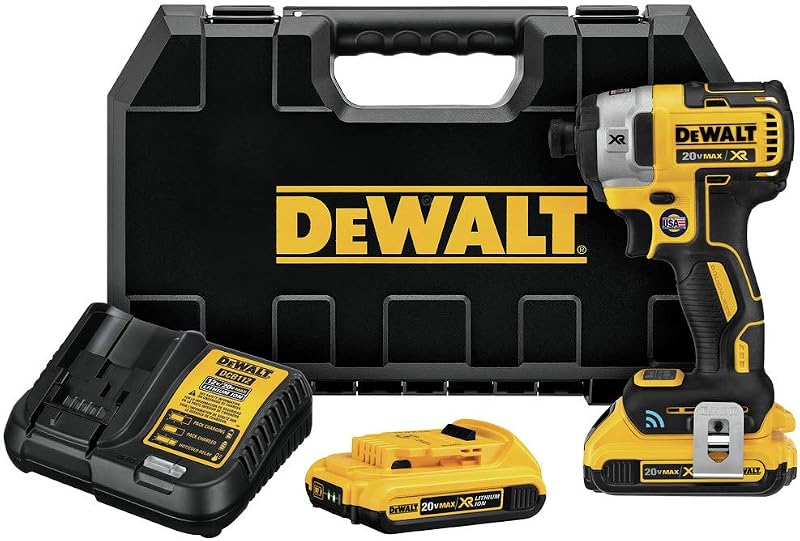
| Package Contents | Tool Only, Belt Hook | Tool, Two 2Ah Batteries, Charger, Kit Box |
| Best For | Individual Contractors Needing Pure Speed | Fleet Managers and Multi-Crew Jobsites |
Tool Connect Integration and Inventory Tracking
Tool management and digital tracking create the widest functional divide between these two impact drivers. On large commercial projects, losing track of equipment leads to lost hours and replacement expenses. The DCF888 eliminates this friction by integrating DeWalt Tool Connect Bluetooth circuitry directly into the tool housing. By pressing and holding the pairing button on the foot of the tool for three to five seconds, users sync the tool with the Tool Connect app. Once linked, the Tool Connect Inventory Manager software lets tool crib coordinators assign the driver to specific jobsites and individual crew members, keeping full accountability across commercial teams. In contrast, similar comparisons like the dewalt dcf887 vs dcf888 highlight how critical integrated tracking is for fleet operations.
The operational features inside the DCF888 go well beyond simple inventory tagging. The driver includes a Last Seen function that logs the street address where the unit was last within Bluetooth range of an authorized mobile device. To combat theft and unauthorized borrowing, site supervisors can configure “disable when out of range” alerts that render the DCF888 inoperable if it leaves the designated job perimeter. The integrated diagnostics also report internal coin cell battery status, tool temperature, total trigger pulls, and cumulative runtime. The DCF845 takes an entirely different approach. It is categorized as a Chip Ready tool, meaning the housing has a designated pocket for an aftermarket Tool Connect chip. However, that chip is sold separately, and installing it still does not grant the internal diagnostic feedback or deep motor programming built directly into the DCF888.
Edge: DeWalt DCF888, thanks to factory-integrated Bluetooth tracking, out-of-range security shutdowns, and internal diagnostic monitoring.
Motor Speed and Fastening Performance
Fastening speed dictates how quickly a tradesperson drives self-tapping screws, ledger bolts, and long framing fasteners throughout the workday. When reviewing the dewalt dcf845 specs against the DCF888, rotational output shows an interesting split. Both drivers share an identical maximum power rating of 300 watts and generate 1825 in-lb of maximum fastening torque. The DCF845 listing emphasizes that this delivers 30 percent more torque than the legacy DCF885 baseline of 1400 in-lb, providing plenty of twisting muscle for heavy structural screws and large-diameter fasteners in wood and metal.
Where the DCF845 pulls ahead is rotational velocity. The DCF845 motor turns at up to 3400 RPM, giving it a 150 RPM advantage over the 3250 RPM ceiling of the DCF888. While 150 RPM seems modest on paper, in high-volume fastening environments-such as hanging hundreds of drywall sheets, assembling metal stud framing, or laying subfloors-those additional rotations translate into noticeable seconds shaved off every individual screw. In performance shootouts like the dewalt dcf845 vs dcf887, higher RPM consistently benefits production builders who value fast driving cycles over internal electronics.
Edge: DeWalt DCF845, because its 3400 RPM maximum rotational speed drives fasteners faster than the 3250 RPM limit of the DCF888.
Speed Modes and Application Control
Controlling power delivery is crucial when switching between delicate hardware installation and heavy framing. The DCF845 relies on a traditional mechanical three-speed slide switch paired with a responsive variable-speed trigger. This tactile setup lets the operator manually restrict maximum velocity across three fixed tiers directly on the tool foot. For workers who wear heavy gloves or simply prefer instant, physical changes without opening a smartphone application, the mechanical selector on the DCF845 offers foolproof, rapid adjustment right at the work face.
The DCF888 completely reinvents speed and torque management by introducing customized digital firmware profiles. While it maintains a default Home mode for quick baseline operation, it features three programmable modes that users can customize through the Tool Connect app. Operators can tailor both speed and torque outputs to match the exact requirements of specific repetitive fasteners, preventing stripped screw heads, sheared fastener shanks, or damaged material surfaces. Furthermore, the DCF888 incorporates Precision Drive in speed mode 1. Precision Drive introduces a short momentary pause before impact engagement, granting exceptional control when seating delicate screws in finished cabinetry or electrical faceplates. Readers evaluating the dewalt dcf845 vs dcf850 often face similar trade-offs between standard three-speed switches and advanced electronic speed management.
Edge: DeWalt DCF888, providing three programmable app-defined speed modes and Precision Drive technology alongside its standard Home setting.
Work Lighting and Low-Light Visibility
Working inside unpowered construction zones, cramped service chases, or dark crawlspaces demands adequate lighting directly around the fastener head. The DCF845 features an integrated 3-LED work light positioned circumferentially around the chuck nosecone. This three-diode layout casts light from multiple angles, virtually eliminating the harsh shadow cast by the impact bit or socket. When the operator pulls the variable-speed trigger, the LEDs immediately illuminate the workpiece, staying active during fastening and shutting off after release.
The DCF888 uses a matching three-light ring around the chuck, but it leverages its digital architecture to give the user absolute control over the lighting behavior. Through the Tool Connect mobile app, tradespeople can adjust the LED light brightness level to conserve battery power or maximize visibility in pitch-black environments. Even more useful, the app allows users to adjust the shut-off delay timer. Rather than cutting out shortly after the trigger is released, the DCF888 can remain illuminated for extended periods to act as an ambient task light while setting up the next fastener. The DCF845 provides fixed illumination with no adjustment options.
Edge: DeWalt DCF888, which allows users to customize LED brightness output and shut-off delay through the companion app.
Size, Weight, and Ergonomics
Impact drivers earn their place on a tool belt by fitting into tight spaces where standard drills cannot go. The DCF888 listing provides concrete specifications regarding its footprint: it measures 5.3 inches from front to back and weighs 2.8 pounds as a bare tool without a battery attached. At 5.3 inches, the tool easily slips between standard 16-inch-on-center wall studs, inside plumbing chases, and between joists. At under three pounds bare, overhead driving causes minimal arm strain during long shifts.
The product listing for the DCF845 emphasizes a compact design and confirms that it includes an attachable metal belt hook for easy transport on a pouch. However, the listing does not specify the exact front-to-back length or the bare tool weight in its technical specification table. While both tools belong to DeWalt’s compact 20V MAX brushless lineage, buyers who need confirmed dimensions for tight clearance work have concrete engineering numbers for the DCF888. Those comparing other compact platforms, such as the dewalt dcf787 vs dcf845, know how important verified housing lengths are when working in confined framing cavities.
Edge: DeWalt DCF888, as its compact 5.3-inch length and 2.8-pound weight are verified in the product data, offering proven clearance in confined spaces.
Packaging, Accessories, and Out-of-the-Box Readiness
The difference in package configurations fundamentally changes how these two products arrive on your doorstep. The DCF845 (model DCF845B) is sold strictly as a bare tool. The package contains the impact driver and a belt hook. It does not include a battery pack, battery charger, or storage case. For tradespeople who already own a fleet of DeWalt 20V MAX lithium-ion batteries and chargers, purchasing the bare tool is straightforward and avoids accumulating redundant charging hardware.
Conversely, the DCF888 is supplied as a complete operating kit under model DCF888D2. The box contains the DCF888 Tool Connect impact driver, two DCB203 2.0Ah XR brushless lithium-ion battery packs, a compatible charger, and a heavy-duty kit box for storage and jobsite transport. This makes the DCF888 ready for immediate work straight out of the box. Having two dedicated 2Ah batteries ensures that one pack can charge while the other powers the driver, preventing workflow interruptions on active job sites. When weighing options like the dewalt dcf809 vs dcf888, full kit packaging represents a substantial operational advantage for teams establishing new tool stations.
Edge: DeWalt DCF888, which ships as a comprehensive kit complete with two 2Ah batteries, a charger, and a protective kit box.
Pros and Cons
DeWalt DCF845

Pros
- Higher top speed at 3400 RPM
- Straightforward manual three-speed mechanical switch
- Chip Ready design for optional tracking upgrades
- Includes standard belt hook
Cons
- Sold strictly as a bare tool without battery
- Tool Connect chip sold separately
- Listing omits exact weight and length measurements
DeWalt DCF888
Pros
- Integrated Tool Connect Bluetooth tracking and diagnostics
- Disable when out of range anti-theft alerts
- Three programmable custom speed modes plus Precision Drive
- Complete kit includes two 2Ah batteries and charger
- Compact 5.3-inch length and 2.8-pound bare weight
Cons
- Slightly lower maximum speed at 3250 RPM
- Requires smartphone application for full feature configuration
Who Should Buy Each One
Choose the DeWalt DCF845 If
- You already own DeWalt 20V MAX batteries and want a bare tool without paying for extra chargers.
- You prioritize raw fastening speed and want 3400 RPM to run long decking, drywall, or framing screws quickly.
- You prefer physical mechanical 3-speed switches over smartphone apps and digital profile setup.
- You want a Chip Ready platform that allows optional tracking integration later without built-in complexity today.
Choose the DeWalt DCF888 If
- You manage tools across multiple jobsites and need Last Seen address tracking and out-of-range security alerts.
- You require a complete kit with two 2Ah XR batteries, a charger, and a durable jobsite carrying box.
- You drive delicate fasteners and need Precision Drive control in speed 1 to prevent surface damage.
- You want customized tool performance profiles with app-controlled speed, torque, and LED delay timers.
Final Verdict
Choosing between these two 20V MAX brushless drivers hinges entirely on whether your workflow benefits from digital connectivity or demands pure mechanical driving speed. The DCF845 is the superior option for individual contractors and independent tradespeople who want maximum production velocity. Delivering 3400 RPM alongside 1825 in-lb of torque, it powers through repetitive framing, decking, and structural fastening faster than the connected alternative. Its straightforward three-speed manual toggle and Chip Ready design keep the tool simple, reliable, and ready to pair with existing battery collections without unnecessary digital overhead.
The DCF888 is the definitive pick for commercial contractors, multi-crew builders, and tool crib managers who need complete transparency over their equipment inventory. While its 3250 RPM rotational speed trails slightly behind the DCF845, its integrated Tool Connect Bluetooth module provides game-changing security through Last Seen street mapping, assignment logs, and out-of-range disable alerts. Combined with Precision Drive, customizable motor and light modes, and a complete kit featuring two 2Ah batteries and a charger, the DCF888 offers an all-in-one smart fastening ecosystem that easily justifies its specialized role on commercial jobsites.
FAQ
Can the DeWalt DCF845 track its location like the DCF888?
The DCF845 cannot track its location out of the box because it does not have integrated Bluetooth. However, it is a Chip Ready tool, which means it includes an internal pocket engineered to hold a DeWalt Tool Connect chip. If you purchase and install the compatible chip separately, you can integrate the DCF845 into the Tool Connect inventory system, though it will not have the advanced motor diagnostics or light customization built into the DCF888.
Does the DeWalt DCF888 deliver more torque than the DCF845?
No, both impact drivers deliver the exact same maximum torque rating of 1825 in-lb and both draw from 300-watt brushless motors. The primary performance difference lies in their rotational speed: the DCF845 spins faster at up to 3400 RPM, while the DCF888 reaches a maximum rotational speed of 3250 RPM.
What is Precision Drive on the DeWalt DCF888?
Precision Drive is an electronic operating mode available in speed setting 1 on the DCF888. It provides added control during delicate fastening tasks by briefly pausing the tool before the impact mechanism engages. This momentary delay allows the screw head to seat flush against the workpiece surface without over-driving, stripping threads, or snapping small fastener heads.
Do both drivers run on the same DeWalt battery platform?
Yes, both models operate on the DeWalt 20V MAX lithium-ion battery system. The DCF845 is sold as a bare tool and is compatible with any standalone 20V MAX battery pack. The DCF888D2 comes packaged with two 2Ah DCB203 XR lithium-ion batteries and a charger, which can also be shared with any other 20V MAX DeWalt power tool on your jobsite.
Can you operate the DeWalt DCF888 without using the smartphone app?
Yes, the DCF888 functions as a standard, heavy-duty impact driver even without connecting to the Tool Connect mobile app. It features a default Home mode and pre-configured speed settings that work immediately upon inserting a battery. However, you will need the mobile app if you wish to reconfigure the programmable speed modes, alter LED brightness and delay, view internal tool diagnostics, or activate out-of-range security disable alerts.
What accessories come in the box with each impact driver?
The DCF845 (model DCF845B) comes only with the impact driver itself and an attachable belt hook. The DCF888 (model DCF888D2) arrives as a comprehensive kit containing the Tool Connect impact driver, two DCB203 2.0Ah XR brushless batteries, a battery charger, and a protective kit box for tool storage.


