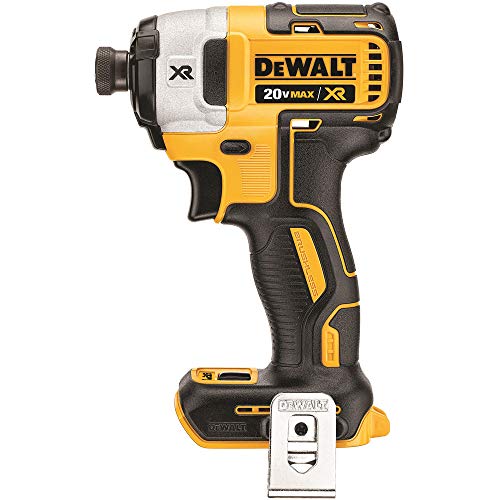
The choice between the DeWalt DCF850 and the DeWalt DCF887 comes down to a direct tradeoff between an ultra-compact chassis engineered for restricted clearances and a higher peak torque output designed for demanding fastening tasks. While both tools belong to the 20V cordless system and feature three-speed control, their physical dimensions and drive profiles serve distinctly different operational priorities.
Choose the DCF850 if your work requires driving fasteners between narrow studs, inside cabinetry, or within cluttered mechanical chases where tool length dictates access. Choose the DCF887 if your workload centers on heavy framing fasteners, structural screws, and larger drilling diameters where maximum rotational force saves time.

DeWalt DCF850 vs DCF887 at a Glance
| Feature | DeWalt DCF850 | DeWalt DCF887 |
|---|---|---|
| Maximum Torque | 1,825 in-lb | 2,000 in-lb |
| Top Speed | 3,250 RPM | 3,250 RPM (2,800 RPM nominal) |
| Maximum Power | 336 Watts | 300 Watts |
| Speed Settings | 3-speed variable trigger | 3-speed selector with Precision Drive |
| Chuck Type | 1/4-inch hex, accepts 1-inch bit tips | 1/4-inch hex one-handed loading, accepts 1-inch bit tips |
| Wood Drilling Capacity | 1 inch | 2.68 inches |
| Metal Drilling Capacity | 1 inch | 2 inches |
| Tool Weight | 2.2 lbs (listed at 2.1 lbs in description) | Not listed |
| Tool Dimensions | 6.5″L x 3″W x 9″H (8″ tall per description) | Not listed |
| LED Lighting | Integrated 3 LED work light | 3 LEDs with 20-second delay |
| Included Components | Belt clip, impact driver | Tool only (battery and charger sold separately) |
| Best For | Tight-space fastening and cabinet assembly | High-torque framing and heavy construction |
Fastening Torque and Power Output
Fastening torque governs how effectively an impact driver sinks heavy fasteners into dense materials without stalling or stripping drive heads. In heavy structural applications, extra rotational muscle translates directly to reduced motor strain, faster seating of lag screws, and less time spent fighting resistance. When evaluating the DCF850 vs DCF887 torque specifications, the DCF887 holds a clear numerical advantage with 2,000 in-lb of peak torque, compared to 1,825 in-lb on the DCF850. That 175 in-lb difference represents a dedicated margin for driving wide structural screws or operating large-diameter accessories.
The operational gap becomes even more noticeable when examining maximum material drilling capacities. The DCF887 is rated to handle up to 2.68 inches in wood and 2 inches in metal, whereas the DCF850 listing rates wood and metal drilling capacity at 1 inch each. Interestingly, the DCF850 delivers a maximum power rating of 336 watts compared to the 300 watts specified for the DCF887, demonstrating an exceptionally dense, efficient motor layout inside the compact shell. Readers who want to understand how DeWalt balances frame size across other tools can examine our breakdown of the dewalt dcf845 vs dcf887 to see how alternate models handle mid-tier fastening tasks.
For builders deciding on the DCF850 or DCF887 for framing, the DCF887 provides greater reassurance when running extensive structural connectors, ledger board fasteners, or long timber screws through green lumber. The DCF850 handles framing, decking, and drywall tasks reliably according to its product specifications, but the higher sustained torque and expanded drilling limits of the DCF887 give it greater capability during heavy framing jobs.
Edge: DeWalt DCF887, providing 2,000 in-lb of torque and substantially higher wood and metal drilling capacities.
Speed Ratings and Precision Control
Rotational speed dictates fastening velocity, while speed selection modes ensure delicate fasteners do not overdrive or snap off in soft substrates. Both drivers deliver an impressive upper-end speed of 3,250 RPM, ensuring swift cycle times whether you are installing subfloor screws or driving self-drilling metal sheet fasteners. However, the exact motor management programming on these two units targets different jobsite challenges.
The DCF887 incorporates a dedicated 3-speed selector featuring a specialized Precision Drive mode in speed 1. This precision mode pauses briefly before impacting begins, granting the operator control over shallow drywall anchors, small brass screws, and delicate cabinet hardware where stripping is a constant risk. The tool also lists a nominal operating speed of 2,800 RPM alongside its 3,250 RPM maximum rotational ceiling. For an in-depth assessment of entry-level speed control versus multi-mode setups, read our guide on the dewalt dcf809 vs dcf887.
The DCF850 features a variable 3-speed trigger layout designed to modulate power directly through finger pressure across three operational bands up to 3,250 RPM. This setup gives the operator instant responsiveness across its 336-watt power band. While both platforms offer three selectable operational tiers, the dedicated Precision Drive functionality on the DCF887 provides a measurable control advantage during sensitive finish work, balancing out the raw speed parity between the two tools.
Edge: Tie, as both drivers reach 3,250 RPM across 3-speed setups, with the DCF887 offering Precision Drive and the DCF850 offering higher maximum wattage.
Chassis Size, Weight, and Maneuverability
Tool length and clearance determine whether an impact driver can seat a fastener straight or force the user to drive screws at awkward angles that risk cam-out. In tight mechanical spaces, cabinet boxes, and dense plumbing chases, a compact front-to-back profile is critical. When assessing the DCF850 or DCF887 for tight spaces, the structural divergence between these two units defines their individual value.
The DCF850 is engineered explicitly around an ultra-compact footprint. The specifications list its dimensions at 6.5 inches in length, 3 inches in width, and 9 inches in height, with the product description noting an 8-inch total tool height and an operating weight of 2.1 to 2.2 pounds. This low-profile chassis allows the tool to slip between standard 16-inch on-center stud spacing with an extended bit tip installed, eliminating the need for right-angle drill attachments in many common installations. Those evaluating compact alternatives may also want to review our comparison of the dewalt dcf809 vs dcf850.
The DCF887 listing advertises a compact and lightweight design intended to fit into tight areas, but the manufacturer does not provide exact exterior dimensions or bare tool weight in the product data table. The DCF887 utilizes a more conventional brushless motor housing layout, giving it a longer head profile than the stubby DCF850. For technicians navigating cramped crawl spaces, electrical boxes, or under-sink framing, the ultra-short nose of the DCF850 provides clearance that longer drivers simply cannot match.
Edge: DeWalt DCF850, featuring an ultra-compact 6.5-inch chassis and low 2.2-pound weight that maneuvers effortlessly in confined quarters.
Chuck Design and Bit Compatibility
The quick-release chuck of an impact driver determines how quickly you can swap between drive bits and drill adapters with one hand while holding workpieces in place. Both the DCF850 and the DCF887 feature a standard 1/4-inch hex drive mechanism capable of accepting standard 1-inch bit tips directly, allowing fasteners to sit closer to the tool nose for improved balance and visibility.
The DCF887 specifies a one-handed loading 1/4-inch hex chuck with an easy-grip sleeve, engineered for rapid bit ejection and insertion without requiring the user to pull back the collar before sliding in the accessory. The listing notes a maximum chuck size of 6.35 millimeters, which corresponds directly to standard 1/4-inch hex shanks. This design reduces fatigue on assembly lines or repetitive decking tasks where swapping from drill bits to drive heads occurs continuously throughout the day.
The DCF850 listing specifies a 1/4-inch impact driver chuck that also accepts 1-inch bit tips, but does not explicitly cite the one-handed quick-release collar mechanism found on the XR-branded unit. For users wondering is DeWalt DCF850 worth it based on bit retention, the tool handles all standard 1/4-inch hex hardware securely and keeps short bits seated firmly without excessive play. You can read more about how specialized chucks interact with connected tool bodies in our dewalt dcf850 vs dcf888 analysis.
Edge: DeWalt DCF887, due to its documented one-handed loading chuck with an easy-grip sleeve design.
Work Lighting and Visibility Features
Dark workspaces such as crawl spaces, unfinished basements, and deep cabinetry require bright, shadow-free illumination at the fastener point. A good LED arrangement eliminates the awkward shadows cast by long bit extensions or standard chuck bodies, letting you place drive heads into screw recesses accurately without guessing.
The DCF887 incorporates 3 LEDs positioned around the chuck collar with a 20-second delay after trigger release. This timed delay essentially turns the impact driver into a temporary flashlight, allowing you to position your next screw or locate a fastener in the dark without having to feather the motor trigger. The circular 3-LED pattern produces clean, radial illumination around the bit tip to prevent one-sided shadows. Shoppers weighing visibility across earlier generations can also explore our dewalt dcf787 vs dcf887 guide.
The DCF850 includes an integrated 3 LED work light situated directly on the tool face to illuminate the work area. While it provides useful, direct illumination for framing, electrical, and plumbing tasks, the listing does not specify a 20-second shutoff delay for the DCF850. In low-light framing bays or dark remodel work, the extra illumination duration provided by the DCF887 offers greater everyday utility.
Edge: DeWalt DCF887, thanks to its 3 LEDs with a dedicated 20-second delay after trigger release.
Pros and Cons
DeWalt DCF850

Pros
- Ultra-compact 6.5-inch chassis length
- Lightweight 2.2-pound design
- 336 watts maximum power output
- High 3,250 RPM top speed
- Belt clip included in box
Cons
- Lower 1,825 in-lb peak torque
- Limited 1-inch wood drilling capacity
- No timed LED shutoff delay listed
DeWalt DCF887

Pros
- Higher 2,000 in-lb maximum torque
- Broad 2.68-inch wood drilling capacity
- Precision Drive mode for delicate fastening
- One-handed loading 1/4-inch hex chuck
- 3 LEDs with 20-second delay
Cons
- Larger overall chassis profile
- Dimensions and bare weight not specified
- Lower 300-watt power output rating
Who Should Buy Each One
Choose the DeWalt DCF850 If
- You regularly work inside tight stud bays, between joists, or inside cramped cabinetry where tool clearance is restricted.
- You need an ultra-short driver that measures only 6.5 inches long and weighs approximately 2.2 pounds to reduce overhead arm fatigue.
- Your primary tasks include electrical, drywall, plumbing, and general remodeling rough-ins where compact size overrides maximum torque.
- You prefer a motor package that delivers 336 watts of power while spinning up to 3,250 RPM.
Choose the DeWalt DCF887 If
- You require up to 2,000 in-lb of fastening torque for heavy structural screws, ledger boards, and framing timbers.
- You regularly bore larger holes with impact accessories, relying on its 2.68-inch wood and 2-inch metal drilling capacities.
- You want the control of Precision Drive mode in speed 1 to avoid stripping delicate cabinet screws and hardware.
- You need the convenience of a one-handed loading chuck sleeve and a 20-second LED shutoff delay when working in dim areas.
Final Verdict
When reviewing the DeWalt DCF887 vs DCF850, the DCF887 remains the stronger overall performer for general construction, heavy framing, and demanding trade work. Its combination of 2,000 in-lb of maximum torque, expansive drilling capacities in wood and metal, and a dedicated Precision Drive mode gives it the versatility needed to transition smoothly from delicate fastening to structural assembly. The one-handed quick-load chuck and 20-second LED delay add refined jobsite conveniences that prove their worth during long workdays.
However, the DCF850 is the clear victor whenever physical space is at a premium. With an ultra-short 6.5-inch chassis, a low weight of 2.2 pounds, and 1,825 in-lb of torque supported by 336 watts of power, it delivers more than enough driving performance for framing, decking, plumbing, and cabinetry without the bulk. If your projects regularly force you into cramped corners where standard impact drivers cannot fit, the DCF850 is the exact problem-solver your tool bag requires.
FAQ
Does the DCF887 deliver more torque than the DCF850?
Yes. The DCF887 provides a maximum torque rating of 2,000 in-lb, whereas the DCF850 delivers 1,825 in-lb. That gives the DCF887 an extra 175 in-lb of rotational muscle for heavy fastening tasks.
Can both impact drivers accept standard 1-inch bit tips?
Yes. Both the DCF850 and the DCF887 listings confirm that their 1/4-inch hex chucks can accept 1-inch bit tips directly, allowing for close-quarter fastening without extra bit length.
Which driver is better for working inside tight stud bays?
The DCF850 is noticeably better for tight spaces because of its ultra-compact chassis length of 6.5 inches and lightweight 2.2-pound body, making it much easier to position between narrow joists and inside dense cabinets.
What is the difference in motor power between the two models?
The DCF850 is listed with a maximum power output of 336 watts, while the DCF887 is listed with a maximum power output of 300 watts. Despite its slightly lower wattage rating, the DCF887 produces higher peak torque.
Does the DCF850 come with a belt clip?
Yes. The included components for the DCF850 listing explicitly specify the impact driver and a belt clip in the package.
What does the Precision Drive mode on the DCF887 do?
Precision Drive operates in speed 1 on the DCF887 to provide added control during precision applications. It introduces a brief pause before impacting begins to help prevent overdriving fasteners and damaging work surfaces.
What are the drilling capacities of the DCF887 compared to the DCF850?
The DCF887 provides a drilling capacity of 2.68 inches in wood and 2 inches in metal. In comparison, the DCF850 listing rates drilling capacity at 1 inch in wood and 1 inch in metal.