The core distinction separating these two cordless stick vacuums comes down to active debris analysis versus straightforward manual cleaning: the Dyson V15 Detect integrates optical bare-floor illumination alongside an acoustic piezo dirt sensor that automatically ramps motor output based on debris volume, whereas the Dyson V11 focuses on high-output mechanical agitation through three straightforward cleaning modes.
Choose the Dyson V11 if you want dependable suction with an anti-tangle conical pet tool and push-button operation for everyday mixed-surface maintenance. Choose the Dyson V15 Detect if you require maximum suction, optical dust illumination on hard surfaces, and dynamic power adjustments guided by microscopic debris detection.

Dyson V11 vs Dyson V15 Detect at a Glance
| Feature | Dyson V11 | Dyson V15 Detect |
|---|---|---|
| Suction Power Rating | 185 AW (60% more power than V8) | 100% more power than V8 |
| Included Cleaner Heads | 1 (Motorbar cleaner head) | 2 (Digital Motorbar and Fluffy Optic) |
| Debris Sensing System | Not listed | Acoustic piezo sensor with particle tally |
| Bare-Floor Illumination | Not listed | Fluffy Optic green light reveals invisible dust |
| Maximum Stated Runtime | Up to 60 minutes (5 min in Boost) | Up to 60 minutes |
| Control Interface | Push button and touch control | Power trigger |
| Filtration Level | Whole-machine HEPA (99.99% at 0.3 microns) | Whole-machine (99.99% Boost, 99.97% standard) |
| Dustbin Capacity | 0.2 gallons | 0.2 gallons |
| Machine Weight | 6.6 pounds | 6.8 pounds |
| Noise Level | 70 dB | Not listed |
| Best For | Carpets, pet upholstery, and trigger-free cleaning | Hardwood floors, microscopic dust, and dynamic power scaling |
Suction Power and Debris Sensing
Raw motor performance dictates how effectively a stick vacuum lifts embedded grit from dense carpets and stubborn pet hair from fabric fibers. In any technical Dyson V11 vs V15 suction power assessment, the motor ratings establish distinct operating classes. The Dyson V11 Origin operates on a 25.2-volt battery platform producing 185 air watts (AW) of suction power, a specification the manufacturer notes as offering 60% more power than the legacy V8 design. This level of airflow provides vigorous lift across high-traffic carpet runners, area rugs, and tile crevices without stalling under heavy dust loads.
The Dyson V15 Detect elevates motor performance further, listing 100% more power compared to the V8 baseline. What separates the V15 Detect beyond raw motor ceiling is its automated responsiveness. While the V11 lets users cycle between Eco, Auto, and Boost modes manually via its rear touch interface, the V15 Detect incorporates an acoustic piezo sensor at the cyclone inlet. This sensor counts and measures debris particles as they enter the stream, automatically commanding the motor to ramp suction when it hits a cluster of dirt and dialing it back down on clean stretches to protect battery endurance. Readers examining our dyson v10 vs v15 detect breakdown will recognize this automated feedback loop as the defining hardware leap of Dyson’s newer platform.
For homes with heavy foot traffic, thick pile carpets, or seasonal debris tracking, the V15’s automated surge capability provides immediate extraction without requiring you to switch into the battery-draining Boost mode manually. The V11 delivers uniform, reliable suction across its three stages, but users must judge dirt volume themselves and toggle settings accordingly. When considering whether the upgrade is worth it, households demanding maximum suction ceiling and hands-off power scaling will benefit directly from the V15 architecture.
Edge: Dyson V15 Detect, providing higher total suction output combined with automated piezo-driven power scaling.
Cleaner Heads and Hardwood Floor Performance
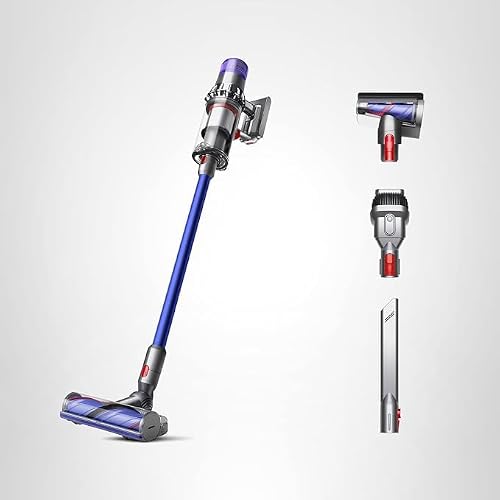
Floorhead design often determines daily cleaning speed more than raw motor specifications, especially when moving between sealed timber, laminate, and textured rugs. Evaluating the Dyson V11 or V15 Detect for hardwood floors reveals completely different equipment strategies out of the box. The V11 includes a single primary floor attachment: the Motorbar cleaner head. This head uses a combination of stiff nylon bristles for carpet agitation and black anti-static carbon fiber filaments to capture fine dust on hard surfaces, functioning as an all-in-one floor tool.
In contrast, the V15 Detect supplies two full-size cleaner heads engineered for distinct surfaces. For carpets and mixed flooring, it provides the Digital Motorbar cleaner head, which actively senses resistance to adapt suction. For bare floors, it introduces the dedicated Fluffy Optic cleaner head. This specialized attachment is wrapped in soft woven nylon to envelop large debris while carbon fiber filaments pull static-bound microdust from wood grain. More crucially, the Fluffy Optic projects an illumination beam across the floor, highlighting microscopic particles that are completely invisible under normal ambient lighting. Shoppers exploring our dyson v12 detect slim vs v15 detect guide often point to this illumination feature as transformative for maintaining bare floors.
Using a bristle-based roller like the V11’s Motorbar on delicate hardwood carries a minor risk of scattering larger grit across polished boards before capturing it. The V15’s Fluffy Optic eliminates this behavior by rolling smoothly over bare floorboards while ensuring no particle escapes unnoticed in dimly lit corners or beneath cabinetry. Homes dominated by hardwood floors, parquet, or polished stone will gain substantial efficiency from the V15’s dual-head package.
Edge: Dyson V15 Detect, thanks to its dedicated Fluffy Optic cleaner head and integrated dust-illuminating beam for bare floors.
Pet Hair Management and Specialized Tools
Managing shed fur requires both floorhead de-tangling capabilities and specialized miniature tools for upholstered furniture, car interiors, and bedding. In a direct comparison of the Dyson V11 or V15 Detect for pet hair, both machines include integrated hair-clearing vanes built into their primary floorheads. The V11’s Motorbar and the V15’s Digital Motorbar both feature polycarbonate teeth that automatically clear hair from the brush roller as you vacuum, preventing long strands and animal coat fibers from wrapping tightly around the axle.
The distinction shifts when looking at the compact handheld attachments. The V11 package includes the specialized Hair screw tool, engineered with an anti-tangle conical brush bar. Because the brush roll tapers toward one end, centrifugal force spirals long strands and pet hair off the end of the bar directly into the suction stream, entirely eliminating brush roll clogs. The package also provides a Mini soft dusting brush and a Crevice tool for delicate surfaces and narrow crevices. As highlighted in our dyson v11 vs v12 detect slim comparison, the conical tool represents one of Dyson’s most effective solutions for stubborn pet bedding.
The V15 Detect listing, meanwhile, specifies the Mini motorized tool alongside a crevice tool and wall dock. The Mini motorized tool concentrates motor power into a compact head to pull deeply embedded fur and dander from car upholstery and mattresses, but its cylindrical brush bar does not feature the conical anti-tangle geometry of the Hair screw tool. Pet owners dealing with heavy shedding of long hair on soft furnishings will find the V11 Origin’s tool kit slightly more resistant to manual hair clearing.
Edge: Dyson V11, driven by its conical anti-tangle Hair screw tool that prevents long strands from wrapping on handheld pet tools.
Display Intelligence and Real-Time Particle Feedback
Onboard digital displays have evolved from basic battery indicators into comprehensive diagnostic dashboards that guide how users clean. The Dyson V11 review specifications highlight an intuitive LCD screen positioned at the rear of the cyclone assembly. This display shows the active cleaning mode (Eco, Auto, or Boost), maintenance alerts such as filter wash reminders or blockage notifications, and a real-time battery runtime countdown calculated down to the second based on current motor draw.
The Dyson V15 Detect review parameters reveal a substantially more sophisticated data interface. Like the V11, the V15 displays mode selection, maintenance prompts, and a precise second-by-second countdown. However, the V15 connects its LCD directly to the onboard acoustic piezo sensor. As debris is vacuumed, the screen presents a live bar graph showing the total number of microscopic particles sorted into four distinct size bands. This provides scientific confirmation that a floor section is genuinely deep-cleaned, with the bar graph flattening once debris intake ceases. Readers researching our dyson v8 vs v15 detect analysis will note that this real-time debris feedback completely changes cleaning habits by showing when to move forward.
For users who prefer a straightforward status screen, the V11 provides everything necessary: battery seconds remaining and power level. But for detail-oriented homeowners, allergy sufferers, or anyone seeking definitive proof of debris clearance, the V15 Detect delivers actionable data that takes the guesswork out of sanitizing carpets and bare floors.
Edge: Dyson V15 Detect, offering real-time acoustic particle counting alongside runtime and maintenance metrics.
Ergonomics, Control Types, and Battery Management
Operating comfort and physical handling dictate how pleasant a stick vacuum feels during prolonged multi-room cleaning sessions. Both vacuums feature similar physical profiles: the V11 measures 10.28 inches long, 9.84 inches wide, and 49.64 inches high with an operating weight of 6.6 pounds, while the V15 Detect measures 10.4 inches long, 9.8 inches wide, and 49.6 inches high, weighing 6.8 pounds. Both feature identical 0.2-gallon dustbins with a hygienic point-and-shoot ejector mechanism and run on 25.2-volt rechargeable lithium-ion battery architectures.
The primary ergonomic divergence lies in how power is engaged. The Dyson V11 Origin utilizes push button and touch controls, allowing you to select your power mode and run the vacuum continuously without holding down an uninterrupted grip switch. The V15 Detect, by contrast, relies on a classic power trigger. The trigger design maximizes energy efficiency by cutting power instantly whenever you adjust furniture, step across a doorway, or shift attachments. However, users with joint stiffness or those tackling full-house sweeps may find holding the trigger slightly more fatiguing than the V11’s continuous operation.
On the battery runtime front, both models list up to 60 minutes of operation in their lowest power settings on hard floors. The V11 listing notes a five-minute runtime ceiling when operated continuously in Boost mode, which matches typical high-draw cordless behavior. In terms of acoustic output, the V11 listing documents a 70 dB operational noise level, whereas the V15 listing does not specify a decibel rating. Those reviewing our dyson v15 detect vs gen5detect overview know that grip fatigue remains a key variable when comparing trigger-operated models against continuous-run setups.
Edge: Dyson V11, edging ahead due to its lighter 6.6-pound frame and trigger-free push button control scheme.
Pros and Cons
Dyson V11

Pros
- 185 AW strong suction rating
- Conical anti-tangle Hair screw tool
- Continuous push button control method
- Whole-machine HEPA filtration system
- Lighter 6.6-pound total machine weight
Cons
- Only one floor cleaner head included
- No optical illumination for hard floors
- Lacks dynamic acoustic debris detection
Dyson V15 Detect

Pros
- Fluffy Optic bare-floor illumination head
- Piezo sensor automates dynamic suction adjustments
- LCD displays real-time particle counts
- Two full-size cleaner heads included
- Maximum motor output for deep extraction
Cons
- Requires holding trigger during operation
- Heavier 6.8-pound stick vacuum body
- Mini motorized tool lacks anti-tangle design
View Dyson V15 Detect on Amazon
Who Should Buy Each One
Choose the Dyson V11 If
- You prefer continuous push-button operation rather than holding down a power trigger during long cleaning sessions.
- Your home consists primarily of wall-to-wall carpets or area rugs where the Motorbar cleaner head excels without needing head swaps.
- You share your home with long-haired pets and want the anti-tangle conical Hair screw tool to de-fuzz upholstery without roller snarls.
- You want high 185 AW suction power and whole-machine HEPA filtration without paying for optical lasers and particle graphs.
Choose the Dyson V15 Detect If
- You have extensive hardwood, tile, or laminate flooring that benefits from the soft-roller Fluffy Optic head and dust-revealing illumination.
- You want automatic suction adjustments that ramp up motor output over dirty patches and scale down over cleaner zones.
- You appreciate scientific cleaning verification through an LCD screen that graphs particle sizes and debris counts in real time.
- You demand maximum motor performance (100% more power than V8) for extracting deeply embedded dirt from thick carpets.
Final Verdict
In this Dyson V11 vs Dyson V15 comparison, the Dyson V15 Detect emerges as the more capable and technologically complete cordless vacuum. Its inclusion of two dedicated cleaner heads-most notably the illuminated Fluffy Optic-solves bare-floor cleaning far more thoroughly than any all-purpose head can manage. Combined with higher peak suction output, an acoustic piezo sensor that automates power management on the fly, and live particle tracking, the V15 Detect justifies its position as the premier choice for homes with substantial hardwood flooring and meticulous cleaning demands.
The Dyson V11 remains an exceptional, practical machine that holds distinct advantages in specific living spaces. Its 185 AW motor provides more than enough lift for everyday household dirt, its conical Hair screw tool outperforms standard motorized mini tools on pet hair, and its push-button control setup prevents the hand fatigue associated with continuous trigger-holding. If your home is carpet-heavy, your pets shed constantly across furniture, and you prefer straightforward power over sensor dashboards, the V11 Origin delivers high-tier Dyson engineering in a focused, reliable package.
FAQ
Can the cleaner heads be swapped between the Dyson V11 and V15 Detect?
The product listings do not specify cross-model cleaner head interchangeability between these exact configurations. While both machines utilize Dyson’s quick-release stick attachment mechanisms and 25.2-volt battery architectures, each model is packaged with tools calibrated specifically to its electronic sensor systems, such as the V15’s automated floor-sensing Digital Motorbar.
How does the Fluffy Optic head on the V15 Detect help on bare floors?
The Fluffy Optic cleaner head uses soft woven nylon to gently capture large debris and anti-static carbon fiber filaments to lift fine microdust without scratching delicate wood. It incorporates a precision-angled illumination beam that makes invisible dust and pet dander clearly visible against bare floor surfaces, ensuring you do not miss spots during cleaning.
What is the runtime difference between the Dyson V11 and Dyson V15 Detect?
Both vacuums advertise up to 60 minutes of total runtime under optimal conditions in Eco mode on hard floors. The V11 listing notes a 5-minute runtime when operating in Boost mode for intensive spot cleaning. The V15 Detect listing notes that actual runtime varies based on power mode, floor type, attachments, and the volume of debris detected by its piezo sensor.
Which vacuum is better for managing pet hair on furniture?
The Dyson V11 Origin includes an edge on soft furniture due to its specialized Hair screw tool. This attachment features an anti-tangle conical brush bar that automatically spirals long hair and pet fur off the end of the roller into the bin. The V15 Detect includes a Mini motorized tool, which provides powerful agitation but lacks the conical anti-tangle bar geometry.
Do both vacuums feature whole-machine HEPA-grade filtration?
The Dyson V11 specifications state that it features whole-machine HEPA filtration capable of capturing 99.99% of particles as small as 0.3 microns. The V15 Detect specifications state that its advanced whole-machine filtration captures 99.99% of particles down to 0.3 microns in Boost mode, while achieving at least 99.97% filtration across all other operational modes.
Does the Dyson V11 adjust its suction power automatically?
The Dyson V11 features an Auto mode among its three power settings, designed to provide an optimal balance of power and runtime for everyday cleaning tasks. However, unlike the V15 Detect, it lacks an acoustic piezo sensor to dynamically measure microscopic debris counts and ramp motor wattage in direct response to dirt volume.