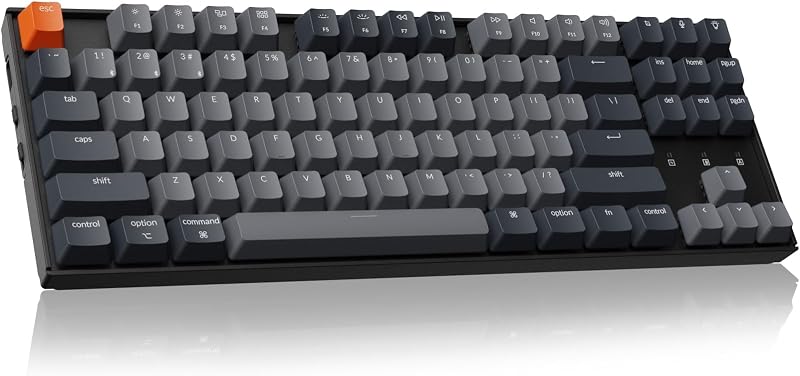
The single defining difference that decides between the Epomaker TH80 V2 and the Lofree Flow is typing architecture: Epomaker engineered a full-height, standard mechanical deck featuring deep multi-layer acoustic foam and a massive 8000mAh battery, while Lofree built an ultra-slim, low-profile keyboard framed in full aluminum with self-lubricating Kailh full POM switches.
Choose the Epomaker TH80 V2 if you want a tall desktop workstation with a dedicated volume knob, substantial key travel, and weeks of continuous wireless power. Choose the Lofree Flow if you want a flat, wrist-friendly profile with an all-metal chassis that packs a full 100-key layout into an easily packable footprint.


Epomaker TH80 V2 vs Lofree Flow at a Glance
| Feature | Epomaker TH80 V2 | Lofree Flow |
|---|---|---|
| Keyboard Profile | Standard mechanical profile | Ultra-slim low-profile |
| Key Count & Layout | 75% layout (79 keys + 1 rotary knob) | Compact 100-key layout |
| Switch Architecture | Hot-swappable custom mechanical switches | Hot-swappable Kailh Full POM Ghost linear switches |
| Mounting & Dampening | PORON, IXPE, latex, silicone layers, PED pad | Gasket-mount cushioning |
| Frame Construction | Contemporary casing with RGB side-plate | All-aluminum body top to bottom |
| Battery Capacity | 8000mAh (200+ hours continuous play) | 1 rechargeable battery (capacity not listed) |
| Connectivity Options | 2.4GHz wireless, Bluetooth, wired USB | Bluetooth, wired USB-C |
| Gaming Latency & Polling | 1000Hz polling rate, 2ms low latency | Not listed |
| Lighting Configuration | South-facing RGB per-key, RGB side-plate | Single-color backlighting, RGB sidelit |
| Best For | Desktop multi-device setups and PC gaming | Mobile productivity and low-profile ergonomics |
Typing Ergonomics and Physical Profile
Typing comfort depends heavily on deck height, keycap curvature, and wrist posture during long sessions. The Epomaker TH80 V2 stands at 1.74 inches in height, utilizing standard mechanical keycaps and traditional switch stems. This standard height delivers significant vertical key travel and a pronounced mechanical bounce, but it creates a steep angle for your hands if typed on flat against a desk surface. Users who prefer resting their palms directly on desk mats may find that standard mechanical decks prompt wrist extension over prolonged work stretches.
In contrast, the Lofree Flow is an ultra-slim board utilizing low-profile switches and shallow keycaps, making it sit much closer to the desk surface. By eliminating the steep slope of traditional mechanicals, the Flow removes the necessity for wrist rests and enables a more relaxed, natural arm position. Shoppers researching the nuphy air75 v2 vs lofree flow will recognize this low-profile advantage, as low-profile stems provide rapid actuation without forcing hands upward. When deciding between the Epomaker TH80 V2 or Lofree Flow for typing comfort across eight-hour shifts, the lower clearance of the Flow reduces ergonomic strain noticeably.
However, the compact typing surface on each keyboard suits different spatial habits. The TH80 V2 provides a compact 75% footprint (12.73 inches long by 5.54 inches wide) with spaced function rows and a physical metal volume roller, keeping your hands centered and leaving generous desk area for sweeping mouse movements. The Flow utilizes its frame to fit a denser 100-key configuration, bringing number keys directly into the main deck. For pure ergonomic wrist alignment, low clearance remains the determining factor.
Edge: Lofree Flow provides a flatter typing angle and low-profile switches that eliminate wrist strain without needing separate wrist support.
Switch Mechanics and Sound Dampening Structure
The internal engineering of these keyboards produces entirely distinct acoustic and tactile feedback. The Epomaker TH80 V2 focuses heavily on thick, layered sound dampening inside its standard housing. Epomaker integrates noise-cancelling layers made of PORON, IXPE, latex, and silicone, paired with a specialized PED pad. This extensive foam sandwich absorbs unwanted metallic hollow reverberations, pinging, and casing rattle, turning every keystroke into a muted, creamy sound profile right out of the box.
The Lofree Flow takes an innovative approach to low-profile acoustic design. It incorporates a cushioned gasket mount-making it the world’s first gasket-mounted low-profile board-to distribute downward pressure evenly. Paired with this gasket mount are factory-installed Kailh Full POM Ghost linear switches. Because polyoxymethylene (POM) is self-lubricating, Lofree Flow ghost switches feel smoother over extended use as friction polishes the contact points. The keycaps are made of PBT utilizing a five-sided dye-sublimation process, which resists finger oil shine and preserves sharp surface legends.
Both models feature hot-swappable sockets, meaning you can pull switches and swap in alternatives without soldering. In an Epomaker TH80 V2 review, the acoustic praise centers on its deep, thick cavity resonance, whereas a Lofree Flow review highlights the remarkably silent, cushioned thud achieved within an ultra-thin frame. Readers cross-referencing our gmmk 3 vs epomaker th80 v2 analysis will recognize how multi-layer acoustic foam alters deep-dish sound signatures. If you love deep, creamy acoustics, Epomaker delivers it through foam density; if you prefer gentle, low-travel cushioned keystrokes, Lofree provides it through gasket-mounted POM components.
Edge: Tie. The TH80 V2 creates a deeper, foam-dampened sound profile, while the Flow delivers unmatched low-profile gasket softness with self-lubricating POM switches.
Battery Capacity and Wireless Connectivity
Wireless endurance and protocol versatility are critical for cord-free desk arrangements and multi-computer workflows. The Epomaker TH80 V2 dominates the wireless power category with a massive 8000mAh rechargeable battery. Epomaker states this battery delivers more than 200 hours of continuous active play on a single charge. Furthermore, the TH80 V2 includes three distinct connectivity methods: Bluetooth, a lag-free 2.4GHz wireless USB receiver, and wired USB. It can remember and cycle between up to five connected devices, making it a powerful hub across laptops, tablets, gaming consoles, and desktop PCs.
Wireless features on the Lofree Flow lean toward travel minimalism. The Flow includes Bluetooth wireless connectivity alongside a standard wired USB-C port. Notably, the product listing does not include a 2.4GHz wireless USB dongle, meaning wireless usage relies entirely on Bluetooth pairing. When investigating Lofree Flow battery life, the listing specifies that the board is powered by a single rechargeable battery, but it does not specify the exact milliamp-hour capacity or rated operational runtime hours. Buyers who prioritize verified wireless runtimes will find the lack of listed hours a noticeable trade-off compared to the 8000mAh powerhouse in the Epomaker.
The lack of a dedicated 2.4GHz connection also limits the Lofree Flow in environments with heavy Bluetooth interference or for devices lacking Bluetooth receivers. While managing multi-machine desks, the TH80 V2 lets you toggle swiftly between office machines, personal laptops, and tablets across multiple protocols. For buyers exploring other high-end alternatives like the akko 5075b plus vs epomaker th80 v2, Epomaker’s massive cell capacity remains a class-leading asset.
Edge: Epomaker TH80 V2 wins definitively with its massive 8000mAh battery, 200+ continuous hours of battery life, and 2.4GHz wireless dongle.
Gaming Performance and Input Latency
Input speed, polling stability, and ghosting protection dictate whether a keyboard can keep pace with fast-paced gaming. Epomaker explicitly optimized the TH80 V2 as a mechanical gaming keyboard. It features a 1000Hz (1k) polling rate and a low latency rating of 2 milliseconds over its wireless and wired connections. Combined with full anti-ghosting technology, the TH80 V2 ensures that simultaneous key presses register cleanly without dropped inputs or sluggish character execution in competitive titles.
The Lofree Flow is engineered primarily as a sleek, low-profile typing and creative instrument rather than an esports deck. While its USB-C connection allows direct wired usage with zero wireless transmission interference, the listing does not specify a 1000Hz polling rate, input latency figures in milliseconds, or dedicated anti-ghosting rollover ratings. Furthermore, relying on Bluetooth for wireless operation introduces inherent transmission delays that casual typists will not detect, but fast-paced gamers will notice during rapid-fire maneuvers.
Choosing the Epomaker TH80 V2 or Lofree Flow for gaming comes down to technical responsiveness. The Epomaker TH80 V2 includes companion software for deep key remapping, RGB customization, and complex macro editing, providing direct tactical utility for gamers. The rotary knob also gives players instantaneous master volume adjustments without alt-tabbing away from full-screen games. Readers exploring standard gaming options in our ducky one 3 vs epomaker th80 v2 breakdown will see that gaming-grade polling numbers are essential for precision play.
Edge: Epomaker TH80 V2 wins due to its specified 1000Hz polling rate, 2ms low latency, anti-ghosting support, and dedicated 2.4GHz connection.
Chassis Build and Desk Aesthetics
Visual presentation and exterior materials define the physical presence each keyboard holds on your desk. The Lofree Flow stands apart with an all-aluminum body from top to bottom. This complete aluminum shell delivers a sturdy, rigid structure with zero chassis flex while keeping the board slim, dense, and premium to the touch. Lofree pairs this metal casing with single-color key backlighting and ambient RGB sidelighting that casts a subtle glow across the desk mat, making the Flow blend seamlessly into modern executive and minimalist workspaces.
The Epomaker TH80 V2 employs a contemporary aesthetic highlighted by a specialized RGB side-plate and south-facing per-key backlighting. South-facing LEDs direct light toward the typist’s eyes rather than away, ensuring maximum brightness and compatibility with non-translucent custom keycaps. Epomaker also incorporates an integrated metal rotary knob on the top right, providing physical tactile control over volume and media playback. While the TH80 V2 looks bold and vibrant in black with its dynamic lighting, its thicker frame occupies more vertical and horizontal desktop volume.
Layout density also impacts desktop aesthetics. The Flow packs 100 keys into a single uniform frame, giving users dedicated numeric key access without expanding outward like traditional full-size boards. The TH80 V2 adopts an 79-key 75% arrangement, leaving generous mouse clearance for gaming setups. If you evaluate an Epomaker TH80 V2 low profile alternative strictly by material construction and sleek desk integration, the all-aluminum Lofree Flow is hard to match, which is why comparisons like the nuphy air75 v2 vs epomaker th80 v2 frequently explore slim metal form factors.
Edge: Lofree Flow wins with its premium all-aluminum body and clean, ultra-slim executive aesthetic.
Pros and Cons
Epomaker TH80 V2

Pros
- Massive 8000mAh battery with 200+ hour runtime
- Multi-layer sound dampening with PORON and silicone
- Fast 1000Hz polling and 2ms latency
- Dedicated physical rotary volume knob
- Includes 2.4GHz dongle and Bluetooth connectivity
Cons
- Tall 1.74-inch standard mechanical profile
- Heavier footprint less convenient for travel
View Epomaker TH80 V2 on Amazon
Lofree Flow

Pros
- Ultra-slim low-profile ergonomic design
- Premium all-aluminum body top to bottom
- Self-lubricating Kailh Full POM Ghost switches
- Cushioned gasket mount typing structure
- Compact 100-key layout with numeric keys
Cons
- Battery capacity and runtime hours not listed
- Lacks 2.4GHz wireless dongle connectivity
Who Should Buy Each One
Choose the Epomaker TH80 V2 If
- You demand extreme wireless longevity and want over 200 hours of continuous runtime from a massive 8000mAh battery.
- You play fast-paced PC games and require a 1000Hz polling rate, 2ms latency, and a 2.4GHz wireless USB connection.
- You love deep, creamy switch sound profiles achieved through multi-layer PORON, IXPE, and silicone acoustic padding.
- You want tactile hardware controls, such as a built-in metal rotary knob for immediate volume adjustments.
Choose the Lofree Flow If
- You prefer an ultra-slim, low-profile typing posture that eliminates wrist strain without requiring an external wrist rest.
- You want a full-metal, all-aluminum chassis that provides superior desk rigidity and a sleek modern aesthetic.
- You need a dense 100-key layout that provides numeric keys while maintaining a slim, packable footprint.
- You value smooth, self-lubricating Kailh Full POM linear switches combined with cushioned gasket-mount typing.
Final Verdict
For most desktop computer users and gaming enthusiasts, the Epomaker TH80 V2 is the more versatile, feature-complete keyboard. Its 8000mAh battery eliminates the constant need for charging cables, while its multi-protocol connectivity-featuring a low-latency 2.4GHz dongle and 1000Hz polling-makes it equally capable of competitive gaming and multi-device office productivity. The heavy foam dampening layers deliver an immensely satisfying, creamy typing tone straight out of the box, making the TH80 V2 a standout performer for traditional mechanical enthusiasts asking is Epomaker TH80 V2 worth it.
However, the Lofree Flow wins decisively when desk ergonomics, metal craftsmanship, and sleek travel portability take priority. If you suffer from wrist fatigue or dislike the tall, chunky posture of standard mechanical keyboards, the Flow’s ultra-slim gasket design and Kailh Full POM switches offer one of the smoothest, most cushioned low-profile typing experiences on the market. For remote workers, Mac users, and design professionals who value an all-aluminum build with 100 keys in a compact frame, the Lofree Flow justifies its premium materials completely.
FAQ
Can you swap the switches on both keyboards?
Yes, both keyboards feature hot-swappable sockets that allow you to pull and replace switches without any soldering. The Epomaker TH80 V2 accepts standard mechanical switches, while the Lofree Flow is designed specifically for compatible low-profile mechanical switches like its factory Kailh Full POM line.
How do the Lofree Flow ghost switches feel?
The Kailh Full POM Ghost switches on the Lofree Flow are linear switches made entirely of self-lubricating polyoxymethylene plastic. They offer a short, smooth key travel with cushioned bottom-out impacts provided by the internal gasket-mount plate, becoming progressively smoother over time as the switch components interact.
Does the Lofree Flow include a 2.4GHz wireless dongle?
No, the Lofree Flow features Bluetooth and wired USB-C connectivity according to its specifications, without a listed 2.4GHz USB wireless receiver. The Epomaker TH80 V2, on the other hand, includes a dedicated 2.4GHz wireless mode alongside Bluetooth and wired options.
How long does the battery last on the Epomaker TH80 V2?
The Epomaker TH80 V2 is equipped with an 8000mAh battery that delivers over 200 hours of continuous active play on a single charge. For the Lofree Flow, the listing confirms a rechargeable battery is included, but the specific milliamp-hour rating and operating hours are not listed.
Can you adjust media volume using a physical dial on both keyboards?
No, only the Epomaker TH80 V2 includes a dedicated metal rotary knob on the top right corner of the keyboard for quick volume adjustments. The Lofree Flow uses standard keycap shortcuts for media commands.
Are both keyboards compatible with Windows and Mac?
Yes, both keyboards support Windows and Mac operating systems. The Lofree Flow listing explicitly notes compatibility with Windows and Mac OS, while the Epomaker TH80 V2 connects across PC, laptops, tablets, and smartphones via its versatile Bluetooth and USB connectivity modes.