The single technical difference that decides the choice for most cooks is surface architecture: HexClad uses a laser-etched lattice of stainless steel peaks over recessed TerraBond ceramic nonstick valleys designed for high-heat searing and metal utensil abuse, whereas All-Clad utilizes a continuous, ultra-smooth PTFE nonstick coating over hard-anodized aluminum that delivers effortless, zero-drag food release for delicate everyday cooking.
Cooks who demand high-heat blister searing, metal tool freedom, and extreme oven tolerance should choose HexClad, while those seeking effortless glide for eggs, simple cleanup, and classic skillet maneuverability should select All-Clad.

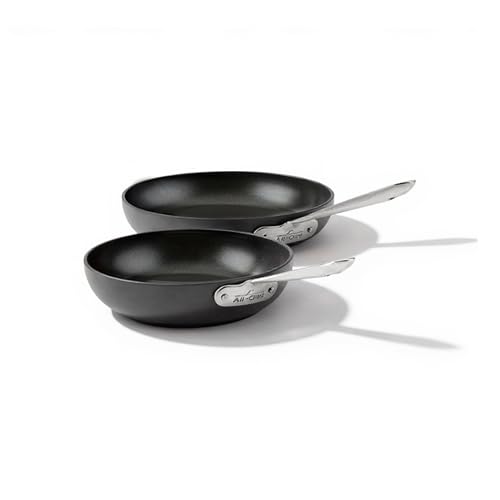

HexClad vs All-Clad at a Glance
| Feature | HexClad | All-Clad |
|---|---|---|
| Cooking Surface Type | Patented hexagonal laser-etched stainless steel with TerraBond ceramic nonstick | Multi-layer PTFE nonstick (PFOA-free) |
| Body Construction | Tri-ply stainless steel with an aluminum core | Scratch-resistant hard-anodized aluminum |
| Cookware Oven Safety Limit | Up to 900°F | Up to 500°F |
| Lid Oven Safety Limit | Tempered glass lids up to 400°F | Tempered glass lids up to 350°F |
| Utensil Compatibility | Metal utensil safe | Nylon, silicone, and wooden utensils only |
| Cooktop Compatibility | Gas, electric, induction, ceramic | Gas, electric, induction, ceramic |
| Surface Preparation | Initial seasoning required per manufacturer instructions | No seasoning required; ready out of box |
| Base Engineering | Full magnetic clad exterior | Optimized stainless steel induction base plate |
| Handle Design | Stay-cool stainless steel handles | Double-riveted contoured stainless steel handles |
| Best For | High-heat browning, metal utensils, and broiler roasting | Delicate egg cookery, low-fat sautéing, and rapid cleanup |
Cooking Surface and Food Release
The primary battle between these two brands unfolds directly on the cooking surface. HexClad relies on a patented hybrid configuration where raised stainless steel hexagonal ridges protect valleys of recessed TerraBond ceramic nonstick coating. This design intends to provide the deep, caramelizing contact of stainless steel while reducing overall sticking. However, because food still makes direct contact with the raised steel peaks, proteins like cold fish or lean chicken breast can adhere if the pan is not properly preheated with cooking oil. Furthermore, official manufacturer guidelines stipulate that seasoning the pan before initial use is mandatory to activate its hybrid nonstick capabilities.
In contrast, the all-clad vs made in cookware discourse frequently highlights the simplicity of traditional culinary surfaces, and the All-Clad HA1 collection exemplifies this classic design. All-Clad uses an uninterrupted, multi-layer PTFE nonstick coating bonded across a flat interior. There are no raised metallic barriers to catch food particles, meaning eggs, crepes, and delicate whitefish glide across the pan with minimal cooking oil. Evaluating All-Clad HA1 nonstick performance reveals a surface optimized strictly for frictionless release rather than high-temperature fond creation.
When assessing this daily trade-off, cooks must weigh pristine food release against browning capability. A HexClad review will consistently note that while it releases food significantly better than pure stainless steel, it does not achieve the slick, slip-and-slide quality of dedicated PTFE. If your morning routine revolves around French omelets and over-easy eggs, All-Clad offers an unmistakably smoother culinary experience with zero break-in period.
Edge: All-Clad because its continuous PTFE surface releases delicate proteins and eggs with far less friction and requires no initial seasoning.
Heat Tolerance and Oven Versatility
Heat resistance separates everyday nonstick skillets from professional kitchen workhorses. The HexClad vs All-Clad oven safe comparison exposes a massive gap in thermal engineering. HexClad vessels feature a structural threshold rated up to 900°F. This astronomical temperature rating allows home cooks to shift a skillet from a high-temperature stovetop burner straight under an aggressive oven broiler without blistering the coating or compromising the underlying pan body. Even its tempered glass lids withstand oven temperatures up to 400°F, accommodating braises and covered bakes with ease.
All-Clad HA1 fry pans feature an oven safety ceiling of 500°F, with their accompanying tempered glass lids rated to 350°F. While a 500°F limit comfortably covers everyday casserole roasting, vegetable blistering, and standard oven finishing, it precludes the use of high-heat broiling elements. Exposing PTFE surfaces to temperatures beyond 500°F degrades the fluoropolymer bonds, leading to premature nonstick breakdown and potential fume emission. Users must maintain strict heat discipline when moving All-Clad pieces between burners and oven racks.
This stark divergence influences recipe flexibility. Deciding between HexClad or All-Clad for searing bone-in steaks or whole pork chops often comes down to this oven ceiling. HexClad permits extreme heat transfers, letting cooks establish a heavy pan crust and finish the cut under intense top-down broiling. For high-temperature kitchen techniques, HexClad provides an unmatched safety margin.
Edge: HexClad due to its class-leading 900°F oven tolerance that permits broiler finishing compared to All-Clad’s 500°F ceiling.
Construction and Utensil Durability
Cookware longevity depends heavily on structural materials and utensil resistance. HexClad hybrid durability stems from its comprehensive tri-ply construction, which sandwiches a fast-conducting aluminum core between layers of heavy-duty stainless steel. The real durability milestone, however, lies in its patented surface engineering: the elevated stainless steel hexagonal ridges bear the mechanical brunt of spatulas, whisks, and spoons. Because metal utensils glide over the steel peaks without digging into the recessed nonstick valleys, cooks can scrape fond and flip burgers using stainless steel turners without flaking the pan.
All-Clad takes an alternative metallurgical route by constructing its HA1 line from heavy-gauge hard-anodized aluminum reinforced with an optimized stainless steel exterior base plate. The hard-anodized exterior resists scratching, denting, and structural warping on demanding stovetops. However, the internal PTFE cooking surface remains vulnerable to abrasive mechanical forces. All-Clad explicitly warns that to protect the nonstick layer, users must restrict themselves to nylon, silicone, or wooden utensils. A single scrape from a metal fork or sharp stainless spatula can slice through the PTFE matrix, permanently degrading the pan.
Investing in cookware involves evaluating how much mindfulness you want to exercise at the stove, a theme also explored in kitchen appliance decisions like the breville barista pro vs delonghi dedica matchup. With HexClad, you never have to warn family members or guests about using metal forks or spoons to turn food. All-Clad requires strict utensil discipline to prevent premature wear of the nonstick barrier.
Edge: HexClad because its raised steel lattice allows the use of metal utensils without damaging the nonstick coating.
Stovetop Performance and Induction Response
Both cookware collections are engineered for universal cooktop versatility, but they translate thermal energy across burners through distinct core designs. HexClad implements true tri-ply clad architecture across its entire body, extending the heat-distributing aluminum core through the bottom and up the sidewalls. When analyzing HexClad or All-Clad for induction, HexClad’s fully magnetic stainless steel exterior ensures immediate coupling with magnetic cooktop inductors, spreading heat rapidly across the base and preventing localized hot spots.
All-Clad HA1 balances heat by combining a thick hard-anodized aluminum body with an optimized bonded stainless steel plate on the base. Aluminum is inherently non-magnetic, so All-Clad integrates the magnetic stainless base plate specifically to achieve induction compatibility. The thick aluminum body excels at soaking up heat and distributing it evenly across the cooking floor, while the flared sidewalls make one-handed flipping, tossing, and spatula maneuvering effortless. This flared geometry facilitates steam evaporation, helping pan-fried foods crisp rather than steam in their own juices.
Choosing the best pan for stovetop responsiveness resembles weighing feature sets in the breville bambino plus vs barista pro analysis, where both contenders accomplish the core mission via slightly different operational mechanics. On gas, electric, ceramic, or induction cooktops, both brands deliver stable bases that resist warping. HexClad heats up somewhat faster due to its fully clad core, while All-Clad provides steady, even thermal mass with superior flared sides for food tossing.
Edge: Tie because both lines feature rock-solid induction compatibility, rapid aluminum-assisted heat spread, and warp-resistant bases.
Maintenance, Cleaning, and Longevity
Daily maintenance determines whether premium cookware remains a joy or becomes a kitchen chore. Although HexClad is dishwasher-friendly, the manufacturer explicitly recommends handwashing to prolong the lifespan of the hybrid surface. In addition, HexClad requires periodic re-seasoning with high-smoke-point cooking oil to maintain release properties over time. When grease builds up on the stainless steel ridges, vigorous scouring with standard scrub pads is safe, but keeping the geometric matrix completely clean of carbonized oil requires consistent attention after high-heat searing sessions.
All-Clad HA1 pans are labeled dishwasher safe, but All-Clad also advises simple washing with soap and a soft sponge to preserve the nonstick coating over years of use. Because the PTFE surface is perfectly continuous and non-porous, handwashing takes mere seconds; burnt fats and crusts rinse away under running water with negligible sponge pressure. For the hard-anodized exterior and stainless base, specialized products like All-Clad Cookware Stainless Steel Cleaner, a 12-ounce non-abrasive powder cleanser and polish, can be deployed to eliminate dirt, grime, and hard water stains without scratching the metal.
When analyzing long-term durability, the central question for shoppers is whether HexClad is worth it compared to traditional nonstick. All-Clad HA1 nonstick pans, like all pure PTFE cookware, have a finite lifespan before the coating wears down and necessitates pan replacement. HexClad’s protective stainless steel lattice extends overall surface resilience, but its ceramic valleys can still lose release properties if neglected. However, for sheer everyday convenience, All-Clad wins on quick dishwashing and zero seasoning chores.
Edge: All-Clad because its uninterrupted nonstick surface wipes clean instantly without mandatory seasoning or meticulous scrubbing between ridges.
Pros and Cons
HexClad
Pros
- 900°F cookware oven safety limit
- Safe for metal utensils
- Durable tri-ply aluminum core body
- Laser-etched hybrid searing capability
Cons
- Requires initial seasoning process
- Less slippery than pure PTFE
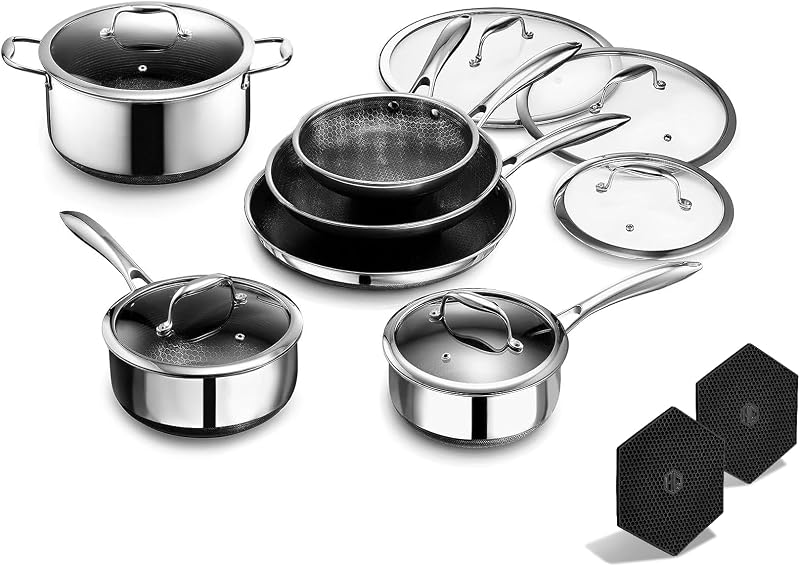
View HexClad Hybrid Nonstick 14-Piece Cookware on Amazon
All-Clad

Pros
- Effortless PTFE food release
- Scratch-resistant hard-anodized aluminum exterior
- Flared sidewalls for easy flipping
- Ready out of the box
Cons
- Lower 500°F oven limit
- Not safe for metal utensils
View All-Clad HA1® Nonstick 2-Piece Fry Pan on Amazon
Who Should Buy Each One
Choose HexClad If
- You want a pan capable of enduring extreme broiler heat up to 900°F for deep roasting and searing.
- You prefer the durability of metal spatulas, spoons, and whisks without scratching your cooking surface.
- You want the high-heat fond development of stainless steel with easier cleanup than traditional clad pans.
- You are willing to properly season your cookware and maintain heat discipline with cooking fats.
Choose All-Clad If
- Your cooking routine focuses on delicate foods like eggs, crepes, light fish, and tender vegetables.
- You prioritize true zero-drag food release that requires minimal butter or cooking oil.
- You want lightweight, flared sidewalls designed specifically for effortless food tossing and spatula access.
- You prefer cookware that requires no initial seasoning ritual and cleans up completely in seconds with a soft sponge.
Final Verdict
For cooks focused on effortless morning cookery, seamless food release, and hassle-free cleanup, All-Clad HA1 remains the superior practical choice. Its continuous PTFE nonstick coating eliminates the sticking frustrations common with delicate proteins, requires zero initial seasoning, and features flared sidewalls engineered for agile flipping. Evaluating whether All-Clad is worth it comes down to daily kitchen utility: if your primary use cases are eggs, quick sautés, and low-oil cooking, All-Clad provides an unmatched, smooth experience that makes weeknight meal preparation straightforward.
On the other hand, HexClad claims the crown for passionate home chefs demanding high-heat searing, heavy oven roasting, and metal utensil freedom. Just as kitchen equipment enthusiasts weigh hardware resilience in the breville barista express vs delonghi dedica breakdown, serious cooks will appreciate HexClad’s robust tri-ply construction, 900°F oven rating, and protective stainless steel lattice. If you treat your pans aggressively, transition recipes directly beneath high-heat broilers, and want stainless steel browning without brutal scrubbing, HexClad is the definitive hybrid solution.
FAQ
Is HexClad better than All-Clad for cooking eggs?
No, All-Clad HA1 is noticeably better for cooking eggs. HexClad features raised stainless steel ridges that can snag delicate egg proteins unless the pan is thoroughly preheated and lubricated with butter or oil. All-Clad’s continuous PTFE nonstick surface allows eggs to slide freely with minimal fat.
Do both HexClad and All-Clad work on induction cooktops?
Yes, both brands are fully compatible with induction burners. HexClad utilizes a full magnetic stainless steel tri-ply exterior, while All-Clad HA1 incorporates an optimized stainless steel base plate bonded to its hard-anodized aluminum core to ensure rapid induction coupling.
Can you use metal spatulas on All-Clad HA1 pans?
No, metal utensils should never be used on All-Clad HA1 cookware. The manufacturer specifies that only nylon, silicone, or wooden utensils should be used to avoid scratching or gouging the delicate PTFE nonstick surface.
Why does HexClad require seasoning before use?
HexClad requires seasoning to polymerize a thin layer of cooking oil across its hybrid surface, particularly over the exposed stainless steel ridges and within microscopic pores. Seasoning according to the manufacturer’s official instructions is required to unlock the pan’s optimal nonstick properties.
What is the maximum oven temperature for HexClad versus All-Clad?
HexClad pans are oven safe up to 900°F, with their tempered glass lids rated up to 400°F. All-Clad HA1 pans are oven safe up to 500°F, and their tempered glass lids can handle oven temperatures up to 350°F.
Are both brands safe to clean in the dishwasher?
Both HexClad and All-Clad state that their cookware is dishwasher safe. However, both manufacturers also note that handwashing with mild soap and water is recommended to extend the performance and aesthetic lifespan of the nonstick surfaces over the long term.
Choosing between hybrid durability and traditional nonstick glide depends on heat tolerance and daily cooking habits. For detailed maintenance breakdowns and pan longevity tests across various materials, explore our comprehensive Cookware Guide. Matching pan construction to kitchen techniques ensures better cooking results and extends the usable lifespan of your investment.