The core distinction deciding the choice between these two chainsaws comes down to displacement and guide bar reach versus overall handling weight. The heavier Husqvarna 460 Rancher packs a 60.3-cc engine built to pull up to a 24-inch bar through wide hardwood trunks, while the lighter Husqvarna 450 Rancher uses a 50.2-cc engine inside an 11.3-pound chassis optimized for all-day maneuverability and reduced operator fatigue.
Choose the Husqvarna 450 Rancher if you primarily cut firewood, trim limbs, and maintain acreage where a nimbler 20-inch saw keeps your arms fresh. Choose the Husqvarna 460 Rancher if your property demands regular felling of mature timber and bucking thick logs that require the reach and pulling torque of a 24-inch bar.


Husqvarna 450 Rancher vs Husqvarna 460 Rancher at a Glance
| Attribute | Husqvarna 450 Rancher | Husqvarna 460 Rancher |
|---|---|---|
| Model Number | 970613120 | 970613934 |
| Engine Displacement | 50.2 cc | 60.3 cc |
| Horsepower | 3.2 hp | 3.6 hp |
| Included Bar Length | 20 inches | 24 inches |
| Recommended Bar Range | 13 to 20 inches | 13 to 24 inches |
| Powerhead Weight | 11.3 pounds | 13.2 pounds |
| Dimensions (L x W x H) | 16.0 x 8.9 x 11.5 inches | 16.9 x 8.8 x 11.8 inches |
| Oil Pump Design | Not listed | Automatic adjustable oil pump |
| Tensioning System | Not listed | Side-mounted tensioning system |
| Included Accessories | Owners manual | Bar, chain, scrench, 2.6 oz 50:1 fuel mix, manuals |
| Best For | Firewood cutting, storm cleanup, and pruning | Demanding tree felling, heavy bucking, and farm chores |
Engine Displacement and Cutting Power
Engine capacity dictates how much torque a chainsaw can deliver under heavy mechanical load. When a long guide bar is buried deep inside dense hardwood, the friction against the chain creates significant resistance that can drag down engine RPM. Evaluating the Husqvarna 450 vs 460 engine specs highlights how these powerplants diverge when put to work. The 450 Rancher runs a 50.2-cc two-cycle X-Torq engine generating 3.2 horsepower, providing ample mechanical output for moderate tree work, mid-sized logs, and residential forestry tasks.
By contrast, any direct stihl ms 271 farm boss vs husqvarna 460 rancher evaluation makes the brute force of the 460 Rancher obvious. Powered by a 60.3-cc X-Torq engine producing 3.6 horsepower, the 460 Rancher delivers substantial low-end torque. The listing notes that its patented engine technology maximizes output even at lower rotational speeds. That extra 10.1 cubic centimeters of cylinder displacement gives the 460 Rancher the grunt required to pull full chain loops through dense logs without bogging down or stalling under operator pressure.
The difference in output changes how aggressively you can work. With the 450 Rancher, you let the 3.2-hp engine maintain high revolutions, moderating feed pressure on thicker oak or maple to prevent the motor from losing momentum. The 3.6-hp 460 Rancher allows a more forceful cutting pace, ripping through wider rounds with fewer dips in chain speed. For operators regularly processing dense green timber, the increased displacement yields faster cuts and fewer binding delays.
Edge: Husqvarna 460 Rancher, because its 60.3-cc, 3.6-hp X-Torq engine produces higher cutting torque and resists bogging down under heavy load.
Guide Bar Length and Maximum Cutting Reach
The reach of your guide bar establishes the maximum log diameter you can cut in a single pass without having to roll the timber or make complicated opposing cuts. When analyzing the Husqvarna 450 vs 460 bar size, the factory configurations reflect two distinct cutting profiles. The 450 Rancher ships with a 20-inch bar and is rated by the manufacturer for guide bars spanning from a 13-inch minimum up to a 20-inch maximum. It represents the upper bound of standard homeowner cutting gear, fully capable of managing 16- to 18-inch logs in one steady sweep.
The 460 Rancher raises the ceiling by including a 24-inch bar straight from the factory, with an approved operational range covering 13 to 24 inches. That four-inch increase in reach transforms how you approach wide trunks. A 24-inch bar lets you slice through two-foot logs cleanly from one side, saving the time, effort, and hazards associated with maneuvering around rolling logs on uneven terrain. This extended reach also allows taller operators to buck logs on the ground without bending over as far, sparing lower back strain during long cutting sessions.
However, running a longer bar requires appropriate powerhead balance and sufficient lubrication. When reviewing the Husqvarna 450 Rancher vs 460 Rancher chain size and setup, the 450 is locked at a 20-inch maximum ceiling. Trying to fit larger bars on the 450 would compromise engine performance, whereas the 460 Rancher powerhead is engineered specifically to feed, drive, and lubricate a 24-inch bar under continuous duty. If your property features wide hardwood trees, the factory 24-inch capacity of the 460 is an unmatched operational advantage.
Edge: Husqvarna 460 Rancher, thanks to its factory 24-inch bar and structural support for wider timber cuts.
Weight, Balance, and Operator Fatigue
Operating a chainsaw requires constant physical control, and carrying excess mass across acreage quickly takes a toll on your wrists, arms, and lower back. Looking closely at the Husqvarna 450 vs 460 weight difference reveals a gap of almost two full pounds in bare powerhead weight. The 450 Rancher weighs in at 11.3 pounds, making it an exceptionally agile saw for a 50-cc machine. Combined with its compact external dimensions of 16.0 inches long, 8.9 inches wide, and 11.5 inches high, the 450 maneuvers smoothly through tangled branches, brush piles, and awkward angle cuts.
The 460 Rancher tips the scale at 13.2 pounds for the powerhead alone, measuring 16.9 inches long, 8.8 inches wide, and 11.8 inches high. When you attach the included 24-inch bar and fill the reservoirs with fuel and chain oil, that extra mass becomes pronounced. In a practical stihl ms 250 vs husqvarna 460 rancher assessment, heavier saws demand significantly more physical effort when holding the unit at waist level or limbing fallen canopies. The 460 Rancher does mitigate some stress using a dedicated 7-degree offset front handle for improved grip geometry, but it remains a burly machine to swing across a multi-hour workday.
For clearing storm debris, pruning branches, and sectioning medium wood, lighter equipment keeps you safer by staving off physical exhaustion. The 450 Rancher incorporates an asymmetrical rear handle, ergonomic trigger, and soft grip inlay that pair with its lighter frame for superior handling. If your chores involve continuous movement rather than stationary stump-cutting, the 11.3-pound profile makes a tangible positive impact on physical comfort.
Edge: Husqvarna 450 Rancher, because its 11.3-pound dry weight provides significantly better agility and causes far less physical fatigue over long hours.
Firewood Processing and Tree Felling Performance
Choosing between the Husqvarna 450 or 460 for firewood cutting depends primarily on the typical trunk diameter of your wood supply. In a detailed Husqvarna 450 Rancher review setting, cutting cordwood measuring between 10 and 16 inches in diameter is where the 450 excels. The 3.2-hp engine spins up rapidly, slicing through typical firewood rounds with minimal vibration. Because processing multiple cords requires continuous lifting, bucking, and stacking, the lightweight frame helps you work through a truck bed of wood without excessive physical strain.
When tasks shift toward felling mature trees, the dynamic changes. In any Husqvarna 450 Rancher vs 460 for tree felling comparison, the 460 Rancher takes the lead due to its displacement and guide bar reach. Slicing through directional notches and boring back cuts into wide timber demands constant chain speed and deep bar penetration. The 60.3-cc engine produces the momentum needed to sever thick wood fibers cleanly, preventing the bar from pinching or stalling inside complex felling cuts. While a smaller machine can often be cross-referenced in a stihl ms 250 vs husqvarna 450 rancher overview for small woodlots, thick timber felling unequivocally rewards the 460 Rancher.
If your annual routine consists of processing pre-cut logs, clearing medium-sized windfall, and preparing a winter firewood stack, the 450 Rancher delivers the optimal blend of speed and low fatigue. However, if your chores involve taking down standing trees with trunk diameters approaching 20 to 22 inches, the 460 Rancher provides the necessary reserve power and single-pass bucking reach that keeps felling operations safe and controlled.
Edge: Tie. The 450 Rancher is better suited for processing standard firewood rounds with low fatigue, while the 460 Rancher dominates heavy tree felling.
Starting Systems and Engine Maintenance Features
Both chainsaws incorporate Husqvarna’s signature small-engine longevity technologies, leveling the playing field on basic maintenance and starting reliability. Both models feature the Smart Start system, engineered to reduce pull-cord resistance so the engine catches quickly with minimal physical effort. Both units also integrate an inertia-activated chain brake to help mitigate kickback risks during unpredictable binding events.
Each saw utilizes Husqvarna’s Air Injection technology, a centrifugal air cleaning system designed into the flywheel assembly. This mechanism spins larger sawdust and chip debris away from the intake tract before the air reaches the primary air filter. In everyday use, this feature dramatically extends the time required between manual air filter cleanings, preventing premature engine wear and preserving fuel efficiency throughout dusty workdays. Both saws also incorporate LowVib technology, using isolated dampening elements to buffer engine and chain vibration before it transfers into the operator’s hands.
The 460 Rancher gains a slight operational convenience with its combined choke and stop control. This integrated switch streamlines the cold-start sequence and automatically disengages the choke when throttle is applied, significantly reducing the likelihood of flooded engine cylinders. The 450 Rancher relies on an air purge bulb alongside its Smart Start pull system, which remains reliable, but the unified choke and stop toggle on the 460 eliminates guesswork during rushed field restarts.
Edge: Husqvarna 460 Rancher, due to its combined choke and stop switch that reduces engine flooding during cold starts.
Chain Tensioning, Oil Delivery, and Included Equipment
Chainsaw efficiency depends heavily on keeping the cutting chain sharp, properly tensioned, and continuously lubricated. When asking is Husqvarna 460 Rancher worth it for farm chores, the machine’s mechanical adjustability offers a clear answer. The 460 Rancher listing highlights an automatic adjustable oil pump. This allows the operator to regulate chain oil delivery based on working conditions, wood density, and whether you are running a short 13-inch bar or a full 24-inch bar that demands maximum flow to shed heat.
Furthermore, the 460 Rancher includes a side-mounted chain tensioning mechanism. Side tensioning allows you to adjust chain slack rapidly using the scrench through the side clutch cover, keeping your hands safely clear of the sharp chain cutters. The 460 Rancher also provides a more complete package out of the box. Its included components comprise the powerhead, 24-inch bar, chain, a scrench, an operator manual, a quick start guide, a fuel cap, and a 2.6-ounce bottle of 50:1 two-cycle fuel mix to get the engine running immediately.
The 450 Rancher listing confirms the gas chainsaw unit and owner’s manual, but it does not specify an adjustable oil pump or side tensioning system in its feature list. While you can evaluate similar ranch models in a stihl ms 271 farm boss vs husqvarna 450 rancher comparison, the explicit inclusion of an adjustable oil pump on the 460 Rancher gives it an undeniable edge when matching oil flow to extended guide bars.
Edge: Husqvarna 460 Rancher, because it features an automatic adjustable oil pump, side chain tensioner, and includes a full starter kit with a scrench and fuel mix.
Pros and Cons
Husqvarna 450 Rancher

Pros
- Lightweight 11.3-pound powerhead reduces fatigue
- Capable 50.2-cc 3.2-hp X-Torq engine
- Air Injection centrifugal air cleaning system
- Ergonomic handle with soft grip inlay
Cons
- Bar capacity capped at 20 inches
- Listing does not specify adjustable oil pump
View Husqvarna 450 Rancher on Amazon
Husqvarna 460 Rancher
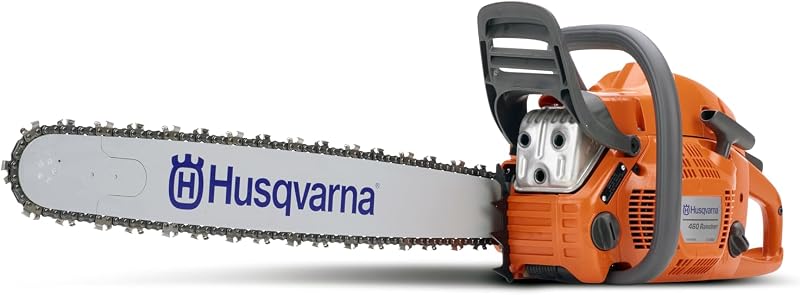
Pros
- Powerful 60.3-cc 3.6-hp X-Torq engine
- Accommodates up to a 24-inch bar
- Automatic adjustable oil pump
- Includes scrench and 50:1 fuel mix
Cons
- Heavier 13.2-pound dry chassis
- Larger footprint increases physical fatigue
View Husqvarna 460 Rancher on Amazon
Who Should Buy Each One
Choose the Husqvarna 450 Rancher If
- You primarily cut firewood, trim branches, and clean up seasonal storm damage on residential property.
- You want a lightweight 11.3-pound powerhead that prevents physical fatigue during extended cutting sessions.
- Your cutting tasks rarely involve timber exceeding 16 to 18 inches in diameter.
- You prefer an agile, compact saw with an asymmetrical handle and ergonomic soft inlays for easy maneuvering.
Choose the Husqvarna 460 Rancher If
- You need to fell standing trees and buck mature hardwood logs up to 24 inches thick in a single pass.
- You require a high-displacement 60.3-cc engine that delivers 3.6 hp to maintain torque through dense grain.
- You want an automatic adjustable oil pump to tailor bar lubrication for varying bar lengths and wood conditions.
- You value an out-of-the-box bundle that includes a scrench, guide bar, chain, and two-cycle fuel mix.
Final Verdict
For the vast majority of suburban landowners and seasonal woodcutters, the Husqvarna 450 Rancher represents the smartest overall pick. Its 50.2-cc X-Torq engine provides plenty of power to pull its 20-inch bar through standard firewood logs, while its 11.3-pound chassis preserves your energy and prevents back strain. The combination of Smart Start, LowVib isolation, and Air Injection filtration gives you a capable, professional-grade saw that is easy to manage across a full day of yard cleanup.
However, when your workload escalates to heavy-duty forestry, farm maintenance, and dropping large-diameter timber, the Husqvarna 460 Rancher takes over. The jump to 60.3 cc and 3.6 horsepower delivers the brute torque needed to spin a 24-inch chain through fibrous hardwoods without stalling. Factor in its adjustable oil pump, combined choke/stop switch, and side-mounted tensioner, and the 460 Rancher stands as the definitive choice for operators who prioritize cutting capacity and bar reach over lightweight portability.
FAQ
What is the exact weight difference between the Husqvarna 450 and 460 Rancher?
The Husqvarna 450 Rancher powerhead weighs 11.3 pounds, whereas the Husqvarna 460 Rancher weighs 13.2 pounds. That creates a 1.9-pound difference in bare engine weight. Once you account for the 460’s longer 24-inch guide bar, longer chain, and filled fluid tanks, the operational weight difference felt during cutting is even more noticeable.
Can the Husqvarna 450 Rancher run a 24-inch bar?
No, the Husqvarna 450 Rancher is not designed for a 24-inch bar. The manufacturer specifications recommend bar lengths between 13 inches minimum and 20 inches maximum. Attempting to fit a 24-inch bar would overload the 50.2-cc engine and lead to poor cutting performance and overheating. If you require a 24-inch cutting reach, choose the 460 Rancher.
Does the Husqvarna 450 Rancher have an adjustable oil pump?
The listing for the Husqvarna 450 Rancher does not specify an adjustable oil pump. By contrast, the Husqvarna 460 Rancher explicitly lists an automatic adjustable oil pump, allowing users to alter bar oil output depending on cutting conditions and bar length.
How do the engine sizes and horsepower ratings compare?
The Husqvarna 450 Rancher features a 50.2-cc two-cycle X-Torq engine producing 3.2 horsepower. The Husqvarna 460 Rancher steps up to a 60.3-cc two-cycle X-Torq engine producing 3.6 horsepower. That gives the 460 an advantage of 10.1 cc in displacement and 0.4 hp in output.
Are both chainsaws equipped with Husqvarna Air Injection and LowVib?
Yes, both models feature Husqvarna’s Air Injection centrifugal air cleaning system to expel large dust particles before they reach the air filter, as well as LowVib technology to dampen handle vibration during operation.
What accessories are included in the box with each saw?
The Husqvarna 450 Rancher listing includes the gas chainsaw and an owner’s manual. The Husqvarna 460 Rancher comes with the powerhead, a 24-inch bar, a chain, a 2.6-ounce bottle of 50:1 fuel mix, a fuel cap, a scrench, an operator manual, and a quick start guide.


