The deciding difference between the Milwaukee 2953-20 and the Milwaukee M18 Fuel Compact is their anvil mechanism and fastening focus: the 2953-20 uses a 1/4-inch hex collet designed for driving construction screws and fasteners at high speed, while the M18 Fuel Compact utilizes a 1/2-inch square friction ring anvil engineered to break loose and secure heavy mechanical bolts.
Woodworkers, framers, and general contractors should choose the 2953-20 for fast, lightweight driving in lumber and sheet metal. Automotive mechanics, machinery technicians, and maintenance professionals should choose the M18 Fuel Compact for high-breakaway torque on stubborn nuts and vehicle fasteners.


Milwaukee 2953-20 vs Milwaukee M18 Fuel Compact at a Glance
| Attribute | Milwaukee 2953-20 | Milwaukee M18 Fuel Compact |
|---|---|---|
| Tool Category | Cordless 1/4-Inch Hex Impact Driver | Cordless 1/2-Inch Square Impact Wrench |
| Drive Mechanism | 1/4-Inch Hex Collet with Single-Handed Insertion | 1/2-Inch Fixed Square Anvil with Friction Ring |
| Torque Rating | Up to 2,000 in-lb | Up to 250 ft-lb Breaking Torque (20 ft-lb listed) |
| Maximum Speed | 3,900 RPM | Not listed |
| Tool Length | 4.47 inches | 4.9 inches |
| Bare Tool Weight | 2.2 pounds | 2.4 pounds |
| Control Settings | 4-Mode Drive Control | Auto Shut-Off Mode and Bolt Removal Mode |
| Lighting System | Tri-LED Work Lights | Three High-Definition LEDs |
| Rated Power Output | 800 watts | Not listed |
| Best For | Carpentry, framing screws, and general construction | Automotive mechanics, machinery, and heavy bolting |
Fastener Attachment and Anvil Design
When comparing a Milwaukee hex driver vs compact impact wrench, the primary design divergence is how hardware mounts to the tool. The 2953-20 features a 1/4-inch hex drive collet equipped with single-handed bit insertion. This setup allows tradespeople to push standard 1/4-inch hex-shank driver bits, magnetic nut runners, or drilling accessories straight into the chuck without pulling back the outer sleeve. The bit clicks into place immediately, streamlining repetitive bit swaps during cabinetry, framing, and drywall installation.
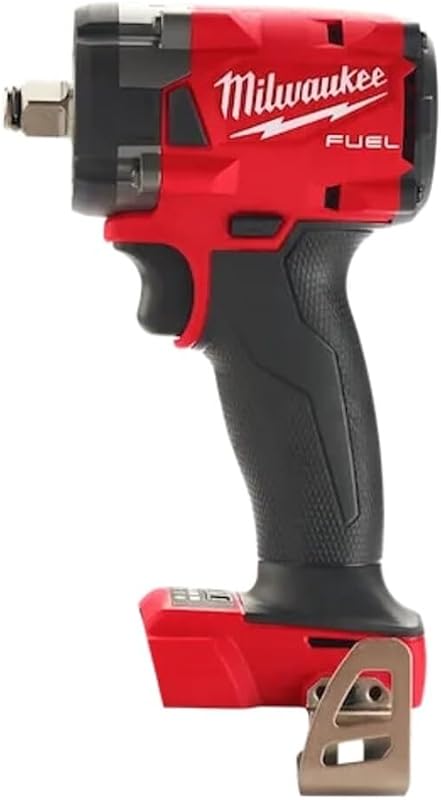
In contrast, the M18 Fuel Compact relies on an alloy steel 1/2-inch fixed square drive anvil fitted with a friction ring, often called a hog ring. This design is built exclusively for 1/2-inch impact sockets. The friction ring provides substantial outward pressure to hold heavy sockets securely during aggressive vibration while allowing the operator to yank sockets off and replace them by hand without needing detent pin tools. Exploring the milwaukee 2953-20 vs m18 fuel dynamic demonstrates why using socket adapters on a hex driver introduces excessive play and wobbling that diminishes working efficiency.
Using the wrong anvil for your primary trade introduces continuous frustration. Running heavy sockets on the 2953-20 requires a 1/4-inch hex-to-square adapter that can twist or snap under high impact loads. Conversely, fitting a 1/2-inch square-to-hex adapter on the M18 Fuel Compact adds unnecessary length and runout that makes driving standard wood screws sloppy and awkward.
Edge: Tie. The 2953-20 excels at quick-release screwdriving bits, while the M18 Fuel Compact is superior for mounting impact sockets directly.
Torque Output and Nut-Busting Capability
Torque determines how easily a tool seats structural fasteners or frees seized, rusted hardware. The Milwaukee 2953-20 torque spec is rated at up to 2,000 in-lb of rotational force, which equals approximately 166.7 ft-lb. This rotational force is delivered via rapid, high-frequency rotational blows designed to continuously pull long wood screws, structural timber lags, and self-drilling metal fasteners into dense materials without stalling or transferring wrist-wrenching kickback to the user.
The M18 Fuel Compact provides a completely different impact profile powered by its Powerstate brushless motor, producing up to 250 feet of breaking torque, alongside an item torque spec of 20 ft-lb in the product data. This Milwaukee M18 Fuel Compact breaking torque is calibrated to fracture rust bonds, road scale, and thread lock on automotive suspension bolts, lug nuts, and industrial machinery hardware. The internal hammer and anvil mass in the impact wrench strikes with broader kinetic impact, designed specifically to jar stuck fasteners loose rather than driving long threads continuously.
Deciding between the Milwaukee 2953-20 or M18 Fuel Compact for automotive work reveals the true limitation of impact drivers. While 2,000 in-lb sounds impressive on paper, an impact driver’s smaller hammer mechanism tends to bounce off heavy, frozen bolts rather than breaking them free. Those analyzing cordless power across brand lines can examine the milwaukee 2801-20 vs 2903-20 to see how internal motor engineering changes overall twisting strength under demanding jobsite conditions.
Edge: Milwaukee M18 Fuel Compact delivers up to 250 feet of breaking torque to conquer seized hardware that causes impact drivers to stall.
Rotational Speed and Fastening Efficiency
Rotational speed dictates how quickly a tool sinks fasteners once the threads catch. The 2953-20 operates at an impressive maximum rotational speed of 3,900 RPM backed by an 800-watt power output. This high-speed rotation makes the tool exceptionally productive when sinking hundreds of subfloor screws, hanging drywall sheets, or assembling composite decking. The listing also notes a 0.5-inch drilling capacity in both wood and metal, meaning that high RPM can drive spade bits and twist drill bits cleanly through framing studs and sheet metal.
The product listing for the M18 Fuel Compact does not specify its maximum rotational speed, focusing instead on bolt management modes and fastening precision. Impact wrenches run at substantially lower rotational speeds than impact drivers because high RPM is counterproductive when handling heavy threaded nuts and machine bolts. High rotational speeds on mechanical fasteners increase the danger of cross-threading, galling threads, or spinning nuts off so rapidly that they drop into hard-to-reach vehicle components.
When selecting the Milwaukee 2953-20 or M18 Fuel Compact for construction environments, speed is paramount. Sinking multi-inch timber screws using a low-speed impact wrench takes noticeably longer per fastener, dragging down production across a long workday. Tradespeople evaluating broader motor capabilities often cross-reference the milwaukee 2903-20 vs m18 fuel drill/driver comparison to understand how dedicated RPM curves support various building materials.
Edge: Milwaukee 2953-20 delivers a rapid 3,900 RPM motor speed that sinks construction fasteners substantially faster.
Physical Dimensions and Handling Comfort
Handling and maneuverability become critical when working overhead, on scaffolding, or inside cramped engine bays. The 2953-20 measures an exceptionally compact 4.47 inches in overall length and weighs just 2.2 pounds for the bare tool. This ultra-short profile allows carpenters and electrical installers to slip the tool between narrow stud bays, floor joists, and small cabinet frames. The included metal belt clip keeps the lightweight driver close at hand without pulling down on work pants.
The M18 Fuel Compact measures 4.9 inches in length and weighs 2.4 pounds. While it is 0.43 inches longer and 0.2 pounds heavier than the impact driver, it remains one of the smallest tools in its power class. Mechanics working on steering racks, brake caliper brackets, or tight engine compartments benefit greatly from this compact 4.9-inch snout, which squeezes into wheel wells where mid-torque and high-torque impact wrenches cannot enter.
For tradespeople carrying a tool for eight hours straight, the 2953-20 holds an ergonomic advantage. Saving 0.2 pounds and almost half an inch of head length reduces forearm fatigue during repetitive ceiling installations. Similar ergonomic trade-offs are explored in the milwaukee 2801-20 vs 2904-20 overview, illustrating how small reductions in tool length improve leverage and balance.
Edge: Milwaukee 2953-20 is shorter at 4.47 inches and lighter at 2.2 pounds, minimizing operator fatigue during prolonged overhead work.
Electronic Control Modes and Workspace Illumination
Advanced electronics give modern fastening tools the flexibility to tackle delicate tasks without damaging workpieces. The 2953-20 incorporates a 4-mode drive control interface. This system lets users select different speed and power output stages, allowing delicate cabinet hinges or small machine screws to be driven at lower settings without stripping threads, while preserving maximum power for heavy structural lag screws.
The M18 Fuel Compact approaches digital control through specialized bolting intelligence. It features an automatic shut-off mode that prevents over-tightening by applying no more than 6 m. couple of torque, allowing technicians to snug critical bolts without stretching threads before finishing with an exact manual torque wrench. Furthermore, it incorporates a bolt removal mode that monitors rotational resistance; the tool breaks the bolt loose at full power and then slows down considerably once the bolt is loosened, preventing nuts from flying off studs and getting lost.
Both models excel in workspace visibility. The 2953-20 features Tri-LED lights encircling the hex collet to eliminate bit shadows. The M18 Fuel Compact features three high-definition LEDs that illuminate dark vehicle chassis. In any thorough Milwaukee 2953-20 review or Milwaukee M18 Fuel Compact review, workspace lighting earns praise, but the M18 Fuel Compact provides superior fastener-protection electronics for automotive tasks. Readers interested in digital tool management can read the milwaukee 2904-20 vs m18 fuel one-key analysis to see how electronic regulation protects fasteners.
Edge: Milwaukee M18 Fuel Compact provides superior automated fastener protection with its dedicated auto shut-off and bolt removal modes.
Pros and Cons
Milwaukee 2953-20

Pros
- 2,000 in-lb maximum torque output
- High-speed 3,900 RPM motor
- Compact 4.47-inch head length
- Lightweight 2.2-pound bare tool body
- Single-handed 1/4-inch hex bit insertion
Cons
- Hex collet unsuited for heavy impact sockets
- Drilling capacity capped at 0.5 inches
View Milwaukee 2953-20 on Amazon
Milwaukee M18 Fuel Compact
Pros
- Up to 250 ft-lb breaking torque
- Dedicated 1/2-inch square friction ring anvil
- Automatic shut-off mode prevents overtightening
- Bolt removal mode slows loosened hardware
- Powerstate brushless motor construction
Cons
- Longer 4.9-inch overall length
- Heavier 2.4-pound tool weight
- Requires adapter to use standard hex bits
View Milwaukee M18 Fuel Compact on Amazon
Who Should Buy Each One
Choose the Milwaukee 2953-20 If
- Your everyday work revolves around driving wood screws, framing fasteners, and sheet metal hardware.
- You need blisteringly fast 3,900 RPM rotation to maximize driving speed on construction sites.
- You demand the lightest (2.2 lbs) and shortest (4.47 in.) tool for all-day overhead fastening.
- You use standard 1/4-inch hex-shank bits and want quick single-handed bit insertion.
Choose the Milwaukee M18 Fuel Compact If
- Your primary duties involve automotive repair, vehicle suspensions, brake work, and engine bay maintenance.
- You require up to 250 ft-lb of breaking torque to shock stubborn, rusted nuts and bolts free.
- You regularly work with 1/2-inch square impact sockets and need a secure friction ring anvil.
- You want automatic shut-off and bolt removal modes to stop over-torquing and prevent dropped nuts.
Final Verdict
For general contractors, woodworkers, remodelers, and tradespeople who handle building materials, the Milwaukee 2953-20 is the clear winner. Its combination of 2,000 in-lb of torque, 3,900 RPM speed, 4-mode drive control, and a compact 4.47-inch body makes it the ideal tool for driving screws all day long. If you are asking is Milwaukee 2953-20 worth it for carpentry, deck building, and general framing, the rapid cycle times and lightweight 2.2-pound chassis provide immediate value on every job.
However, when the work order shifts to breaking loose seized nuts, suspension hardware, and machinery bolts, the M18 Fuel Compact takes the crown. Its 1/2-inch square anvil, 250 ft-lb breaking torque rating, and smart bolt removal profile solve mechanical problems that an impact driver simply cannot manage. If your daily environment involves automotive bays, farm equipment, or industrial maintenance, asking is Milwaukee M18 Fuel Compact worth it results in an easy affirmative, as its purpose-built bolting features protect both your hardware and your working pace.
FAQ
Can the Milwaukee 2953-20 remove car lug nuts
While the 2953-20 generates up to 2,000 in-lb of torque (around 166.7 ft-lb), it is not recommended for vehicle lug nuts. Lug nuts frequently seize due to road grime, corrosion, and overtightening, demanding heavy shock forces to break free. Using an impact driver with a 1/4-inch hex-to-square adapter can snap the adapter and strain the motor. The M18 Fuel Compact, with its 250 ft-lb breaking torque and 1/2-inch square anvil, is specifically built for that workload.
Can the Milwaukee M18 Fuel Compact drive wood screws
The M18 Fuel Compact can technically drive wood screws if fitted with a 1/2-inch square to 1/4-inch hex adapter, but it is not ideal for the job. The tool is heavier, longer, and lacks the 3,900 RPM speed of the 2953-20, making screw installation slow. Additionally, square-to-hex adapters introduce bit wobble that makes driving drywall and deck screws clumsy.
What is the difference between an impact driver and an impact wrench
An impact driver uses a 1/4-inch internal hex collet designed for driver bits, operating at high rotational speeds to sink screws into building materials. An impact wrench uses a heavy square drive anvil (such as 1/2-inch) designed to fit impact sockets. Impact wrenches deliver heavier, lower-speed rotational blows engineered to tighten and loosen mechanical nuts and bolts.
Does the Milwaukee 2953-20 have a brushless motor
The Milwaukee 2953-20 listing specifies an 18V battery-powered motor delivering 800 watts of power and 3,900 RPM. This motor provides advanced performance, thermal efficiency, and 4-mode electronic drive control for demanding commercial fastening tasks.
What is the purpose of the friction ring on the Milwaukee M18 Fuel Compact
The friction ring, or hog ring, is a small split-steel ring mounted on the tip of the 1/2-inch square anvil. It applies outward tension against the inside of an impact socket, keeping the socket firmly attached during heavy vibration while still permitting the operator to pull the socket off and swap sizes quickly by hand without using specialized pin-release tools.
Which tool is better for residential construction and remodeling
The 2953-20 is far better suited for residential construction and home remodeling. Tasks like hanging drywall, building stud walls, installing cabinetry, and securing subfloors require driving thousands of screws. The 2953-20 provides the rapid 3,900 RPM speed, 4.47-inch compact clearance, and light 2.2-pound weight necessary to work continuously without wrist and shoulder fatigue.


