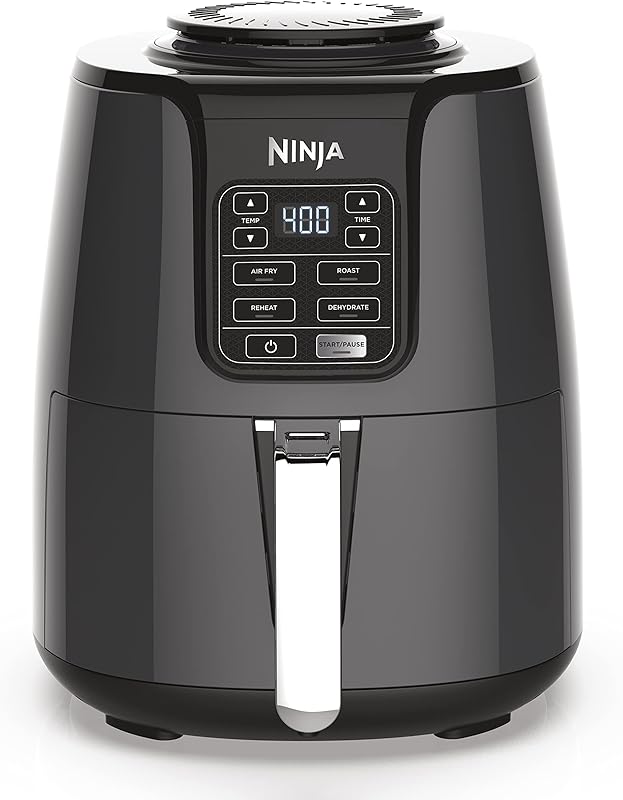
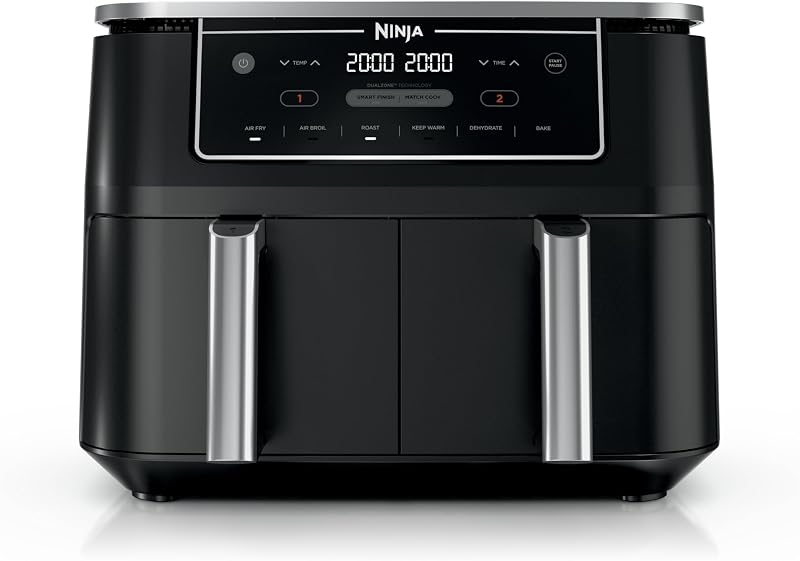
The core difference between the Ninja AF101 and the Ninja DZ302 centers on basket architecture and volume: the AF101 uses a single 4-quart basket built for compact, single-dish cooking, while the DZ302 provides a split 10-quart dual-zone layout engineered to cook two separate foods at different temperatures simultaneously. This design distinction governs how much food you can prepare in one session, how you coordinate entrees and sides, and how much counter space the appliance occupies permanently.
Choose the Ninja AF101 if you cook primarily for one or two people and need a lightweight appliance that preserves kitchen counter space. Choose the Ninja DZ302 if you feed a busy household and want to finish complete, multi-component meals at the exact same moment without sequential batching.


Ninja AF101 vs Ninja DZ302 at a Glance
| Feature | Ninja AF101 | Ninja DZ302 |
|---|---|---|
| Total Capacity | 4 Quarts | 10 Quarts (2 x 5 Quarts) |
| Basket Configuration | Single independent basket | Dual independent baskets |
| Cooking Functions | 4 (Air Fry, Roast, Reheat, Dehydrate) | 6 (Air Fry, Air Broil, Roast, Keep Warm, Dehydrate, Bake) |
| Temperature Range | 105°F to 400°F | 105°F to 450°F |
| Wattage | 1550 Watts | 1690 Watts |
| Dimensions (D x W x H) | 13.6″D x 11″W x 13.3″H | 17.1″D x 14.65″W x 12.87″H |
| Weight | 10.6 lbs | 18.7 lbs |
| Basket Construction | Ceramic-coated aluminum | Plastic exterior with nonstick crisper plates |
| Synchronization Tech | Not listed | Smart Finish, Match Cook, IQ Boost |
| Best For | Individuals, couples, and small kitchens | Families and multi-dish meal prep |
Capacity and Basket Architecture
The operational gap between these two models starts with usable cooking volume. The Ninja AF101 provides a single 4-quart basket designed to hold roughly 2 pounds of French fries or a cluster of chicken breasts in a stacked arrangement. Because hot air must circulate freely around the food via convection currents, filling this round 4-quart cavity to its upper perimeter restricts airflow, which means denser ingredients must be shaken repeatedly during the cooking cycle to achieve an even crisp. When weighing the ninja af101 vs af141, the AF101 remains the benchmark for entry-level single-basket geometry.
By contrast, the Ninja DZ302 houses an extra-large 10-quart capacity separated into two identical 5-quart baskets. Evaluating the Ninja AF101 vs DZ302 capacity highlights more than just a 2.5-fold increase in raw volume; it fundamentally alters pan surface area. The DZ302 can accommodate up to 8 pounds of chicken wings across its two cavities, or hold a whole 6-pound chicken in one zone while the secondary zone roasts vegetables. Each 5-quart basket on the DZ302 actually offers more volume on its own than the entire AF101 basket, providing ample horizontal surface area so food lies flat rather than piling up.
For cooks trying to prepare an entire family dinner, this architectural variation determines whether cooking is an ongoing chore or a single operation. Preparing a main dish and a vegetable side in the AF101 requires consecutive batches, meaning the first item sits cooling on the counter while the second cooks. The dual-basket setup of the DZ302 removes this friction entirely by running independent chambers simultaneously.
Edge: Ninja DZ302, thanks to its massive 10-quart total capacity and twin 5-quart compartments that eliminate back-to-back cooking batches.
Dual-Zone Cooking vs Single-Basket Workflow
The defining technological separation in this comparison is DualZone Technology. On the DZ302, each 5-quart cooking basket operates with its own cyclonic fan and dedicated rapid heating element. Ninja pairs this hardware with two smart software modes: Smart Finish and Match Cook. Smart Finish allows you to program two entirely different cooking modes, temperatures, and runtimes across the two baskets-such as roasting salmon at 375°F for 15 minutes in Zone 1 while crisping potato wedges at 425°F for 25 minutes in Zone 2-and automatically synchronizes the heating cycles so both compartments finish cooking at the precise same moment.
When cooking large volumes of a single item, the DZ302 uses Match Cook to instantly duplicate the cooking program and temperature from Zone 1 over to Zone 2 with a single button press. When neither synchronization setting is required, the built-in IQ Boost feature dynamically allocates power between the two baskets to cook unequal loads as quickly as possible. When comparing the ninja af101 vs dz201 or exploring Ninja DZ302 dual zone vs AF101 capabilities, the practical impact of automated timing control is immediately obvious.
The Ninja AF101 does not include zone synchronization because it possesses only a single heating element and fan. Operating the AF101 requires manual meal planning: you must calculate which dish retains heat better, calculate carryover cooking times, and often re-warm the earlier component once the second completes. For shoppers questioning is Ninja DZ302 worth it, the convenience of serving two completely different, piping-hot dishes simultaneously provides a compelling justification.
Edge: Ninja DZ302, because its Smart Finish, Match Cook, and IQ Boost systems completely remove the timing headaches inherent to single-basket cooking.
Cooking Versatility and Preset Functions
Preset cooking functions dictate how broadly an air fryer can substitute for full-sized kitchen appliances. The AF101 is configured as a 4-in-1 cooker, offering Air Fry, Roast, Reheat, and Dehydrate presets. Its digital touch panel manages temperatures between 105°F and 400°F. The 105°F baseline is low enough to gently remove moisture for homemade jerky and dried fruit chips, while the 400°F ceiling handles standard roasting and air-crisping needs. However, the lack of an intense broiling mode limits surface browning speed on thicker meats.
The DZ302 broadens your options with a 6-in-1 control board that includes Air Fry, Air Broil, Roast, Keep Warm, Dehydrate, and Bake. Its operational temperature span runs from 105°F up to 450°F, with the specification sheet noting a minimum setting that reaches 100°F. The elevated 450°F top-end temperature makes a noticeable difference when searing proteins, melting cheese toppings, or generating a heavy blister on vegetables. Furthermore, the dedicated Keep Warm setting ensures food stays ready to serve if mealtime is delayed, a utility completely missing from the AF101 control panel.
A rigorous Ninja DZ302 review reveals that having Bake and Air Broil as discrete modes gives you finer control over convection air speeds. Broiling directs fierce overhead heat to brown without drying out interiors, whereas the AF101 requires you to use the standard Air Fry setting at 400°F for all high-heat applications. Shoppers comparing the ninja af161 vs dz302 will recognize that the DZ302 offers a noticeably wider functional ceiling than basic four-button units.
Edge: Ninja DZ302, offering six cooking modes, a Keep Warm feature, and a higher 450°F upper heat threshold.
Countertop Footprint and Kitchen Storage
While cooking capacity favors the dual-zone unit, physical dimensions tell the opposite story. The Ninja AF101 measures 13.6 inches deep, 11 inches wide, and 13.3 inches high, weighing a manageable 10.6 pounds. Its slender 11-inch width slides easily under standard overhead kitchen cabinets and leaves substantial prep space on cramped countertops. When dinner is done, lifting and storing a 10.6-pound appliance inside a pantry or deep cupboard is virtually effortless.
The Ninja DZ302 demands far more territory. Measuring 17.1 inches deep, 14.65 inches wide, and 12.87 inches high, it claims nearly 15 inches of linear counter width and over 17 inches of depth. At 18.7 pounds, the DZ302 is not an appliance you will want to haul out of a low cabinet on a daily basis; it is designed to claim a permanent workstation on your counter. When deciding between the ninja af101 vs dz071 or weighing the Ninja AF101 or DZ302 for small kitchen layouts, these extra 3.65 inches of width and 3.5 inches of depth can quickly overwhelm studio apartments, RV galleys, or compact urban condos.
If counter space is strictly constrained, the DZ302 can crowd out cutting boards, coffee makers, and prep zones. The AF101 delivers functional air frying without demanding that you rearrange your entire kitchen layout to accommodate its footprint.
Edge: Ninja AF101, measuring significantly narrower, shallower, and over 8 pounds lighter for easy maneuvering and storage.
Power Consumption and Heating Dynamics
Thermal efficiency depends heavily on the relationship between electrical wattage and chamber volume. The AF101 draws 1550 watts through a standard 120-volt outlet to heat its compact 4-quart chamber. Distributing 1550 watts across a modest cavity creates an intense thermal environment, allowing the rapid air circulation system to achieve target temperatures quickly and recover heat rapidly after the basket is opened.
The DZ302 pulls 1690 watts, which is an increase of only 140 watts despite encompassing an extra 6 quarts of internal volume. When both 5-quart zones operate concurrently at peak output, that 1690-watt budget is divided between two heating elements and two cyclonic fans. Ninja mitigates this limitation via IQ Boost, which channels wattage to where it is needed most, but heating 10 quarts of space with 1690 watts naturally delivers less thermal concentration per cubic inch than pumping 1550 watts into a 4-quart bucket. Exploring the ninja af141 vs dz302 shows similar wattage allocations across expanded cooking areas.
For small, quick snacks like a single serving of frozen fries or reheating pizza slices, the AF101 heats up rapidly and cycles heat efficiently without pulling maximum line power. The DZ302 provides sufficient cooking power across both zones, but the AF101 concentrates its energy into a much tighter space.
Edge: Ninja AF101, due to its superior ratio of electrical wattage to internal cavity volume.
Cleaning, Materials, and Maintenance
Daily upkeep often determines whether an appliance gets used regularly or stays neglected. The Ninja AF101 stands out for its basket construction: both the removable 4-quart basket and the crisper plate are made of aluminum finished with a nonstick ceramic coating. Ceramic coatings resist flaking and provide an exceptionally slick surface that releases baked-on oils without aggressive scrubbing. Furthermore, both the basket and crisper plate are rated as dishwasher safe, while the smooth grey exterior wipes clean with a damp cloth.
The DZ302 features two separate 5-quart baskets, two nonstick crisper plates, and a black exterior composed of metal and plastic. The manufacturer notes that the crisper plates are dishwasher safe, while the baskets are described as easy-to-clean. Hand-washing two separate 5-quart baskets after every meal consumes considerably more sink space than cleaning the compact basket of the AF101. Additionally, loading two deep baskets and two crisper plates into a residential dishwasher takes up an entire lower rack.
Any comprehensive Ninja AF101 review must emphasize the simplicity of cleaning a single ceramic-coated assembly. With fewer parts to wash, dry, and reassemble, the AF101 requires significantly less post-dinner maintenance than maintaining the dual-chamber hardware of the DZ302.
Edge: Ninja AF101, thanks to its ceramic-coated basket and crisper plate that take up half the sink and dishwasher space of dual baskets.
Pros and Cons
Ninja AF101
Pros
- Compact countertop footprint
- Ceramic-coated aluminum basket
- Lightweight at 10.6 pounds
- Efficient 1550-watt power draw
Cons
- Single 4-quart basket capacity
- Caps at 400°F maximum temperature
- Requires sequential batch cooking
Ninja DZ302
Pros
- Generous 10-quart total capacity
- Two independent 5-quart cooking zones
- Reaches higher 450°F maximum temperature
- Smart Finish and Match Cook sync features
- 6 versatile cooking presets
Cons
- Demands substantial counter space
- Heavy 18.7-pound chassis
- Higher 1690-watt power draw
Who Should Buy Each One
Choose the Ninja AF101 If
- You cook primarily for one or two people and usually prepare single-dish snacks or modest meals.
- Your kitchen features limited countertop area or low hanging cabinets where an extra-wide appliance cannot live permanently.
- You prefer ceramic-coated cooking surfaces over conventional nonstick coatings.
- You want a lightweight machine that you can lift, move, and store in a cupboard with minimal physical effort.
Choose the Ninja DZ302 If
- You regularly prepare meals for a family of three or more and need to produce substantial volume in a single session.
- You want to serve an entree and a side simultaneously without managing staggered cooking times or reheating food.
- You require a high-heat 450°F cooking ceiling for crisping wings, searing meats, or intense air-broiling.
- You plan to leave your air fryer on the countertop full-time and have at least 15 inches of horizontal width to spare.
Final Verdict
Choosing between the Ninja DZ302 vs AF101 comes down to household scale versus countertop real estate. For households feeding three or more people, the Ninja DZ302 is the definitive pick. Its 10-quart volume, split-basket versatility, and Smart Finish synchronization fundamentally change dinner preparation, allowing you to prepare two distinct foods with disparate cooking parameters and serve them hot at the exact same moment. The addition of a 450°F maximum temperature and six preprogrammed cooking modes gives it the cooking flexibility required to handle everything from roast dinners to game-day appetizers.
However, if you are evaluating the Ninja AF101 or DZ302 for family cooking when counter space is at an absolute premium, or if you cook exclusively for yourself or a partner, the Ninja AF101 is the smarter acquisition. It delivers 1550 watts of rapid convection heat in an efficient 4-quart ceramic-coated basket, requires a fraction of the cleanup effort, and occupies an unobtrusive footprint on your counter. While the DZ302 wins on raw capacity and synchronization features, the AF101 remains a benchmark for streamlined, single-basket efficiency.
FAQ
Can the Ninja DZ302 cook two different foods at different temperatures at the same time?
Yes. The Ninja DZ302 features two independent 5-quart cooking zones, each equipped with its own heating element and convection fan. You can adjust the temperature and cooking function on each side independently, and utilize the Smart Finish feature to ensure both baskets complete their cycles at the exact same time.
Can you fit a whole chicken in the Ninja AF101?
The 4-quart basket of the Ninja AF101 is generally too compact for a whole standard roasting chicken. It is designed to accommodate up to 2 pounds of French fries, small roasts, or cut poultry pieces. The Ninja DZ302, by contrast, is specified to accommodate up to a 6-pound whole chicken in one of its 5-quart zones.
Which model is better for small kitchens or apartments?
The Ninja AF101 is much better suited for small kitchens. It measures only 11 inches wide and 13.6 inches deep, taking up significantly less counter real estate than the DZ302, which measures 14.65 inches wide and 17.1 inches deep. The AF101 is also over 8 pounds lighter, making it easy to store in a cupboard when not in use.
Do both air fryers feature dishwasher-safe parts?
The Ninja AF101 includes a dishwasher-safe ceramic-coated basket and crisper plate. For the Ninja DZ302, the listing specifies that the two nonstick crisper plates are dishwasher safe, while the baskets are designated as easy-to-clean.
Does the Ninja DZ302 require you to run both baskets at once?
No, you do not have to run both baskets. You can use a single 5-quart basket on the Ninja DZ302 for small meals or quick snacks without turning on the second zone, which helps conserve energy when cooking small portions.
What is the difference between Smart Finish and Match Cook on the DZ302?
Smart Finish coordinates two different cooking settings (different times, temperatures, or functions) across the two baskets so that both baskets finish cooking at the exact same moment. Match Cook copies the settings from Zone 1 directly onto Zone 2, allowing you to use the full 10-quart capacity for a single large batch of food with identical cooking parameters.


