The core difference that decides the choice between the Noctua NF-A12x25 and the Arctic P14 is frame dimension coupled with speed governance: Noctua delivers a high-precision 120mm platform molded from Sterrox liquid-crystal polymer with 4-pin pulse-width modulation, whereas Arctic provides an expanded 140mm footprint focused on raw swept surface area managed through a traditional 3-pin header interface.
Builders needing precision thermal curve automation, specialized anti-vibration dampening, and compact chassis compatibility should choose the Noctua NF-A12x25. Builders requiring broad panel coverage to flood spacious mid-tower or full-tower enclosures with high air volume across 140mm brackets should select the Arctic P14.
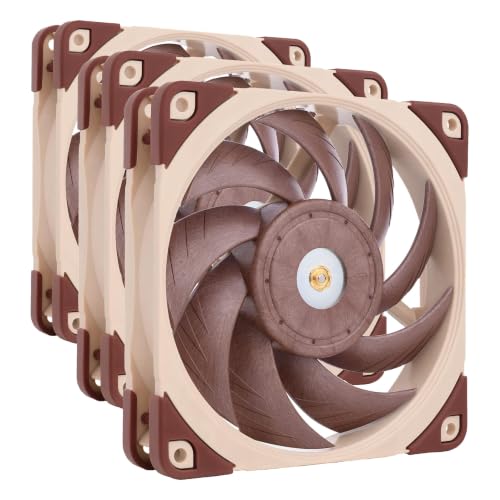

Noctua NF-A12x25 vs Arctic P14 at a Glance
| Attribute | Noctua NF-A12x25 | Arctic P14 |
|---|---|---|
| Frame Dimensions | 120 x 120 x 25 mm | 140 x 140 x 27 mm |
| Connector Type | 4-Pin PWM | 3-Pin |
| Maximum Rotational Speed | 2000 RPM (1700 RPM with LNA) | 1700 RPM |
| Documented Airflow | Not listed | 72.8 CFM (123.76 m³/h) |
| Documented Static Pressure | Not listed | 2.40 mmH₂O |
| Acoustic Output | 22.6 dB(A) | 0.3 Sone |
| Impeller / Frame Material | Sterrox LCP with metal hub | Metal / standard polymer composite |
| Bearing Technology | Metal bearing shell | Fluid Dynamic Bearing with German alloy/lubricant |
| Included Accessories | Anti-vibration mounts, gasket, screws, extensions, Y-cable | Mounting screws |
| Warranty Coverage | 6 years | 6 years |
| Best For | Acoustic precision and radiator sealing in 120mm mounts | Broad surface intake and exhaust across 140mm brackets |
Chassis Mounting and Radiator Form Factor
The primary physical boundary when evaluating the 120mm Noctua vs 140mm Arctic is chassis accommodation. The NF-A12x25 measures precisely 120 x 120 x 25 mm, aligning with universal 120mm mounting holes found on nearly every modern PC chassis, compact mini-ITX enclosure, and standard liquid-cooling heat exchanger. Because 120mm remains the legacy baseline across the cooling market, the NF-A12x25 can populate tight front rails, bottom intakes, and rear exhaust slots where larger units simply cannot clear adjacent motherboard heatsinks or memory modules. Readers weighing smaller form-factor upgrades often compare standard 120mm alternatives like the noctua nf-a12x25 vs arctic p12 before stepping up in physical size.
In contrast, the P14 requires a dedicated 140mm mounting configuration, featuring outer measurements of 140 x 140 x 27 mm. That extra 20 mm in width and 2 mm in depth provides significantly more swept blade area, allowing the impeller to displace air across a much wider cross-section of your case interior. However, this extra mass prevents installation on strictly 120mm brackets or dual-120mm radiators. If an enclosure lacks native 140mm screw spacing, forcing the P14 into the build is physically impossible without custom bracket adapters. For builders with modular cases that support both standards, deciding whether to install the Noctua NF-A12x25 or Arctic P14 for case fan duties usually hinges on whether the goal is localized, high-velocity directional airflow or sweeping, low-resistance case ventilation.
Choosing between these two form factors determines your entire liquid cooling layout as well. When deciding on the Noctua NF-A12x25 or Arctic P14 for radiator configurations, the fan dimensions dictate whether you build around a 240mm/360mm radiator or a 280mm/420mm platform. Radiator fin arrays built for 140mm fans present roughly one-third more surface area than 120mm counterparts of equivalent length. The P14 directly covers these broader radiators without leaving dead zones along the outer fin edges, whereas the NF-A12x25 demands a 120mm-wide radiator core where its frame edges match the heat exchanger profile.
Edge: Arctic P14 because its larger 140mm swept footprint moves air across a wider intake zone inside modern enclosures with multi-size mounting brackets.
Speed Regulation and PWM Header Connectivity
The electrical interface is one of the starkest operational differences between these two cooling devices. The NF-A12x25 features a 4-pin PWM connector designed for precise, automated pulse-width modulation control directly from modern motherboard headers. Through PWM signaling, the system firmware or fan control software can modulate motor duty cycles down to fine percentages without reducing the core 12-volt supply line. Noctua also supplies a Low-Noise Adaptor inside the box, which hardware-caps the top rotational speed from 2000 RPM down to 1700 RPM for users who want a physical ceiling against aggressive thermal spikes.
The P14 utilizes a traditional 3-pin connector operating under fixed-speed engineering. The listing identifies it as a fixed-speed class fan rated at 1700 RPM on a standard 12V DC input, though it notes a low starting voltage of 2.1 volts. Managing a 3-pin fan requires DC voltage regulation via the motherboard BIOS, lowering the supplied voltage to decelerate the motor. However, DC voltage scaling alters motor torque, can prevent fans from spinning up reliably if dialed below their threshold, and cannot achieve the granular 1% duty-cycle increments delivered by 4-pin PWM logic. Those exploring high-pressure alternatives with differing wiring schemes often assess comparisons like the noctua nf-f12 vs arctic p14 to determine header compatibility.
For daily desktop operation, the NF-A12x25 grants superior speed agility. You can map silent, resting idle curves at minimal RPM during word processing or basic web browsing, then permit the fan to ramp smoothly toward 2000 RPM during intensive video encoding or gaming loads. The P14, running on its 3-pin connection, provides a consistent 400mm cable drop that makes perimeter routing straightforward, but it generally operates at or near its full 1700 RPM rotational velocity unless tied to an active DC voltage step-down header. Builders who value dynamic acoustic shifts based on core temperature sensors will immediately recognize the functional utility of the 4-pin PWM standard.
Edge: Noctua NF-A12x25 because its 4-pin PWM architecture enables continuous, dynamic motherboard fan curves down to low speeds without the torque instability of DC voltage drops.
Acoustic Profiles and Noise Optimization
Noise management represents a major factor in any Noctua NF-A12x25 review. The NF-A12x25 lists a maximum acoustic output of 22.6 dB(A) when rotating at its peak 2000 RPM. Noctua combats mechanical whine, blade resonance, and motor hum through an advanced aerodynamic approach. The fan integrates Flow Acceleration Channels along the suction side of the blades to smooth out turbulent air boundaries, alongside an Advanced Acoustic Optimisation (AAO) frame featuring integrated silicone anti-vibration pads at every corner. When evaluating NF-A12x25 vs P14 noise, Noctua also mitigates resonant chassis transfer by bundling an anti-vibration gasket that wraps the entire perimeter of the housing.
The P14 states an acoustic output of 0.3 Sone, leveraging a specialized 5-blade impeller profile designed specifically to minimize mechanical and turbulence frequencies at 1700 RPM. Sone ratings use a linear scale of perceived loudness, where 0.3 Sone translates to an exceptionally faint hum during standard desktop operation. Arctic pairs this blade profile with a quiet motor assembly and a Fluid Dynamic Bearing featuring an oil capsule developed in Germany to reduce frictional chatter. Those studying the brand’s larger and smaller options frequently cross-reference the arctic p12 vs p14 to track acoustic shifts across different fan blade spans.
However, the acoustic qualities diverge drastically when these fans are mounted flush against resistance. The rigid structural dampening of the NF-A12x25 prevents vibration migration into thin aluminum panels, keeping the Noctua NF-A12x25 noise level steady and predictable even behind restrictive dust filters. The P14 lacks rubberized dampening corners or perimeter gaskets in its basic packaging, meaning motor oscillations or blade frequencies can travel directly into the PC chassis sheet metal if screws are over-tightened. While the P14 runs quietly through open air, its structural mounting lacks the multi-tier isolation hardware included standard with Noctua.
Edge: Noctua NF-A12x25 because its integrated anti-vibration pads, perimeter radiator gasket, and 22.6 dB(A) ceiling produce a more controlled acoustic environment under load.
Static Pressure and Radiator Airflow Dynamics
Static pressure determines how effectively a fan pushes air through dense obstacles like water-cooling radiators, compact CPU heatsinks, or tightly meshed front intake filters. In any Arctic P14 review, static pressure stands front and center: the P14 explicitly specifies a high static pressure of 2.40 mmH₂O alongside a maximum airflow capacity of 72.8 CFM (123.76 m³/h). This pressure-optimised design concentrates air velocity into a tight, focused column, preventing the outward dispersion that degrades thermal transfer on thick radiator fins. Many builders researching static pressure compare Arctic against other quiet alternatives, such as the arctic p14 vs be quiet! silent wings 4, to gauge airflow resilience.
The manufacturer listing for the NF-A12x25 does not specify exact numerical values for CFM or mmH₂O, stating instead that its next-generation A-series engineering combines high airflow with high static pressure performance for heatsinks, AIO coolers, and radiators. What the listing does detail is the physical engineering used to generate that pressure: a record-tight 0.5mm tip clearance between the blade edges and the surrounding frame. In fluid mechanics, an ultra-small tip gap prevents air from escaping backward around the outer rim of the blades when pushing against high backpressure. This aerodynamic seal forces the entire air column forward through radiator fins rather than leaking uselessly off the blade tips.
When assessing Arctic P14 static pressure against the NF-A12x25, the debate comes down to published raw force versus microscopic engineering tolerance. The P14 relies on the broader physical mass of its 140mm curved blades to drive 72.8 CFM and 2.40 mmH₂O through restrictive radiators. The NF-A12x25 relies on rotational velocity up to 2000 RPM and its 0.5mm clearance barrier to stop backpressure losses on 120mm radiators. For setups utilizing massive 280mm or 420mm liquid cooling systems, the P14 covers the broader fin surface with proven static numbers, whereas the NF-A12x25 excels on dense 120mm, 240mm, and 360mm radiator arrays.
Edge: Arctic P14 because its verified 2.40 mmH₂O pressure rating and 72.8 CFM volumetric flow provide documented performance metrics for pushing air across high-resistance cooling fins.
Blade Construction, Bearing Mechanics, and Accessories
Material science is where the NF-A12x25 demonstrates remarkable mechanical specialization. The fan uses Sterrox liquid-crystal polymer (LCP) for its impeller. Sterrox provides immense tensile strength and an exceptionally low thermal expansion coefficient, which is precisely what enables the record-tight 0.5mm tip clearance. Standard plastics stretch and flex under centrifugal force at 2000 RPM, which would cause blades to strike the outer frame if built with a 0.5mm gap. To support this material, the NF-A12x25 incorporates a metal-reinforced hub and a metal bearing shell, resulting in an MTTF rating exceeding 150,000 hours and a 6-year manufacturer warranty. Builders exploring Noctua’s internal lineup frequently check the noctua nf-a12x25 vs nf-f12 to see how this Sterrox engineering differs from traditional molded fans.
The P14 utilizes a Fluid Dynamic Bearing (FDB) featuring an alloy and lubricant combination engineered in Germany. It includes an integrated oil capsule designed to eliminate lubricant leakage, offering a quiet operational lifespan that mirrors sleeve bearings while providing the extended endurance of ball bearings. The materials listing cites metal construction elements within its internal assembly. Like Noctua, Arctic backs the P14 with a full 6-year warranty, demonstrating strong confidence in the long-term reliability of its bearing assembly and motor coils across its 0 to 40 °C ambient operating range.
The bundled hardware drastically separates these two offerings. Noctua packs a massive suite of accessories with every unit: silicone anti-vibration mounts, standard fan screws, a dedicated silicone radiator gasket for airtight sealing, an extension cable, a 4-pin Y-cable for running two fans on one motherboard header, and the Low-Noise Adaptor. The P14 comes solely with basic mounting screws and its attached 400mm cable. For builders who need modular cabling, airtight radiator mating, or vibration-decoupling mounts right out of the box, Noctua provides a turnkey hardware package that Arctic does not match.
Edge: Noctua NF-A12x25 because of its exotic Sterrox LCP construction, reinforced metal hub, and comprehensive assortment of mounting and cabling accessories.
Pros and Cons
Noctua NF-A12x25

Pros
- Advanced Sterrox LCP impeller construction
- Ultra-tight 0.5mm blade tip clearance
- 4-pin PWM variable speed control
- Comprehensive accessory bundle with anti-vibration mounts
- Rated for over 150,000 hours MTTF
Cons
- Smaller 120mm swept area
- Listing omits exact CFM and pressure specs
View Noctua NF-A12x25 on Amazon
Arctic P14

Pros
- Large 140mm frame for broad airflow
- High 72.8 CFM maximum airflow capacity
- Documented 2.40 mmH2O static pressure rating
- Fluid Dynamic Bearing with sealed oil capsule
- Long 400mm integrated connection cable
Cons
- Fixed-speed 3-pin connector limits curve automation
- Lacks bundled anti-vibration pads and gaskets
Who Should Buy Each One
Choose the Noctua NF-A12x25 If
- You need automated 4-pin PWM speed curves to keep your system virtually silent at idle while ramping dynamically to 2000 RPM under load.
- You are cooling a 120mm, 240mm, or 360mm radiator and require an airtight perimeter gasket to eliminate static pressure blowback.
- You want complete isolation from chassis vibration using pre-installed rubberized frame corners and included silicone pull-through mounts.
- You build in compact small-form-factor enclosures where 140mm fans cannot physically clear memory modules, heat sinks, or chassis brackets.
Choose the Arctic P14 If
- Your chassis features 140mm mounting points and you want broad volumetric displacement totaling up to 72.8 CFM per intake position.
- You are configuring a 280mm or 420mm water-cooling loop that demands the documented 2.40 mmH₂O static pressure of a dedicated 140mm fan.
- You prefer a simplified 3-pin configuration with a 400mm continuous cable run to populate broad multi-fan panels.
- You want high-volume airflow across broad hard drive cages or open chassis chambers without requiring specialty vibration dampening pads.
Final Verdict
For most desktop builders seeking precision cooling, acoustic balance, and versatile hardware integration, the Noctua NF-A12x25 is the superior technical choice. Its 4-pin PWM functionality allows seamless fan-curve tailoring, while its Sterrox LCP impeller and 0.5mm tip clearance set a benchmark in fluid engineering. When combined with its modular cabling, anti-vibration gaskets, and a 6-year warranty, the NF-A12x25 delivers an uncompromising cooling solution for heatsinks, standard radiators, and high-performance exhaust slots.
The Arctic P14 wins when your build prioritizes physical displacement area across native 140mm intake bays and larger radiators. If you are outfitting a wide mid-tower or full-tower chassis with 140mm rails, the P14 delivers a verified 72.8 CFM and 2.40 mmH₂O of static pressure at a smooth 0.3 Sone profile. When an enclosure provides the space for 140mm fans and simple 3-pin motherboard headers are sufficient, the P14 sweeps massive volumes of fresh air that no 120mm fan can duplicate across identical frame dimensions.
FAQ
Can I mount the Arctic P14 onto a standard 120mm case bracket?
No, the Arctic P14 measures 140 x 140 x 27 mm and uses 140mm mounting hole spacing. It will not align with standard 120mm chassis mounting brackets or 120mm radiators unless you install an aftermarket adapter bracket that provides proper clearance.
How does the Noctua NF-A12x25 reduce noise when running at 2000 RPM?
The Noctua NF-A12x25 minimizes noise through its rigid Sterrox LCP blades, which eliminate high-speed flutter and resonance, alongside integrated Flow Acceleration Channels on the blades. It also utilizes an AAO frame with rubber anti-vibration pads to isolate the 22.6 dB(A) profile from the chassis.
Is Arctic P14 worth it for liquid cooling radiators?
The Arctic P14 is exceptionally well-suited for 280mm and 420mm radiators because it delivers 2.40 mmH₂O of static pressure and 72.8 CFM of airflow. Its pressure-optimised blade sweep pushes air cleanly through dense cooling fins across 140mm radiator brackets.
What does the Noctua Low-Noise Adaptor do?
The included Low-Noise Adaptor (LNA) physically restricts the maximum rotational velocity of the Noctua NF-A12x25 from 2000 RPM down to 1700 RPM. This lowers acoustic output and establishes an absolute ceiling on fan speed regardless of PWM signaling.
Does the Arctic P14 support 4-pin PWM fan headers?
The Arctic P14 model listed here features a 3-pin connector. While it can physically plug into a standard 4-pin motherboard header, it will operate as a 3-pin fan without PWM signaling, meaning any speed modulation must be handled via DC voltage control in your motherboard BIOS.
Why does Noctua use Sterrox LCP instead of standard plastic?
Sterrox liquid-crystal polymer possesses extreme tensile strength and minimal thermal expansion, which prevents the fan blades from stretching over time under centrifugal force. This structural rigidity allows Noctua to maintain an unprecedented 0.5mm clearance gap between the blade tips and frame.