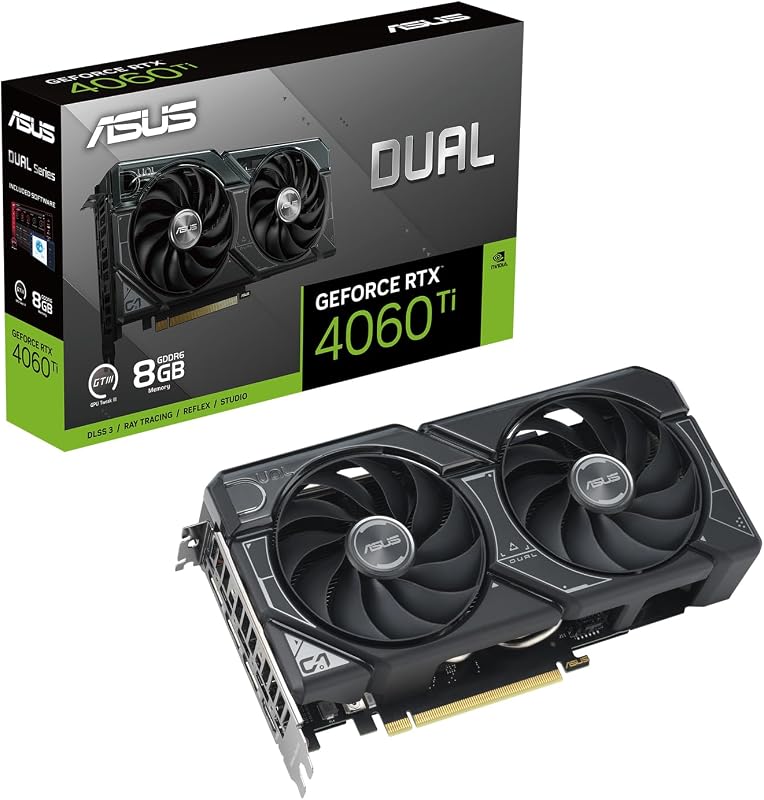
The decisive factor when choosing between these two enthusiast-tier graphics cards comes down to specialized graphical features versus raw memory capacity: the Nvidia RTX 4080 Super relies on Ada Lovelace architecture to deliver advanced DLSS 3 neural rendering and dedicated ray tracing hardware, while the AMD RX 7900 XTX provides an expansive 24GB GDDR6 frame buffer paired with next-generation DisplayPort 2.1 video connectivity.
Gamers who prioritize visual fidelity, AI-driven frame generation, and superior lighting simulations should choose the RTX 4080 Super. Users who need uncompromised memory bandwidth for high-resolution asset modding and forward-looking monitor connectivity should invest in the RX 7900 XTX.


Nvidia RTX 4080 Super vs AMD RX 7900 XTX at a Glance
| Attribute | Nvidia RTX 4080 Super | AMD RX 7900 XTX |
|---|---|---|
| GPU Architecture | NVIDIA Ada Lovelace | AMD RDNA 3 |
| Video Memory (VRAM) | 16 GB GDDR6X | 24 GB GDDR6 |
| Memory Bus Width | Not listed | 384-bit |
| Boost / OC Clock Speed | 2640 MHz (OC mode) / 2610 MHz (Default) | 2680 MHz (Boost) / 2510 MHz (Game) |
| Compute Units / Accelerators | 4th Gen Tensor Cores, 3rd Gen RT Cores | 96 Compute Units (with RT + AI Accelerators) |
| Display Outputs | HDMI 2.1a, DisplayPort 1.4a | 1x HDMI 2.1, 3x DisplayPort 2.1 |
| Power Connectors / Delivery | Adapter cable (1 to 3) | Triple 8-pin connectors (22 power phases) |
| Cooling Hardware | Axial-tech triple fans (+23% airflow) | Taichi 3X triple striped ring fans |
| Maximum Display Resolution | 7680 x 4320 pixels | 7680 x 4320 pixels |
| Best For | Ray tracing immersion and DLSS 3 upscaling | Massive VRAM capacity and high-bandwidth output |
VRAM Capacity and Memory Bandwidth
Memory capacity dictates how comfortably a modern graphics card handles high-resolution texture packs, ray tracing overhead, and complex compute environments. In the comparison of RTX 4080 Super vs RX 7900 XTX VRAM, the hardware profiles represent fundamentally different engineering philosophies. The ASRock AMD RX 7900 XTX features a massive 24GB pool of GDDR6 memory operating over an ultra-wide 384-bit bus, backed by 96MB of AMD Infinity Cache technology and 20 Gbps memory speeds. This substantial pool eliminates memory bottlenecks when running games with high-resolution assets or heavy visual modifications.
Conversely, the ASUS TUF Gaming Nvidia RTX 4080 Super provides 16GB of GDDR6X video memory. While GDDR6X delivers exceptionally rapid memory clock performance at 2640 MHz, the 16GB ceiling offers noticeably less overhead for extreme multi-tasking and high-resolution texture loading than AMD’s 24GB configuration. When analyzing a standard nvidia rtx 4070 ti super vs 4080 super upgrade path, the 16GB buffer remains standard on NVIDIA’s tier, ensuring stable 4K output today, but leaving less long-term headroom compared to AMD’s flagship.
For players running heavy simulation titles, custom texture packages, or productivity rendering tasks that demand massive frame buffers, the 8GB memory advantage on the Radeon card offers practical operating security. The 384-bit bus width on the RX 7900 XTX facilitates rapid data movement between the compute units and the memory cache, mitigating data congestion during high-demand sequences.
Edge: AMD RX 7900 XTX, because its 24GB VRAM buffer and 384-bit memory bus provide superior capacity and longevity for memory-heavy workloads.
Ray Tracing and AI Reconstruction
Ray tracing calculates authentic reflections, refractions, and global illumination by simulating physical light paths, which introduces significant computational drag on graphics hardware. In evaluating RTX 4080 Super vs RX 7900 XTX ray tracing capabilities, architectural focus plays a central role. The RTX 4080 Super incorporates NVIDIA’s dedicated 3rd Generation RT Cores alongside 4th Generation Tensor Cores, engineered to execute complex ray calculations and neural upscaling with minimal frame latency.
NVIDIA’s Ada Lovelace architecture utilizes DLSS 3 frame generation to produce up to 4x performance compared to brute-force rendering pipelines. By synthesizing entire frames through deep learning models rather than rendering every pixel through traditional rasterization, the RTX 4080 Super maintains fluid frame rates even when full path tracing is activated. Readers reviewing our nvidia rtx 4080 super vs 4090 comparison will note that Ada Lovelace maintains an architectural stronghold over real-time lighting tasks across the entire product tier.
The AMD RX 7900 XTX utilizes 96 RDNA 3 Compute Units, each embedded with dedicated Ray Tracing and AI Accelerators. While these accelerators represent an improvement over previous RDNA generations, the unified compute unit approach struggles to match the processing efficiency of NVIDIA’s specialized hardware when heavy ray tracing workloads are applied. Consequently, complex lighting algorithms place a heavier performance penalty on the Radeon card.
Edge: Nvidia RTX 4080 Super, courtesy of dedicated 3rd Generation RT Cores and 4th Generation Tensor Cores supporting DLSS 3 frame generation.
High-Resolution 4K and Ultra-Wide Output
Choosing between the RTX 4080 Super or RX 7900 XTX for 4K gaming involves examining not only the silicon itself, but also the physical output ports that transfer frames to your display. The ASRock RX 7900 XTX features cutting-edge display connectivity consisting of three DisplayPort 2.1 outputs and one HDMI 2.1 port. DisplayPort 2.1 delivers substantially higher display transmission bandwidth, which supports extreme refresh rates at 4K and 8K resolutions without relying on display stream compression.
The ASUS TUF RTX 4080 Super provides video outputs consisting of HDMI 2.1a and DisplayPort 1.4a connections, achieving a maximum resolution of 7680 x 4320 pixels. While this specification supports standard 4K high-refresh displays, the older DisplayPort 1.4a standard lacks the raw output bandwidth provided by DisplayPort 2.1. Gamers who invest in ultra-high-end monitors capable of dual 4K or extreme refresh rates may find DisplayPort 1.4a restrictive over time.
Examining an nvidia rtx 4070 super vs 4080 super tier progression highlights that NVIDIA opted to keep DisplayPort 1.4a throughout the 40 Series family. AMD took a forward-thinking step with RDNA 3 by integrating triple DisplayPort 2.1 connectors, giving the RX 7900 XTX a distinct mechanical advantage for cutting-edge multi-monitor arrays and future ultra-high-bandwidth gaming monitors.
Edge: AMD RX 7900 XTX, due to its inclusion of three DisplayPort 2.1 ports that support higher uncompressed bandwidth for future display hardware.
Core Architecture and Clock Speeds
Graphics processor clocks and underlying architectural design define baseline rendering throughput. The ASUS TUF RTX 4080 Super operates at a default boost clock of 2610 MHz, which pushes to 2640 MHz when engaging its software-configured OC mode. NVIDIA’s Ada Lovelace architecture emphasizes dense processing efficiency, extracting high performance per cycle while maintaining manageable power and thermal signatures.
The ASRock Taichi RX 7900 XTX features aggressive factory clock specifications, with a game clock rated at 2510 MHz and a boost clock extending up to 2680 MHz. Backing these clocks are 96 RDNA 3 compute units, operating in tandem with AMD’s dual-issue stream processor design. Readers comparing different market options, such as in our nvidia rtx 4070 ti vs 4080 super breakdown, will recognize that pure frequency must always be evaluated alongside architectural structure.
ASRock also integrates a physical Dual BIOS switch directly onto the RX 7900 XTX Taichi, allowing users to toggle instantly between high-performance overclocking profiles and quiet operational profiles without adjusting desktop software. While the RTX 4080 Super relies on high architectural efficiency, the RX 7900 XTX delivers higher listed clock ceilings and integrated hardware BIOS versatility.
Edge: AMD RX 7900 XTX, thanks to its higher 2680 MHz boost frequency and physical Dual BIOS functionality.
Thermal Hardware, Power Delivery, and Chassis Fit
Cooling hardware and power distribution systems dictate whether an enthusiast graphics card can sustain its advertised boost frequencies under heavy gaming sessions. The ASUS TUF Gaming RTX 4080 Super implements an updated triple-fan cooler featuring Axial-tech fans scaled up to generate 23% more airflow across the internal fin stacks. Power is delivered through an included 1-to-3 power adapter cable, and the package includes a dedicated TUF graphics card holder to eliminate chassis sag.
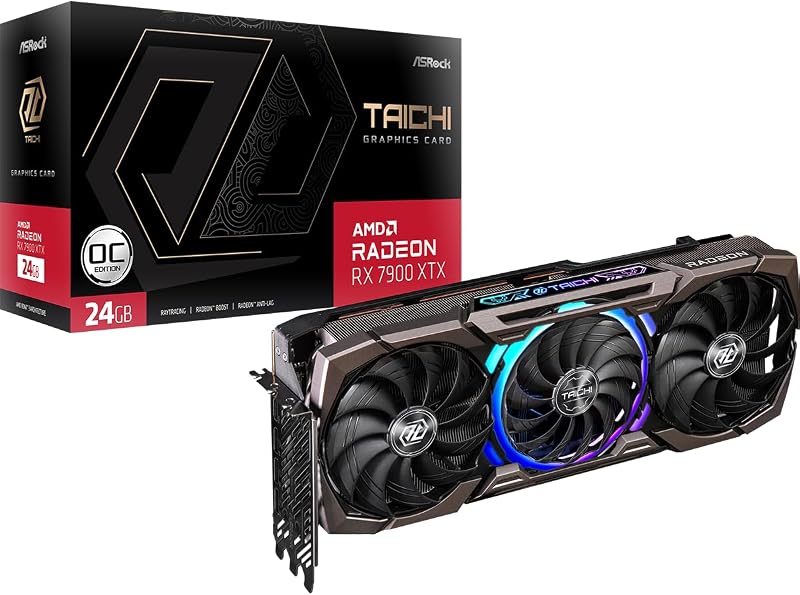
The ASRock RX 7900 XTX Taichi features an expansive thermal layout utilizing a Taichi 3X cooling design with 110/100/110mm striped ring fans, a reinforced metal frame, and an integrated ARGB backplate compatible with Polychrome SYNC. Power delivery on the Taichi card is exceptionally robust, utilizing a 22 power phase design fed by three standard 8-pin power connectors. This traditional triple 8-pin connector layout eliminates the need for proprietary adapter cables, working natively with standard power supplies.
Prospective buyers must note the physical footprint of these graphics cards. The ASRock RX 7900 XTX measures 16.55 inches in length by 9.5 inches in width according to its product specifications, requiring an extraordinarily spacious computer chassis to fit properly. While both cards incorporate high-grade three-fan cooling solutions and bundled support stands, the standard 8-pin power connectors of the RX 7900 XTX provide broad power supply compatibility, whereas the RTX 4080 Super features a more manageable overall profile for mid-tower cases.
Edge: Tie. Both cards feature premium triple-fan thermal designs and support hardware, trading off traditional power connectors against physical card size.
Pros and Cons
Nvidia RTX 4080 Super

Pros
- DLSS 3 frame generation support
- Dedicated 3rd Gen RT Cores
- High-efficiency Ada Lovelace architecture
- Axial-tech fans boost airflow by 23%
Cons
- Smaller 16GB VRAM capacity
- DisplayPort limited to version 1.4a
- Requires 1-to-3 power adapter
View Nvidia RTX 4080 Super on Amazon
AMD RX 7900 XTX
Pros
- Massive 24GB GDDR6 memory buffer
- Three DisplayPort 2.1 output ports
- 22 power phase delivery design
- Physical Dual BIOS profile switch
Cons
- Lacks DLSS 3 neural reconstruction
- Substantial 16.55-inch card length
- Requires three 8-pin power connectors
View AMD RX 7900 XTX on Amazon
Who Should Buy Each One
Choose the Nvidia RTX 4080 Super If
- You prioritize ray tracing visual fidelity in demanding games that utilize complex path tracing lighting engines.
- You want DLSS 3 frame generation to multiply frame output via dedicated 4th Generation Tensor Cores.
- You prefer an Ada Lovelace graphics card that uses an included 1-to-3 adapter cable rather than running three separate 8-pin power lines.
- You require a card with standard chassis clearance that avoids the massive 16.55-inch physical length of oversized alternatives.
Choose the AMD RX 7900 XTX If
- You want a massive 24GB GDDR6 frame buffer on a 384-bit memory bus for asset-heavy gaming and texture modding.
- You plan to connect next-generation high-refresh monitors using native DisplayPort 2.1 display outputs.
- You prefer standard triple 8-pin power connector inputs backed by a 22 power phase delivery design.
- You appreciate hardware-level customization through an integrated Dual BIOS profile switch and customizable ARGB backplate lighting.
Final Verdict
When weighing this enthusiast-class matchup, the Nvidia RTX 4080 Super emerges as the superior option for gamers focused on cutting-edge visual technologies and modern rendering pipelines. Its combination of 3rd Generation RT Cores, 4th Generation Tensor Cores, and DLSS 3 support ensures that visually complex games run smoothly with advanced lighting active. While its 16GB frame buffer is smaller than AMD’s offering, its architectural efficiency and neural rendering toolset make it the more complete graphical package for the vast majority of premium gaming setups.
The AMD RX 7900 XTX remains an exceptional choice for enthusiasts seeking raw hardware capacity, future display bandwidth, and traditional power connectivity. With its enormous 24GB GDDR6 memory buffer, 96MB of Infinity Cache, triple DisplayPort 2.1 connections, and robust 22 power phase design, the Taichi edition is tailor-made for high-resolution 4K asset loading and uncompressed multi-monitor workflows. If you value maximum VRAM capacity over proprietary ray tracing performance, the RX 7900 XTX is a compelling alternative.
FAQ
What are the primary display connection differences in an AMD RX 7900 XTX vs Nvidia RTX 4080 Super setup?
The AMD RX 7900 XTX features three DisplayPort 2.1 ports and one HDMI 2.1 port, providing high uncompressed bandwidth for next-generation 4K and 8K displays. In contrast, the ASUS TUF Nvidia RTX 4080 Super offers DisplayPort 1.4a and HDMI 2.1a ports, which support high resolutions but lack the raw bandwidth ceiling of the DisplayPort 2.1 standard.
How does the RTX 4080 Super vs RX 7900 XTX VRAM difference affect gaming longevity?
The RX 7900 XTX includes 24GB of GDDR6 memory on a 384-bit bus, whereas the RTX 4080 Super includes 16GB of GDDR6X memory. The additional 8GB on the RX 7900 XTX provides a substantial safety margin for extreme texture packs, heavy community modifications, and high memory allocation in 4K resolution titles over the coming years.
Which card is better when comparing RTX 4080 Super vs RX 7900 XTX ray tracing capabilities?
The Nvidia RTX 4080 Super delivers superior ray tracing performance due to its dedicated 3rd Generation RT Cores and 4th Generation Tensor Cores. NVIDIA’s DLSS 3 frame generation technology leverages machine learning to reconstruct frames and maintain fluid frame rates under heavy ray tracing loads, whereas the RX 7900 XTX experiences a more pronounced performance drop in ray-traced workloads.
How do you choose between the RTX 4080 Super or RX 7900 XTX for 4K gaming?
For native resolution rendering with maximum memory headroom, the RX 7900 XTX is advantageous due to its 24GB VRAM and DisplayPort 2.1 connectivity. However, for 4K titles utilizing advanced lighting, the RTX 4080 Super is often preferred because DLSS 3 allows the card to output high frame rates while preserving intricate image quality.
Should you pick the RTX 4080 Super or RX 7900 XTX for VR workloads?
Both graphics cards support maximum display resolutions up to 7680 x 4320 pixels for high-resolution virtual reality headsets. The RX 7900 XTX provides a larger 24GB VRAM buffer to cache massive virtual environments, while the RTX 4080 Super offers tensor-accelerated rendering and reliable driver pipelines across a wide variety of VR development platforms.
Is the RX 7900 XTX worth it for multi-monitor and ultra-wide setups?
The ASRock RX 7900 XTX is well suited for expansive multi-display arrangements because it features three dedicated DisplayPort 2.1 connections alongside an HDMI 2.1 port. This setup delivers the necessary transmission bandwidth to drive multiple high-resolution, high-refresh panels simultaneously without encountering display protocol bottlenecks.
Is the RTX 4080 Super worth it over competing high-end alternatives?
The RTX 4080 Super is worth serious consideration for gamers who demand access to modern rendering features like DLSS 3 neural upscaling, refined power efficiency, and industry-leading ray tracing hardware. Similar to trends seen in our nvidia rtx 4070 super vs amd rx 7900 gre analysis, NVIDIA’s proprietary feature stack adds tangible value for gamers seeking maximum fidelity in visually intensive titles.