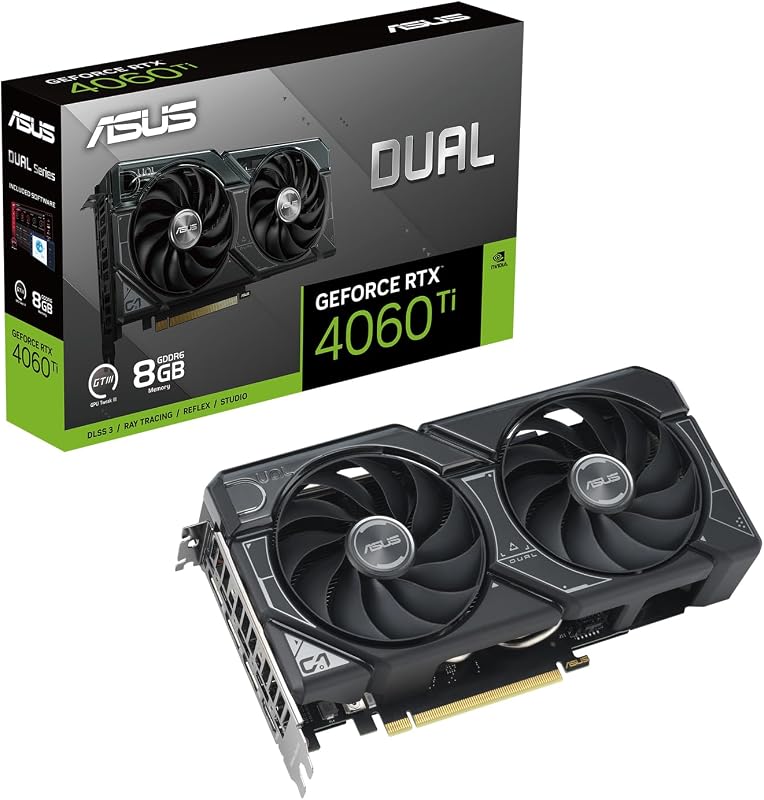
Deciding between the mainstream Nvidia RTX 5060 Ti and the halo-tier Nvidia RTX 5090 comes down to a fundamental divergence in memory bandwidth and hardware dimensions. While both graphics cards leverage next-generation GDDR7 memory architecture, the RTX 5060 Ti prioritizes power efficiency and dual-slot compatibility for standard desktop cases, whereas the RTX 5090 delivers a massive 32 GB frame buffer on a 512-bit bus paired with a dedicated liquid-cooling loop for uncompromised compute tasks.
Builders putting together a compact mid-range desktop who prioritize straightforward power requirements should choose the RTX 5060 Ti. Enthusiasts demanding extreme frame rates at 4K resolution alongside massive memory capacity for creative rendering pipelines should opt for the RTX 5090.


Nvidia RTX 5060 Ti vs Nvidia RTX 5090 at a Glance
| Attribute | Nvidia RTX 5060 Ti | Nvidia RTX 5090 |
|---|---|---|
| GPU Series | NVIDIA RTX 50 Series | NVIDIA RTX 50 Series |
| Graphics Architecture | NVIDIA Blackwell | NVIDIA Blackwell |
| VRAM Capacity & Type | 8 GB GDDR7 | 32 GB GDDR7 |
| Memory Bus Width | 128-bit | 512-bit |
| Memory Bandwidth / Speed | 448 GB/s (2407 MHz clock) | 28000 MHz memory clock |
| GPU Boost Clock | 2692 MHz | 2655 MHz |
| PCIe Interface | PCI-Express 5.0 x8 | PCI-Express 5.0 x16 |
| Cooling Hardware | Dual-fan air cooler with vented metal backplate | WATERFORCE All-in-One liquid cooling system |
| Physical Dimensions | 9.65″L x 4.72″W (Dual-slot, SFF-Ready) | 9.65″L x 5.75″W (Liquid-cooled card unit) |
| Display Outputs | HDMI, DisplayPort 2.1 | 1 x HDMI 2.1b, 3 x DisplayPort 2.1a |
| System Power Requirement | 600W PSU, single 8-pin connector | Not listed |
| Best For | 1080p and 1440p high-refresh gaming | Extreme 4K rendering and workstation production |
VRAM Capacity and Memory Bus Width
The memory subsystem represents the most consequential division between these two graphics cards. In any modern GPU comparison, available memory capacity and data bus width determine how effectively a graphics card handles high-resolution texture packs, volumetric fog, and heavy geometry datasets. Evaluating RTX 5060 Ti vs 5090 VRAM reveals an enormous fourfold divergence: the PNY RTX 5060 Ti integrates 8 GB of GDDR7 memory, whereas the Gigabyte AORUS RTX 5090 carries an expansive 32 GB GDDR7 pool. For light to moderate workloads, 8 GB provides adequate room, but modern simulation engines and dense compute environments rapidly saturate smaller capacities.
Examining RTX 5060 Ti vs 5090 memory bus specifications highlights a similar structural divide. The RTX 5060 Ti relies on a 128-bit memory interface pushing 448 GB/s of bandwidth with memory clocks at 2407 MHz. In contrast, the RTX 5090 is built around an ultra-wide 512-bit bus operating with a 28000 MHz memory clock speed. As discussed in our analysis of the nvidia rtx 5060 ti vs 5070, narrow bus configurations rely heavily on internal caching to maintain throughput, which functions well at lower resolutions but encounters bottlenecks under extreme parallel data loads.
In practice, the 512-bit bus on the RTX 5090 prevents data starvation when streaming complex geometry or high-definition ray-traced assets across multiple monitors. The 128-bit architecture on the RTX 5060 Ti remains optimized for streamlined data streams at standard resolutions, ensuring that memory management stays lean without consuming excessive board power or running hot during intense sessions.
Edge: Nvidia RTX 5090 delivers four times the memory capacity and four times the bus width for uncompromised memory throughput.
Gaming Performance Across 1440p and 4K Resolutions
Resolution targets define the real-world operational profiles of these cards. When choosing between the RTX 5060 Ti or 5090 for 1440p displays, the RTX 5060 Ti operates directly in its performance sweet spot. Built on the NVIDIA Blackwell architecture with 5th-Gen Tensor Cores and 4th-Gen Ray Tracing Cores optimized for Mega Geometry, the 5060 Ti targets high-refresh 1080p and 1440p gaming with ray tracing enabled. The card also supports DLSS 4.5, allowing it to leverage neural reconstruction shaders to deliver smooth frame delivery on 1440p gaming panels without overburdening its 8 GB frame buffer.
Shifting the benchmark to the RTX 5060 Ti or 5090 for 4K gaming changes the calculus completely. Pushing a full 3840×2160 raster presentation-or handling the maximum supported display resolution of 7680×4320-demands immense shading capacity and memory headroom. The Gigabyte RTX 5090 features the full GeForce RTX 5090 chipset backed by NVIDIA DLSS 4 support and a factory-tuned 2655 MHz core frequency, ensuring stable frame pacing across complex 4K open-world environments where an 8 GB card encounters memory limits. For builders considering middle-tier alternatives, examining the nvidia rtx 5060 ti vs 5080 provides additional perspective on scaling past standard 1440p monitor resolutions.
Consequently, in a direct Nvidia RTX 5090 vs 5060 Ti comparison, the RTX 5060 Ti serves as a practical, focused solution for high-fps 1080p and balanced 1440p setups. The RTX 5090 is built to eliminate framerate drops in high-fidelity 4K scenarios, delivering stable rendering performance across maximum visual presets where intensive ray tracing and asset streaming would exhaust smaller cards.
Edge: Nvidia RTX 5090 provides effortless 4K and ultra-high-resolution rendering headroom that outmatches the 1440p focus of the RTX 5060 Ti.
Cooling Architecture and Chassis Compatibility
Thermal management dictates what kind of computer chassis and layout you need for these graphics cards. The PNY RTX 5060 Ti implements a conventional dual-fan air-cooling mechanism within a tidy dual-slot footprint. Measuring 9.65 inches in length and 4.72 inches in width, this Small Form Factor (SFF-Ready) package fits comfortably into standard micro-ATX and mini-ITX desktop cases. A dense internal heatsink draws heat directly away from the core, while a vented metal backplate reinforces the structural frame against card sag and facilitates passive pass-through heat dissipation.
Conversely, the Gigabyte AORUS RTX 5090 incorporates the WATERFORCE All-in-One cooling system. Liquid cooling systems move thermal energy away from high-power silicon via dedicated coolant channels and an external radiator assembly. While the main card body measures 9.65 inches long and 5.75 inches wide-substantially wider than the 5060 Ti-installing this card also requires dedicated fan mounts inside the PC case to house the external WATERFORCE radiator and its associated tubing. Those building in smaller enclosures should reference our review of the nvidia rtx 5060 vs 5070 ti to see how physical dimensions impact case clearance.
While the liquid-cooled loop on the RTX 5090 provides elite heat dissipation under continuous heavy rendering loads, it introduces physical routing challenges and restricts case options. The PNY RTX 5060 Ti provides a true drop-in air-cooled layout, allowing users to secure the card in standard expansion brackets without configuring external radiator brackets or managing liquid tubing runs.
Edge: Nvidia RTX 5060 Ti takes the lead for straightforward physical installation, smaller dual-slot dimensions, and broad chassis compatibility.
Power Delivery and System Integration Requirements
Power requirements and board connectivity influence whether a card can slot into an existing setup or necessitates an extensive component overhaul. The PNY RTX 5060 Ti is built for accessible system upgrades, requiring only a single 8-pin power connector and a modest 600W system power supply. Its PCIe interface operates at PCI-Express 5.0 x8, providing ample data throughput for mainstream gaming boards without saturating available PCIe motherboard lanes.
The Gigabyte AORUS RTX 5090 employs a full PCI-Express 5.0 x16 connection to maximize point-to-point bandwidth with the host processor. While the product listing does not specify the exact minimum system power supply wattage or cable layout for this custom WATERFORCE model, enthusiast-tier flagship GPUs operate with substantially higher power delivery demands than 600W mainstream components. Upgrading to a card of this scale routinely requires a high-output power unit with specialized cabling to handle peak transient spikes. Readers evaluating power tiers will find helpful parallels in our nvidia rtx 5060 ti vs 5070 ti breakdown.
For PC builders who want to keep their existing power supply unit, case fans, and motherboard without rewiring internal cables, the RTX 5060 Ti offers zero friction. The RTX 5090 demands an uncompromising platform with high-capacity power distribution, robust chassis ventilation, and unrestricted PCIe lane configurations.
Edge: Nvidia RTX 5060 Ti wins on system integration thanks to its single 8-pin connector and accessible 600W power supply requirement.
Display Connectivity, Tuning Control, and Warranty
Connectivity options and hardware management software determine how effectively a graphics card integrates into multi-monitor battle stations or professional editing suites. The PNY RTX 5060 Ti provides modern display functionality through HDMI and DisplayPort 2.1 interfaces supporting resolutions up to 7680×4320. For hardware tuning, PNY supplies its proprietary VelocityX software utility. This interface allows users to dial in custom fan curves, fine-tune core and memory clock speeds, observe temperatures in real time, and store up to five custom performance profiles for quick switching.
The Gigabyte AORUS RTX 5090 steps ahead in total display flexibility by offering three DisplayPort 2.1a ports alongside a dedicated HDMI 2.1b connection. This configuration enables expansive multi-panel productivity or multi-display gaming without requiring external display adapters. Furthermore, the Gigabyte card features integrated RGB lighting across its shroud and includes a 4-year warranty upon completing online registration, complemented by a 4-year spare parts availability commitment in the EU. Buyers considering high-tier monitor arrays should explore our guide on the nvidia rtx 5070 ti vs 5090 for further hardware insights.
While the PNY VelocityX software provides comprehensive control over the RTX 5060 Ti’s factory 2692 MHz boost clock, the Gigabyte RTX 5090 delivers a more versatile array of physical output ports, integrated aesthetic lighting, and extended manufacturer warranty protection.
Edge: Nvidia RTX 5090 offers superior display connectivity with three DisplayPort 2.1a outputs and a 4-year registered manufacturer warranty.
Pros and Cons
Nvidia RTX 5060 Ti

Pros
- Compact dual-slot SFF-ready design
- Modest 600W power supply requirement
- Factory-tuned 2692 MHz boost clock
- Single 8-pin power connector simplicity
- Full VelocityX tuning profile software
Cons
- Limited to 8GB GDDR7 capacity
- Narrow 128-bit memory bus width
- Operates on PCIe 5.0 x8 interface
View Nvidia RTX 5060 Ti on Amazon
Nvidia RTX 5090

Pros
- Massive 32GB GDDR7 memory pool
- Ultra-wide 512-bit memory interface
- Dedicated WATERFORCE all-in-one liquid cooling
- Three DisplayPort 2.1a output connections
- Includes 4-year registered warranty coverage
Cons
- Chassis must accommodate liquid cooling radiator
- Wider 5.75-inch physical card footprint
- Product listing omits power supply wattage
View Nvidia RTX 5090 on Amazon
Who Should Buy Each One
Choose the Nvidia RTX 5060 Ti If
- You play primarily on 1080p or 1440p high-refresh gaming monitors and want native DLSS 4.5 support.
- You own a compact or Small Form Factor (SFF) computer case that only accommodates standard 2-slot graphics cards.
- Your desktop relies on an existing 600W power supply with a single standard 8-pin auxiliary power lead.
- You prefer a self-contained, dual-fan air cooling design that avoids managing liquid cooling radiator mounts.
Choose the Nvidia RTX 5090 If
- You demand uncompromising frame rates in modern titles running at native 4K or ultra-wide resolutions.
- Your workflow includes complex 3D rendering, simulation, or AI model hosting requiring 32 GB of high-speed GDDR7 VRAM.
- You run a multi-monitor productivity setup requiring three native DisplayPort 2.1a connections.
- Your PC chassis has ample clearance to mount an integrated WATERFORCE liquid cooling radiator assembly.
Final Verdict
For the vast majority of everyday PC gamers and general builders, the PNY RTX 5060 Ti represents the practical choice. It packs the latest Blackwell architecture, advanced ray tracing cores, and super-fast GDDR7 memory into a dual-slot, 9.65-inch body that drops cleanly into mainstream desktops. With a factory boost clock of 2692 MHz, low thermal demands, and compatibility with standard 600W power supplies, it delivers smooth high-refresh 1080p and 1440p performance without demanding extensive chassis modifications or ancillary hardware replacements.
On the other hand, anyone questioning is RTX 5090 worth it will find their answer in the realm of extreme 4K gaming and high-throughput creative production. With an immense 32 GB frame buffer, an ultra-wide 512-bit bus, and an integrated WATERFORCE liquid cooling system, the Gigabyte RTX 5090 operates in an entirely different performance tier. When your primary objectives demand maximum frame rates at 4K, extensive video memory for neural network execution, and support for multi-monitor arrays, the RTX 5090 stands as the decisive winner.
FAQ
Is RTX 5090 worth it for a standard gaming rig?
For gamers using 1080p or standard 1440p monitors, the RTX 5090 offers far more capacity and bandwidth than conventional games can utilize, making it overkill for standard setups. It is primarily built for users driving high-refresh 4K panels, multi-screen configurations, or heavy creative compute pipelines that demand its 32 GB GDDR7 memory buffer.
What are the primary differences in RTX 5060 Ti vs 5090 specs?
Looking at the RTX 5060 Ti vs 5090 specs, the most significant differences lie in memory, bus width, and cooling. The RTX 5060 Ti features 8 GB of GDDR7 memory on a 128-bit bus with dual-fan air cooling and a PCIe 5.0 x8 interface. The RTX 5090 features 32 GB of GDDR7 memory on a massive 512-bit bus, PCIe 5.0 x16 interface, and an integrated WATERFORCE liquid cooling loop.
Can the RTX 5060 Ti run games at 4K resolution?
While the RTX 5060 Ti supports output resolutions up to 7680×4320 via HDMI and DisplayPort, its 8 GB VRAM capacity and 128-bit memory bus are tailored specifically for high-refresh 1080p and 1440p gaming. Running demanding modern games at native 4K will quickly exceed its 8 GB memory capacity and constrain frame rates.
How do the cooling systems differ on these two graphics cards?
The PNY RTX 5060 Ti uses an air-cooled dual-fan design with a dense heatsink and a vented metal backplate that fits within standard dual-slot spacing. The Gigabyte AORUS RTX 5090 uses an integrated WATERFORCE all-in-one liquid cooling system that circulates liquid coolant to an external radiator, requiring dedicated radiator mounting positions within your PC chassis.
Does the RTX 5060 Ti require a power supply upgrade?
In most existing gaming builds, the RTX 5060 Ti will not require a new power supply. The manufacturer specifies a standard 600W system power supply requirement and uses a single 8-pin power connector, allowing for a straightforward upgrade in standard desktop towers.
What display outputs do these two models feature?
The PNY RTX 5060 Ti includes DisplayPort 2.1 and HDMI video outputs. The Gigabyte AORUS RTX 5090 includes three DisplayPort 2.1a ports and one HDMI 2.1b port, providing broader display connectivity for multi-monitor workstations and gaming arrays.