The single operational factor that decides between a single-stage and a two-stage snow blower is intake capacity paired with the clearing mechanism: single-stage units rely entirely on a single auger that scrapes the ground and throws snow directly out the discharge chute, whereas two-stage machines collect snow with an auger and feed it into a high-speed discharge impeller. This fundamental mechanical difference determines whether a machine can blast through knee-deep drifts, frozen plow banks, and gravel driveways, or whether it is built for quick, nimble clearing of moderate snow on smooth pavement.
Homeowners maintaining short, flat paved driveways who want a lightweight, low-maintenance machine for moderate winter storms should choose a single stage snow blower. Property owners managing long driveways, steep inclines, gravel surfaces, or frequent heavy accumulations exceeding ten inches should invest in a self-propelled two stage snow blower.


Single-Stage vs. Two-Stage Snow Blowers at a Glance
| Feature | Single-Stage Snow Blowers | Two-Stage Snow Blowers |
|---|---|---|
| Clearing Width | 20 to 21 inches | 24 to 28 inches |
| Intake Height | 10 to 13 inches | 20 to 21.7 inches |
| Clearing Mechanism | Single auger scoops and expels snow directly | Auger feeds snow into high-speed impeller fan |
| Drive System | Manual push assisted by auger ground contact | Self-propelled (multi-speed friction disc or hydrostatic track) |
| Maximum Throw Distance | 26 to 42 feet | 30 to 52 feet |
| Snow Clearing Throughput | Not listed | 1,900 to 2,000+ pounds per minute |
| Power Type | Cordless battery (40V to 56V platforms) | Gas-powered 4-cycle OHV engines (209cc to 270cc) |
| Gravel Driveway Use | Not recommended (select models offer skid shoes) | Fully compatible via adjustable skid shoes and housing height |
| Machine Weight | 37.7 pounds to moderate carrying weight | Up to 358 pounds |
| Best For | Light to moderate snowfall on paved surfaces | Deep snow, wet drifts, steep inclines, and gravel roads |
Clearing Width and Intake Height
The primary physical specification defining any winter clearing tool is the dimensions of the front intake box. The single stage vs two stage snow blower intake height directly determines how deep of a snowdrift you can tackle before snow begins spilling over the sides and top of the housing. When snow exceeds the intake height, the machine must push the excess accumulation forward rather than processing it, which quickly bogs down manual equipment and requires multiple slow passes.
Looking closely at standard single-stage designs, intake housings are compact to preserve operator visibility and balance. The Wild Badger Power WB40VSNBL2 features a 20-inch clearing width paired with a 10-inch intake height, making it ideal for typical residential snowfalls of three to six inches. The heavy-duty EGO Power+ SNT2122 expands this envelope with a 21-inch clearing width and a 13-inch intake height, powered by a durable 6-inch steel auger capable of taking on an 8-inch snowfall across a 10-car driveway on a single charge. However, both designs max out when winter storms deliver foot-deep drifts or when municipal street plows compact a wall of frozen slush across your driveway apron.
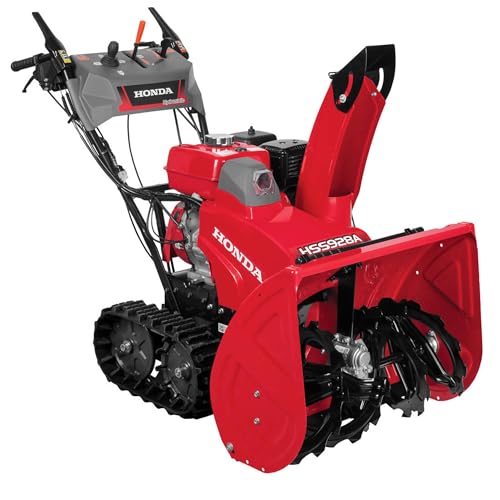
In contrast, two-stage snow blowers operate on an entirely different scale. The WEN SB209E delivers a 24-inch clearing path with a 20-inch clearing depth, cutting down wide driveways in fewer passes. Moving up to commercial-grade hardware, the Honda HSS928AATD expands the front housing to a 28-inch clearing width and a 21.7-inch intake height. This massive vertical clearance lets the operator drive straight through knee-high snowbanks without hesitation. Understanding this difference between single stage and two stage snow blowers is vital for anyone who regularly faces lake-effect blizzards or heavy regional snowfalls, much like evaluating build scale in our toro vs ariens comparison.
Edge: Two-Stage Snow Blower. With intake depths up to 21.7 inches and clearing widths reaching 28 inches, two-stage models easily process more than double the volume of snow per pass compared to single-stage units.
Throwing Distance and Clearing Mechanism
Snow removal efficiency depends not only on how quickly a machine takes in accumulation, but also on how far it can fling it. The single stage vs two stage snow blower throw distance highlights a major functional divergence. In a single-stage machine, the auger must perform two jobs at once: slicing through packed snow and creating enough rotational centrifugal force to eject it out the chute. In a two-stage snow blower, the auger turns slowly to meter and feed snow into a secondary high-speed spinning impeller fan, which accelerates and discharges the snow with immense force.
The single-stage approach works well for moderate distances. The Wild Badger Power WB40VSNBL2 throws snow up to 26 feet using its 40V brushless motor, while the EGO Power+ SNT2122 uses variable auger speed control and 56V Peak Power technology to fling snow up to 42 feet. These numbers are more than sufficient for standard one-car and two-car residential driveways. However, because the single auger must directly contact the snow to throw it, discharge velocity can drop significantly when working with heavy slush, damp sleet, or packed snow crust.
Two-stage snow blowers bypass this bottleneck through their two-phase operation. The WEN SB209E relies on its 209cc 4-cycle engine and notched 4-blade auger to blast over 2,000 pounds of snow per minute up to 30 feet through an easily adjusted 190-degree chute. Taking performance further, the Honda HSS928AATD utilizes a 270cc Honda GX270 OHV commercial engine to clear up to 1,900 pounds per minute while achieving an extraordinary throwing distance of up to 52 feet. This throwing power prevents snow from landing on adjacent walkways, lawns, or cleared areas, making it indispensable for broad paved parking areas and large properties.
Edge: Two-Stage Snow Blower. The secondary high-speed impeller provides dedicated acceleration, delivering throw distances up to 52 feet and processing up to 2,000 pounds of snow per minute.
Drive Systems and Steep Incline Traction
Maneuvering a snow blower across an icy surface requires reliable propulsion and grip. Single-stage snow blowers are push-propelled machines. While their rubber-tipped or steel augers may make light contact with the ground to pull the machine forward slightly, the operator is responsible for pushing the tool up hills, through drifts, and around turns. Because units like the Wild Badger Power WB40VSNBL2 weigh only 37.7 pounds and roll on 8-inch rear wheels, pushing them across level surfaces is almost effortless. However, when working on sloped terrain, that manual effort multiplies rapidly.
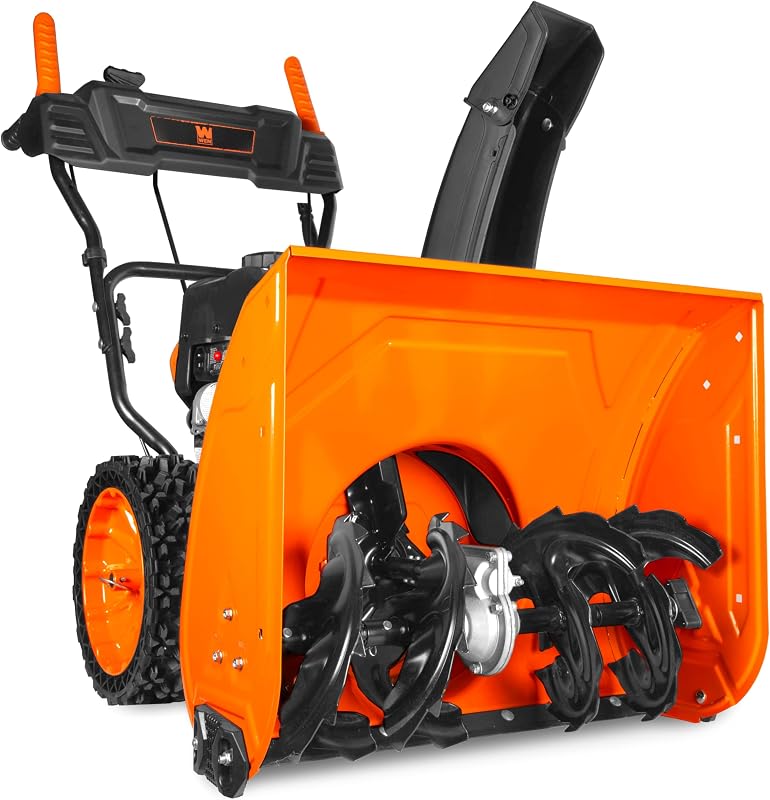
By contrast, two-stage snow blowers incorporate mechanical drive systems connected directly to the engine transmission. The WEN SB209E features a self-propelled drive system with eight speed settings-six forward and two reverse-riding on 13-inch tubeless, never-flat snow tires with aggressive deep treads. These driven tires provide continuous forward momentum through high resistance without forcing the operator to strain their back or legs.
When selecting a two stage snow blower for steep incline applications, track drive mechanisms represent the pinnacle of traction engineering. The Honda HSS928AATD incorporates pliable, low-temperature dual rubber tracks equipped with sure-gripping cleats. Controlled by a self-propelled hydrostatic transmission, the operator can continuously vary forward and reverse ground speeds without affecting the auger rotation speed. Even though the Honda machine weighs a substantial 358 pounds, its tracked drive climbs steep, icy driveways and irregular grades with total stability and zero slipping.
Edge: Two-Stage Snow Blower. Mechanical self-propulsion featuring multi-speed transmissions or cleated rubber track systems handles steep slopes, icy inclines, and heavy drifts without requiring physical pushing from the operator.
Surface Versatility and Gravel Driveway Safety
The type of surface you need to clear plays a decisive role when determining whether you need a single stage or two stage for gravel driveway clearing. Because traditional single-stage blowers are designed to leave a completely clean, snow-free path, their augers make direct contact with the ground surface. On smooth asphalt or poured concrete, this design cleans down to the pavement cleanly. On loose stone, dirt, or crushed gravel, a ground-contact auger acts like a high-velocity stone thrower, scooping up loose rocks and flinging them through the chute into parked vehicles, siding, or nearby windows.
Some premium single-stage units introduce surface flexibility. For instance, the EGO Power+ SNT2122 includes adjustable skid shoes that elevate the scraper bar to improve performance on irregular terrain and gravel driveways. Nevertheless, the Wild Badger Power WB40VSNBL2 is strictly designated for paved driveways, sidewalks, walkways, and patios. For unpaved surfaces, relying on a lightweight single-stage machine requires extreme care and flat ground to prevent catching loose stones in the spinning 6-inch steel auger.
Two-stage blowers are inherently built for unpaved terrain because the auger housing is elevated off the ground by adjustable skid shoes, meaning the rotating auger never touches the underlying surface. The Honda HSS928AATD includes an auger height control lever that lets the user adjust the housing height with the press of a thumb, floating the intake box over uneven ground, lawn transitions, and gravel beds. The WEN SB209E also incorporates durable steel construction and adjustable skid clearance to hover cleanly above stone driveways, making two-stage hardware the standard choice for rural properties. For more tool infrastructure decisions, consider how matching tools to work environments is explored in our ego lb5804 vs ryobi ry404100 analysis.
Edge: Two-Stage Snow Blower. Elevated auger housings and micro-adjustable skid shoes allow two-stage units to clear snow safely over crushed gravel and uneven dirt without throwing rocks.
Wet Snow Performance and Plow Pile Handling
When winter weather transitions into sleet, freezing rain, or heavy slush, clearing requirements change drastically. Selecting a single stage or two stage for wet snow comes down to torque, chute clogging resistance, and intake power. Heavy slush easily sticks to intake surfaces and bogs down lower-powered motors, creating frustrating chute blockages that stop clearing progress entirely.
In a standard single stage snow blower review, wet snow represents the operational limit. The Wild Badger Power WB40VSNBL2 can tackle deep, compacted, or icy snow, but its product listing notes this requires multiple passes, and wet snow reduces battery runtime compared to dry powder. The EGO Power+ SNT2122 bridges this gap effectively using its 56V brushless motor and Peak Power system, cutting through packed snow and municipal plow piles using its heavy-duty 6-inch steel auger. However, because the auger must both break up the ice and loft the dense slush out of the 180-degree chute, throwing distance degrades considerably in saturated conditions.
A two stage snow blower review shows clear dominance in slush and ice. The 209cc gas engine on the WEN SB209E powers a notched 4-blade steel auger specifically engineered to chop through hard ice crusts and packed end-of-driveway snowbanks left by city plows. Because the mechanical work is divided, the auger only needs to crush the snow and push it backward, allowing the high-speed spinning impeller to eject heavy wet slush up to 30 feet without stalling. The Honda HSS928AATD raises this bar further, utilizing 270cc of commercial OHV power to slice through frozen plow walls and throw dense accumulation up to 52 feet.
Edge: Two-Stage Snow Blower. Notched steel augers crush frozen crusts and wet slush while high-rpm impellers prevent chute clogs and maintain high-volume snow ejection.
Storage, Maintenance, and Handling Ergonomics
While two-stage snow blowers dominate in clearing capacity and power, single-stage blowers excel in daily usability, storage footprint, and routine maintenance. Many prospective buyers ask themselves: is a two stage snow blower worth it if you only have a modest suburban lot? The trade-off comes down to handling weight and seasonal upkeep. Just as appliance buyers weigh capacity against storage space in a single basket vs dual basket air fryer review, snow blower owners must consider off-season footprint.
Single-stage cordless blowers are compact, clean, and whisper-quiet. The Wild Badger Power WB40VSNBL2 weighs a mere 37.7 pounds and features an easy push-button electric start, rear wheels, and a folding handle designed to minimize garage storage space. The EGO Power+ SNT2122 also features a height-adjustable, quick-fold handle that collapses flat for compact off-season storage, alongside an IPX4 weather-resistant build. Both models operate without gasoline, crankcase oil, spark plugs, or engine fumes, making them as simple to grab and operate as common household appliances reviewed in our instant vortex plus vs chefman turbofry breakdown.
Two-stage gas machines demand substantial garage floor space and ongoing mechanical upkeep. The Honda HSS928AATD weighs 358 pounds and measures as a full-size industrial machine, requiring oil level checks, fresh fuel with stabilizer, spark plug inspection, and a detailed maintenance schedule outlined in the owner’s manual. The WEN SB209E similarly requires 4-cycle engine care, fuel drainage before summer storage, and belt inspections. Maneuvering these 200-to-350-pound gas blowers around parked cars or through tight garden gates requires physical effort that many homeowners simply do not want to manage.
Edge: Single-Stage Snow Blower. Weighing under 40 pounds with quick-folding handles, push-button electric starting, and zero gasoline maintenance, single-stage blowers offer vastly superior storage and handling convenience.
Pros and Cons
Single Stage Snow Blower

Pros
- Lightweight design under 40 pounds
- Compact storage with quick-fold handles
- Push-button starting with zero gas maintenance
- Cleans down to paved surfaces cleanly
- Throws snow up to 42 feet
Cons
- Intake height limited to 10-13 inches
- Requires manual pushing on inclines
- Unsuitable for most loose gravel driveways
View EGO Power+ SNT2122 21″ Single-Stage Snow on Amazon
Two Stage Snow Blower
Pros
- Intake depths reaching over 21 inches
- Self-propelled wheel and track drive systems
- Clears up to 2000 pounds per minute
- Throws snow up to 52 feet
- Safe for gravel and unpaved terrain
Cons
- Heavy footprint weighing up to 358 pounds
- Requires ongoing gas engine maintenance
- Takes up substantial garage storage space
View WEN 24-inch 209cc Two-Stage Self-Propelled Gas-Powered on Amazon
Who Should Buy Each One
Choose a Single-Stage Snow Blower If
- You clear a smooth asphalt or concrete driveway measuring one to two cars wide with room for light storage.
- Your local climate typically receives moderate storms producing under 8 to 10 inches of snowfall per event.
- You want a lightweight machine under 40 pounds that can be lifted, hung, or stored easily using folding handles.
- You prefer a gas-free, cordless battery platform with instant push-button start, zero engine maintenance, and quiet operation.
Choose a Two-Stage Snow Blower If
- You manage a gravel, stone, or unpaved driveway that requires an elevated auger housing and skid shoes to avoid throwing rocks.
- You live in an area prone to major winter storms that deposit 12 to 20+ inches of heavy, wet snow and deep drifts.
- You must navigate steep driveways, icy inclines, or uneven terrain requiring self-propelled drive wheels or cleated rubber tracks.
- You regularly need to clear frozen, compacted snowbanks and ice walls left across your driveway apron by municipal road plows.
Final Verdict
For the vast majority of suburban homeowners with flat, paved driveways, a single stage snow blower represents the most practical and convenient winter tool. Modern cordless platforms like the EGO Power+ SNT2122 and Wild Badger Power WB40VSNBL2 provide instant push-button starting, folding handles for compact summer storage, and plenty of power to clear 10 to 13 inches of accumulation across typical residential layouts. They eliminate the hassle of stale fuel, pull cords, oil changes, and heavy lifting, while clearing right down to the pavement surface.
However, when harsh winter conditions push snow accumulations past ten inches, or when you are dealing with gravel surfaces, steep grades, and frozen plow berms, a two stage snow blower is absolutely worth the investment. Commercial-grade power plants and self-propelled systems-such as the 8-speed transmission on the WEN SB209E or the tracked hydrostatic drive on the Honda HSS928AATD-eliminate operator fatigue while throwing up to 2,000 pounds of heavy snow per minute up to 52 feet. Choose a single-stage model for quick, agile paved clearing, and step up to a two-stage machine when extreme snow depth, incline, and surface conditions demand raw mechanical throughput.
FAQ
What is the difference between single stage and two stage snow blowers?
The primary difference lies in the clearing stages: a single-stage snow blower uses a single auger that gathers snow and immediately throws it out the chute in one motion. A two-stage snow blower uses an auger to break up snow and feed it into a separate high-speed impeller fan, which expels the snow out the chute with greater force and velocity.
Can you use a single stage or two stage for gravel driveway clearing?
A two-stage snow blower is strongly recommended for gravel driveways. Two-stage units feature adjustable skid shoes that elevate the auger housing above the ground, allowing you to clear snow without scooping up and throwing loose rocks. Most single-stage blowers scrape directly against the ground surface, making them dangerous on gravel, though select models like the EGO Power+ SNT2122 include adjustable skid shoes to help manage irregular surfaces.
How does intake height compare between single-stage and two-stage models?
Single-stage snow blowers typically feature intake heights between 10 and 13 inches, designed for light-to-moderate snowfall on residential walkways. Two-stage snow blowers provide significantly taller housings ranging from 20 to 21.7 inches, allowing them to cut through deep drifts, heavy blizzards, and tall plow banks without spilling snow over the top of the machine.
Is a two stage snow blower worth it for suburban homeowners?
A two-stage snow blower is worth it if you have a driveway that accommodates four or more cars, experience frequent blizzards exceeding 10 inches, manage steep slopes, or have to clear heavy, frozen snowbanks at the street curb. For homeowners with flat two-car driveways and moderate snowfall, a single-stage cordless blower is generally easier to maneuver, maintain, and store.
Which design works better when clearing heavy, wet snow?
Two-stage snow blowers perform much better in wet, heavy snow. Their notched steel augers slice through dense, slushy accumulation, while the independent high-speed discharge impeller prevents clogging and propels wet snow up to 30 to 52 feet away. Single-stage units must use the same auger to both slice and throw, which can lead to reduced throwing distances and chute clogs in heavy slush.
Why is a two stage snow blower for steep incline clearing recommended over single-stage units?
Two-stage snow blowers feature self-propelled drive wheels or cleated rubber tracks powered directly by the engine, providing continuous traction up steep hills without operator strain. Single-stage snow blowers are manually pushed, which can cause slipping, fatigue, and loss of control when working on icy grades or sloped driveways.