The core decision in this Sony WH-1000XM4 vs WH-1000XM5 comparison comes down to whether you prioritize acoustic processing power or physical packability. The newer Sony WH-1000XM5 upgrades the platform to a dual-processor architecture with an eight-microphone array and integrated wind noise reduction, while the older Sony WH-1000XM4 relies on a single noise sensor system paired with a fully collapsable folding frame that stows inside a compact travel footprint.
Choose the WH-1000XM4 if you commute frequently, pack light, and need a proven folding headphone that slips easily into crowded bags. Choose the WH-1000XM5 if your daily routine centers on office meetings, voice calls in windy areas, and the strongest possible isolation across vocal frequencies.


Sony WH-1000XM4 vs Sony WH-1000XM5 at a Glance
| Feature | Sony WH-1000XM4 | Sony WH-1000XM5 |
|---|---|---|
| Noise Canceling Architecture | Dual Noise Sensor technology | Integrated Processor V1 and HD Noise Cancelling Processor QN1 |
| Microphone Array | 5 built-in microphones | 8 microphones with wind noise reduction |
| Acoustic Drivers and Upscaling | DSEE Extreme with Edge AI | Specially designed driver unit with High-Resolution Audio |
| Impedance | Not listed | 48 ohm |
| Battery Playback Time | Up to 30 hours | Up to 30 hours |
| Quick Charge Capabilities | 10 minutes for 5 hours playback | Not listed |
| Device Pairing Protocols | Multipoint connection | Multipoint connection, Fast Pair, Swift Pair |
| Chassis Weight | Not listed | 250 g |
| Carrying Case Profile | Protective case | Collapsible case |
| Warranty Coverage | 1 year | Amazon Policy |
| Best For | Travelers wanting compact folding portability | Call-heavy workdays and maximum acoustic isolation |
Active Noise Cancellation and Processing Architecture
Active noise cancellation relies on microphones capturing ambient frequencies so onboard processors can generate inverted sound waves that cancel them out before they reach your eardrum. In the WH-1000XM4 vs WH-1000XM5 noise cancelling matchup, the foundational hardware reflects two distinct generations of digital signal processing. The WH-1000XM4 employs Dual Noise Sensor technology, utilizing dual microphones on each ear cup to catch ambient noise and pass it to Sony’s dedicated noise-canceling hardware. This system proves effective at eliminating continuous, low-frequency rumbles such as train tracks or jet engine hums, making it a reliable choice for long transit routes.
The Sony WH-1000XM5 noise cancelling difference stems from a significant hardware expansion. Rather than relying solely on a single processing pipeline, the WH-1000XM5 introduces the Integrated Processor V1, which works alongside the established HD Noise Cancelling Processor QN1. This dual-processor architecture coordinates with an expanded array of eight microphones to capture higher-frequency acoustic disturbances. The listing highlights its ability to block out irregular ambient intrusions, ranging from airplane cabin rumble to mid-range conversational chatter. When weighing premium isolation platforms against rivals in our sony wh-1000xm5 vs bose quietcomfort ultra evaluation, processing speed across unpredictable noise floors remains a defining benchmark.
In everyday use, the dual chips on the XM5 calculate environmental changes with greater efficiency than the single-processor setup on the XM4. While both headsets feature Adaptive Sound Control to adjust settings automatically based on location and movement, the WH-1000XM5 processes background clutter across a broader spectrum of voices and erratic office sounds. The WH-1000XM4 still handles monotonous background drone with ease, but it allows more upper-midrange sounds to filter through.
Edge: Sony WH-1000XM5 because its dual-processor architecture and eight-microphone system deliver superior attenuation across complex, high-frequency background noise.
Microphone Performance and Voice Call Clarity
Voice clarity during phone calls and virtual conferences depends on physical microphone placement and the digital algorithms isolating your speech from surrounding chaos. When evaluating the Sony WH-1000XM4 or WH-1000XM5 for calls, the physical sensor layout creates an immediate dividing line. The WH-1000XM4 combines five built-in microphones with advanced audio signal processing under its Precise Voice Pickup system. This hardware configuration captures vocal tones cleanly in moderate indoor environments, ensuring voice assistants and callers register your words without noticeable distortion.
The WH-1000XM5 raises the microphone count significantly, deploying eight microphones distributed around the earcups. Sony pairs this expanded hardware with Precise Voice Pickup Technology and a newly developed wind noise reduction system. The physical baffling and multi-mic beamforming work together to isolate speech from moving air and sudden outdoor gusts. Buyers comparing top-tier headsets across categories in our sony wh-1000xm4 vs bose quietcomfort ultra breakdown often discover that wind mitigation represents one of the hardest engineering challenges for over-ear headphones.
For users who take work calls from coffee shops, outdoor transit hubs, or open office spaces, the WH-1000XM5 isolates speech far more cleanly. The four additional microphones grant the V1 processor extra data streams to distinguish background voices from your own voice. The WH-1000XM4 remains sufficient for quiet rooms, but its five-microphone system struggles to suppress aggressive wind and overlapping speech as effectively as the eight-mic array on the newer model.
Edge: Sony WH-1000XM5 because its eight-microphone array and integrated wind noise reduction deliver substantially clearer voice transmission in loud environments.
Portability, Folding Mechanism, and Case Design
Physical footprint and case geometry often dictate whether an over-ear headset is practical for everyday carry. In the Sony WH-1000XM4 folding vs WH-1000XM5 debate, the physical hinge design represents the starkest mechanical contrast between the two generations. The WH-1000XM4 features cast hinges that allow both earcups to swivel inward and fold upward into the curve of the headband. This collapsible layout allows the headphones to tuck into a rigid, rounded protective case that takes up minimal volume inside a briefcase or personal item bag.
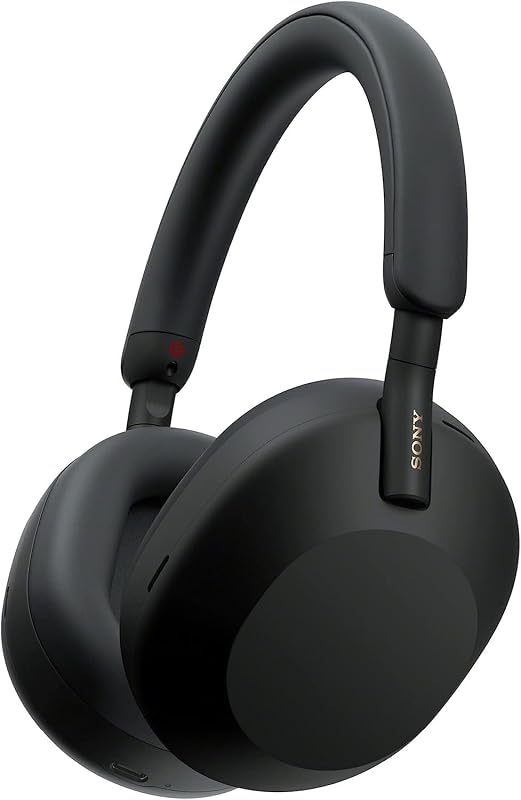
Conversely, the WH-1000XM5 features a redesigned non-folding chassis. The earcups swivel flat to rest against your chest or slip into its case, but they do not fold upward into the headband arch. To accommodate this larger rigid silhouette, Sony supplies a collapsible case that flattens down when empty but occupies a noticeably wider footprint inside a backpack when holding the headset. When reviewing everyday travel convenience alongside alternatives in our sony wh-1000xm4 vs bose quietcomfort 45 comparison, physical stowability frequently outweighs theoretical software upgrades for frequent travelers.
On weight specifications, the WH-1000XM5 listing confirms an item weight of 250 grams, presenting a well-balanced distribution across the skull with rounded or angular earcups. The WH-1000XM4 listing does not specify exact gram weight, but notes an updated pressure-relieving design with circular earcups that support prolonged listening sessions. For buyers deciding between the Sony WH-1000XM4 or WH-1000XM5 for travel, the compact folded volume of the XM4 remains its single biggest physical advantage over the newer version.
Edge: Sony WH-1000XM4 because its folding headband design collapses into a much smaller, travel-friendly protective case.
Sound Quality, Drivers, and Audio Processing
Evaluating WH-1000XM5 vs XM4 sound quality requires looking at both physical transducers and software-driven digital enhancement. The WH-1000XM4 features DSEE Extreme (Digital Sound Enhancement Engine), an Edge AI upscaling engine co-developed with Sony Music Studios Tokyo. DSEE Extreme restores the high-range frequencies lost in compressed digital audio files in real time, delivering a rich, dynamic presentation across lossy streaming services and wireless Bluetooth connections.
The WH-1000XM5 counters with a specially designed driver unit tuned for High-Resolution Audio reproduction, backed by a listed impedance of 48 ohms. The integration of the V1 and QN1 dual processors aids acoustic clarity, enabling the drivers to reproduce fast transients and subtle low-end textures without harmonic blurring. The listing notes that the 1000X series secured What Hi-Fi Awards two years in a row, reflecting the acoustic engineering invested in this redesign. Similar high-resolution performance discussions appear throughout our sony wh-1000xm5 vs bose quietcomfort 45 analysis, where driver responsiveness defines the overall audio experience.
In practice, the WH-1000XM4 offers a powerful, energetic sound signature that makes compressed digital audio files punchy and vibrant through DSEE Extreme. The WH-1000XM5 provides a more refined, articulate presentation with its specially designed driver unit, revealing finer instrumental separation across high-resolution sources. While both headsets elevate compressed audio streams, the XM5 delivers tighter control over complex orchestral and acoustic recordings.
Edge: Sony WH-1000XM5 because its specially designed driver unit and dual-processor acoustic management provide tighter detail and clarity.
Connectivity, Pairing, and Smart Automation
Everyday usability depends heavily on how quickly a headset pairs with source hardware and how intelligently it handles daily interactions. Both headphones provide seamless multipoint connection, allowing you to pair two Bluetooth devices simultaneously. This enables you to listen to audio on a laptop and automatically switch over to receive an incoming call on your smartphone without opening a Bluetooth settings menu.
Where the WH-1000XM5 pulls ahead in wireless convenience is its inclusion of Google Fast Pair and Microsoft Swift Pair. Fast Pair facilitates instant visual pairing with Android hardware and allows you to locate the WH-1000XM5B if misplaced, while Swift Pair enables rapid, pop-up pairing with Windows PCs and tablets. The WH-1000XM4 provides standard Bluetooth multipoint pairing, but the product data does not list Fast Pair or Swift Pair functionality.
Both models share Sony’s smart automation suite, including Speak-to-Chat, which senses when you begin speaking and automatically drops playback volume so you can hold a conversation without removing the headset. Both feature capacitive touch sensor controls on the earcups to skip tracks, change volume, and summon voice assistants, along with wearing detection that pauses audio whenever you take the headphones off. The WH-1000XM5 adds native optimization for both Alexa and Google Assistant with hands-free wake word activation directly from the headset.
Edge: Sony WH-1000XM5 because the addition of Fast Pair and Swift Pair simplifies multi-device connection routines across computers and mobile devices.
Battery Life, Charging Speeds, and Warranty Coverage
Longevity away from power outlets is vital for work trips and long-haul flights. In this Sony WH-1000XM5 vs WH-1000XM4 comparison, battery playback endurance appears identical on paper. Both models provide up to 30 hours of battery life on a full charge, giving listeners enough reserve power to endure multiple days of moderate listening or continuous transcontinental travel without searching for an electrical outlet.
The details surrounding fast recharging, however, favor the older headset based on published technical data. The WH-1000XM4 listing explicitly specifies a quick-charging benchmark: a 10-minute charge over its included USB Type-C cable yields up to 5 hours of playback. The WH-1000XM5 listing confirms an extended 30-hour battery life and the inclusion of a USB cable, but it does not specify an exact minute-to-hour quick-charge ratio in the provided data.
Warranty coverage reveals another concrete administrative difference. The WH-1000XM4 comes backed by a standard 1-year manufacturer warranty. The WH-1000XM5 listing corresponds to an International Version (model WH1000XM5B) that lists Amazon Policy under its warranty description and states no manufacturer warranty in the listing title. For buyers who place a high premium on official manufacturer backing and documented quick-charge metrics, the WH-1000XM4 provides greater clarity.
Edge: Sony WH-1000XM4 because it documents a 10-minute quick charge for 5 hours of playback and includes a 1-year manufacturer warranty.
Pros and Cons
Sony WH-1000XM4

Pros
- Collapsible folding frame saves bag space
- 10-minute charge provides 5 hours playback
- DSEE Extreme Edge AI audio upscaling
- Standard 1-year manufacturer warranty
Cons
- Only 5 microphones for voice calls
- Lacks Fast Pair and Swift Pair features
View Sony WH-1000XM4 on Amazon
Sony WH-1000XM5
Pros
- Dual processors V1 and QN1 for noise cancelling
- Eight-microphone array with wind noise reduction
- Fast Pair and Swift Pair connectivity
- Specially designed driver unit with high-resolution audio
Cons
- Non-folding headband creates larger carry footprint
- International version listing carries no manufacturer warranty
View Sony WH-1000XM5 on Amazon
Who Should Buy Each One
Choose the Sony WH-1000XM4 If
- You travel frequently and need a headset that folds into a compact carrying case to save luggage space.
- You want documented 10-minute quick charging that delivers 5 hours of playback in emergencies.
- You rely heavily on compressed music streaming and want Edge AI DSEE Extreme upscaling.
- You prefer a confirmed 1-year manufacturer warranty over an international version backed only by standard store return policies.
Choose the Sony WH-1000XM5 If
- You spend hours on calls and require an eight-microphone array with dedicated wind noise reduction.
- You work in noisy shared offices and need dual-processor noise cancellation that attenuates human speech.
- You pair across multiple operating systems and want Google Fast Pair and Microsoft Swift Pair integration.
- You want high-resolution audio fidelity powered by a specially designed driver unit and dual processing chips.
Final Verdict
When asking is Sony WH-1000XM5 worth it over the previous generation, the answer depends entirely on your working environment. The WH-1000XM5 is the superior technical instrument for productivity, remote calls, and dense office environments. Its dual-processor arrangement (Integrated Processor V1 plus QN1) and eight-microphone array elevate voice isolation and acoustic cancellation well beyond what the older platform can achieve. Added software conveniences like Swift Pair and hands-free voice assistant integration make it an exceptionally seamless desktop companion.
However, the WH-1000XM4 remains the better headphone for mobile commuters and frequent flyers. By retaining a folding hinge assembly, it packs down into a protective case that takes up considerably less volume than the non-folding XM5. Combined with an identical 30-hour battery rating, proven 10-minute fast charging, and a standard 1-year manufacturer warranty, the XM4 holds clear practical value. As buyers evaluate future generational changes in our sony wh-1000xm4 vs wh-1000xm6 overview, the WH-1000XM4 continues to stand as one of the most practical travel headphones Sony has ever produced.
FAQ
What is the main Sony WH-1000XM5 noise cancelling difference compared to the WH-1000XM4?
The primary difference lies in processing hardware and microphone coverage. The WH-1000XM4 uses Dual Noise Sensor technology with a single processor, whereas the WH-1000XM5 utilizes two processors (Integrated Processor V1 and HD Noise Cancelling Processor QN1) operating eight microphones. This allows the XM5 to process more acoustic data simultaneously and filter out human speech and wind noise more effectively.
Which model is better: Sony WH-1000XM4 or WH-1000XM5 for travel?
The WH-1000XM4 is generally better for travel due to its folding frame. Its earcups fold upward into the headband, allowing it to fit into a substantially smaller protective case. The WH-1000XM5 earcups only swivel flat, requiring a wider case that takes up more space in your carry-on luggage.
How do the microphone setups compare in a Sony WH-1000XM4 or WH-1000XM5 for calls decision?
The WH-1000XM4 features five built-in microphones with Precise Voice Pickup, which works well in quiet or moderately busy rooms. The WH-1000XM5 upgrades to eight microphones paired with newly developed wind noise reduction, making it significantly better at isolating your voice outdoors or in loud communal office spaces.
Do both headphones support multipoint pairing with two devices?
Yes, both models feature multipoint connection, allowing you to stay connected to two Bluetooth sources at once, such as a phone and a computer. However, the WH-1000XM5 adds Google Fast Pair and Microsoft Swift Pair to make initial connections and switching faster on Android and Windows hardware.
How does battery performance compare between the two models?
Both models offer up to 30 hours of battery life on a full charge. The WH-1000XM4 listing explicitly specifies that a 10-minute quick charge provides up to 5 hours of playback time, while the WH-1000XM5 listing confirms its 30-hour runtime but does not state specific quick-charge figures in its product data.
Are the carrying cases for both models identical?
No, the cases are shaped differently to match each headphone’s folding mechanism. The WH-1000XM4 includes a compact, rounded protective case designed for folded headphones. The WH-1000XM5 includes a collapsible case that accommodates its flat-folding earcups and can be compressed down when the headphones are in use.


