The decisive difference between a track saw and a table saw comes down to whether you bring the tool to the material or the material to the tool. A track saw guides a handheld circular saw along a stationary aluminum track resting directly on top of broad panels, whereas a table saw passes the workpiece over a spinning, table-mounted blade aligned to a rigid parallel fence.
Choose a track saw if your primary challenge is breaking down large four-by-eight plywood panels safely and navigating tight workshop space without handling heavy machinery. Choose a table saw if your daily woodworking requires rapid, repeatable rip cuts on solid timber, dimensional lumber, and smaller sheet parts where a fixed fence eliminates the need to measure each cut twice.

Track Saw vs Table Saw at a Glance
| Feature | Track Saw | Table Saw |
|---|---|---|
| Cutting Motion | Saw travels over stationary material | Material pushed across stationary blade |
| Maximum Cut Reach | 50 inches to 100 inches with extensions | 25-1/2 inches to 32-1/2 inches rip capacity |
| Tool Weight | 1 to 3.96 pounds (guide rail only) | 51.2 to 110 pounds (saw with stand) |
| Depth of Cut at 90° | 1-3/4 inches to 2 inches | 3-1/8 inches (cuts up to 4×4 material) |
| Alignment System | Visual cut strip aligned to pencil marks | Rack and pinion telescoping fence system |
| Bevel Capability | Determined by paired circular saw bevel | 0 to 45° positive stops (up to 47° range) |
| Workshop Footprint | Hangs on wall or stores in corner | Dedicated floor footprint with infeed and outfeed clearance |
| Included Drive Motor | Requires external circular saw | Dedicated 15-Amp corded electric motor |
| Best For | Breaking down full sheet goods solo | Repeat rip cuts and dimensional lumber |
Sheet Breakdown and Rip Capacity
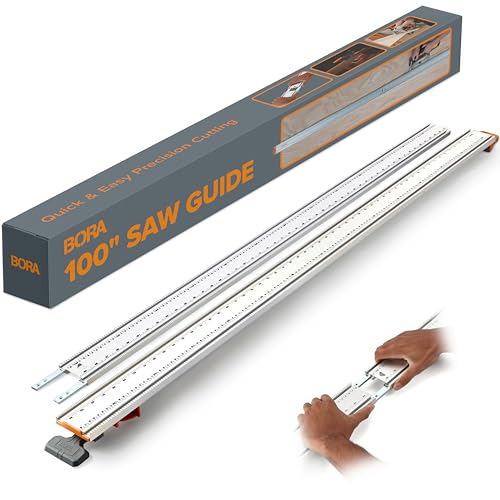
When dealing with four-by-eight sheets of cabinet-grade sheet stock, managing material scale dictates whether a cut feels effortless or hazardous. In a standard table saw vs track saw comparison, a track saw completely changes the dynamic of sizing sheet goods. Instead of wrestling an unwieldy eighty-pound sheet of three-quarter-inch hardwood plywood across a small cast-metal top, you lay the sheet flat on a sacrificial foam board or support grid and place the rail directly on your layout marks. Dedicated rail systems like the BORA NGX Circular Saw Guide Rail combine a 50-inch clamp edge with a 50-inch extension to provide 100 inches of continuous guide track, easily traversing the entire eight-foot length of full panels in a single, uninterrupted pass.
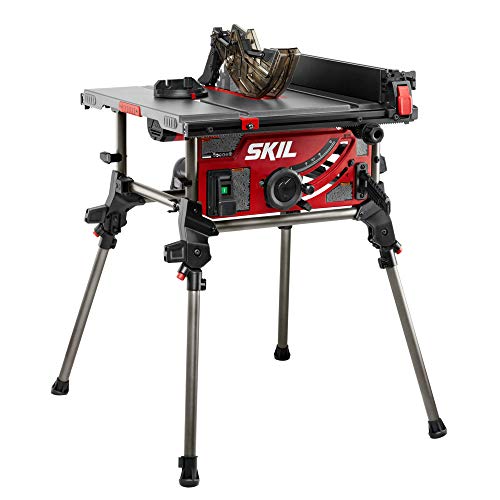
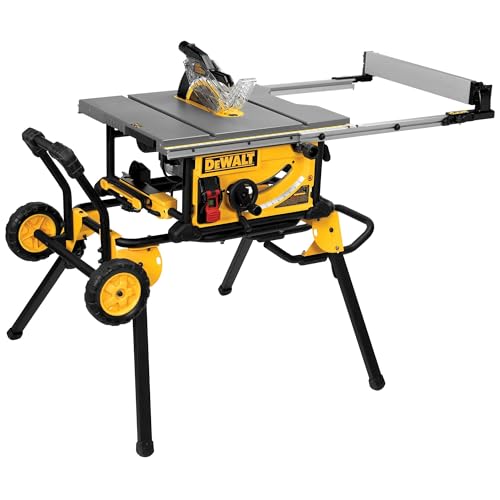
Jobsite table saws run into rigid geometric limits when confronted with full panels. The SKIL TS6307-00 provides a 25-1/2-inch rip capacity, which handles half-sheets and standard cabinet widths but cannot rip the center of a four-foot-wide board. Stepping up to larger portable units like the DEWALT DWE7491RS extends that barrier to a 32-1/2-inch rip capacity. While that extra width allows cabinetmakers to cut wider panels, feeding a full eight-foot panel into a 21-7/8-inch by 26-3/8-inch table surface single-handedly requires considerable outfeed support and careful muscle control to keep the edge flush against the fence.
For builders assessing a track saw or table saw for plywood, track systems remove the physical strain and kickback danger inherent in balancing large sheets on compact machine tables. Compact guides like the Milescraft 1409 Track Saw Guide offer 50 inches of cut length straight out of the box, perfect for crosscutting sheets down to manageable sub-panels. When full-sheet ripping is the daily routine, the track saw delivers boundless cutting reach without requiring expansive infeed and outfeed tables.
Edge: Track saw provides superior capacity and safety for managing full-size sheet breakdown.
Cutting Accuracy and Repeatability
Evaluating track saw vs table saw accuracy requires distinguishing between two distinct types of precision: cutting directly to a laid-out pencil mark versus reproducing identical dimensions across twenty consecutive workpieces. Track saws excel at the former. The Milescraft 1409 features a sacrificial red cutting strip that acts as an exact cut guide right against the blade edge, reducing splintering and chipping on delicate veneers. Similarly, the rigid aluminum straight edge of the BORA NGX locks firmly into place using an integrated Quick Lock clamp handle, ensuring your saw tracks dead-straight along the drawn pencil line without drifting.
However, when a project demands eight drawer sides or four cabinet stiles cut to the exact same millimeter, track saws slow down dramatically. Because a track saw possesses no automated referencing fence, you must measure, mark both ends, align the rail to the marks, and clamp the guide rail down for every individual cut. Human error in pencil marking or rail placement will inevitably create microscopic variances from piece to piece, making true batch consistency labor-intensive.
This is precisely where jobsite table saws dominate. Modern table saws feature rack and pinion fence rails that keep the fence locked perfectly parallel to the blade through geared tracks at both ends of the table. The DEWALT DWE7491RS utilizes a telescoping rack and pinion fence system that lets you set a measurement on the onboard scale, lock it down with a single lever, and rip dozens of pieces with absolute, identical repeatability. Woodworkers comparing precision options across platforms-such as the dewalt dwe7485 vs dwe7491rs-often find that rack-and-pinion gearing remains the gold standard for swift, repeatable joinery dimensions.
Edge: Table saw wins for fast, foolproof repeatability, while track saws win for cutting directly along arbitrary surface markings.
Workshop Space and Portability
Shop space is frequently the deciding factor when choosing a track saw or table saw for small shop configurations. A table saw demands not only its physical machine footprint, but also a dedicated operational envelope. To rip an eight-foot board on a table saw, you need eight feet of clear runway in front of the blade for infeed, another eight feet behind the blade for outfeed, and clearance on the sides. While the SKIL TS6307-00 includes integrated folding legs and the DEWALT DWE7491RS incorporates a heavy-duty rolling stand, the Dewalt unit weighs 110 pounds, making it a substantial piece of equipment to lift into a truck bed or maneuver up basement stairs.
In contrast, track systems take up virtually zero permanent floor space. The aluminum guide rails can hang on a wall hook or tuck into an unused corner behind a door. The Milescraft 1409 weighs a mere 1 pound, and the 100-inch heavy-duty aluminum BORA NGX weighs just 3.96 pounds. Instead of clearing wide pathways across your shop to move wood through a saw, you can set down a folding work table or rigid foam insulation board on the floor, place the sheet on top, and walk alongside it.
For mobile contractors, mobile carpenters, and woodworkers operating out of a shared single-car garage, the difference in handling effort is immense. Transporting a circular saw and an aluminum rail requires minimal cargo space, whereas loading a 50-to-110-pound table saw demands significant trunk room and muscle. If physical storage space and effortless jobsite transport dictate your tool purchases, track guides provide an unmatched spatial advantage.
Edge: Track saw wins easily on storage footprint and physical portability.
Setup Speed and Production Workflow
How a tool integrates into your cutting sequence fundamentally influences overall project speed. For carpenters breaking down lumber for framework or trim, a table saw review always highlights setup immediacy. With a table saw, your fence is always mounted, calibrated, and ready. If you need a board ripped from four inches down to three and a half inches, you unlock the fence, dial the rack-and-pinion knob, lock the lever, flip the power switch on the 15-Amp motor, and push the board through using the included push stick. The entire operation takes under twenty seconds.
The track saw workflow involves significantly more procedural steps for basic dimensioning. To rip that same board, you must place the board on a supportive, non-marring cutting surface, measure the width on the front and back ends, lay down the track, align the edge strip to both marks, engage the clamps-such as the one-sided adjustability Quick Lock mechanism on the BORA NGX-check clearance underneath, put on the saw, and make the cut. Repeating this process across multiple parts adds noticeable setup fatigue.
Furthermore, small workpieces present serious clamping difficulties for track systems. A track requires sufficient surface contact area to clamp securely without teetering. Ripping a narrow strip off a two-inch-wide board is nearly impossible with a track saw alone without packing out secondary support boards of identical thickness beside it. Table saws bypass this issue entirely; the DEWALT DWE7491RS even features a patented flip-over narrow ripping fence support specifically engineered to safely feed thin stock tight against the blade.
Edge: Table saw delivers substantially faster setup and higher operational efficiency for everyday dimensioning.
Depth of Cut, Bevels, and Material Versatility
Material thickness separates light trim guides from heavy stationary cutting machines. Track saw guides designed for standard handheld circular saws are inherently constrained by the blade diameter and the thickness of the track extrusion itself. The Milescraft 1409 specifies a low profile that allows cutting over 1-3/4 inches deep, which is sufficient to slice through standard interior doors and typical sheet panels up to a maximum 2-inch depth. However, it cannot accommodate thick timber, structural framing, or thick dimensional hardwoods in a single pass.
Jobsite table saws are engineered specifically for deep capacity and heavy-duty stock preparation. Powered by 1800-watt, 15-Amp electric motors spinning 10-inch, 24-tooth carbide blades at up to 4800 RPM, these saws power through dense, thick hardwoods without stalling. The SKIL TS6307-00 features true 4×4 cutting capacity, allowing woodworkers to cleanly slice four-by-four posts at 90 degrees in a single pass. The DEWALT DWE7491RS delivers a 3-1/8-inch depth of cut at 90 degrees and 2-1/4 inches at 45 degrees, providing the muscle and clearance needed for thick lumber and framing materials.
Beveling mechanics also favor the table saw for heavy duty work. While track guides rely on the bevel housing of whatever circular saw base you attach-which shifts the blade pivot point and can chew into the track’s zero-clearance edge if not purpose-built-table saws feature mechanical trunnions with geared tilt controls. Both the Skil and Dewalt models feature solid positive stops at 0 and 45 degrees, with the Skil offering a 2 to 47-degree range. When examining alternatives like the dewalt dwe7485 vs skil ts6307-00, users consistently note that built-in bevel scales and blade alignment micro-adjustments provide structural versatility that rail attachments cannot duplicate.
Edge: Table saw wins decisively on cut depth, motor power, and heavy timber handling.
Pros and Cons
Track Saw
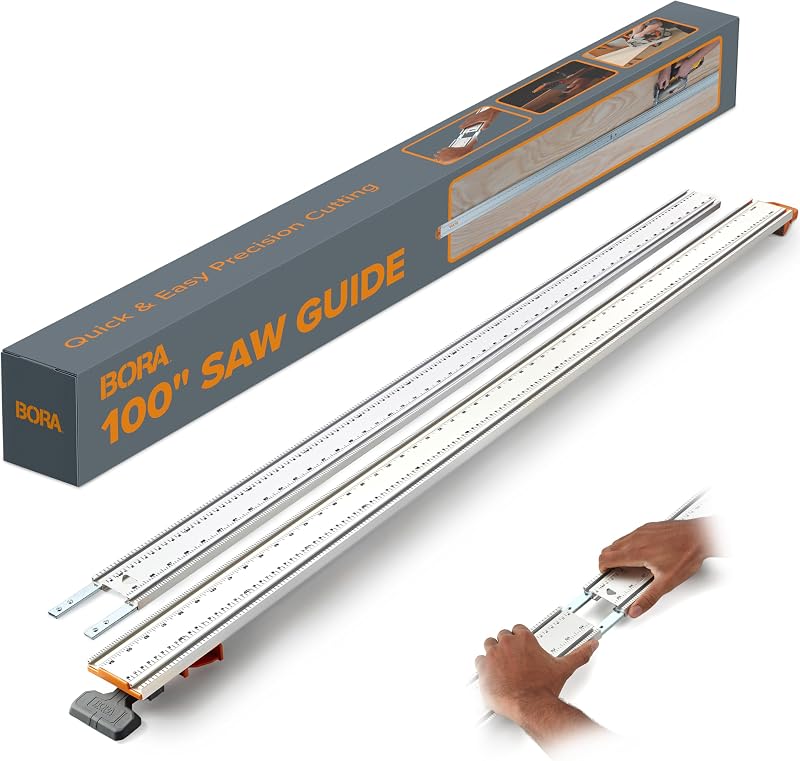
Pros
- Full 100-inch continuous cutting reach
- Lightweight guide rails under 4 pounds
- Zero-clearance cut strip prevents splintering
- Safe one-person sheet breakdown
Cons
- Requires manual alignment for every cut
- Cutting depth limited to two inches
- Cannot safely cut narrow workpieces
View BORA NGX Circular Saw Guide Rail on Amazon
Table Saw

Pros
- Geared rack and pinion fence precision
- Deep 3-1/8 inch and 4×4 cutting capacity
- Rapid repeatability without rail clamping
- Integrated folding and rolling jobsite stands
Cons
- Heavy footprint weighing up to 110 pounds
- Rip capacity capped at 32-1/2 inches
- Difficult to feed full sheet panels solo
View SKIL 15 Amp 10-Inch Jobsite Table on Amazon
Who Should Buy Each One
Choose the Track Saw If
- Your projects primarily involve breaking down 4×8 plywood sheets for cabinets, shelving, and paneling without an assistant.
- You work in a small shop, basement, or garage where you cannot justify dedicating permanent floor space to wide infeed and outfeed runs.
- You need to trim installed doors, scribe irregular wall angles, or make long mitered panel cuts directly on the jobsite.
- You already own a compatible 7-1/4-inch circular saw and want high-precision straight edges without carrying 50 to 110 pounds of machinery.
Choose the Table Saw If
- You regularly rip solid hardwood lumber, framing 2x4s, or 4×4 timber requiring up to 3-1/8 inches of cutting depth.
- Your workflow relies on producing batches of identical-width boards rapidly using a geared rack and pinion fence.
- You cut narrow strips, face frames, and small project parts that are too small to support a clamped guide rail.
- You want an integrated, all-in-one cutting station with dedicated 15-Amp power, built-in dust ports, and integrated folding or rolling stands.
Final Verdict
When weighing a track saw against a table saw, neither tool completely replaces the other because their core design philosophies address opposite ends of the cutting spectrum. The track saw is the undisputed champion of sheet goods and jobsite mobility. Guiding a light aluminum extrusion like the 100-inch BORA NGX or the 50-inch Milescraft 1409 over full-sized four-by-eight panels eliminates the strain, awkward balancing, and safety hazards of managing large sheets alone. For cabinetmakers breaking down sheet stock in tight spaces or solo carpenters sizing doors, is a track saw worth it? Absolutely, because it delivers furniture-grade edges without demanding a massive workshop envelope.
Conversely, the table saw remains the foundational heart of traditional woodworking joinery and lumber dimensioning. If your work involves cutting solid boards, narrow trim, framing lumber, or dozens of identical cabinet rails, is a table saw worth it? Unquestionably. Tools like the SKIL TS6307-00 with its 4×4 cut capacity or the DEWALT DWE7491RS with its 32-1/2-inch rack and pinion fence execute repeat cuts with a speed and consistency no rail-and-clamp setup can replicate. Choose the track saw if sizing large flat panels in compact quarters defines your workflow; choose the table saw if processing dimensional lumber with rapid, repeatable accuracy is your daily priority.
FAQ
Can a track saw completely replace a table saw?
No, a track saw cannot completely replace a table saw for general woodworking. While a track saw excels at breaking down large sheet materials and long straight cuts, it struggles with repetitive cuts on identical parts and cannot safely cut narrow boards or small pieces that do not offer enough surface area to support and clamp the guide rail. Additionally, track saws lack the 3-1/8-inch cut depth necessary to slice through thick 4×4 dimensional stock in one pass.
Is a table saw or track saw for beginners safer to use?
For breaking down large plywood panels, a track saw is substantially safer for beginners. Handling an eighty-pound sheet across a spinning table saw blade carries a high risk of binding and kickback if the wood drifts away from the rip fence. A track saw clamps securely to the stationary panel, allowing a beginner to guide the saw forward with both hands on the tool while the material rests safely on a support table or foam grid.
How do track saw vs table saw rip capacity limits compare?
Table saws are mechanically limited by the reach of their fence rails. Compact jobsite saws like the SKIL TS6307-00 top out at a 25-1/2-inch rip capacity, while larger portable models like the DEWALT DWE7491RS reach 32-1/2 inches. In contrast, a track saw system has an effective rip width limited only by the size of the room, as rails like the BORA NGX span 100 inches lengthwise and can be positioned at any distance across a panel.
Can I use any circular saw on a track saw rail?
Universal track guide systems like the Milescraft 1409 and BORA NGX are engineered to clamp or adapt to most standard circular saws up to 7-1/4 inches. However, compatibility is not universal across all tool designs; for example, the Milescraft listing explicitly states that it is not compatible with most worm drive style saws. Dedicated plunge-cut track saws, by contrast, feature proprietary bases molded specifically to interlock with brand-specific track channels.
Which tool is better for dust collection?
Both systems provide dedicated dust management, but table saws typically feature integrated dust port elbows or 2-1/2-inch vacuum hookups beneath the blade shroud, as seen on the DEWALT DWE7491RS. Track saw dust collection depends heavily on the circular saw mounted to the guide; while purpose-built plunge track saws have enclosed blade guards that capture nearly all airborne debris, universal guide rails running open circular saws will eject more stray dust unless your saw features a sealed shroud port.
How do setup times compare between the two systems?
Table saws offer dramatically faster setup times for everyday cuts. Once the fence is set against the rack-and-pinion ruler scale, you can cut multiple pieces in rapid succession without measuring again. A track saw requires measuring both ends of the stock, aligning the track edge strip against both pencil marks, and clamping the rail down securely before every individual cut, making batch production considerably slower.
Related reading: sawstop jss-120a60 vs skil ts6307-00, dewalt dwe7485 vs sawstop jss-120a60.