Choosing between the Werner MT-22 and the Little Giant Velocity comes down to a fundamental choice between raw vertical extension reach and compact rolling maneuverability. The Werner multi-ladder extends to an impressive 19-foot maximum extension height that excels at tackling high exterior rooflines, second-story siding, and tall commercial walls. In contrast, the Little Giant Velocity emphasizes rapid transport and setup speed by integrating built-in Tip and Glide wheels alongside a much shorter 55-inch folded storage height, making it far easier to guide through standard interior doorways and tight hallways without straining your back.
Exterior contractors, roofers, and homeowners maintaining two-story properties should pick the Werner MT-22 for its superior extension elevation and extensive position count. Interior painters, facility maintenance technicians, and DIY remodelers who constantly shift work zones across flat floors should pick the Little Giant Velocity for its effortless rolling transport and swift locking adjustments.
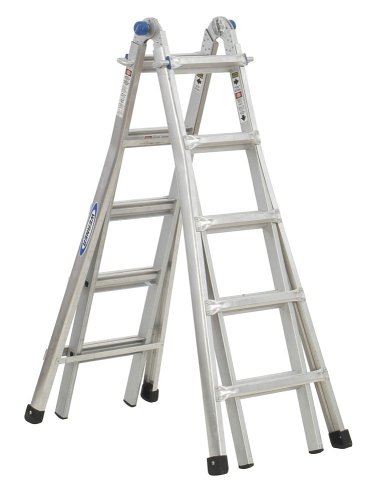

Werner MT-22 vs Little Giant Velocity at a Glance
| Attribute | Werner MT-22 | Little Giant Velocity |
|---|---|---|
| Ladder Type | Telescoping multi-ladder | Telescoping multi-position ladder |
| Maximum Extension Height | 19 feet (extends 11 ft to 19 ft) | 136 inches (listing specified) |
| Advertised Reach | Not listed (22-foot multi-ladder rating) | 18 ft Reach |
| Stepladder Working Height | 5 feet to 9 feet | Not listed |
| Duty Rating | 300-pound rating | 300 lbs. rating |
| Position Configurations | 28 working heights or positions | A-frame, Extension, Staircase, 90-degree, Trestle modes |
| Locking Mechanism | Soft-touch push knobs | Patented Rock Locks and Palm Buttons |
| Mobility System | Not listed | Tip & Glide wheels |
| Folded Dimensions (W x H) | 20 inches wide x 69 inches high | 24 inches wide x 55 inches high |
| Product Weight | The listing does not specify | 30.5 pounds |
| Manufacturer Warranty | The listing does not specify | Limited lifetime |
| Best For | High-elevation exterior projects | Frequent room-to-room interior mobility |
Working Height and Overhead Extension Reach
The primary reason tradespeople invest in multi-position ladders is to replace multiple bulky dedicated units with a single telescoping frame. When working outdoors on gutters, soffits, window trims, and roof edges, total overhead reach determines whether you can complete the task safely or end up stranded several feet short. In this category, the Werner MT-22 reach height provides a significant working advantage for demanding high-elevation jobs. As an extension ladder, the MT-22 telescopes from an 11-foot base setting up to a full 19-foot maximum extension, providing the necessary elevation for exterior maintenance on typical two-story residential homes.
By comparison, the Little Giant Velocity listing highlights an 18-foot total reach, while its detailed specifications cite a maximum ladder height of 136 inches (approximately 11.3 feet). This makes the Velocity an outstanding selection for standard residential ceiling heights, foyer chandelier servicing, single-story gutter clearing, and interior drywall finishing. However, when evaluating the werner mt-22 vs louisville fe3220 or comparing it directly to the Velocity, the Werner MT-22 delivers substantially more vertical reach in extension mode. For exterior specialists who frequently work above the first story, the Werner eliminates the need to haul a secondary heavy fiberglass extension ladder to the job site.
Beyond straight extension setups, the difference in stepladder heights alters how both tools function in freestanding mode. The Werner multi-ladder adjusts in self-supporting A-frame stepladder mode between 5 feet and 9 feet, allowing users to select the exact rung elevation required for overhead painting or tree pruning away from supportive wall structures. The Velocity listing does not specify distinct stepladder height increments, focusing instead on overall versatile positioning. If your seasonal projects regularly call for cleaning second-story windows or accessing steep roof overhangs, the Werner provides the required vertical safety margin.
Edge: Werner MT-22 provides substantially taller extension ladder height for demanding high-elevation tasks.
Mobility, Weight, and Transport Convenience
A multi-ladder cannot deliver value if moving it across the work site leads to physical exhaustion before the project even begins. Multi-position aluminum units are inherently heavier than traditional single-purpose ladders due to their overlapping telescoping rails, dual-hinge mechanisms, and internal lock pins. Moving a heavy frame through landscaped yards, up stairs, or through narrow interior hallways quickly exposes how well each manufacturer accounted for user ergonomics during transit.
The Little Giant Velocity holds a clear operational advantage in transit due to its built-in Tip & Glide wheels. When you need to relocate the ladder between rooms or roll it across a smooth driveway, you simply tilt the folded frame onto the durable bottom wheels and pull it effortlessly behind you. This design eliminates the need to carry the full 30.5-pound weight across your shoulder, drastically cutting down on fatigue during multi-room interior renovations. When reviewing the little giant vs werner product line, the inclusion of integrated wheels remains one of Little Giant’s signature mobility features.
The Werner MT-22 listing does not specify an official product weight, nor does it list integrated transport wheels. Carrying the Werner requires picking up the full structural frame manually or using a shoulder-carry technique. Furthermore, the Werner stands 69 inches high when completely retracted, making it over a foot taller than the Velocity when packed away. Maneuvering the 69-inch Werner around sharp stairwell corners or through standard interior doorways requires careful attention to avoid scuffing drywall and doorways, whereas the 55-inch compact height of the Velocity rolls under standard door jambs with ease.
Edge: Little Giant Velocity dominates transport convenience with its lighter folded stature and integrated Tip & Glide wheels.
Adjustment Mechanisms and Speed of Setup
Multi-ladders require constant readjustment as you transition from flat walls to unlevel terrain or change your working elevation. If the adjustment hardware is stiff, cumbersome, or hard to manipulate while supporting the ladder’s weight, repositioning becomes frustrating and slows down workflow. Both Werner and Little Giant have engineered proprietary hardware systems to handle these transitions, yet they function with distinctly different user mechanics.
The Little Giant Velocity incorporates patented Rock Locks along the outer telescoping rails paired with oversized Palm Buttons at the central articulating hinge. To extend or retract the outer rungs, you simply push the lower edge of the Rock Lock to disengage the pins, slide the inner rails smoothly to the desired height, and lock them in place with a firm push. The Palm Buttons make setting the main hinge angle straightforward: tap the round button with your palm to unlock the joint, pivot the ladder into an A-frame, straight extension, or 90-degree position, and the mechanical hinge snaps securely into place with an audible confirmation.
The Werner MT-22 uses soft-touch push knobs to manage rail extensions and angle transformations. These push knobs are smooth to the touch, preventing finger pinching while cycling between different heights. While dependable and rugged for harsh job site environments containing dust and paint overspray, push knobs generally require a firmer two-handed coordination to hold the pins clear while aligning the telescoping rails. In head-to-head comparisons such as the little giant velocity vs king kombo, the Velocity’s rocker-latch mechanism is widely regarded as one of the fastest locking systems available for rapid one-person adjustments.
Edge: Little Giant Velocity provides faster transitions between modes thanks to its Rock Lock and Palm Button system.
Multi-Position Configurations and Staircase Setup
Versatility is the central selling point for both tools, allowing workers to adapt to challenging layouts where conventional ladders fail to provide level footing. Uneven ground, sunken living rooms, and complex switchback stairwells demand independently adjustable ladder legs so that the rungs remain horizontal and safe to climb.
The question of whether to choose the Werner MT-22 or Little Giant Velocity for stairs is easily answered: both excel on uneven ground because each telescoping side adjusts independently. On a stairwell, you can lengthen the downhill legs while shortening the uphill legs, allowing you to set up a rigid, perfectly vertical A-frame directly over the steps. This capability is invaluable for painting high stairwell walls, hanging light fixtures over landings, or reaching ceiling drywall above split-level steps.
Where the two ladders diverge is in their specialized position modes. The Werner MT-22 is advertised with 28 different working heights or positions, converting into a certified 2-person stepladder, an extension ladder, or splitting apart to form bases for a scaffold system. The double-sided stepladder design allows two workers to climb simultaneously, dramatically speeding up tasks like hanging commercial gutters or running electrical conduit. The Little Giant Velocity counters with its dedicated 90-degree wall position, which lets you stand the ladder flush against a flat vertical surface. This puts you directly over your work without leaning back awkwardly, a huge plus when cutting in paint lines right against tight wall corners.
Edge: Werner MT-22 offers a broader spectrum of 28 discrete position adjustments and 2-person stepladder capability.
Build Quality, Stability, and Footing Design
When working multiple rungs above the floor, structural rigidity and slip resistance are paramount. Both manufacturers constructed these multi-position ladders to meet stringent professional standards, utilizing heavy-duty aluminum alloys engineered to eliminate unwanted rail flex while supporting substantial operational loads.
The Werner MT-22 features professional-grade aluminum construction with double-riveted steps that withstand frequent climbing stress and heavy tool loads. It features a robust 300-pound duty rating to support a worker alongside full tool belts and material buckets. The base of the Werner is fitted with heavy-duty non-marring feet designed specifically for slip resistance across smooth surfaces like hardwood, tile, and wet exterior concrete without leaving unsightly black scuff marks behind. When evaluating a comprehensive werner mt-22 vs little giant king kombo evaluation, Werner’s solid rail riveting is consistently noted for maintaining long-term structural integrity under demanding outdoor conditions.
The Little Giant Velocity is built from lightweight aircraft-grade aluminum, designed to resist corrosion, rust, and heavy jobsite impacts while minimizing overall frame bulk. Like the Werner, the Velocity provides a certified 300 lbs. duty rating and includes wide flared outriggers at the base for lateral stability when extended. Furthermore, Little Giant backs the Velocity with a limited lifetime manufacturer warranty, whereas the Werner listing does not specify its warranty terms. When asking whether the Little Giant Velocity is worth it, the lifetime warranty and aircraft-grade aluminum frame confirm that it is built to deliver decades of reliable service.
Edge: Tie, as both multi-ladders provide robust 300-pound load capacities, slip-resistant feet, and heavy-duty aluminum construction.
Storage Footprint and Vehicle Transport
Storing and transporting a multi-position ladder when it is collapsed is a critical consideration for homeowners with limited garage space and contractors working out of standard service vehicles. Even though both ladders fold down into compact units compared to traditional 20-foot extension ladders, their collapsed physical dimensions differ considerably.
The Little Giant Velocity folds down to a remarkably compact package measuring 24 inches wide by 55 inches high. Standing at just over 4.5 feet tall when closed, it easily slides into the back of an SUV, a crossover with the rear seats folded down, or even standard vehicle trunks with pass-through capability. It can also be stored upright inside standard residential utility closets or tucked neatly under garage shelving. This compact storage profile makes it an exceptional choice for service pros who drive compact vans or work vehicles.
In contrast, the Werner MT-22 measures 20 inches wide by 69 inches high when retracted. At nearly 5 feet 9 inches tall in its most compact form, the MT-22 is roughly 14 inches taller than the Velocity when stored. While it is narrower across the base at 20 inches, the added vertical length makes it difficult to squeeze into smaller passenger vehicles, virtually requiring a full-size pickup truck bed, cargo van, or dedicated roof rack system. If vehicle cargo space is at a premium, the Velocity’s compressed height offers an undeniable advantage.
Edge: Little Giant Velocity stores in significantly tighter spaces due to its 55-inch collapsed profile.
Pros and Cons
Werner MT-22

Pros
- 19-foot maximum extension ladder height
- 28 working heights and positions
- Certified two-person stepladder mode
- Double-riveted steps for durability
- Heavy-duty non-marring slip-resistant feet
Cons
- No integrated transport wheels
- Taller 69-inch collapsed storage height
Little Giant Velocity

Pros
- Integrated Tip & Glide transport wheels
- Compact 55-inch collapsed storage height
- Fast-adjusting patented Rock Locks
- Flush 90-degree wall setup mode
- Manufacturer limited lifetime warranty
Cons
- Lower 136-inch maximum ladder height
- The listing does not specify stepladder heights
View Little Giant Velocity on Amazon
Who Should Buy Each One
Choose the Werner MT-22 If
- You regularly work on exterior maintenance tasks that require up to 19 feet of extension ladder reach.
- You need a certified two-person stepladder configuration so you and a coworker can work simultaneously.
- You want to build an elevated jobsite work platform by separating the sections into scaffolding trestles.
- You drive a pickup truck, work van, or trailer that easily accommodates a 69-inch collapsed ladder height.
Choose the Little Giant Velocity If
- You want integrated Tip & Glide wheels to easily roll the ladder between rooms without shoulder strain.
- You work alone and need a manageable 30.5-pound frame that adjusts quickly using Rock Locks.
- You frequently paint or remodel tight interiors that benefit from a flush 90-degree wall positioning mode.
- You have limited storage space and need a multi-ladder that retracts down to just 55 inches in height.
Final Verdict
For most interior tradespeople, general handymen, and active homeowners, the Little Giant Velocity is the overall winner. Its combination of integrated Tip & Glide wheels, a manageable 30.5-pound total weight, rapid Rock Lock adjustments, and an ultra-compact 55-inch collapsed height makes it far more practical for daily residential use. You can easily roll it down hallways, set it up flush against walls in 90-degree mode, and slide it into the back of a standard passenger vehicle without fighting unwieldy ladder rails.
However, if your primary workload involves exterior home maintenance, roofing projects, or two-story commercial painting, the Werner MT-22 is the superior choice. Its 19-foot maximum extension height provides substantial reach advantages that the shorter Velocity cannot match, while its 28 height configurations and 2-person stepladder capability give exterior crews the structural flexibility they need to finish elevated jobs safely.
FAQ
How does the Werner MT-22 reach height compare to the Little Giant Velocity?
The Werner MT-22 provides significantly taller extension reach, extending from an 11-foot base height up to a full 19-foot maximum extension ladder height. The Little Giant Velocity listing specifies an 18-foot reach with a maximum ladder height of 136 inches (approximately 11.3 feet), making the Werner the clear favorite for reaching two-story gutters and high exterior walls.
Can I use the Werner MT-22 or Little Giant Velocity on stairs?
Yes, both models feature independently telescoping outer rails that allow you to set up a perfectly level, stable A-frame stepladder directly over staircases. You simply extend the downhill legs while keeping the uphill legs shortened, locking them securely at the proper height for your step elevation.
Does the Werner MT-22 include transport wheels?
The Werner MT-22 product listing does not mention or include transport wheels, requiring you to lift and carry the unit manually. The Little Giant Velocity, on the other hand, comes equipped with built-in Tip & Glide wheels that allow you to roll the folded frame across floors and walkways with minimal physical strain.
What are the duty ratings for the Werner MT-22 and Little Giant Velocity?
Both ladders carry a 300-pound duty rating. This capacity ensures that each multi-ladder can safely support a professional tradesperson, full tool belts, and necessary project materials without compromising structural stability.
How do the collapsed storage sizes compare between both ladders?
The Little Giant Velocity is noticeably more compact when closed, measuring 24 inches wide by 55 inches high. The Werner MT-22 measures 20 inches wide by 69 inches high, making it 14 inches taller when stored and considerably more demanding to fit inside passenger vehicles or low-ceiling closets.
What is the difference between the Rock Locks and the Soft-Touch push knobs?
The Little Giant Velocity uses patented Rock Locks on the outer rails and Palm Buttons on the hinge, which let you snap configurations into place using simple palm taps and finger latches. The Werner MT-22 uses soft-touch push knobs that smoothly depress to disengage locking pins, providing dependable tactile control that resists snagging or pinching your hands during height adjustments.


