The deciding difference between choosing a 32GB RAM setup and upgrading to a 64GB RAM configuration is total memory capacity under heavy parallel workloads. While general computing, standard desktop operations, and operating system processes consume modest memory pools, demanding creative suites and virtualization engines aggressively scale their throughput when provided with surplus uncompressed space. Having adequate memory headroom determines whether your PC holds live application data in low-latency system memory or repeatedly drops into drive-based swap paging that slows overall responsiveness.
Choose 32GB RAM if your primary workloads center on modern AAA gaming, general productivity, streaming, and moderate multitasking. Choose 64GB RAM if you regularly edit multi-stream 4K or 8K video, render complex 3D scenes, or host multiple virtual machines simultaneously on your desktop platform.


32GB RAM vs 64GB RAM at a Glance
| Attribute | 32GB RAM | 64GB RAM |
|---|---|---|
| Total Memory Capacity | 32 GB (2 x 16GB) | 64 GB (2 x 32GB) |
| Memory Generation | DDR4 | DDR5 |
| Data Transfer Rate | Up to 3200 MT/s | Up to 6000 MT/s |
| Primary CAS Latency | CL16 (16-18-18-38) | CL30 (30-40-40-96) |
| Operating Voltage | 1.35 V | 1.40 V |
| Overclocking Profile Standard | Intel XMP 2.0 | AMD EXPO |
| Form Factor and Pin Count | 288-pin UDIMM | 288-pin UDIMM |
| Error Correction Code | Non-ECC | Non-ECC |
| Validated Chipset Compatibility | Intel and AMD DDR4 Desktop Motherboards | AMD X870, X670, B850, B840, B650 Desktop Motherboards |
| Best For | Mainstream gaming, everyday multitasking, and office productivity | High-resolution video editing, virtual machine hosting, and heavy 3D rendering |
Gaming Performance and System Overhead
When evaluating 32GB or 64GB for gaming, real-world utility comes down to how modern game engines allocate assets. Modern AAA titles operate comfortably within 16GB to 24GB of total system memory allocation, even when running at maximum graphic presets. When pairing your game client with background software such as voice chat, web browsers with multiple active tabs, and operating system overhead, a 32GB configuration provides sufficient breathing room. Popular desktop modules such as the G.SKILL Ripjaws V kit operate at 3200 MT/s with tight CL16 timings, delivering responsive frame delivery across modern game titles without saturating memory address pools.
Upgrading to 64GB does not inherently raise baseline frame rates or improve frame pacing in games that do not exceed the 32GB limit. A system executing a title that requests 18GB of active memory performs identically whether it sits inside a 32GB pool or a 64GB pool, assuming identical memory speeds and timings. In a direct 32GB vs 64GB RAM performance assessment for dedicated gaming, the extra capacity of a 64GB kit remains dormant. The secondary memory blocks do not accelerate rendering threads if the working set fits entirely within the first 32GB of physical space.
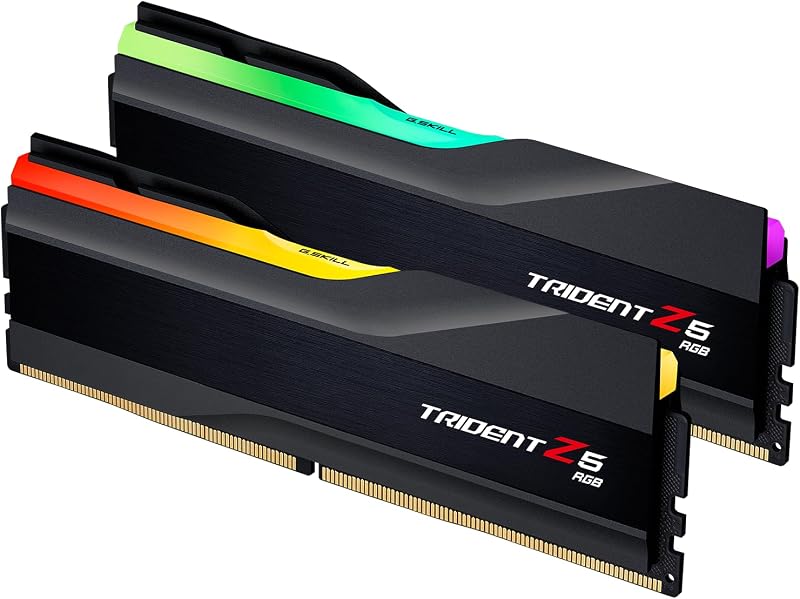
Certain simulation titles, heavily modded sandbox games, and flight simulators can consume memory far beyond typical titles when processing custom asset packs and ultra-high-resolution textures. However, for the vast majority of gaming catalogs, 32GB avoids the physical memory wall entirely. The listing data confirms that kits like the G.SKILL Trident Z RGB supply matched dual-channel 16GB modules, which keep dual-channel memory controllers operating efficiently without the overhead of higher-density module management. If you are examining whether is 32GB RAM enough for gaming today and into the immediate future, modern benchmarks confirm it handles modern gaming workloads without running out of room.
Edge: 32GB RAM. It supplies complete memory coverage for modern games and background applications without leaving half of the total capacity unutilized.
Content Creation and Video Editing Demands
Workstation tasks change memory dynamics dramatically, making the question of 32GB or 64GB for video editing central to content creators. Video editing applications such as DaVinci Resolve and Adobe Premiere Pro rely heavily on random-access memory to store uncompressed video frames for real-time timeline playback and multi-layer compositing. When editing 10-bit 4K footage or handling complex color grading, raw frame data rapidly consumes active memory. A 32GB pool fills quickly once timeline previews, audio tracks, transition buffers, and background caching services compete for space.
When physical capacity is exhausted, the operating system invokes disk paging, offloading active memory blocks to the system drive. Even on fast solid-state storage, drive swapping introduces micro-stuttering during timeline scrubbing and lengthens export queues. Stepping up to 64GB provides sufficient memory to preserve full video frame buffers directly in RAM. High-performance DDR5 kits like the G.SKILL Trident Z5 Neo RGB deliver 64GB capacity alongside 6000 MT/s throughput, allowing creative software to maintain complex timelines without purging cached frames from high-speed memory.
Beyond timeline playback, composite motion graphics and 3D rendering engines like Blender or After Effects scale their performance directly with available physical memory. In these applications, is 64GB RAM worth it becomes clear when previewing RAM-cached animations. A 64GB array allows multiple seconds of uncompressed frames to be rendered directly to cache for instant real-time review. In any comprehensive 64GB RAM review focused on production output, having that 64GB workspace prevents out-of-memory errors during export and eliminates timeline rendering slowdowns caused by memory starvation. Builders working on DDR4 platforms can also consult our G.Skill Ripjaws V DDR4 3600 vs Trident Z Neo DDR4 breakdown to evaluate workstation-level module options.
Edge: 64GB RAM. Doubling capacity prevents timeline caching bottlenecks, prevents disk swap paging, and maintains smooth playback during intensive video rendering.
Multitasking, Virtualization, and Heavy Workstations
The operational divide between 64GB vs 32GB RAM becomes most pronounced when managing simultaneous virtual environments and deep background task queues. In an intensive 32GB vs 64GB RAM multitasking environment, a power user may run multiple integrated development environments, compile software, manage containerized microservices via Docker, and keep dozens of browser documentation tabs open across several monitors. Under 32GB of capacity, these workflows run close to maximum limits, leaving minimal space for unexpected memory spikes or large background data sets.
Virtualization environments require fixed physical memory assignments for guest operating systems. If you run a host desktop and assign 16GB of memory to a Windows virtual machine and 8GB to a Linux guest, a 32GB system is left with only 8GB for the host OS and base applications. This immediate constraint forces host processes to compress memory pages. With a 64GB setup, such as a matched pair of modules like the G.SKILL Flare X5 kit, a user can comfortably dedicate 32GB to guest instances while preserving 32GB of unconstrained capacity for the primary workstation environment.
Engineering simulations, virtual machines, local machine learning models, and complex database testing setups demand massive contiguous address spaces. When comparing module pairings on newer motherboards, memory stability under heavy multi-threaded workloads is critical. Builders evaluating platforms often compare boards like the MSI MAG B650 Tomahawk WiFi vs Pro B650-P WiFi to confirm stable multi-channel memory support. Having 64GB allows software developers and system administrators to run full multi-tier production environments locally without system slowdowns.
Edge: 64GB RAM. It provides the essential address space required to isolate large blocks of memory for virtual machines, containers, and complex development stacks.
Platform Architecture, Memory Speeds, and Bandwidth
Evaluating memory capacity also involves understanding the underlying memory generation and data transfer architecture. The representative 32GB options in this comparison utilize the mature DDR4 standard, operating at a transfer rate of 3200 MT/s. In contrast, the representative 64GB kits are built on the DDR5 generation, which moves data at a rate of 6000 MT/s. Data transfer rate represents raw throughput: 6000 MT/s moves roughly double the theoretical megabits per second per pin compared to 3200 MT/s, drastically improving memory bus bandwidth for high-core-count processors.
However, memory speed must be evaluated alongside Column Address Strobe (CAS) latency. The 32GB DDR4 modules run with a primary CAS latency of CL16, with full sub-timings rated at 16-18-18-38. The 64GB DDR5 modules feature a rated CAS latency of CL30, running sub-timings of 30-40-40-96. While a rating of CL30 appears substantially higher on paper, DDR5 compensates with higher transfer frequencies and split internal 32-bit subchannels per DIMM, which improves overall bus efficiency. For a closer look at styling and heat spreader choices between DDR5 designs, see our comparison of the G.Skill Trident Z5 RGB DDR5 6000 vs Flare X5 DDR5 6000.
Operating voltage also differs between these architectures based on manufacturer specifications. The 32GB DDR4 kits require 1.35 volts to maintain their 3200 MT/s XMP profiles, whereas the 64GB DDR5 kits require 1.40 volts to sustain their 6000 MT/s EXPO profiles. Both platforms share a standard 288-pin desktop form factor, but the pinout, keying notch, and internal power management architectures are physically incompatible across generations. The generation you choose depends on your motherboard socket and processor family, such as those discussed in our analysis of the ASUS ROG Strix Z790-A vs TUF Gaming B860-Plus.
Edge: 64GB RAM. The representative 64GB DDR5 kits provide a higher data transfer rate of 6000 MT/s, delivering superior memory bus bandwidth over DDR4 3200 MT/s kits.
Matched Kits, Stability, and Overclock Profiles
Memory reliability is governed by strict manufacturing and configuration rules regardless of capacity. Both the 32GB and 64GB product listings explicitly warn users never to mix memory kits. Memory modules are sold in matched, factory-tested kits engineered to run together as a single set. Combining two separate 32GB kits to create a 64GB array, or mixing individual sticks from different batches, frequently results in system failure, failed boot sequences, or random blue-screen errors due to minute differences in sub-timing tolerances and silicon binning.
Both capacities rely on manufacturer-certified overclock profiles to achieve their advertised speeds beyond standard JEDEC defaults. The 32GB DDR4 kits incorporate Intel XMP 2.0 (Extreme Memory Profile), which automatically adjusts the motherboard BIOS settings to 3200 MT/s at 1.35V with CL16 latency. The 64GB DDR5 kits feature AMD EXPO (Extended Profiles for Overclocking), designed specifically for AMD platforms including the X870, X670, B850, B840, and B650 chipsets to reach 6000 MT/s at 1.40V with CL30 latency. Both setups boot at standard JEDEC default SPD speeds until the user explicitly enables XMP or EXPO within the system BIOS.
Operating these kits outside manufacturer parameters or failing to check the motherboard Qualified Vendor List (QVL) can lead to system instability. Both 32GB and 64GB options operate as non-ECC (non-error-correcting code) unbuffered DIMMs (UDIMMs) designed for standard desktop platforms. Builders considering alternative DDR4 memory kits can also review our comparison of the Corsair Vengeance RGB Pro DDR4 vs Kingston Fury Beast DDR4 to see how manufacturer profiles and timings compare across competing desktop kits.
Edge: Tie. Both capacities adhere to the same critical operational rules regarding matched kits, non-ECC UDIMM design, BIOS profile activation, and validated platform compatibility.
Pros and Cons
32GB RAM

Pros
- Optimal capacity for modern PC gaming
- Low CL16 latency on DDR4 platforms
- Broad compatibility with older desktop systems
- Lower operating voltage at 1.35V
Cons
- Bottlenecks heavy 4K and 8K rendering
- Restricts concurrent virtual machine instances
View G.SKILL RipjawsV Series DDR4 RAM (XMP) on Amazon
64GB RAM

Pros
- Doubled headroom for heavy multitasking
- Eliminates disk paging during video editing
- High bandwidth up to 6000 MT/s DDR5
- Supports extensive virtual machine memory pools
Cons
- Higher operating voltage at 1.40V
- Excess unused capacity for pure gaming
View G.SKILL Trident Z5 Neo RGB Series on Amazon
Who Should Buy Each One
Choose 32GB RAM If
- Your primary desktop activities consist of modern PC gaming, live web streaming, and standard everyday productivity.
- You are building or maintaining a desktop system built around a DDR4-compatible motherboard and processor.
- You want snappy multitasking performance across web browsers, office suites, and media players without paying for idle capacity.
- You prefer lower operating voltages (1.35V) and lower CAS latencies (CL16) on established desktop platforms.
Choose 64GB RAM If
- You regularly edit high-bitrate 4K, 6K, or 8K video timelines in DaVinci Resolve or Adobe Premiere Pro.
- You run multiple virtual machines, Docker containers, or local database environments that require dedicated memory allocations.
- You utilize complex 3D modeling and animation software like After Effects and Blender that cache frames directly to system RAM.
- You are building an AMD AM5 desktop system with an X870, X670, or B650 motherboard optimized for 6000 MT/s AMD EXPO profiles.
Final Verdict
For the majority of PC builders and dedicated gamers, 32GB RAM remains the practical performance standard. Modern desktop operating systems and high-end video games operate well within a 32GB memory footprint, leaving ample overhead for background voice chat, game launchers, and web browsers. In a standard 32GB RAM review context, kits running at 3200 MT/s with CL16 timings provide snappy memory response and reliable dual-channel bandwidth. Choosing 32GB prevents leaving system memory capacity unutilized while keeping power draw down at 1.35V.
On the other hand, 64GB RAM is the clear winner for professional content creators, software engineers, and power users who push parallel computing limits. The doubled address space prevents workstation applications from dropping into slow drive-based swap files during intense 4K timeline rendering, 3D composition, and multi-guest virtualization. Furthermore, high-performance 64GB kits moving at 6000 MT/s under AMD EXPO provide the massive bandwidth required by high-core-count processors on modern chipsets. If your daily workflow generates sustained multi-gigabyte memory loads, 64GB provides the essential headroom needed for reliable workstation stability.
FAQ
Is 32GB RAM enough for PC gaming in 2025?
Yes, 32GB of RAM is more than enough for modern PC gaming. Current AAA video games generally consume between 12GB and 24GB of system memory under maximum settings. Having 32GB provides ample headroom for the game client, operating system background processes, and auxiliary applications like Discord or web browsers without causing memory exhaustion.
Is 64GB RAM worth it for video editing?
Yes, 64GB of RAM is highly beneficial for video editing, particularly when working with 4K, 6K, or 8K footage in applications like Adobe Premiere Pro and DaVinci Resolve. Extra memory allows creative software to store uncompressed video frames and timeline caches directly in high-speed RAM, which eliminates timeline stuttering and avoids slow disk swap paging.
Can you mix two separate 32GB kits to reach 64GB?
No, the product specifications explicitly warn against mixing memory kits. Memory modules are sold in matched kits that are factory-tested to run together as a single set. Combining two separate kits, even of the same brand and model, frequently leads to memory timing mismatches, system instability, or boot failures.
Does upgrading from 32GB to 64GB RAM increase FPS?
Upgrading from 32GB to 64GB will not increase frames per second in games if your total memory utilization remains under 32GB. Frame rate gains only occur when upgrading memory speeds and latency, or when the previous memory capacity was completely exhausted and forcing the system to page data to a storage drive.
What BIOS settings are needed to run these memory kits at rated speeds?
Both 32GB and 64GB memory kits will boot at standard JEDEC default SPD speeds out of the box. To reach their advertised speeds, such as 3200 MT/s or 6000 MT/s, you must enter the motherboard BIOS and enable the appropriate memory overclocking profile, such as Intel XMP 2.0 or AMD EXPO.
Which motherboard chipsets support 64GB DDR5 memory kits?
According to the product specifications, representative 64GB DDR5 kits featuring AMD EXPO profiles are validated for AMD platforms including the X870, X670, B850, B840, and B650 desktop chipsets. Users should consult their motherboard Qualified Vendor List (QVL) to verify full kit compatibility.