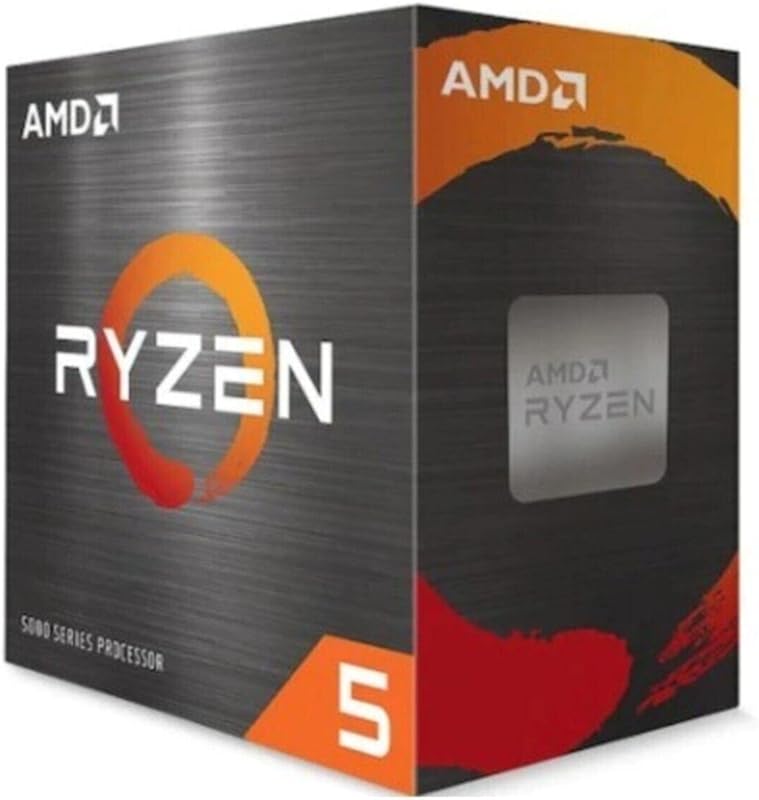
Choosing between the Intel Core i7-14700K and the AMD Ryzen 7 7800X3D comes down to whether your everyday system usage demands broad multithreaded compute power across 20 cores or pure low-latency gaming execution backed by specialized 3D V-Cache memory. While both processors stand at the center of high-performance desktop builds, their underlying design principles serve completely different user priorities.
Workstation operators and content creators balancing render queues, heavy video encoding, and virtual machines should choose the Intel Core i7-14700K for its massive thread count. Competitive players and enthusiasts seeking the highest sustained frame rates in simulation, strategy, and action titles should select the AMD Ryzen 7 7800X3D for its massive 96 MB L3 cache buffer.
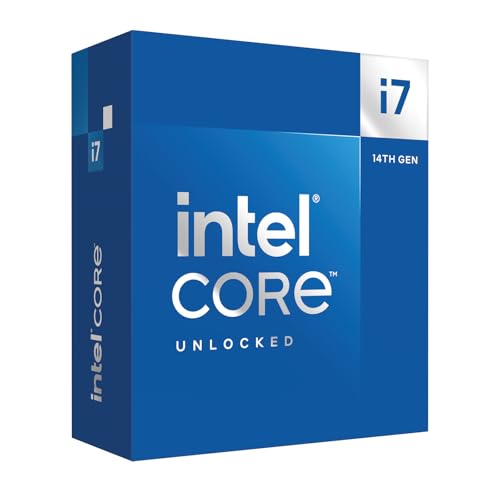

Intel Core i7-14700K vs AMD Ryzen 7 7800X3D at a Glance
| Attribute | Intel Core i7-14700K | AMD Ryzen 7 7800X3D |
|---|---|---|
| Processor Series | Core i7 | Ryzen 7 |
| Core Architecture | 20 cores (8 P-cores + 12 E-cores) | Octa-core (8 cores) |
| Concurrent Threads | 28 threads | 16 threads |
| Clock Speed | Up to 5.6 GHz | 4.20 GHz |
| Cache Configuration | 33 MB Secondary Cache | 8 MB L2 + 96 MB L3 (104 MB total) |
| Base Power Rating | 125 watts | 120 watts |
| Process Technology | Not listed | 5 nm |
| Motherboard Socket | LGA 771 (600/700 series chipsets) | Socket AM5 |
| Supported Platforms | Windows 11 | Windows 10, Windows 11 |
| Integrated Graphics | Intel UHD Graphics 770 | AMD Radeon Graphics (2200 MHz) |
| Best For | Multithreaded productivity, content creation, and hybrid multitasking | High-framerate gaming, latency reduction, and energy efficiency |
Core Architecture and Multithreaded Workloads
The fundamental structural division between these two central processing units lies in how they allocate physical computing resources. In any comprehensive Intel Core i7-14700K review, the defining engineering highlight is Intel’s hybrid design, pairing 8 Performance-cores with 12 Efficient-cores to deliver a total of 20 physical cores and 28 processing threads. In contrast, the AMD Ryzen 7 7800X3D relies on a homogeneous Zen 4 octa-core layout running 16 concurrent threads. When evaluating the i7-14700K 20 cores vs 7800X3D 8 cores for day-to-day productivity, the additional 12 threads on the Core i7-14700K allow the operating system to distribute massive compute tasks across distinct hardware blocks without choking foreground applications.
Heavy multithreading defines the modern creator workflow. When running an i7-14700K vs 7800X3D productivity benchmark suite covering video transcoding, 3D scene compilation, complex architectural modeling, and large archive compression, having 20 hardware cores allows the Intel chip to finish batch operations with substantial time savings. While the Ryzen 7 7800X3D executes multi-core workloads reliably using its efficient 5 nm Zen 4 architecture, an 8-core CPU cannot match the raw throughput delivered by a 20-core processor when all hardware execution units are fully saturated. Builders deciding on the Intel Core i7-14700K or AMD Ryzen 7 7800X3D for streaming and simultaneous background encoding will find that the Core i7-14700K offers much broader architectural headroom for complex broadcast layouts.
For readers tracking how generational upgrades stack up against previous flagships, exploring the intel core i7-13700k vs amd ryzen 7 7700x matchup highlights how quickly core counts and cache sizes have evolved. Ultimately, for software environments that scale linearly across thread pools, the physical core deficit of the Ryzen 7 7800X3D limits its ceiling compared to Intel’s dense hybrid design.
Edge: Intel Core i7-14700K provides an indisputable advantage in multithreaded compute workloads thanks to its 20-core, 28-thread hybrid configuration.
Gaming Architecture and Cache Memory
When gaming performance serves as the primary evaluation standard, the hardware equation inverts completely. Any detailed AMD Ryzen 7 7800X3D review centers on the processor’s extraordinary memory layout: an integrated 8 MB L2 cache paired directly with 96 MB of stacked L3 cache, creating an expansive 104 MB local cache reservoir. The Intel Core i7-14700K features 33 MB of secondary cache memory. In active gaming environments, cache capacity dictates how frequently the processing cores must fetch instructions from system system RAM, which introduces micro-latency and frame drops.
In side-by-side 7800X3D vs 14700K gaming performance assessments, the massive 96 MB L3 cache of the Ryzen 7 7800X3D drastically cuts memory latency in cache-sensitive engines. Titles that continuously simulate thousands of independent entities, such as open-world role-playing games, complex physics sandboxes, and competitive tactical shooters, see dramatic increases in both average frame rates and crucial 1% low frame stability. By holding vast segments of game logic directly on-die, the Ryzen 7 7800X3D bypasses external data bottlenecks, allowing the graphics pipeline to operate at maximum efficiency.
Much like the top-tier comparison between the intel core i9-14900k vs amd ryzen 9 7950x3d, the choice here hinges on whether raw execution pipelines or specialized cache architectures deliver the better return for your software stack. Because game engines rarely utilize more than eight physical processing cores, the extra compute clusters on the Core i7-14700K offer minimal benefit in gaming, whereas the massive L3 cache buffer on the Ryzen 7 7800X3D directly accelerates 3D frame rendering. Players wondering is AMD Ryzen 7 7800X3D worth it for dedicated gaming will discover that its architectural focus yields tangible frame-time smoothness.
Edge: AMD Ryzen 7 7800X3D wins decisively in pure gaming performance due to its massive 96 MB L3 3D V-Cache architecture.
Clock Speeds and Single-Core Responsiveness
Operating frequency governs how quickly a processor executes individual instructions when software cannot distribute its operations across multiple threads. The Intel Core i7-14700K ships with an aggressive maximum clock ceiling, scaling up to 5.6 GHz utilizing Intel Turbo Boost Max Technology 3.0. In contrast, the AMD Ryzen 7 7800X3D runs at a fixed listed clock speed of 4.20 GHz. Because the physical 3D V-Cache silicon layer is mounted directly on top of the processing die, thermal dissipation characteristics require the Ryzen 7 7800X3D to operate at lower clock parameters than standard Zen 4 desktop models.
The 1.4 GHz clock speed difference between these two processors creates noticeable variance in applications that prioritize single-thread velocity. Office suites, web application runtimes, code parsing scripts, and older game engines heavily reliant on a single primary dispatch loop show immediate responsiveness from the 5.6 GHz frequency of the Core i7-14700K. When analyzing Intel Core i7-14700K or AMD Ryzen 7 7800X3D for gaming titles that lack multi-core optimization and fail to exploit massive cache buffers, the higher clock speed of the Core i7-14700K ensures reliable, snappy execution.
Budget-conscious builders evaluating midrange options often review the intel core i5-14600k vs amd ryzen 5 7600x to see similar hybrid architecture trade-offs at an entry price point. When evaluating the AMD Ryzen 7 7800X3D vs Intel Core i7-14700K strictly on raw frequency output, the unlocked Intel desktop processor provides substantially higher single-core clock headroom.
Edge: Intel Core i7-14700K takes the lead with its 5.6 GHz Turbo Boost Max 3.0 capability versus the 4.20 GHz clock rate of the Ryzen chip.
Power Consumption and Thermal Operating Limits
Power delivery and thermal control dictate the scale of cooling hardware and power supply capacity required to build a stable desktop system. The product specifications outline distinct foundational envelopes: the Intel Core i7-14700K lists a 125W Processor Base Power, whereas the AMD Ryzen 7 7800X3D specifies a 120-watt power rating alongside an explicit maximum operating temperature limit (Tjmax) of 89°C. While both chips feature closely aligned advertised base wattages, real-world 14700K vs 7800X3D power consumption diverges significantly under sustained processing loads.
Intel’s 20-core arrangement can draw massive current when running uncapped under Turbo Boost parameters during all-core rendering tasks, demanding heavy thermal dissipation hardware to prevent throttling. Conversely, the AMD Ryzen 7 7800X3D leverages a dense 5 nm manufacturing process that achieves incredible operational efficiency. Under full gaming workloads, the 7800X3D consistently draws far less operational energy, staying well within its defined 89°C thermal boundary with standard air or closed-loop cooling configurations.
Extreme thermal demands are not unique to this tier, as seen in our breakdown of the intel core i9-14900ks vs amd ryzen 9 9950x3d where power envelopes play a decisive role in cooling requirements. For users operating compact chassis configurations, running long gaming sessions, or seeking to minimize room heat output, the power characteristics of the Ryzen 7 7800X3D provide a cleaner, more efficient thermal profile.
Edge: AMD Ryzen 7 7800X3D offers superior efficiency through its 5 nm manufacturing process and modest thermal dissipation requirements.
Platform Compatibility and Memory Support
Platform longevity and memory flexibility represent crucial considerations when assembling a modern system. The Intel Core i7-14700K supports both DDR4 and DDR5 memory standards, offering builders the choice between existing memory kits or ultra-fast modern modules. The Core i7-14700K is compatible with motherboards utilizing Intel 700-series chipsets as well as older Intel 600-series boards with a potential BIOS update, providing backwards compatibility for users upgrading existing LGA 771 systems without requiring a full motherboard replacement.
The AMD Ryzen 7 7800X3D docks into Socket AM5 and runs exclusively on Windows 10 and Windows 11 operating platforms, whereas the Intel specification highlights dedicated Windows 11 support. The Ryzen listing does not specify DDR4 memory support, centering its platform around high-speed memory architectures. While Socket AM5 represents AMD’s forward-looking motherboard standard, Intel’s architecture accommodates dual-memory generations and provides broad compatibility across two entire chipset series.
Both processors include integrated display output options to simplify system assembly, troubleshooting, and media handling. The Core i7-14700K incorporates Intel UHD Graphics 770, while the Ryzen 7 7800X3D features an integrated AMD Radeon Graphics controller clocked at 2200 MHz. For flexibility across diverse component selections and legacy memory kits, Intel’s platform offers wider hardware variability.
Edge: Intel Core i7-14700K secures the edge with dual DDR4 and DDR5 memory compatibility and cross-generation support on 600 and 700-series motherboards.
Pros and Cons
Intel Core i7-14700K

Pros
- 20 cores and 28 processing threads
- Turbo Boost clock reaches 5.6 GHz
- Supports both DDR4 and DDR5 memory
- Integrated Intel UHD Graphics 770
Cons
- 125-watt base power demands substantial cooling
- Smaller 33 MB secondary cache capacity
View Intel Core i7-14700K on Amazon
AMD Ryzen 7 7800X3D

Pros
- Massive 96 MB L3 cache memory
- High efficiency 5 nm Zen 4 process
- Integrated Radeon Graphics running at 2200 MHz
- Moderate 120-watt maximum power rating
Cons
- Limited to 8 cores and 16 threads
- Lower listed clock speed of 4.20 GHz
View AMD Ryzen 7 7800X3D on Amazon
Who Should Buy Each One
Choose the Intel Core i7-14700K If
- You run demanding multithreaded creative software such as 3D rendering engines, professional video editors, or intensive code compilers.
- You want the flexibility to use either DDR4 or DDR5 system memory on an Intel 600 or 700-series motherboard.
- You regularly stream gameplay while running hardware-intensive background encoding, chat applications, and system utilities concurrently.
- You require fast burst frequencies up to 5.6 GHz for single-threaded processing and everyday desktop responsiveness.
Choose the AMD Ryzen 7 7800X3D If
- Your primary desktop objective is achieving maximum frame rates and low-latency stability across modern PC games.
- You want the frame-time smoothing advantages provided by 96 MB of dedicated L3 3D V-Cache memory.
- You prioritize energy efficiency and want to keep operating power and room heat to a minimum via a 5 nm processor.
- You are building a modern Socket AM5 gaming rig designed around Windows 10 or Windows 11 platforms.
Final Verdict
For builders whose systems serve as comprehensive multimedia workstations, the Core i7-14700K represents the more complete computing solution. Its 20 cores, 28 execution threads, high 5.6 GHz Turbo Boost frequencies, and backward compatibility with DDR4 memory and 600-series chipsets make it exceptionally capable across creative, computational, and multitasking demands. When productivity schedules and multithreaded render pipelines define your system’s value, the Intel processor stands out.
However, for the dedicated gamer, the Ryzen 7 7800X3D is the superior choice. Its massive 96 MB L3 cache delivers class-leading gaming performance, smoothing out frame drops and maximizing high-refresh displays while maintaining an efficient 120-watt power envelope. Entry-level builders examining earlier generations via the intel core i5-13400f vs amd ryzen 5 5600 will find that the foundational differences between multi-core efficiency and gaming cache persist across modern price brackets. If your PC spends 80 percent of its active uptime inside game engines, the Ryzen 7 7800X3D remains the undisputed champion.
FAQ
Is the Intel Core i7-14700K or AMD Ryzen 7 7800X3D better for pure gaming?
The AMD Ryzen 7 7800X3D is generally superior for pure gaming due to its massive 96 MB L3 cache memory. This extra local memory capacity allows processing cores to access critical game engine assets almost instantly, resulting in smoother frame times and higher frame rates in cache-sensitive games.
Can the AMD Ryzen 7 7800X3D handle heavy video editing and content creation?
Yes, the AMD Ryzen 7 7800X3D handles content creation reliably with its 8 cores and 16 threads built on the 5 nm Zen 4 architecture. However, in heavy multithreaded workflows like 4K video exports and 3D rendering, the 20-core Intel Core i7-14700K completes batch operations significantly faster due to its higher thread count.
Does the Intel Core i7-14700K require a new motherboard?
The Intel Core i7-14700K is compatible with both Intel 700-series motherboards and previous-generation Intel 600-series chipsets, though the latter may require a BIOS update before the processor can be installed and operated properly.
Do both processors come with integrated graphics?
Yes, both desktop processors feature built-in graphics processing. The Intel Core i7-14700K features Intel UHD Graphics 770, while the AMD Ryzen 7 7800X3D includes an integrated AMD Radeon Graphics controller operating at a 2200 MHz graphics frequency.
What memory types do these processors support?
The Intel Core i7-14700K product listing confirms compatibility with both DDR4 and DDR5 platform memory standards, giving builders flexible system design options. The AMD Ryzen 7 7800X3D listing does not specify DDR4 memory support, operating on the newer Socket AM5 platform.
How do the power requirements compare between the two processors?
The Intel Core i7-14700K lists a 125-watt Processor Base Power, whereas the AMD Ryzen 7 7800X3D lists a 120-watt power rating. However, under heavy multithreaded workloads, the Intel processor utilizes substantially more energy to power its 20 cores, while the 5 nm AMD processor maintains high efficiency under gaming loads.