The core difference deciding between these two cordless tools comes down to smart connectivity versus raw driving power: the DeWalt DCF887 delivers a higher maximum torque rating of 2000 in-lb for demanding manual driving tasks, whereas the DeWalt DCF888 integrates Bluetooth Tool Connect technology with 1825 in-lb of torque to give fleet supervisors real-time tracking, diagnostics, and customized digital controls.
Individual carpenters, mechanics, and residential tradespeople who want straightforward power without needing a smartphone app should choose the DeWalt DCF887, while commercial crew managers, jobsite contractors, and facility teams requiring tool tracking and custom speed configurations should opt for the DeWalt DCF888.
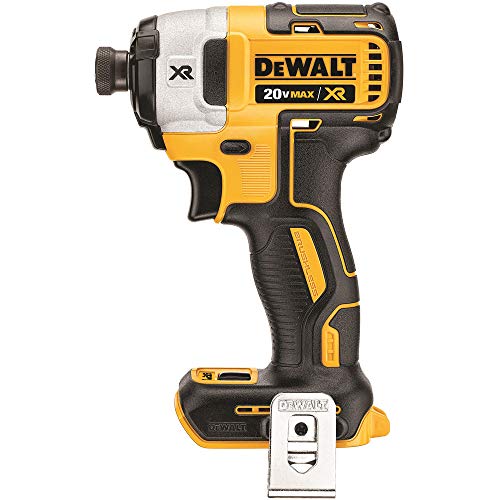

DeWalt DCF887 vs DCF888 at a Glance
| Attribute | DeWalt DCF887 | DeWalt DCF888 |
|---|---|---|
| Maximum Torque | 2000 in-lb | 1825 in-lb |
| Maximum Rotational Speed | 3250 rpm | 3250 rpm |
| Maximum Power | 300 watts | 300 watts |
| Speed Settings and Modes | 3 physical speeds with Precision Drive | Home mode plus 3 programmable digital modes |
| Wireless Connectivity | Not listed | Bluetooth Tool Connect |
| Worklight System | 3 LEDs with fixed 20-second delay | 3 LEDs with customizable brightness and delay |
| Chuck Design | 1/4-inch hex, accepts 1-inch bit tips | 1/4-inch hex (listing notes 20 mm chuck size) |
| Head Length | Not listed | 5.3 inches |
| Tool Weight (Bare) | Not listed | 2.8 lbs |
| Included Components | Bare tool (battery and charger sold separately) | Impact driver, two 2Ah batteries, charger, kit box |
| Best For | Individual tradespeople wanting peak torque | Contractors and crews needing inventory tracking |
Maximum Torque and Fastening Power
When driving long structural lag screws, ledger fasteners, or heavy-duty anchors into framing lumber, peak rotational torque dictates how efficiently an impact driver finishes the drive without stalling out. In any rigorous DeWalt DCF845 vs DCF887 or DeWalt 20V XR impact driver comparison, torque output remains a defining performance metric. The DCF887 generates up to 2000 in-lb of maximum torque alongside 300 watts of maximum motor power, providing the muscle required to power large fasteners home quickly. The listing indicates a drilling capacity of up to 2.68 inches in wood and 2 inches in metal, proving its utility as a primary construction driver.
In contrast, the DCF888 is rated at 1825 in-lb of maximum torque, which is 175 in-lb lower than its sibling, despite matching the same 300-watt maximum motor power. In practical field tasks, 1825 in-lb remains more than sufficient for standard framing screws, decking fasteners, self-tapping sheet metal screws, and general electrical installations. However, when evaluating the DCF887 vs DCF888 torque variance, users who frequently seat structural fasteners will notice that the DCF887 drives heavier fasteners with slightly less hesitation under prolonged resistance.
The difference in torque output is the direct trade-off for the internal electronic management found inside the connected model. If your daily workflow centers on pure driving power and high-torque mechanical fastening without digital intervention, the additional rotational twisting force of the standard unit provides a noticeable advantage on the job.
Edge: DeWalt DCF887 because it delivers a higher peak output of 2000 in-lb compared to 1825 in-lb on the DCF888.
Bluetooth Asset Tracking and Loss Prevention
Jobsite tool loss, inventory misplacement, and equipment theft can rapidly drain productivity and inflate replacement expenses on commercial projects. The DCF888 addresses this operational vulnerability by embedding Bluetooth Tool Connect directly into the base of the handle. Using the free Tool Connect Inventory Manager software, fleet supervisors can pair the tool in three to five seconds by pressing the foot-mounted button. Once registered, the tool communicates its status directly with connected smart devices.
The standout feature of this system is the Last Seen function, which records the physical street address where the impact driver was last in wireless range of a company device running the app. Administrators can set up a “disable when out of range” alert, preventing the motor from engaging if someone removes the tool from the authorized workspace. Crew leads can also assign tools to specific jobsites or individual technicians within the software, instilling accountability and eliminating confusion over tool ownership. For further context on how compact smart drivers fit into connected workflows, see our analysis of the DeWalt DCF809 vs DCF888.
The DCF887 offers zero wireless connectivity or tracking capability. If an individual misplaces the tool on a commercial deck or leaves it behind in an attic, there is no digital trail to aid recovery. For lone operators who guard their own tool bag, this omission is trivial, but for supervisors overseeing multiple workers, the tracking features alone answer whether is DeWalt DCF888 worth it.
Edge: DeWalt DCF888 because its integrated Tool Connect functionality provides Last Seen street location tracking, inventory management, and out-of-range motor disablement.
Diagnostic Reporting and Tool Health Monitoring
Maintaining battery-operated equipment requires insight into duty cycles, thermal performance, and internal wear, especially when tools are shared across shifts. The DCF888 acts as an intelligent diagnostic hub, transmitting telemetry directly to the companion app. Users can inspect the operating temperature of the motor and electronics, verify the health and remaining life of the internal coin cell battery powering the Bluetooth chip, check the cumulative operating runtime, and review the total number of trigger pulls the tool has executed.
These real-time diagnostics provide preventative maintenance advantages that traditional power tools cannot match. If an apprentice is overworking the driver or pushing it into thermal throttling, a manager can identify the temperature spike before internal components suffer damage. Tracking trigger pulls also allows service technicians to schedule routine inspections, chuck lubrication, and motor maintenance based on verified usage data rather than guesswork.
The DCF887 provides no diagnostic feedback or data logging whatsoever. Users must rely entirely on tactile feel, auditory motor pitch, and external casing heat to judge when the tool is reaching its operational limits. While seasoned tradespeople often manage fine using experience alone, having objective data prevents accidental tool burnout in demanding commercial environments.
Edge: DeWalt DCF888 because it monitors trigger pull counts, motor temperature, internal coin cell life, and running hours.
Customizable Modes and Trigger Sensitivity
Different fastening operations require distinct starting speeds, running rpms, and seating sensitivities to avoid stripping screw heads or snapping small bit tips. The DCF887 features a physical 3-speed sliding switch on its base. Speed 1 incorporates DeWalt Precision Drive, which provides added control by pausing momentarily before impacting begins, helping prevent damage to delicate materials. Speeds 2 and 3 step up the rpm, maxing out at 3250 rpm (with the listing also noting a 2800 rpm operational rating). This mechanical selector is intuitive, robust, and requires zero setup.
The DCF888 takes speed and torque control several steps further through its programmable digital architecture. The foot of the tool features a default Home mode alongside three fully customizable operational modes. Through the mobile app, users can dial in custom speed thresholds, restrict torque limits, and modify how the Precision Drive feature behaves. For instance, an electrician can configure Mode 1 specifically for delicate electrical faceplates, Mode 2 for conduit clamps, and Mode 3 for heavy strut framing.
This level of precision eliminates human error when junior workers tackle delicate finish surfaces. However, it does require maintaining an app connection to alter the profile parameters. For workers who prefer setting their tool once and never dealing with a phone interface, the physical switch on the DCF887 remains faster and simpler to operate between tasks. When evaluating the DeWalt DCF887 or DCF888 for contractors, the choice comes down to programmable digital safeguards versus instant mechanical adjustment.
Edge: DeWalt DCF888 because it offers three user-programmable digital modes with custom speed, torque, and Precision Drive tuning beyond the standard mechanical presets.
Worklight Visibility and Lighting Controls
Working in recessed cabinets, dark crawl spaces, mechanical chases, and unlit framing bays requires an effective shadow-free lighting solution. Both drivers feature a 3-LED halo array positioned around the chuck nosecone, casting balanced illumination forward without casting shadows from the bit sleeve. This circular arrangement represents a massive improvement over traditional single-LED drivers placed low on the battery base, as explored in our DeWalt DCF787 vs DCF887 guide.
The difference between the two models lies in how that lighting is managed. The DCF887 utilizes a factory-fixed system where the three LEDs activate on trigger squeeze and remain illuminated for exactly 20 seconds after releasing the trigger. This provides ample time to inspect the fastener or align the next screw in pitch darkness, but the duration and intensity cannot be altered.
The DCF888 integrates light control into its digital ecosystem. Through the Tool Connect app, operators can actively adjust the brightness output of the three LEDs to save battery juice or increase visibility. Furthermore, users can customize the light delay duration, extending it to act as a task light or reducing it to shut off immediately upon trigger release. For specialized technical work where glare is an issue, this adjustability is a valuable addition.
Edge: DeWalt DCF888 because it allows custom app adjustments for both LED brightness and shutoff delay times.
Chuck Design, Ergonomics, and Kit Inclusions
Both tools utilize a composite and blend body design wrapped in signature black and yellow styling, engineered to withstand rigorous jobsite drops and chemical exposure. The DCF888 listing provides concrete exterior dimensions, measuring 5.3 inches from front to back and weighing 2.8 lbs bare. Its compact profile lets tradespeople squeeze into narrow joist bays and deep cabinet boxes where bulkier drivers cannot seat perpendicular fasteners. For even smaller alternatives, tradespeople often evaluate the DeWalt DCF850 vs DCF887.
The DCF887 highlights an easy-grip sleeve on its 1/4-inch hex chuck that supports true one-handed bit insertion, accepting 1-inch bit tips directly without needing an extension sleeve. This feature is particularly valuable when working atop ladders or holding materials in place with an off-hand. The listing specifies a maximum chuck size of 6.35 millimeters (the metric equivalent of 1/4 inch), while the DCF888 listing references a 20 mm chuck size, though both function as quick-release impact chucks.
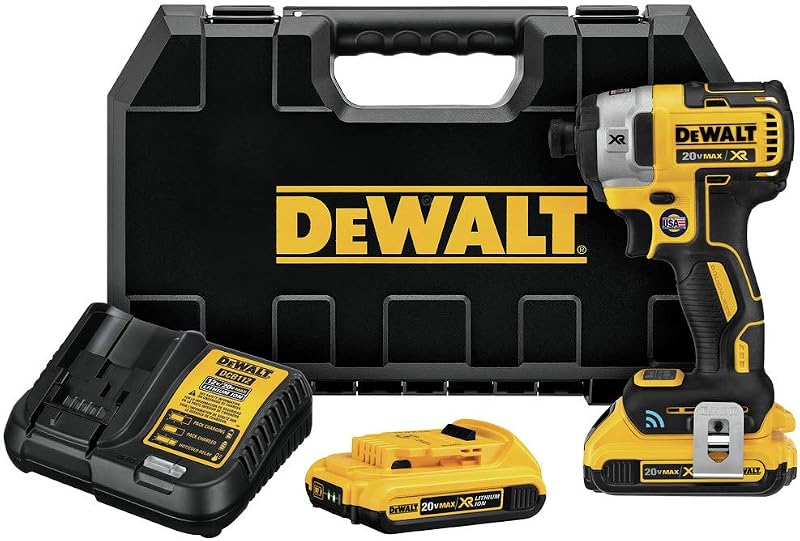
A notable DCF887B vs DCF888 difference lies in the retail packaging documented in their listings. The DCF887B is sold as a bare tool, meaning battery packs and chargers are sold separately. The DCF888D2 listing arrives as a complete kit, containing the Tool Connect impact driver, two DCB203 2Ah XR brushless battery packs, a charger, and a protective kit box. For someone entering the DeWalt 20V ecosystem without existing batteries, the DCF888 kit is ready to work out of the box, whereas the DCF887 bare tool caters to users who already own DeWalt batteries.
Edge: Tie. The DCF887 provides superior one-handed chuck loading with 1-inch bit tip compatibility, while the DCF888 kit includes two 2Ah batteries, a charger, and a storage box.
Pros and Cons
DeWalt DCF887

Pros
- 2000 in-lb maximum fastening torque
- One-handed loading 1/4-inch hex chuck
- Accepts 1-inch bit tips directly
- Simple physical 3-speed selector switch
- 300 watts maximum motor power
Cons
- No Bluetooth tracking or diagnostic telemetry
- Fixed 20-second LED shutoff delay
- Battery and charger sold separately
DeWalt DCF888
Pros
- Integrated Bluetooth Tool Connect tracking
- Three programmable custom operational modes
- Full kit includes two 2Ah batteries
- Comprehensive internal diagnostics and alerts
- Customizable LED brightness and delay times
Cons
- Lower maximum torque at 1825 in-lb
- Requires app pairing for mode customization
- Slightly higher operational complexity
Who Should Buy Each One
Choose the DeWalt DCF887 If
- You need the absolute maximum fastening power, benefiting from 2000 in-lb of rotational torque for structural lag screws and heavy timbers.
- You already own DeWalt 20V MAX batteries and prefer buying a bare tool without redundant accessories.
- You dislike managing tools through smartphone apps and prefer a simple mechanical 3-speed toggle switch on the tool foot.
- You frequently swap accessories one-handed while balancing materials, taking advantage of the chuck accepting 1-inch bit tips.
Choose the DeWalt DCF888 If
- You manage a commercial jobsite or maintenance crew and need Bluetooth Tool Connect to track tool locations and assign inventory.
- You need out-of-range disable alerts to secure your tools against jobsite walking and unauthorized off-hours use.
- You drive delicate fasteners into sensitive materials that require custom-programmed speed, torque, and Precision Drive profiles.
- You want a complete out-of-the-box package that includes two 2Ah batteries, a charger, and a hard kit box.
Final Verdict
For most individual tradespeople, residential contractors, and DIY woodworkers, the DeWalt DCF887 is the superior choice. It focuses entirely on core performance, packing a class-leading 2000 in-lb of torque, a robust 3-speed brushless motor, and an effortless one-handed 1/4-inch hex chuck. Without the added complexity of wireless pairing, the DCF887 provides rugged, dependable fastening power that operates at peak capability straight out of your toolbox. You can also explore how it stacks up against other entry-level options in our DeWalt DCF809 vs DCF887 breakdown.
On the other hand, the DeWalt DCF888 wins decisively for commercial subcontractors, facility operations managers, and multi-worker job crews. The integrated Bluetooth Tool Connect hardware provides vital asset security, Last Seen tracking, and motor disablement features that can save companies significant money in lost equipment. Furthermore, the three programmable digital modes and customizable LED settings provide fine-tuned control that prevents fastener stripping across specialized industrial applications. If jobsite accountability and digital precision are critical to your workflow, the DCF888 is well worth the investment.
FAQ
What is the main DCF887 vs DCF888 difference?
The primary difference is the DCF888’s built-in Bluetooth Tool Connect system, which allows users to track the tool, monitor diagnostics, set security alerts, and customize speed modes via an app. The DCF887 lacks Bluetooth features but provides a higher maximum torque rating of 2000 in-lb compared to the DCF888’s 1825 in-lb.
Can the DeWalt DCF888 be used without the mobile app?
Yes. The DCF888 includes a default Home mode that allows it to operate like a standard impact driver right out of the box. However, you will need the mobile app if you wish to adjust the three customizable modes, modify LED light delays, or utilize the Tool Connect tracking and disablement features.
Does the DeWalt DCF887 have Precision Drive?
Yes. The DCF887 features Precision Drive in speed setting 1. This mode provides added control during precision driving tasks by briefly pausing before engaging the impact mechanism, reducing the risk of over-driving or damaging fasteners.
How does the Last Seen tracking feature on the DCF888 work?
The Tool Connect app records the street address where the DCF888 was last within Bluetooth range of a mobile device running the Tool Connect software. While it does not feature active GPS tracking on its own, it logs the geographic location of the companion smartphone when connected.
Do both impact drivers use the same DeWalt 20V battery platform?
Yes. Both the DCF887 and the DCF888 run on DeWalt 20V MAX lithium-ion battery packs. The DCF888D2 kit comes packaged with two 2Ah XR compact batteries and a charger, while the DCF887B is sold as a bare tool without batteries included.
Can the DCF887 accept 1-inch bit tips directly in the chuck?
Yes. The DCF887 features a 1/4-inch hex chuck with an easy-grip sleeve designed for one-handed loading that directly accepts 1-inch bit tips, allowing you to work in tighter clearances without needing a separate bit holder extension.
Which model has higher torque for heavy-duty driving?
The DCF887 has higher torque. According to the manufacturer specifications, the DCF887 generates up to 2000 in-lb of maximum torque, while the DCF888 produces up to 1825 in-lb of maximum torque.


